eBook - ePub
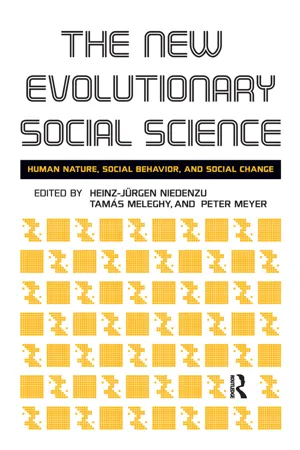
New Evolutionary Social Science
Human Nature, Social Behavior, and Social Change
- 270 pages
- English
- ePUB (mobile friendly)
- Available on iOS & Android
eBook - ePub
New Evolutionary Social Science
Human Nature, Social Behavior, and Social Change
About this book
Social scientists have long declared their autonomy from the natural sciences, and in doing so have tended to neglect important biological constraints on human nature. Many sociological theories have suggested a nearly complete malleability of patterns of social life. The New Evolutionary Social Science challenges this view by building on Stephen K. Sanderson's 'Darwinian conflict theory' which sets out to synthesise sociological theories with key findings from biology into an overarching scientific paradigm. Configuring and expanding this groundbreaking theory, the contributors to this volume are well-known European and American experts in evolutionary science. The New Evolutionary Social Science develops a new basis for understanding social change and the world's future through a better integration of the natural and social sciences.
Information
Part I
PRELUDE
INTRODUCTION
The New Evolutionary Social Science
Tamás Meleghy
Peter Meyer
Heinz-Jürgen Niedenzu
From its very beginning, sociology was concerned with problems of social change and the formation of different types of society. Many early sociologists, most prominently Herbert Spencer, took biology seriously by comparing societies to organisms. The subfield of sociology then known as social statics was concerned to describe how the parts of societies were interrelated in the same manner that they were in biological organisms. The other major subfield of sociology at the time, social dynamics, made a different kind of comparison, in this case between the long-term development of societies and ontogenetic development. This, of course, was the tradition of sociological organicism (Martin-dale 1960). In these early years it was also common for sociologists to take biology seriously in another way, which was in terms of conceptions of human nature. Social scientists in different fields, sociologists included, took the then new Darwinian evolutionism seriously; they thought there was such a thing as human nature, and that it played an important role in shaping social behavior and social structure. The early-twentieth-century sociologist Edward Westermarck, for example, wrote multivolumed works on human marriage practices and morality that revealed the very strong influence of Darwinian natural selectionist thinking.
However, due to disciplinary institutionalization and differentiation, most of twentieth-century sociology was characterized by a growing discord between sociology and biology. Emile Durkheim equated the “social” with moral sentiments, such as social norms and institutions, whereas Max Weber conceived of sociology as a science specializing in verstehen, or the understanding of human action from the subjective point of view of the actor. From the point of departure of these classical sociologists, the discipline turned sharply away from biology, largely ignoring biological factors in favor of entirely social explanations. And what was true in the classical period is equally true today. In German sociology, the two leading sociological theorists have been Niklas Luhmann and Jürgen Habermas. Even though Luhmann pleaded for an evolutionary account of social behavior, he chose Stephen Jay Gould’s approach (Gould and Lewontin 1997) instead of referring to mainstream evolutionary biology. Habermas envisages still another version of evolutionary thinking, one referring to a universal, quasi-teleological developmental logic (Antweiler 1985). In France the leading contemporary sociological theorist was, of course, Pierre Bourdieu, who explicitly made the point in one of his last interviews that the distinctiveness of sociology as a discipline was its rejection of all naturalistic explanations in favor of social explanations. One of his last books, La domination masculine (1998), had as its main theme the notion that gender is a social construct that attempts to naturalize itself, i.e., to make us think that the differences between the sexes are natural differences. And in Britain, the leading sociological theoretician, Anthony Giddens, has rarely made reference to anything biological. In his introductory textbook, for example, his exceedingly brief treatment of sociobiology regards it as an entirely speculative endeavor.
For an extended period of time, the adequacy of sociological approaches to the “social” remained unchallenged. More recently, however, sociology has been confronted with various forms of biological explanation. More and more, the approaches known as sociobiology and evolutionary psychology have had a significant influence in sociology’s sister disciplines of psychology and anthropology, and are even being referred to in public discourse. These and related approaches are part of a Second Darwinian Revolution that was initiated by such biologists as William Hamilton (1964), Robert Trivers (1971), Richard Dawkins (1976, 1986), and Edward O. Wilson (1975, 1998). Hamilton introduced the notion of kin selected altruism, which has paved the way for a radically new understanding of individuality in social life (Maynard Smith and Szathmary 1995, 259). Along the same lines, Richard Dawkins (1976) introduced the metaphor of the selfish gene. These evolutionary biologists were unwilling to maintain any clear-cut separation between animal species and the human species with regard to different behavioral modes and capacities for problem solving, and therefore they insisted upon an enlarged understanding of the human social and cultural spheres. Unlike sociologists, sociobiologists and evolutionary psychologists turned to studies of the ultimate causes of behaviors in animals and in the human species. Sociobiologists were, for example, able to account for the different strategies males and females employ in both animals and humans. As pointed out by Sarah Blaffer Hrdy (2000, 40), women seem “to belong to a kind of species men know the least of.” Unlike evolutionary biologists, sociologists did not bother to look into sex- or gender-specific interests in human reproduction, focusing instead on gender-typical roles in the human species.
Even though most sociologists have paid very little attention to these new approaches, they have gained increasing influence in recent years, whereas traditional sociology’s impact seems to be dwindling. But the lack of interest in evolutionary theory is not characteristic of all sociologists. As sociologists interested in evolutionary theory, several years ago Tamás Meleghy and Heinz-Jürgen Niedenzu organized a workshop, “Social Evolution: The Theory of Evolution and the Social Sciences,” at the Institute of Sociology, University of Innsbruck, Austria, in 2001. Contributors from various European countries convened in Innsbruck for intensive discussions of this topic. Following this meeting an edited volume was published (Meleghy and Niedenzu 2001), which was well received by specialists in the field (Pohlmann 2004; Antweiler 2005) and was soon out of print.
The present volume is the result of a second meeting held in June 2006, which was again organized at the University of Innsbruck by Meleghy and Niedenzu, this time in cooperation with Peter Meyer of the University of Augsburg in Germany. Unlike the previous meeting, this one focused largely on a specific book, Stephen K. Sanderson’s The Evolution of Human Sociality, a work in which the author has attempted to integrate sociobiology into sociological theory through the creation of a new synthetic paradigm known as Darwinian conflict theory. The conference brought together sociologists and other social scientists from Europe, the United States, and Australia, who took advantage of the occasion for lively discussions with Stephen Sanderson, explaining, criticizing, defending, and applying various aspects of his theoretical approach.
Sanderson’s book was chosen as the main focus of the conference because we felt it made several very important contributions that few other sociologists were making. For example:
• It links modern sociology to recent evolutionary theorizing in the social sciences.
• It critically evaluates the major theoretical approaches in contemporary sociology and attempts to draw on what is most useful in them.
• It distinguishes between different levels and modes of explanation.
• It provides by far the most extensive review ever undertaken by a sociologist of contemporary empirical research informed by sociobiological, evolutionary psychological, and related evolutionary perspectives.
• It brilliantly demonstrates the regularities among diverse societies, while at the same time not neglecting the less common or even unique features of some societies. This demonstration is for us the raison d’être of sociology.
• For sociologists, it is the most complete appraisal ever made of evolutionary biology’s understanding of human nature, social organization, and social change.
Sanderson’s work maps out the most well-developed version to date of a major new type of sociology, evolutionary sociology (Maryanski 1998). We view the following as the most important of evolutionary sociology’s concerns:
•Disclosing the genetic, neurobiological, and other aspects of human nature and the basic dimensions of the human motivational structure. To accomplish this, evolutionary sociology must draw on theories and research findings in sociobiology, ethology, evolutionary psychology, behavioral ecology, and other evolutionarily oriented social science fields
•Clarifying whether the typical motivations that evolved during humankind’s long period in its ancestral environment are manifest not only in the surviving forms of these ancestral societies, but in modern societies as well
•Understanding the various types of linkages among biological, psychological, and sociocultural phenomena
•Clarifying the relationship between ultimate and proximate explanations
•Understanding the long-term evolution of human societies and the extent to which this evolution is a Darwinian process. How well do the Darwinian concepts of “variation,” “selection,” “retention,” etc., apply to social evolution? How is social evolution constrained by human nature?
•Reexamining the history of the relationship between evolutionary biology and sociology and the other social sciences and the reasons why these social science disciplines spurned biology for so long.
All of the contributors to the present volume address one or more of these concerns. The contributions fall into several distinct categories. In Chapter 1 Sanderson provides a brief overview of the history of sociology’s reception of evolutionary theory, which also includes a summary of his Darwinian conflict theory. Part II then consists of ten critical assessments of Darwinian conflict theory. The most positive assessments are those of Michael Schmid, Rosemary Hop-croft, and Christoph Antweiler. Schmid (Chapter 2) is very sympathetic to Sanderson’s theoretical project but raises numerous questions about it. For example, he contends that Sanderson’s attempt to ground his arguments in a type of conflict theory seems to have nothing to do with his materialist historical analyses. In addition, since Darwinian conflict theory does not make use of concepts like “variation,” “selection,” and “retention,” Schmid wonders in what sense it is truly evolutionary. Hopcroft (Chapter 4) believes that Sanderson’s general approach is perhaps the best sociology currently has to offer. Perhaps her most significant criticism of Sanderson is that he focuses heavily on anthropological and historical evidence and rather neglects sociological evidence on modern industrial societies. She points out that, although very little current sociological research is guided by evolutionary ideas, much of it turns out to be surprisingly consistent with those ideas. Antweiler (Chapter 5), while in agreement with most of Sanderson’s main arguments, contends that he does not devote enough attention to human universals and that his list of universals is incomplete.
The chapters by Nico Wilterdink, Khaled Hakami, Peter Meyer, Heinz-Jürgen Niedenzu, Tamás Meleghy, Johan van der Dennen, and Christopher Hallpike are more critical. Wilterdink (Chapter 3) claims that Sanderson is a metaphysical materialist who takes insufficient account of the role of culture in behavior. Wilterdink seeks to illustrate his point through an analysis of human sexual and reproductive behavior. Hakami (Chapter 6), who has been significantly influenced by the cultural materialism of Marvin Harris, is highly resistant to Sanderson’s attempt to synthesize that perspective with sociobiology. Meyer (Chapter 7), although undoubtedly accepting of many of Sanderson’s arguments, is critical of him for being perhaps too materialist in his theoretical outlook and, more specifically, for explaining human cooperation as entirely the outcome of self-interested individual strategies. The predisposition to cooperate, Meyer insists, is an integral part of the human evolutionary heritage. Niedenzu (Chapter 8) focuses on Sanderson’s three different modes of materialist explanation – biomaterialist, ecomaterialist, and polimaterialist – and is critical of what he sees as Sanderson’s tendency to relegate ecomaterialist and polimaterialist explanations to a derivative role. Ecomaterialist and polimaterialist explanations, Niedenzu contends, deserve equal billing alongside biomaterialist explanations in the full scope of sociological explanation. Meleghy (Chapter 9) believes that Sanderson is much too harsh in his criticisms of Lévi-Straussian structuralism and seeks to show that it can, in fact, be combined with Darwinian conflict theory. Van der Dennen (Chapter 10) deals specifically with Sanderson’s treatment of warfare. He is highly skeptical of Sanderson’s favored biomaterialist and ecomaterialist explanations of war, holding that they result from a “vulgar materialism.” Van der Dennen argues that war is far too complex a phenomenon to be explained by only one or two types of theories. In this regard he contends that there are several important types of war that are quite different, types that Sanderson fails to distinguish. Hallpike (Chapter 11) contends that Darwinian conflict theory is inadequate to the task of explaining the development of modern science. Sanderson’s theory, Hallpike submits, fails because it is based on a flawed set of assumptions derived from the social ideology of modern capitalism, that of “atomistic competitive individualism.” Sanderson’s model of science also assumes that science develops linearly, whereas it actually develops in a more dialectical and uneven manner.
Part III is devoted to sociological applications of evolutionary theory that refer to Darwinian conflict theory either indirectly or not at all. J. P. Roos (Chapter 12) compares the thinking of two classical sociological giants, Edward Westermarck and Emile Durkheim. Westermarck was a sociologist who was deeply influenced by Darwinian natural selectionist thinking, whereas Durkheim, of course, was the consummate antireductionist who insisted that sociological explanations had to be based on social facts. Even though Westermarck declined into virtual invisibility and Durkheim is still regarded as a key member of the founding sociological triumvirate, Roos contends that the contest between Durkheim and Westermarck was an uneven match: On all the central questions that they both considered, it was Westermarck who has turned out to be right. Anna Rotkirch (Chapter 13) discusses a newly recognized phenomenon known as “baby fever,” which is essentially an intense desire to have a child. She considers several related evolutionary explanations of this phenomenon. Like Roos, she invokes Westermarck, one of the...
Table of contents
- Cover
- Half Title
- Title Page
- Copyright Page
- Table of Contents
- Acknowledgements
- Part I: Prelude
- Part II: Darwinian Conflict Theory and Its Critics
- Part III: Evolutionary Theory in Sociology: Diverse Applications
- Part IV: Reflections and Final Thoughts
- References
- Index
- Contributors
Trusted by 375,005 students
Access to over 1.5 million titles for a fair monthly price.
Study more efficiently using our study tools.
Frequently asked questions
Yes, you can cancel anytime from the Subscription tab in your account settings on the Perlego website. Your subscription will stay active until the end of your current billing period. Learn how to cancel your subscription
No, books cannot be downloaded as external files, such as PDFs, for use outside of Perlego. However, you can download books within the Perlego app for offline reading on mobile or tablet. Learn how to download books offline
Perlego offers two plans: Essential and Complete
- Essential is ideal for learners and professionals who enjoy exploring a wide range of subjects. Access the Essential Library with 800,000+ trusted titles and best-sellers across business, personal growth, and the humanities. Includes unlimited reading time and Standard Read Aloud voice.
- Complete: Perfect for advanced learners and researchers needing full, unrestricted access. Unlock 1.5M+ books across hundreds of subjects, including academic and specialized titles. The Complete Plan also includes advanced features like Premium Read Aloud and Research Assistant.
We are an online textbook subscription service, where you can get access to an entire online library for less than the price of a single book per month. With over 1.5 million books across 990+ topics, we’ve got you covered! Learn about our mission
Look out for the read-aloud symbol on your next book to see if you can listen to it. The read-aloud tool reads text aloud for you, highlighting the text as it is being read. You can pause it, speed it up and slow it down. Learn more about Read Aloud
Yes! You can use the Perlego app on both iOS and Android devices to read anytime, anywhere — even offline. Perfect for commutes or when you’re on the go.
Please note we cannot support devices running on iOS 13 and Android 7 or earlier. Learn more about using the app
Please note we cannot support devices running on iOS 13 and Android 7 or earlier. Learn more about using the app
Yes, you can access New Evolutionary Social Science by Heinz-Jurgen Niedenzu,Peter Meyer,Tamas Meleghy in PDF and/or ePUB format, as well as other popular books in Social Sciences & Evolution. We have over 1.5 million books available in our catalogue for you to explore.