- 323 pages
- English
- ePUB (mobile friendly)
- Available on iOS & Android
eBook - ePub
Archaeology and the Media
About this book
The public's fascination with archaeology has meant that archaeologists have had to deal with media more regularly than other scholarly disciplines. How archaeologists communicate their research to the public through the media and how the media view archaeologists has become an important feature in the contemporary world of academic and professional archaeologists. In this volume, a group of archaeologists, many with media backgrounds, address the wide range of questions in this intersection of fields. An array of media forms are covered including television, film, photography, the popular press, art, video games, radio and digital media with a focus on the overriding question: What are the long-term implications of the increasing exposure through and reliance upon media forms for archaeology in the contemporary world? The volume will be of interest to archaeologists and those teaching public archaeology courses.
Information
1
INTRODUCTION
Archaeology and the Media
Marcus Brittain and Timothy Clack
Media’s Past
‘What hath God wrought?’ The first message transmitted by electric telegraph by Samuel Morse in the mid-nineteenth century whispered a sharpened edge of uncertainty that was soon to cut through the world, transforming it forever. Revolutions of media followed: prewar radio, postwar television, and the entry into a digital era in which we are now approaching. Archaeology has, like many other disciplines, featured prominently in each. ‘Television once bought me the best meal I have ever had on British Rail’, Glyn Daniel wrote having enjoyed first-class hospitality after being mistaken for Woodraw Wyatt on a train bound from Cambridge to York (Daniel 1986: 269). But he could just as easily have been recognised as Glyn Daniel, professor of archaeology and British Television Personality of the Year for 1955. Archaeology, it might be thought, had not just sung a note of celebrity, but a whole chorus.
A deeper look into the first figures for television ownership in private domestic households in Britain for 1956 might put this into a different context. These estimate that the total number of homes with a television tallied to just 36.5 per cent. The consumers of this relatively new media were predominantly well off, educated, middle-class citizens, and although the transmission of particular programmes became an event of communal viewing, their accessibility was limited. The perception that archaeology was reaching a mass public is in many respects correct, but an understanding of just how, who, or through which media is justifiably a little skewed. Even so, electronic media had begun its relationship with archaeology that is today of greater magnitude than ever before. But various chapters in this volume reveal how other forms of mass media – well established before TV – continued to be fascinated by new and amasing archaeological discoveries, as well as the conflicts, personalities, and imagination of a past that could be made less foreign with an expert touch. What is more uncertain is how archaeology should be equipped for the digital age of multiplicity in voice, choice and unparalleled speed, and scope of communication.
Media, in its most basic form, is a means to mass communication, or an agency by which that communication is transmitted, transferred, or conveyed. ‘The media’ may be viewed as an entity in itself, a body of journalism with broadcast values that intersect markets of commerce, audience profiles, the boundaries of discursive space, and disciplinary expertise. It may also be understood as a process of translation or engagement embedded in the materiality of the media form. Different media convey different messages in varying ways, impacting on the context of interpretation as well as framing and reframing contexts for consumption.
The circumstances that precipitated the amalgamation of the following chapters began their course in summer 2004 when, during the organisation of an interdisciplinary conference on misrepresentation in the media, we realized that many of the concerns stated to us about the transference of scholarly research to a wider audience through the media of various technological forms were congruent with many questions being raised by archaeologists. Few of these were in print, however, and the vast majority was being expressed in pubic debates and conference venues, while many more appeared in the everyday exchange of views and opinions. While the relationship between archaeology and the media has deep historical roots, it has largely been perceived as a direct or hierarchical passage of information from expert to audience, complexity of scholarly rigour to the excruciating simplicity of popular tone. It was our aim, therefore, to bring together contrasting perspectives on a diverse range of media and their impact on the way archaeological narratives are produced and presented, along with the successes, failures, ethics, and potentials of a relationship that is ultimately symbiotic. The ways in which these perspectives are conveyed are equally varied, representing a range of communicative and analytical styles. This volume is therefore not a manual on how to enter the media or a handbook for communicating with the media (for basic guides, see Danien 1997; Klesert 1998; Milanich 1999; Stoddart and Malone 2001).
Two primary aspects of archaeology’s relationship with the media have been ‘frozen’ for a moment in this volume. First, engagement with the mass media has precluded a conglomeration of concerns regarding representation of archaeology and archaeologists, accuracy of information and reportage, the ‘dumbing-down’ of information, individual credibility within one’s discipline, and the legitimisation of archaeological narratives as recognised by a mass audience. While archaeology is enjoying more media presence than ever before, television is unlikely to be financially damaged if archaeology was to disappear from the screen. The enormous benefit of media interest is precariously balanced against ‘non-professional’ archaeological narratives and the proliferation of ‘other’ narratives. While multiplicity is a key aim of postprocessual methodologies and arguments, the openness of truth claims beyond disciplinary walls – expounded by the media – has become a cause for concern from numerous archaeological corners.
While the authority of archaeological narratives may be under scrutiny, the political accountability of archaeology’s relationship to the media is also distinctly apparent (e.g., Coleman and Dysart 2005; Daggett 1992; Gero and Root 1994; Rao and Reddy 2001; Seymour 2004; Spriggs 1994). Ian Hodder (2003: 166; 1998) has described how at Çatalhöyük, for example, press conference days organized by the excavation sponsors attract fifty or more local, national, and international media representatives. This coverage has meant that Çatalhöyük has become a stage for politicians – both local and European – to gain their own media coverage with their own political intentions. These range from attempts to raise an awareness of the local importance of the site and region in the past and the present, the difficult question of the genetic ancestry of the local population to the ancient inhabitants, and the relevance and potential of the European Union for Turkey. ‘As a professional archaeologist and as a member of society,’ reminds Hodder (2000: 11), ‘one has to be responsive to the impact of one’s work’. A critical analysis of archaeology’s relationship to the media is an essential part of this pro-active awareness.
Second, the materiality of the media bears an impact upon the way archaeological data is collected, compacted, interpreted, and disseminated. It also bears direct relevance to the means by which the mass media engages with archaeology and vice-versa. Old media technologies are not simply succeeded by new and novel technologies. They blend and merge many aspects of the techniques required for their function as well as retaining, enhancing, or displacing technological components or designs and the issues that these critically raise for social analysis. Media impact on the world and life within. As Bolter and Grusin (1999: 15) state, ‘No medium today, and certainly no single media event, seems to do its cultural work in isolation from other media, any more than it works in isolation from other social and economic forces’. How should archaeology even begin to reflect on its situation among such tumultuous and rapid transfers, let alone contemplate its next move for survival?
Inevitably, television receives much of the emphases within this volume, and with good cause. It accounts for 40 per cent of all leisure time in Britain (Roberts 2004), and almost every survey that has been carried out on the public reception of archaeology has found television to rest comfortably as the most popular means to information (Merriman 1991; Paynton 2002; Pokotylo and Guppy 1999; Pokotylo and Mason 1991; Ramos and Duganne 2000; Statistiska Centralbyrån 2002). With important bodies such as the Archaeological Institute of America working closely with the Learning Channel (Hammond 1992), for example, television’s visual impact has been instrumental in presenting archaeology to an audience hungry for images of the past.
The wide range of media technologies discussed in this volume signifies the diversity of research that is available from the archives and stores of broadcasters and museums. In some cases, media may be regarded as untapped resources either for communication or critical analysis. For example, one particular area for future consideration is radio – which, as mentioned in numerous chapters throughout this volume, has been used successfully at least since the BBC broadcasts from the National Museum of Wales, Cardiff, by Cyril Fox and his staff in the 1930s, forties, and fifties, and John Irving’s The Archaeologist series in the 1950s. It is often perceived that because radio usually goes unnoticed, it therefore has a minor role to play in the routine of everyday life (cf. Pertti 1997). However, sound may be regarded as an ordering presence in a domestic routine, filling empty space and time with a familiar texture in which everyday life takes place (Tacchi 1999). Radio’s regular use maps memories of past experiences and moods within an encompassing soundscape. Although the experience of listening is difficult to put into words, radio sound may be opened to analysis as part of the material culture of the dwelling place or an agent in the formation of the social environment.
This introduction aims to open a critical analysis of archaeology’s relationship with the media by providing a background to the themes presented throughout this volume, situating these arguments within the broader context of media analysis and the related concerns raised within other disciplines. The chapters that follow will not only be of interest to archaeologists working with the media, but for wider debates regarding issues of representation, identity formation, public communication, and the political accountability of archaeological interpretation. The chapters that have been brought together for this volume can add not only to archaeology’s awareness of its location within a sociotechnic world and the effects that media may have upon the structure of archaeological practice, but may actively contribute in the broader discussions of the history and possibilities of an increasingly media-oriented society.
We cannot escape media; it is all around us, permeating the practices through which our intelligibility of the world transpires. We cannot stop this mediation: it has no off switch; it lives and feeds upon our own necessity to communicate; we cannot escape media.
Archaeology’s Reception of the Media
The terms ‘archaeology’ and ‘archaeologists’ embody a myriad of images and meanings both inside and outside the discipline itself. It might seem strange, then, that concerns of misrepresentation often dominate the reaction to any mere mention of mass media forms, when in reality there is little common consensus both nationally and internationally as to what constitutes these terms in the first place. Whilst heterogeneity of opinion lies within the profession itself, a series of caricatures are repeatedly conjured up within media images of the archaeological profession. As Ascherson (2004: 145) notes, the foundations for many of these lie upon nineteenth century stereotypes, although various others have been added more recently by Hollywood cinema (Day 1997; Hall 2004). A variety of assumptions exist regarding archaeology and archaeologists (Holtorf 2005a; Merriman 1991). However, many of the most prevalent distinctions are historically those between the heroic masculine explorer (either male or female) and the absent-minded collector, antiquarian, or professor – or as Kidder (1949: xi) once wrote, ‘the hairy-chested and the hairy-chinned’. These caricatures are often combined with the portrayal of the archaeologist as the expert, adventurer, digger, discoverer, and treasure hunter (Ascher 1960; Bray 1981: 225–227). The most valued archaeologies appear as those that hold the key to mysteries unsolved, unravelling the truth behind the oldest, grandest, or most splendid of ancient wonders.
Reactions to these portrayals in commercial cinema are invariably divided between those who believe that there is ‘a legitimate cause for concern… [in that] these often erroneous and stereotyped images are a driving force in shaping popular perceptions of our discipline’ (Baxter 2002b: 18), and those who believe that ‘the profession should derive a measure of pleasure in seeing itself evolve in film, very much in command of the great, grand sweep of time and place, the setting for human cultural and biological evolution’ (Day 1997: 44). Placed somewhere between the two, Hall (2004: 171) believes that a fluctuation between images such as ‘the positive pursuit of hidden knowledge’ and ‘the negative rape of the sacred and indigenous’ is ‘healthy’, reinforcing ‘the reality of cinema as something made by diverse makers and audiences and reflecting wider political debates, not just what we might call the mechanics of the discipline’.
The concern with how archaeology and archaeologists are portrayed in the media signifies the importance of representation (e.g., Felder et al. 2003; Gale 2002). With regard to broadcast television, Cornelius Holtorf’s chapter ‘An Archaeological Fashion Show’ identifies the way archaeologists present themselves through what they wear. It becomes clear that archaeologists may express a combination of their personality and ambitions, or their clothing may draw upon specific contexts of archaeological practice. Depending on what is being signified – the exotic, the (sexy) adventurer, the competent professional, the eccentric, the scholar – particular popular stereotypes may be emphasised to their own advantage, utilising the perception that you are what you wear. However, Holtorf warns, fashion styles may be ambiguous, open to unintended interpretation. Yet it is this ambiguity that may open discussion about what an appropriate image of archaeology and archaeologists might be, thus empowering archaeology to present its own image against the morass of traditional programming.
It is arguable that many of these images have been challenged through innovative programming in the last 15 years. This has not meant that series such as Channel 4’s hugely successful Time Team (first broadcast in 1991) are closed to criticism (Fig. 1.1); in fact, the success of the series has instilled those two words ‘Time Team’ as a bye-word for British archaeology in the public consciousness, and has subsequently opened the programme to criticism as to what an appropriate media portrayal of archaeology and archaeologists should be. Cleere (2000: 91), for example, expressed his disappointment that the producers lacked, in his words, ‘confidence in the appeal of the subject’ by relying on a non-archaeologist as the link between specialist knowledge and narrative communication (see also Stoddart and Malone 2001: 461). Added to this, Cleere’s criticism of the programme’s format of a three-day excavation as ‘presenting a somewhat distorted and oversimplified picture of what archaeology is all about’ (2000: 91–92) is unlikely to be alone. The media portrayal of excavation and the ongoing process of interpretation are two of the main topics of disapproval within the discipline. While Fowler (1981: 63) acknowledged that these may be ‘flatly unphotogenic’, Hudson (1981: 119) – applauding the extent of archaeology’s media attention in previous decades – lamented that archaeologists had yet to present to the ‘great mass of the population in [Britain] the importance of a disciplined and logical approach to our heritage’. Little difference may be noted in today’s criticism of archaeological excavation and recording on television, reproducing an image of a practice that is ‘simple and speedy’ (Hills 2003: 207) or ‘untidy, rushed and incomplete’ (Schadla-Hall 2003: 56). As Finn (2001: 265) acknowledges, ‘[I]mpatience, necessary to the process of journalism, rubs against the pace of archaeological excavation’.
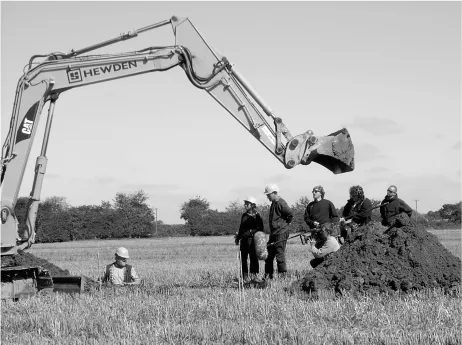
Figure 1.1 The Time Team crew film Francis Pryor at the excavation of a Neolithic causewayed enclosure at Northborough Fen, Cambridgeshire, in 2004 for an episode in the programme’s twelfth series, broadcast 30 January 2005 (Marcus Brittain).
Finding a successful format in broadcast media, one that suitably pulls in the audience ratings and satisfies the demand for appropriate representation by the subjects of its content, are hard to come by (West 2004), but Time Team appears to have at least contented the former with viewing ratings in excess of 3.4 million, if not fully succeeding with the latter. Its ‘sister’ spin-off Extreme Archaeology was directed at a younger, fashionable viewing audience, attempting each week to enter a danger zone and investigate perilous sites often under potential threat. The reception to the all-bar-one female cast (a welcome blend in an otherwise male-dominated frontline role) was mixed despite a format otherwise not dissimilar to that of Time Team. One broadsheet commentator rather crudely described the programme’s intention as ‘a cross between Charlie’s Angels and Tomb Raider’ with a result nearer to ‘a joke’ (Hoggart 2004).
The content of a broadcast format is a measure of its time and its audience and may be tightly bound with changing ethical certainties. In an episode of the BBC’s archaeological quiz show Animal, Vegetable, Mineral? in the 1950s, for example, a number of models characterising varying ethnic physical traits were paraded in front of the studio panel of distinguished academics, whose task was to name their country of origin. Despite the embarrassingly offensive comments by one member of the panel – a rather inebriated Margaret Mead – the episode was relatively acceptable over 50 years ago (see Daniel 1986: 253–254), yet the same format would be unthinkable today.
The popularity of Animal, Vegetable, Mineral? was due largely to the magical personalities of its contestants (Fig. 1.2), but its game show format in the 1950s and 1960s succeeded, as Mortimer Wheeler explained, because the viewer was ‘interested in watching your process of thought’ (quoted in Hawkes 1982: 299). Much more of the archaeological thought process is presented in Time Team, but as with many archaeological programmes, the product of that thought process is then left open to criticism. A lack of interpretation, and the mistrust of insight to the past beyond the material reality of the artefact (Holtorf 2003: 126), lies precariously balanced against the alternative that is an excess of interpretation. While the latter may grasp the heavy baggage of metanarrative, each could be tried and in many cases found guilty of lacking the wider context informed by previous research (Hills 2003: 208). When used, previous research may vary in quality and extent between media forms or individual reportage. The popularity of ‘treasure hunting’ and narratives of the past often labelled ‘fringe,’ ‘fantastic’, ‘cult,’ ‘alternative’, or ‘independent’ archaeologies are often framed within these formats considered to be media friendly (Cole 1980; Feder 1984; Fagan 2006; Williams 1991). This entails a proliferation of imagery, a lack of information on previous research, and high entertainment value, all in contrast to the seriousness of scientific endeavour. ‘Alternative’ and serious archaeology subsequently have become perceived as two separate cultures competing for the same audience. It is no coincidence that the French word for static or interference in media transmission is parasite. Silence is a hindrance to the transmission of news, and archaeological dead air or gaps within the media market are regarded as an empty space to be filled, and a parasite to be removed before it is fed by ‘erroneous belief’ or irresponsible ‘treasure hunting’ (Eve...
Table of contents
- Cover Page
- Half Title page
- Series page
- Title Page
- Copyright Page
- Contents
- List of Illustrations
- Preface
- 1. Introduction Archaeology and the Media
- Part I. Archaeology's Reception of the Media
- Part II. Translating Archaeological Narratives
- Part III. Has the Media Changed Archaeology?
- Part IV. Visual Archaeology
- Part V. Archaeology, The Media, and the Digital Future
- References
- Index
- About the Editors and Contributors
Trusted by 375,005 students
Access to over 1.5 million titles for a fair monthly price.
Study more efficiently using our study tools.
Frequently asked questions
Yes, you can cancel anytime from the Subscription tab in your account settings on the Perlego website. Your subscription will stay active until the end of your current billing period. Learn how to cancel your subscription
No, books cannot be downloaded as external files, such as PDFs, for use outside of Perlego. However, you can download books within the Perlego app for offline reading on mobile or tablet. Learn how to download books offline
Perlego offers two plans: Essential and Complete
- Essential is ideal for learners and professionals who enjoy exploring a wide range of subjects. Access the Essential Library with 800,000+ trusted titles and best-sellers across business, personal growth, and the humanities. Includes unlimited reading time and Standard Read Aloud voice.
- Complete: Perfect for advanced learners and researchers needing full, unrestricted access. Unlock 1.5M+ books across hundreds of subjects, including academic and specialized titles. The Complete Plan also includes advanced features like Premium Read Aloud and Research Assistant.
We are an online textbook subscription service, where you can get access to an entire online library for less than the price of a single book per month. With over 1.5 million books across 990+ topics, we’ve got you covered! Learn about our mission
Look out for the read-aloud symbol on your next book to see if you can listen to it. The read-aloud tool reads text aloud for you, highlighting the text as it is being read. You can pause it, speed it up and slow it down. Learn more about Read Aloud
Yes! You can use the Perlego app on both iOS and Android devices to read anytime, anywhere — even offline. Perfect for commutes or when you’re on the go.
Please note we cannot support devices running on iOS 13 and Android 7 or earlier. Learn more about using the app
Please note we cannot support devices running on iOS 13 and Android 7 or earlier. Learn more about using the app
Yes, you can access Archaeology and the Media by Timothy Clack,Marcus Brittain in PDF and/or ePUB format, as well as other popular books in Ciencias sociales & Arqueología. We have over 1.5 million books available in our catalogue for you to explore.