- 416 pages
- English
- ePUB (mobile friendly)
- Available on iOS & Android
eBook - ePub
About this book
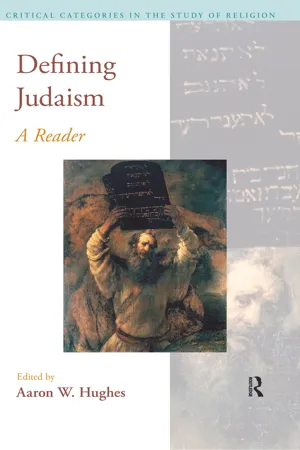
Judaism is a monotheistic religion with a history of over 3,500 years. 'Defining Judaism' illustrates the range of theoretical and practical issues required for comparative and historical study of the faith. The texts range from historical attempts to define individual 'Jews' to imagining Judaism as a religion like other religions, to modern and post-modern attempts to decentre these earlier definitions. The reader brings together a wide range of essays from influential scholars of ancient and contemporary Judaism to attempt a full picture of Judaism that will be of interest to all those involved in the study of religion.
Information
Historical and Chronological Definitions
Orientation
Judaism, like any collective or even individual, maintains a certain degree of flexibility while at the same time a sufficient measure of coherence. As a result, it is important to think about Jewish identity as a series of constant reimaginings and reinventions (Boyarin 2008,19). Byway of introduction to the chapters in this section, I provide something of the historical, cultural, and intellectual contexts of the authors in question. These contexts, more often than not, dictated and determined the nature of how Judaism was defined. This was the case because Jews, like virtually every other group, tended to define themselves by what they were not, something that occurred in their encounters with others (i.e., non-Jews). Although, as the selections in Part II will reveal, the terms "Jewish" and "non-Jewish" are certainly not hermetically sealed containers or markers of identity, they nevertheless functioned, for the authors considered here, as precisely such containers. Although most of these authors grappled with and ultimately pushed the boundaries of what terms like "Jew" or "Judaism" consisted of, these definitions are certainly historically situated.
As mentioned in the introduction, rabbinic Judaism, despite its voluminous writings, was not necessarily interested in issues that we would today call theological. The first person really interested in defining who counted as a "Jew" and what beliefs defined "Judaism" was Saadya ben Joseph (882-942), the head rabbi igaon) of the main rabbinical academy located in Sura (modern-day Iraq). Influenced by the rational school of Islamic theology', known as kalām emphasized the importance of reason for understanding religious belief. It is probably worth pointing out that the influence of Islamic theology may be witnessed in Saadya's composition of his main work, Kitāb al-amānāt wal-'i'tiqādāt ("The Book of Beliefs and Opinions") in Arabic, using Arabic theological terms to define and describe what he considered to be Jewish beliefs.
In the passage included here, we witness Saadya's definition of what constitutes true belief (īmān) and how this is to be distinguished from improper belief. True belief, according to him, is that which is contingent upon four roots of knowledge: direct observation (e.g., based on the five senses), intuition (e.g., the true is better than the false), logical necessity (e.g., where there is smoke there is fire), in addition to what he calls authentic tradition. This latter category is composed of all that is contained in the biblical and rabbinical traditions. Here we have to remember that Saadya was very critical of the Karaite tradition within Judaism that upheld the Bible but ridiculed rabbinical texts such as the Talmuds. Saadya's definition of what counts as rational belief, for him the only kind of belief, is that supplied by the rabbinical Jewish tradition, something that upholds the tenets of reason. He is also quick to juxtapose this with a taxonomy of what constitutes heretical belief.
Maimonides (1137-1204) is generally considered to be the most important philosopher and thinker in the Jewish tradition. His two greatest works are the Guide of the Perplexed, written in Arabic, which attempts to harmonize the points of discrepancy between faith and reason by reading the former allegorically. His Mishneh Torah, written in Hebrew, presents a rational synthesis of the entire rabbinical corpus. The selection reproduced here, his Thirteen Articles of Faith, comes from another work, his Commentary to the Mishnah. These principles, coming at the end of the commentary, are meant to establish the beliefs to which all Jews must assent to be assured a "place in the world to come." This systematic formulation, the first in the history of Judaism, would prove the point of departure for subsequent attempts—often acrimonious—to articulate the dogmas of Judaism (see the comments in Kellner 1986,1-9).
Yet, if Jews tried to define the quiddity of Judaism, often in response to non-Jews, the latter also did not hesitate to define what Judaism was or was not. (Witness, for example, Church law from the medieval period or, more recently, the Nuremberg Laws.) In this respect, the third selection, that from the Assembly of Jewish Notables, provides evidence for this. In 1789, the French National Assembly began the ambiguous process of granting Jews, as individuals and not as a nation or collectivity, citizenship (Hertzberg 1990,1-12). Although Jews might well have received legal emancipation, their basic acceptance into French society was not nearly as swift or as smooth. In order to try and address this, Napolean, the self-styled custodian of the French Revolution, called 112 Jewish Notables to the Hotel de Ville in Paris on July 29,1806. There he put to them a series of questions meant to ensure that Judaism did not violate the civic and moral statutes of the French Republic.
Living in both the aftermath of the emancipation brought about by the French Revolution and the continued ambiguity of Jews living in Europe was Abraham Geiger (1810-1874). As both a well-respected scholar of Islam and one of the founding fathers of Reform Judaism, Geiger's methodology was based on the necessity of understanding religious texts within their immediate historical, intellectual, and social contexts. Motivated largely by ideological concerns, he sought to show that the aridity of rabbinic Judaism was but one stage in the evolutionary development of Judaism. This, of course, would pave the way for arguing that the normative sources of rabbinic texts could be either revised or jettisoned because they were not an integral part of the religion.
The final chapter, from Standing Again at Sinai by Judith Plaskow, is the only modern piece in this section. She argues that many of the Jewish religi ous sources—and, by extension, definitions of Judaism—have been penned by men and, thus, uphold the categories of patriarchy. Her project, in contrast, is one of reclamation: to redefine Judaism in such a manner that is inclusive of women and women's experiences.
References
Boyarin, Jonathan. 2008. Jewishness and the Human Dimension. New York: Fordham University Press.
Hertzberg, Arthur. 1990. The French Enlightenment and the Jews: The Origins of Modern Anti-Semitism. New York: Columbia University Press, 1990.
Kellner, Menachem. 1986. Dogma in Medieval Jewish Thought: From Maimonides to Abravanel. Oxford: Oxford University Press for the Littman Library.
Selection from Book One of The Book of Beliefs and Opinions
Saadya Gaon
And now that we have finished expounding, as much as we felt it desirable, the matter of resolving uncertainties and doubts, it behooves us to explain what is meant by belief. We say that it is a notion that arises in the soul in regard to the actual character of anything that is apprehended. When the cream of investigation emerges, [and] is embraced and enfolded by the minds and, through them acquired and digested by the souls, then the person becomes convinced of the truth of the notion he has thus acquired. He then deposits it in his soul for a future occasion or for future occasions, in accordance with the statement of Scripture: "Wise men lay up knowledge; but the mouth of the foolish is an imminent ruin" (Prov. 10:14); and it says also: "Receive, I pray thee, instruction from His mouth" (Job 22:22).
Now beliefs fall into two categories: true and false. A true belief consists in believing a thing to be as it really is; namely, that much is much, and little is little, and black is black, and white is white, and that what exists exists, and what is nonexistent is nonexistent. A false belief, on the other hand, consists in believing a thing to be the opposite of what it actually is, such as that much is little, and little is much, and white is black, and black is white, and that what exists is nonexistent, and what is nonexistent exists.
The praiseworthy wise man is he who makes reality his guiding principle and bases his belief thereon. Notwithstanding his wisdom, he relies only on what is deserving of trust and is wary wherever caution is in order. The reprehensible fool, on the other hand, is he who sets up his personal conviction as his guiding principle, assuming that reality is patterned after1 his belief. Notwithstanding his ignorance, he trusts in what should be shunned and shuns what is deserving of trust. All this is borne out by Scripture, which says:2 "A wise man feareth, and departeth from evil; but the fool behaveth overbearingly, and is confident" (Prov. 14:16).
To this [last] observation I must append the expression of my amazement at [the view of] certain people who, being slaves, yet believe that they have no master, and who are confident that any object the existence of which they deny must be nonexistent and whatever they declare to be in existence is so. These individuals are so sunken in folly as to have reached the very nadir of mental deterioration.3 For if they be right, then let him among them who has no money take it into his head that his coffers and chests are filled with money, and see what it would profit him. Or let him believe he is seventy years old, when he is only forty years of age, and see what good it would do him. Or let him assume that he is sated when he is hungry, or that his thirst is quenched when he is thirsty, or that he is covered up when he is naked, and see what would happen to him. Or let him among them who has a vicious enemy believe that his enemy has died, aye perished, with the result that he no longer takes precautions against the latter. But, oh, quickly will he [in such a case] be overcome by the misfortune4 of which he was not [sufficiently] apprehensive.
Now it is sheer folly on the part of people to imagine that their [mere] refusal to acknowledge the sovereignty of the Lord exempts them from [heeding] His commandments and prohibitions and from [being sub ject to] His promise of reward and threat of punishment and other such things. It is such individuals that Scripture quotes [as saying]: "Let us break their bands asunder" (Ps. 2:3).
Thus there are certain Hindus who have hardened themselves against fire, although it burns them whenever they come in contact with it. Again there are individuals who, affecting youthfulness, have hardened themselves to endure the blows of the cane and the scourge, although they smart from them whenever they are struck by them. How much more should this apply in the case of those who in this wise embolden themselves against the Creator of the universe! Their [mere] ignorance [of it] will not cause them to escape the lot that His wisdom has decreed for them, as Scripture has indeed said: "He is wise in heart, and mighty in strength"; "who has hardened himself against Him, and prospered?" (Job 9:4).
Having concluded now what we thought fit5 to append to our first statement, it behooves us to give an account of the bases of truth and the vouchers of certainty which are the source of all knowledge and the mainspring of all cognition. Discoursing about them in keeping with the aim6 of this book, we declare that there are three [such] bases. The first consists of the knowledge gained by [direct] observation. The second is composed of the intuition of the intellect. The third comprises that knowledge which is inferred by logical necessity.
Following up [this] enumeration with an explanation of each of these roots of knowledge, we say that we understand by the knowledge of observation whatever a person perceives by means of one of the five senses; that is, by means of sight or hearing or smell or taste or touch. By the intuition of the intellect, we mean such notions as spring up solely in the mind of a human being, such as approbation of truthfulness and disapproval of mendacity. By the knowledge derived from logical necessity, again, is meant conclusions, which, unless they are accepted by the individual as true, would compel his denial of the validity of his rational intuitions or the perception of his senses. Since, however, he cannot very well negate either of these two, he must regard the said inference as being correct. Thus we are forced to affirm, although we have never seen it, that man possesses a soul, in order not to deny its manifest activity. [We must] also [agree], although we have never seen it, that every soul is endowed with reason, [merely] in order not to deny the latter's manifest activity.
Now we find that there are many people who deny [the reliability of] these three sources [of knowledge]. A small minority of them reject the first source. Of these we shall give an account in the first treatise of this book, together with a refutation of their view. By rejecting the first source, they have automatically rejected the second and the third, since the latter two are based upon the first. More numerous than this group are those that acknowledge the validity of the first but reject the second and the third [sources]. Of their thesis, too, we shall make mention in the first treatise and refute it. Most numerous of all, however, are those who acknowledge the validity of the first two sources [of knowledge] and reject the third. The reason for the difference in their rating of these [various sources of knowledge] lies in the fact that the second [type of] knowledge is more recondite than the first, and likewise the third more so than the second, and that whatever is invisible can more readily be denied than what is visible.
Again there are people who reject the validity of this [last type of] knowledge in certain instances7 and recognize8 it in others, each group among them affirming what its opponent negates. Their argument [in each case] is that logical necessity led them to the particular conclusion. Thus there is he who affirms that all things are at rest. He consequently denies the reality of motion. Another, again, affirms that all things move, and by virtue thereof denies the reality of rest. Each one declares the evidence adduced by his opponent dubious and unconvincing.
As for ourselves, the community of monotheists, we hold these three sources of knowledge to be genuine. To them, however, we add a fourth source, which we have derived by means of the [other] three, and which has thus become for us a further principle. That is [to say, we believe in] the validity of authentic tradition, by reason of the fact that it is based upon the knowledge of the senses as well as that of reason, as we shall explain in the third treatise of this book.
At this point, however, we remark that this type of knowledge (I mean that which is furnished by authentic tradition and the books of prophetic revelation), corroborates for us the validity of the first three sources of knowledge. Thus it enumerates the senses in connection with the denial of their functioning in the case of the idols, making them a total of five with two more added to them. It says, namely: "They have mouths but they speak not; eyes have they but they see not... neither speak they with their throat" (Ps. 115:57).
The first five [organs] mentioned refer to the senses themselves, whilst of the two [functions] that are added to them, one is motion. This is implied in the statement: "Feet have they but walk not" (Ps. 115:7). By means of this faculty [incidentally] there is also obtained consciousness of heaviness and lightness. Thus a person may be prevented from moving about [freely] by reason of his weight, whereas he would not thus be hindered if he were light. On this account, indeed, certain people were minded to add to the number of the senses, for they asked [themselves]: "How [else] can the sensation of lightness and heaviness be experienced?" Our answer is: "By means of the sense9 of motion, according to whether the latter is found to be easy or difficult."
The other one [of the added faculties] is [that of] speech. It is implied in the statement: Neither speak they with their throat [By] that [of course] is [meant] speech in general, [whether it consists] of individual nouns or combinations [of words], or premises, or proofs, as we have previously explained.
Furthermore [authentic tradition] verifies for us the validity of the intuition of reason. It enjoins us, namely, to speak the truth and not to lie. Thus it says: "For my mouth shall utter truth, and wickedness is an abomination to my lips. All the words of my mouth are in righteousness, there is nothing perverse or crooked in them" (Prov. 8:7, 8).
Besides that it confirms for us the validity of knowledge inferred by logical necessity, [that is, to say] that whatever leads to the rejection of the perception of the senses or rational intuition is false. The untenability of any [theory] that rejects the perception of the senses is affirmed by such Scripture statements as: "Thou that tearest thyself in thine anger; shall the earth be forsaken for thee, or shall the rock be removed out of its...
Table of contents
- Cover
- Half Title
- Title
- Copyright
- Contents
- Acknowledgements
- Introduction: Judaism, Judaisms, Jewish: Toward Redefining Traditional Taxa
- PART I: HISTORICAL AND CHRONOLOGICAL DEFINITIONS
- PART II: THE CONTOURS OF JUDAISM
- PART III: RE-DEFINITIONS
- Index of Subjects
- Index of Names
Trusted by 375,005 students
Access to over 1.5 million titles for a fair monthly price.
Study more efficiently using our study tools.
Frequently asked questions
Yes, you can cancel anytime from the Subscription tab in your account settings on the Perlego website. Your subscription will stay active until the end of your current billing period. Learn how to cancel your subscription
No, books cannot be downloaded as external files, such as PDFs, for use outside of Perlego. However, you can download books within the Perlego app for offline reading on mobile or tablet. Learn how to download books offline
Perlego offers two plans: Essential and Complete
- Essential is ideal for learners and professionals who enjoy exploring a wide range of subjects. Access the Essential Library with 800,000+ trusted titles and best-sellers across business, personal growth, and the humanities. Includes unlimited reading time and Standard Read Aloud voice.
- Complete: Perfect for advanced learners and researchers needing full, unrestricted access. Unlock 1.5M+ books across hundreds of subjects, including academic and specialized titles. The Complete Plan also includes advanced features like Premium Read Aloud and Research Assistant.
We are an online textbook subscription service, where you can get access to an entire online library for less than the price of a single book per month. With over 1.5 million books across 990+ topics, we’ve got you covered! Learn about our mission
Look out for the read-aloud symbol on your next book to see if you can listen to it. The read-aloud tool reads text aloud for you, highlighting the text as it is being read. You can pause it, speed it up and slow it down. Learn more about Read Aloud
Yes! You can use the Perlego app on both iOS and Android devices to read anytime, anywhere — even offline. Perfect for commutes or when you’re on the go.
Please note we cannot support devices running on iOS 13 and Android 7 or earlier. Learn more about using the app
Please note we cannot support devices running on iOS 13 and Android 7 or earlier. Learn more about using the app
Yes, you can access Defining Judaism by Aaron W. Hughes in PDF and/or ePUB format, as well as other popular books in Teologia e religione & Religioni comparate. We have over 1.5 million books available in our catalogue for you to explore.