- 252 pages
- English
- ePUB (mobile friendly)
- Available on iOS & Android
eBook - ePub
Christian Inculturation in India
About this book
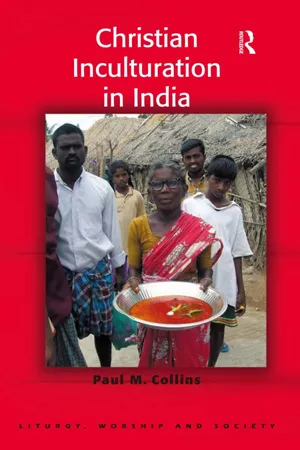
Drawing together international and Indian sources, and new research on the ground in South India, this book presents a unique examination of the inculturation of Christian Worship in India. Paul M. Collins examines the imperatives underlying the processes of inculturation - the dynamic relationship between the Christian message and cultures - and then explores the outcomes of those processes in terms of architecture, liturgy and ritual, and the critique offered of these outcomes, especially by Dalit theologians. This book highlights how the Indian context has informed global discussions, and how the decisions of the World Council of Churches, Vatican II and Lambeth Conferences have impacted upon the Indian context.
Trusted by 375,005 students
Access to over 1.5 million titles for a fair monthly price.
Study more efficiently using our study tools.
Information
Subtopic
Architecture religieuseChapter 1
Cultures, Commerce and Colonies: The Export Factor
And thus over all the World may the British Conquests be extended, while you gain still new accessions to the Kingdom of Christ, and conquer not for yourselves, but for HIM! Hence will the Name of Britains be made every Day more glorious by a continued Train of Victories over the common Enemy, the Great Tyrant of Mankind and Prince of this World.1
Setting the Scene
The context for this discussion of inculturation is the considerable theological literature produced during the twentieth century on the inter-face between the Christian Tradition and the culture or cultures in which individual Christians, and the community of the Church find themselves at any one time and place. Niebuhr’s Christ and Culture published in 1951, and Paul Tillich’s Theology of Culture, published in 1959 bear testimony to the centrality of this focus during the twentieth century. It is in part from this emphasis on culture in academic theological discourse that the ‘task’ of inculturation emerges. The desire to locate culture in a dialogical relation to the Christian Tradition, either in terms of theology and culture or theology of culture lends an impetus towards the desire to re-model Christian practice in relation to context and culture. As Pope Paul VI commented the inter-play between Gospel and culture is without doubt a drama of our time.2 It will be necessary in this and the following chapters to examine in more detail where the imperatives for the task of inculturation originate, and also to ask why such imperatives emerge in each particular time and place. The main examples of inculturation to be investigated will be drawn from south India, but examples from other parts of the globe will be mentioned in this chapter, including south America. In order to embark upon an analysis of the processes of cultural adaptation in Christian practice I will first set out some possible understandings of culture, then I will investigate where the imperatives towards inculturation emerge from and some of the issues and concerns underlying these imperatives.
Many attempts have been made to define ‘culture’, and a particularly well known attempt sets out the following understanding:
Culture consists of patterns, explicit and implicit of and for behaviour acquired and transmitted by symbols, constituting the distinctive achievement of human groups, including their embodiment in artefacts; the essential core of culture consist of traditional (i.e. historically derived and selected) ideas, especially their attached values; culture systems may, on the one hand, be considered as products of action, on the other hand, as conditioning element of future action.3
Emerging from such an understanding it has been argued that culture is
(a) something that is learned, not inherited;
(b) something that is shared by all or almost all members of some social group;
(c) something that the old members of the group try to pass on to the younger members, and
(d) something (as in the case of morals, laws and customs) that shapes behavior, or structures one’s perception of the world.4
Another well-known and complementary attempt at definition was made by Clifford Geertz5 who argues that culture relates primarily to the semiotic and thus to questions of significance. Cultural analysis is an attempt to discern and interpret meaning. If human behaviour is to be understood as symbolic action, then participants in the same culture or new-comers to it or observers of it will seek to understand what is intended or meant by behaviour. A potential problem here is the possibility that human actions become reified. Nonetheless Geertz argues that culture consists of socially established structures of meaning. Culture is a series of inter-worked systems of construable signs (or symbols), which he argues do not deliver up power, but provide a context for human existence. If the understanding of culture and the analysis of culture are dependent upon the notion of context, then as Geertz also argues there can be no general theory of cultural interpretation. Geertz concludes that the vocation of the analyst of cultures is not to provide answers to the deep existential questions of life, but to seek to identify how in a given context answers to those questions have been provided by those in the cultures themselves. Thus Geertz argues that
Culture is best seen not as complexes of concrete behaviour patterns – customs, usages, traditions, habit clusters – as has, by and large, been the case up to now, but as a set of control mechanisms – plans, recipes, rules, instructions (what computer engineers call ‘programs’) – for the governing of behaviour …The ‘control mechanism’ view of culture begins with the assumption that human thought is basically both social and public – that is, its natural habitat is the house yard, the marketplace, and the town square. Thinking consists not of ‘happenings in the head’ (though happenings there and elsewhere are necessary for it to occur) but of a traffic in what have been called significant symbols – anything, in fact, that is disengaged from its mere actuality and used to impose meaning upon experience. From the point of view of any particular individual, such symbols are largely given.6
These brief summaries raise important questions for any understanding of issues concerning the relationship of the Gospel or of Christ to culture as well as to the task of inculturation. Firstly are such concepts of the phenomena of culture brought to bear upon theological reflection and action? And secondly were this to be the case how would this affect the outcomes of reflection upon practice? The study and analysis of religion as culture and of religious cultures is a major sub-set in cultural studies. It will be necessary in the course of analysing both theological reflection and practice to bear in mind the insights and conventions of this sub-set of cultural studies. However for the moment the role of cultural analyst as interpreter of symbolic action understood as ‘control mechanism’ provides a sufficient basis upon which to proceed with the discussion of theological discourse concerning culture as well as the processes of inculturation. Having said this, it should be noted that these ‘definitions’ as with any others that might be used, are approximations, and should be used with this proviso in mind.
Before looking at theological discourse concerning culture, I want to consider how the conceptualization of culture is understood and employed by those whose work crosses cultural boundaries, in today’s global economy. One way in which to reduce, if not eliminate prejudice and misunderstanding in terms of commercial marketing has been the use of what Lee calls, Self Reference Criteria (sRC).7 Lee identified a four-step approach:
1) Determining the problem or goal in terms of home country culture, habits and norms.
2) Determining the same problem or goal in terms of host country culture, habits and norms.
3) Isolating the SRC influence on the problem and how it complicates the issue.
4) Redefining the problem without the SRC influence and solving it according to the specific foreign market situation.8
This approach may well be an over simplification of the issues facing either commercial marketing or liturgical adaptation, but it sets out in an open and seemingly transparent way how to approach the issues of crossing cultural boundaries or of inter-cultural encounter. However such processes are not immediately transferable to a context such as south India where indigenous people are themselves entering into the task of adaptation or inculturation. Indeed the starkness of Lee’s four-fold steps highlights the complexity of the quest for Indian-ness when the proponents themselves are already Indian and live out their lives in Indian culture.
So I turn to examine theological reflection and discourse on the relation between Gospel / Church and culture. Cardinal Walter Kasper in a recent statement on the nature of ecumenical dialogue, emphasizes the need to relate and situate all theological debates within their context and culture.9 His concern testifies to the ongoing centrality of ‘culture’ in theological discourse today. Indeed more than this I want to argue that Kasper’s clear sighted understanding of the crucial status of culture bears witness to what might be called a ‘shift to culture’ in the practice of theology, which might be seesnas a parallel with the ‘shift to the subject’ attributed to Kant. The emphasis on culture in theological writing and debate is one of the outcomes of and effects upon theology of that ‘shift to the subject’. The effects of that shift are borne out in the theological method of Schleiermacher who in response to the Enlightenment Project redefined the focus of theology as giving an account of the human subject’s response of faith, in place of the prior focus on giving an account of the divine being, with its attendant ontological and metaphysical expressions in creeds and dogmas. It is also significant that Schleiermacher’s first work of note was, On Religion: Speeches to its Cultured Despisers,10 which itself points to a concern with culture. What may be said to have occasioned this paradigm shift in theology towards a predominant focus on culture, what are its effects, and how, if at all, does it relate to the task of inculturation?
Debates about theology in relation to culture and theologies of culture are by no means novelties of the twentieth century. They can reasonably be situated in the Tradition in relation to the implications of the Incarnation, and by extension to the debates about analogy: i.e. analogia entis or analogia fidei.11 Nonetheless the current focus on culture is a shift from giving an account of the human response of faith, to giving an account of the context in which that faith and subjectivity are formed, which arguably might be a move further away from the traditional account of theos – logos or more subtly be a means by which to clothe faith in realities of context.12 In seeking to trace where the paradigm shift in the twentieth century to culture comes from, I want to begin with Karl Barth. It is indisputable that his whole theological endeavour rests upon an appeal to the analogia fidei.13 Thus it may be argued that despite his neo-orthodoxy, his endeavour also sits within the framework of Schleiermacher’s method in giving an account of the human response of faith. Furthermore while Barth’s theological endeavour was initiated by his rejection of Kulturprotestantismus,14 and set forth in his theological manifesto in his commentary on The Epistle to the Romans,15 his rejection of ‘culture’ is far from absolute as is witnessed in his acknowledgement of the influence of Mozart upon him.16 The later Barth in Volume IV of the Church Dogmatics17 and the Humanity of God18 demonstrates an understanding of the Incarnation, which sets much greater store by context and places value on the human and the material. This change of response to culture in Barth’s work is symptomatic of an ambivalence to culture within theological discourse as well as within Church practice.
Niebuhr’s classic work Christ and Culture is a benchmark to which many still refer today. It also bears witness to a sense of ambivalence, in the different types of inter-face identified between Christ and Culture as well as in the overall attitude he espouses which falls between outright acceptance or rejection of culture. It is as though in some sense, somewhere culture might be avoided. Kathyrn Tanner in her work Theories of Culture19 presents an interpretation of a variety of understandings of cultural analysis and of the inter-face between theology and culture, which clearly values culture in its own right and from her perspective is understood as God-given. Thus her work positively avoids the ambivalence, which I have identified. Hers is not the only work to do so, but through her appeal to a conceptuality of diversity she sets before us a dialogical framework for the inter-play between theology and culture which potentially avoids setting two static objects in confrontation with one another. More recently Robert Jenson has gone further still in the rejection of Niebuhr’s endeavour. He writes
H. Richard Niebuhr’s famous book, Christ and Culture, has many merits, but nevertheless has for some time seemed to me foundationally misconceived. The title presumes that Christ is one thing and culture another; and the book is about possible prepositions to replace the non-commital conjunction. Christ must be against culture, or above culture, or ahead of culture, or whatever….Thus it makes a logical tangle to speak of Christ ‘and’ culture absolutely, since by referring to C...
Table of contents
- Cover
- Half Title
- Title Page
- Copyright Page
- Table of Contents
- List of Figures
- List of Abbreviations
- Preface and Acknowledgements
- Foreword
- Introduction
- 1 Cultures, Commerce and Colonies: The Export Factor
- 2 Redefining Identities: Landscapes and Imperatives to 1963
- 3 Whose Values; Which Cultures? The Effects of Local Theologies
- 4 Art, Architecture and Topography: Temples and Churches in South India
- 5 Rites and Rituals: Lex Orandi, Lex Credendi?
- 6 Imperatives for a New Agenda
- Afterword
- Liturgical Texts
- Bibliography
- Index of Names
- Index of Subjects
Frequently asked questions
Yes, you can cancel anytime from the Subscription tab in your account settings on the Perlego website. Your subscription will stay active until the end of your current billing period. Learn how to cancel your subscription
No, books cannot be downloaded as external files, such as PDFs, for use outside of Perlego. However, you can download books within the Perlego app for offline reading on mobile or tablet. Learn how to download books offline
Perlego offers two plans: Essential and Complete
- Essential is ideal for learners and professionals who enjoy exploring a wide range of subjects. Access the Essential Library with 800,000+ trusted titles and best-sellers across business, personal growth, and the humanities. Includes unlimited reading time and Standard Read Aloud voice.
- Complete: Perfect for advanced learners and researchers needing full, unrestricted access. Unlock 1.5M+ books across hundreds of subjects, including academic and specialized titles. The Complete Plan also includes advanced features like Premium Read Aloud and Research Assistant.
We are an online textbook subscription service, where you can get access to an entire online library for less than the price of a single book per month. With over 1.5 million books across 990+ topics, we’ve got you covered! Learn about our mission
Look out for the read-aloud symbol on your next book to see if you can listen to it. The read-aloud tool reads text aloud for you, highlighting the text as it is being read. You can pause it, speed it up and slow it down. Learn more about Read Aloud
Yes! You can use the Perlego app on both iOS and Android devices to read anytime, anywhere — even offline. Perfect for commutes or when you’re on the go.
Please note we cannot support devices running on iOS 13 and Android 7 or earlier. Learn more about using the app
Please note we cannot support devices running on iOS 13 and Android 7 or earlier. Learn more about using the app
Yes, you can access Christian Inculturation in India by Paul M. Collins in PDF and/or ePUB format, as well as other popular books in Théologie et religion & Architecture religieuse. We have over 1.5 million books available in our catalogue for you to explore.