eBook - ePub
Power of the Talking Stick
Indigenous Politics and the World Ecological Crisis
- 210 pages
- English
- ePUB (mobile friendly)
- Available on iOS & Android
eBook - ePub
Power of the Talking Stick
Indigenous Politics and the World Ecological Crisis
About this book
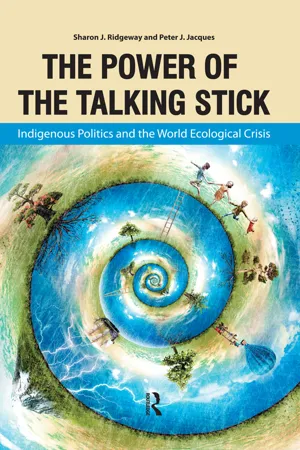
The Power of the Talking Stick makes the case that, reaching back to the beginning of the nation-state and all through the current period of corporate-led globalisation, our governments and social institutions have been engaged in activities that will ultimately extinguish the world's ecological life support systems. This book offers an alternative, listening to indigenous leaders and others whose voices often go unheard in the din of contemporary culture. Sharon Ridgeway and Peter Jacques offer a stark warning, but their insights are firmly grounded in traditional knowledge and provide a way to see past the politics and rescue the earth. An important resource for climate activists, students and academics.
Information
CHAPTER ONE
IT IS TIME FOR OUR HEARTS TO BE BROKEN
The old people, surveying a landscape, had such a familiarity with the world that they could immediately see what was not in its place …they went to work immediately to discover what this change meant.
—Vine Deloria Jr.1
As we witness the accelerating devastation of our home, planet Earth, the time has come to acknowledge that the piecemeal approaches employed in the name of modern science to address this ecological destruction are failing. The authors of this book have spent years trying to support various technical solutions to stop further damage to the natural environment, yet conditions continue to worsen at alarming rates. In the United States, Congress has passed numerous forms of legislation attempting to protect our water, air, and nonhuman inhabitants just to see these laws weakened to the point of nonexistence as commercial interests declare them too costly. We are told that there is no alternative. We are told that we must drill for oil in ever-deeper waters even as oil spills, such as that of the 2010 blowout of the Deepwater Horizon in the Gulf of Mexico, break offshore oil spill records and cause untold damage, only to fade in our collective memory until the next one.
As ever more powerful and destructive hurricanes try to cool the oceans’ rising water temperatures, we are told that economic growth demands that we burn even more fossil fuels, which spew greenhouse gases (GHGs), sulfur, nitrogen, mercury, and other pollutants into the atmosphere. GHGs absorb heat and raise the average global temperature of the Earth. This added heat has mostly been absorbed by the World Ocean. Between 1955 and 2010, the World Ocean soaked up 24 × 1022J, or 24,000,000,000,000,000,000,000 joules of energy, and this added heat cannot be explained without including the effects of human greenhouse gas emissions.2 To translate what this means, if this much energy were instantly transferred to the atmosphere, it would raise the average global temperature ~35°C (65°F).3 Indeed, in recent decades, the Arctic Sea has lost nearly half of its ice.4 In 2007, the Northwest Passage was open for the first time in human memory, allowing ships to pass through the Arctic. Tim Lenton has measured daily Arctic Sea extent since the availability of satellite measurements in 1979, and he comments, “The system has passed a tipping point.”5 Because the currents of the ocean are driven by temperature and salinity, the changing temperature is disrupting the way the ocean moves water around, which alters climate stability and disrupts the marine food web. That marine food web is, at the same time, being torn apart by overfishing and other pressures. We have depleted large fish (4 kg/8.8 lbs and larger) by 97 to 99 percent.6 Overall, for every hook we put in the ocean today, we land half of the fish we did in the 1970s, and more and more fisheries are collapsing or are depleted, with almost none of the world fisheries recovering.7
There are signs everywhere we look that human use of the planet Earth is overwhelming her ability to survive in a form we can recognize. The great mammals of the sea are still being hunted “for science” while dolphins and other ocean mammals are beaching themselves for unknown reasons. In November 2012, the National Oceanic and Atmospheric Administration (NOAA) reported that October had finally ended sixteen straight months of above-average temperatures, making 2012 on track to be the warmest year on record since 1998.8 The first ten months of 2012 were also the second most extreme on record in the United States, measured by assessing the top and bottom 10 percent in extremes of temperature, precipitation, and drought.9 These broken records and extremes are consistent with global climate change as were the records set when post–tropical storm Sandy came ashore on the US coast on October 29, 2012, with the lowest air pressure reading observed in the Northeast, at 946 mb. Sandy flooded low-lying sections of New York and caused a record crest in the Delaware River, beating previous records set in 1950.10
Record global temperatures in 2010 during June and July also resulted in severe weather events, including massive forest fires in western Russia that lasted from July to September and unusually strong monsoons that caused deadly floods in Pakistan, all of which are now described with a very high level of confidence by scientists as being part of global warming.11 Long-term warming of the waters of the Indian Ocean is causing floods in northern Australia while the southern-most regions are hotter and drier, causing drought. Fresh water is becoming dangerously limited due to warming temperatures that cause the ice packs of the world’s mountains to melt so fast that great parts of the Earth will lose their water security. The eastern Himalayan Mountains, known as the water towers of Asia, have the largest glaciated area outside of the two poles. The melt from these glaciers supplies the river basins that provide fresh water for 1.3 billion people in India, Bangladesh, Bhutan, Nepal, and China.12 Global climate change is causing increased rates of glacial retreat, threatening the water supply of these nations and causing drought and disruption of flow, which leads to climate refugees. Similar rapid mountain melt is threatening the water supply to the American Southwest from the Colorado River basin.13 In the Andes, tropical glaciers are predicted to disappear within twenty years, threatening the water supply of 77 million people and roughly half of the hydroelectric power for Bolivia, Peru, and Ecuador.14 The countries of the global South are set to feel some of the worst impacts of global climate change, yet they had virtually no role in causing it.
Philosopher of ecology Joanna Macy states it well: “We’ve been treating the Earth as if it were a supply house and a sewer. We’ve been grabbing, extracting resources from it for our cars and our hair dryers and our bombs and we’ve been pouring the waste into it until it’s overflowing, but our earth is not a supply house and a sewer. It is our larger body. We breathe it. We taste it. We are it and it is time now that we venerate that incredible flowering of life that takes every aspect of our physicality.” She continues, “World is lover, world is self and …it’s ok for our hearts to be broken over the world.”15
The most immediate threat to planet Earth is global climate change, yet the global North (wealthy, industrialized countries), especially the United States, has been unwilling to even make small steps to slow down the emission of GHGs. While China recently surpassed the United States as the largest emitter of GHGs, the global North is still responsible for the GHGs that have been building up since the Industrial Revolution. Yet, the countries that are hardest hit by the impacts are in the global South, including many Indigenous and subsistence communities who have produced minimal amounts to none of these gases.
Although there have been multiple global environmental conferences, experts indicate that “few conferences have yielded meaningful outputs that galvanized widespread state responses.”16 Perhaps most telling is the period of 1992–2012. One of the more important global conferences was the 1992 Earth Summit in Rio De Janeiro, Brazil, which announced the arrival of global environmentalism, launched several treaties, and heard dramatic intentions from world leaders. Twenty years later, the United Nations held the “Rio+20” conference, and it was clear that little, if any, genuine progress was made from the first Rio conference to the next. Worse, the urgent commitment apparent in 1992 was absent, with no important commitments or programs to emerge out of Rio in the summer of 2012.17 The United States has the worst record of Annex 1 (wealthy industrialized) countries in that it failed to ratify the Kyoto protocol, which then expired in 2012 without any substantial treaty to take its place. The US Senate’s failure to ratify Kyoto in the 1990s was then followed by the George W. Bush administration rejecting it totally. So far, the Barack Obama administration has done little to change this policy, seeking only voluntary limits of GHGs in secret negotiations at the 2009 Conference of Parties in Copenhagen and market mechanisms designed to benefit corporate polluters in Cancun, Mexico, in 2010, and virtual silence at the Rio+20.
Indigenous Voices of Resistance
Along the way, Indigenous peoples have not been silent, even if few have heard their coherent and consistent message. The peoples of the global South, especially the Indigenous peoples and subsistence farmers, who have been excluded from the mainstream international meetings led by nation-states, have still come together many times as heads of state alongside these official global conferences.
Indeed, across the last few decades, Indigenous demands have gone largely unacknowledged in mainstream media, domestic and international relations, and certainly in economic decision making. The latest of these Indigenous agreements was made in Rio de Janeiro in 2012 at the World Indigenous Peoples Conference on Territories, Rights, and Sustainable Development, or Kari-Oca II. The first Kari-Oca meeting occurred parallel to the state-led Rio Earth Summit in 1992, when Indigenous peoples from around the world met in their own conference and produced the Kari-Oca Declaration, discussed more in Chapter 7. “Kari-Oca” comes from the Tupí-Guaraní language, and it denotes the area where Rio de Janeiro now stands as “white man’s house” and the settlements of the first Portuguese colonists. This second Kari-Oca meeting of Indigenous leaders from around the world was held again alongside, but outside, of the Rio+20 conference. Hortencia Hidalgo Cáceres (of the Aymara tribe), a member of the Indigenous Women’s Network of Latin America and the Caribbean for Biodiversity (RMIB), captured the frustration of the Indigenous voices with the lack of action by nation-states. “We can’t keep going on the same path that we have been on the last 20 years…. Real change is needed. We want to invite the world to a brighter future based on indigenous values and principles of ‘buen vivir’ (living well).”18 Here, living well has nothing to do with economic growth, but is about “living in harmony with nature while pursuing material, social and spiritual well-being for all members of society, but not at the cost of other members or the environment.”19 The declarations produced by Indigenous leaders at Kari-Oca and Kari-Oca II have remarkable consistency with other declarations, such as the Cochabamba Declaration.
Indigenous leaders came together in Cochabamba, Brazil, in April 2010 because they were seeing the impacts of global climate change firsthand, and they wanted to warn the rest of us that there is no more time to wait. They came together to call for the creation of an International Climate Justice Tribunal, to press for a Universal Declaration of the Rights of Mother Earth, and to recognize the harm being done by the current capitalist system in which a handful of global transnational corporations are dominating all market exchanges. This World People’s Conference on Climate Change demands that the countries of the global North, which have caused and continue to cause the buildup of GHGs, be held responsible to the rest of the world’s people who will most suffer the consequences of global climate change. Not only have the developed countries not reduced their emissions since 1990, in fact, they increased emissions by 11.2 percent in the period from 1990 to 2007. The United States “has increased its greenhouse gas emissions by 16.8%, reaching an average of 20 to 23 tons of CO2 per person. This represents 9 times more than that of the average inhabitant of the ‘Third World,’ and 20 times more than that of the average inhabitant of Sub-Saharan Africa.”20 Thankfully, the US per capita emissions declined in 2010—the data lag a few years—where US CO emissions were around 18 tons per person.21 The bottom line, though, is that rich countries have caused between 60 and 80 percent of global warming, while poor countries have contributed between 20 and 40 percent.22 Further, most of these emissions from poor countries are from producing goods they export to wealthy countries.23
In a search for justice, Indigenous leaders have composed agreements that go beyond short-term technical fixes to not only global climate change but all impacts created by corporate-led economic globalization that are destructive to the natural world, which all forms of life depend upon. One particular focus is on the impacts of industrial agriculture, which is destroying their ability to feed themselves. The industrial approach to agriculture replaces diverse plants and animals with only a few chosen varieties that are grown for economies of scale while eliminating diverse Indigenous and peasant cultures along the way.24 These forces threaten biological and cultural diversity directly and indirectly, “placing the world’s diversity in both nature and culture increasingly at risk. This means no less than placing at risk the very basis of life on Earth as we know it: the natural life-supporting systems that have evolved on the planet, and their cultural counterparts have dynamically coevolved with them since the appearance of Homo sapiens.”25 Areas of rich biodiversity and cultural diversity show “parallel extinction risk,”26 where diversity is replaced with homogeneity “almost everywhere” and where “forces promoting homogeneity are playing an endgame on a global scale.”27 In response, Indigenous peoples and subsistence farmers seek food sovereignty in which there is a recognition of the right of peoples to control their own seeds, lands, food production in addition to the recognition of water as a fundamental human right.
At this point, we would like to pass the talking stick to the authors of the Cochabamba Declaration, an amazing document that captures many of the mes- sages Indigenous leaders have tried repeatedly to convey to the rest of the world. In many tribal cultures, each member is given the right to address the rest of the village. The symbol of that right is referred to as the talking stick in particular North American tribes. The rest of the village accords the holder of the stick time to present his or her views. For the limited purposes of this book we present only a small portion of their statement, but strongly encourage all to go to the actual document to read it in its entirety. We now pass the talking stick to the Indigenous and other peoples largely of the global South, who begin,
Today, our Mother Earth is wounded and the future of humanity is in danger…. The capitalist system has imposed on us a logic of competition, progress and limitless growth. This regime of production and consumption seeks profit without limits, separating human beings from nature and imposing a logic of domination upon nature, transforming everything into commodities: water, earth, the human genome, ancestral cultures, biodiversity, justice, ethics, the rights of peoples, and life itself.
Under capitalism, Mother Earth is converted into a source of raw materials, and human beings into consumers and a means of production, into people that are seen as valuable only for what they own, and not for what they are.
Capitalism requires a powerful military industry for its processes of accumulation and imposition of control over territories and natural resources, suppressing the resistance of the peoples. It is an imperialist system of colonization of the planet.
Humanity confronts a great dilemma: to continue on the path of capitalism, depredation, and death, or to choose the path of harmony with nature and respect for life.
It is imperative that we forge a new system that restores harmony with nature and among human beings. And in order for there to be balance with nature, there must first be equity among human beings. We propose to the peoples of the world the recovery, revalorization, and strengthening of the knowledge, wisdom, and ancestral practices of Indigenous Peoples, which are affirmed in the thought and practices of “Living Well,” recognizing Mother Earth as a living being with which we have an indivisible, interdependent, complementary and spiritual relationship.28
The Hidden Costs of Economic Globalization
Before those of us immersed in a Western materialist consciousness will be able to truly hear these voices, we will need to unburden ourselves of the hubris of believing that we are the “civilized” peoples of the world and the rest of the world should try to become like us. We have not yet acquired a sense of humility that our ideas of progress have been constru...
Table of contents
- Cover
- Half Title
- Title
- Copyright
- Contents
- Preface: Lessons in Listening
- 1 It Is Time for Our Hearts to Be Broken
- 2 Bretton Woods Takes Center Stage in the Carnival
- 3 Industria Encloses the Global Commons
- 4 Capitalism’s Endless Pursuit of Profit Destroys the World’s Food Supply
- 5 A Green Theory of the State
- 6 Earth Consciousness, Earth Action
- 7 A World Indigenous Movement: “We Are the Watchers, We Are Witnesses”
- Notes
- References
- Index
- About the Authors
Trusted by 375,005 students
Access to over 1.5 million titles for a fair monthly price.
Study more efficiently using our study tools.
Frequently asked questions
Yes, you can cancel anytime from the Subscription tab in your account settings on the Perlego website. Your subscription will stay active until the end of your current billing period. Learn how to cancel your subscription
No, books cannot be downloaded as external files, such as PDFs, for use outside of Perlego. However, you can download books within the Perlego app for offline reading on mobile or tablet. Learn how to download books offline
Perlego offers two plans: Essential and Complete
- Essential is ideal for learners and professionals who enjoy exploring a wide range of subjects. Access the Essential Library with 800,000+ trusted titles and best-sellers across business, personal growth, and the humanities. Includes unlimited reading time and Standard Read Aloud voice.
- Complete: Perfect for advanced learners and researchers needing full, unrestricted access. Unlock 1.5M+ books across hundreds of subjects, including academic and specialized titles. The Complete Plan also includes advanced features like Premium Read Aloud and Research Assistant.
We are an online textbook subscription service, where you can get access to an entire online library for less than the price of a single book per month. With over 1.5 million books across 990+ topics, we’ve got you covered! Learn about our mission
Look out for the read-aloud symbol on your next book to see if you can listen to it. The read-aloud tool reads text aloud for you, highlighting the text as it is being read. You can pause it, speed it up and slow it down. Learn more about Read Aloud
Yes! You can use the Perlego app on both iOS and Android devices to read anytime, anywhere — even offline. Perfect for commutes or when you’re on the go.
Please note we cannot support devices running on iOS 13 and Android 7 or earlier. Learn more about using the app
Please note we cannot support devices running on iOS 13 and Android 7 or earlier. Learn more about using the app
Yes, you can access Power of the Talking Stick by Sharon J Ridgeway,Peter J Jacques in PDF and/or ePUB format, as well as other popular books in Politics & International Relations & Environment & Energy Policy. We have over 1.5 million books available in our catalogue for you to explore.