eBook - ePub
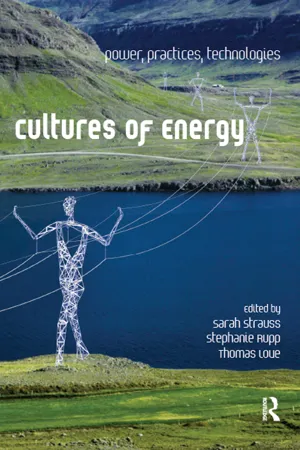
Cultures of Energy
Power, Practices, Technologies
- 360 pages
- English
- ePUB (mobile friendly)
- Available on iOS & Android
eBook - ePub
About this book
This path-breaking volume explores cultures of energy, the underlying but under-appreciated dimensions of both crisis and innovation in resource use around the globe. Theoretical chapters situate pressing energy issues in larger conceptual frames, and ethnographic case studies reveal energy as it is imagined, used, and contested in a variety of cultural contexts. Contributors address issues including the connection between resource flows and social relationships in energy systems; cultural transformation and notions of progress and collapse; the blurring of technology and magic; social tensions that accompany energy contraction; and sociocultural changes required in affluent societies to reduce dependence on fossil fuels. Each of five thematic sections concludes with an integrative and provocative conversation among the authors. The volume is an ideal tool for teaching unique, contemporary, and comparative perspectives on social theories of science and technology in undergraduate and graduate courses.
Information
PART 1
Theorizing Energy and Culture
CHAPTER ONE
The Fossil Interlude: Euro-American Power and the Return of the Physiocrats
INTRODUCTION
In this chapter I discuss the phenomenon of modern technology as a total social fact, viewed from the combined perspectives of history, sociology, economics, thermodynamics, ecology, epistemology, and culture theory. Anthropology is uniquely equipped to assemble such transdisciplinary perspectives on material aspects of contemporary societies and to “defamiliarize” lifestyles and social arrangements that have come to appear natural and desirable. It is high time for those of us who enjoy the benefits of modern technology and patterns of energy consumption to recognize our lifestyle as the privilege of a global minority, and technology itself as a strategy for appropriating and redistributing time and space in global society. Such a reconceptualization of deeply rooted notions of “technological progress” and “modernization” would make it easier to grasp the nature of the global crisis that we are currently facing. Rather than fragment our understanding of this crisis into legitimate but separate worries over energy scarcity, environmental degradation, resource depletion, food shortages, climate change, global inequalities, and financial collapse, we need to realize that all these concerns are aspects of a single problem.
This problem is the incongruous relation between modern social institutions and policies, on one hand, and the second law of thermodynamics, on the other. This natural law (also known as the entropy law) observes that any conversion of energy in the universe will entail a net increase in entropy (cf. Georgescu-Roegen 1971). “Entropy” is a measure of disorder or arbitrariness in the distribution of energy and matter. A currently familiar example of increasing entropy is the rising level of carbon dioxide in the atmosphere. The emission of carbon dioxide is largely an unintentional and long-unacknowledged by-product of maintaining a technological infrastructure founded on the combustion of fossil energy. As most of us are now aware, this by-product of growth is undermining the prospects for future generations of human life. As long as our societal pursuit of “economic growth” is based on an expanding combustion of finite stocks of fossil fuels, our cultural understanding of growth and progress is thus completely at odds with what natural law can tell us.
The social arrangements and aspirations that are most fundamentally at odds with the second law of thermodynamics are general-purpose money and beliefs in economic growth and technological progress. Of these illusions, the one that is most difficult to “defamiliarize” is undoubtedly that of technological progress. For this reason, the main objective of this chapter is to suggest a radical reinterpretation of technology.
THE METABOLISM OF SOCIETIES
Energy flows from the sun are the sine qua non of most living systems, including societies. Whereas organisms are programmed to harness such energy in specific and generally predetermined ways, human social systems have been able to devise a number of different strategies for accessing energy and distributing it among its members. As all human societies are organized in terms of more or less collective understandings of their own operation (the domain of cultural meanings), cultural images of energy and energy use constitute a formidable field for comparative study. Such study is inevitably contested and controversial, because access to and distribution of energy is everywhere closely connected to power. In fact, the very concept of “power” can be used to denote energy as well as social dominance (Hornborg 2001).
For the 99 percent of its existence that our species has lived as mobile hunter-gatherers, humans have occupied specific niches in natural food chains, defined by their technologies for extracting food energy from plants and animals. With the development of increasingly complex cognitive and communicative capacities, human societies became more elaborate, populations more concentrated and sedentary, and energy requirements more demanding. Beginning around ten thousand years ago, the domestication of plants and animals provided a more abundant and reliable energy niche for more complex societies in several parts of the world. The new demands on and sources of energy were recursively connected, so that, for instance, ceremonial feasting and chiefly generosity prompted expanded cultivation; more abundant harvests permitted larger settlements; the concentration of population demanded more intensified production; investments in productive facilities (generally farmland) required even greater concentrations of people for defensive purposes; and so on.
No doubt all these premodern societies, from hunter-gatherers to agricultural chiefdoms, had developed their own understandings of the energy flows that sustained them. Many of them seem to have recognized the sun as the source of vital power animating humans and the rest of the world. Agrarian empires were also ultimately dependent on the productivity of solar energy processed by plants, animals, and humans, and they, too, generally acknowledged (and in fact often worshipped) the sun.
From an abstract, comparative perspective, we can observe that these societies relied almost completely on the photosynthesis of various plant species and their conversion into food and fodder as well as the mechanical work of animals and humans. What we have come to call “land” and “labor” were the ultimate energy resources, but they could be invested in “capital” in the form, for instance, of agricultural terraces, irrigation canals, livestock, roads, ships, armies, and temples. Capital is here defined as some kind of material infrastructure through which the extraction of energy can be increased.
Preindustrial agricultural cosmologies invariably recognized the productivity of the land as the foundation of human society. This was evident in Europe as recently as among the eighteenth-century Physiocrats, and continues to be a dominant conception among nonindustrial agriculturalists in other areas of the world system today (Gudeman 1986; Gudeman and Rivera 1990). In fact, even the physical energy of labor in these cosmologies is considered secondary to the “strength of the earth” (Gudeman and Rivera 1990). The labor theories of value of the nineteenth century were a product of industrial societies, for which the ultimate dependence on land had become increasingly opaque.
MONEY AS FICTIVE ENERGY
The mercantile empires that often handled long-distance trade between settled, agrarian polities developed a measure of power that had a much more tenuous connection to energy. Their “niche” was not land or labor but exchange value, or purchasing power. This was particularly evident with the sixteenth- and seventeenth-century emergence of transoceanic trading empires like the Portuguese, Dutch, Spanish, and British. If solar energy had been the vital force flowing through agrarian societies, money became the more abstract and elusive “value” that seemed to flow through and empower mercantile societies. The ambiguous relation between energy and money continues to elude us to this day. Purchasing power certainly appears to suffice to empower modern empires, but the particular way in which access to energy is significant for the economy seems to escape economics as a discipline and profession. Nor does a clear understanding of energy seem to be a part of the general public image of the organization of modern society.
But neither, of course, is there a clear understanding of money. The intellectual efforts that have been expended over the past two millennia to grasp the nature of money are impossible to summarize, and the general public today seems as baffled by its logic as ever. Suffice it to say that concepts of energy and money appear to fill similar functions in denoting a vital essence flowing through society.
Like other species we are still, of course, as dependent on solar-derived food energy as ever, but the dominant cultural image of how modern society operates tends to marginalize such concerns in favor of a preoccupation with flows of money. This alienation from the vital flows that animate the biosphere in part derives from the historical experience of merchants and the social institution of money, in part from the nineteenth-century turn to inorganic, fossil energy, which was itself largely a consequence of the mercantile world order.
The concept of energy may seem as abstract and inaccessible as that of money, but it refers to objective material flows that through various intuitive understandings have been part of human consciousness and rationality for hundreds of thousands of years. Its replacement, over the past few millennia, by the concept of monetary value as the standard against which all things are assessed represents a cultural and ideological shift of momentous proportions. Unlike energy, money is fundamentally a fiction. Karl Marx observed that modern Europeans tend to conceive of money as an item that magically grows on its own account, comparable to the premodern worship of idols in West Africa. This was a quintessentially anthropological reflection in that it turned observations of exotic Others back onto the observer’s own familiar society. The economic reality in which modern humans are suspended is as culturally constituted and opaque as that of any pre-modern humans. This has been demonstrated by generations of economic anthropologists, but probably no one has done it more convincingly than David Graeber (2011). Money is truly a very peculiar idea and institution. It generates its own varieties of rationality that paradoxically tend to be both imbued with and divorced from morality, as Graeber shows. A fundamental conclusion from his wide-ranging studies, I suggest, is that the historical inclusion of human obligations in the sphere of “goods” exchanged through the medium of general-purpose money has generated pervasive ambiguities about how to draw boundaries between persons and (commodified) things. It is in this context we should understand the phenomenon of slavery. We could add that the impersonal rationality of managing money is decoupled not only from considerations of face-to-face human morality but from the exigencies of living sustainably on planet Earth.
Numerous philosophers, social thinkers, and spiritual leaders have shown very persuasively that money is indeed a fetish. It is a reified representation of social exchange relations that in itself has no substance and no agency except through the ideas that people have about it. As such, it is the ideal tool for controlling people. The premises for rational transactions (e.g., commodity prices, interest rates, currency exchange rates, etc.) can be changed overnight without undermining basic trust in the rationality of money as such. Relative purchasing power can be redistributed in a population through adjustments of this or that regulation in ways so complex that it is impossible for anyone but the high priests of economics to decipher what is being done.
MONEY AS THE CONDITION FOR TECHNOLOGY
As we turn to the phenomenon of modern technology, we should begin by recalling that technology, like energy, is fundamentally a capacity to conduct work. The Industrial Revolution basically boiled down to the unprecedented substitution of organic with inorganic energy in mechanical work. Industrial technology not only replaced much of the work previously conducted with human and animal energy, it made human societies thoroughly dependent on new forms of energy (that is, fossil fuels).
The notion that monetary exchange value is the substance or at least the driving force of society goes much further back than the Industrial Revolution, but it was a condition for it. There would have been no incentive for British textile manufacturers in the nineteenth century to radically intensify their production of cotton cloth if these commodities could not, by means of money, be exchanged for increasing volumes of embodied labor and land (for instance, in the form of imports of cotton fiber). The rationale of mechanization is inextricably intertwined with global differences in the prices of labor and resources. If the African slaves harvesting cotton fiber on the colonial plantations had been paid standard British wages, and the owners of New World soils had demanded standard British land rent, industrialization would simply not have occurred. The existence of modern technology, like the lucrative trade in spices, silver, or beaver pelts, is founded on strategies of conversion between different parts of the world market, where labor and land are very differently priced. This explains why the density of technological infrastructure continues to be very unevenly distributed over the face of the Earth, as can be observed on any global satellite image of nighttime lights. Thus money came to replace the concern of the eighteenth-century Physiocrats with fertile farmland as the basis of an affluent society. Although Thomas Malthus had worried about the availability of land as a constraint on economic growth, David Ricardo observed that capital and labor could substitute for land, and Karl Marx, too, was optimistic about the prospects of technological progress. These giants of economics appear not to have been very concerned about the fact that industrialization was fundamentally a strategy for Britain to appropriate, in terms of land area, an ecological footprint several times the size of its entire national territory, and, in terms of embodied labor, the toil of a workforce several times larger than its national population (Pomeranz 2000; Hornborg 2006, 2011).
The adoption of technologies propelled by fossil fuels two centuries ago was strongly connected to the emergence of the modern world view, articulated by Ricardo, that I referred to twenty years ago as the “image of unlimited good” (Hornborg 1992). This view sharply contrasted with that of premodern agricultural societies throughout the world, where the existence of absolute constraints was acknowledged, for example in the concern that one person’s gain may be another person’s loss. The anthropologist George Foster in 1965 presented such beliefs in a Mexican village as an exotic “image of limited good” (Foster 1965). Although realistic from a local perspective, Foster argued, this cultural image posed an obstacle to development. As we today face renewed Malthusian concerns with the limits to growth, not least in relation to problems of peak oil and global warming, it may be worth asking who has been living with a cultural illusion, and whether those villagers are in fact now being vindicated, but at a global level?
The turn to fossil fuels as a source of mechanical energy was revolutionary in many ways. Geopolitically, it turned Britain into the most extensive empire the world had ever seen. In part, this was because its textile industry was able to oust its Indian competitors and thrive from the profitable triangular Atlantic trade that converted cotton cloth into African slaves, which were in turn converted into New World plantation produce, including cotton fiber. But fossil fuels also propelled the railways and the steamships with which Britain, frequently using military coercion, organized the metabolic flows of its global empire.
As already mentioned, fossil fuels also revolutionized economics and the public image of the economy. Up until the Industrial Revolution, energy requirements were basically synonymous with land requirements. The work of animals and humans always required land, either for animal fodder or for human food. This meant that there was a fundamental competition over land for production of food versus fodder, which farmers had been familiar with for millennia. Feeding draft animals such as horses and oxen claimed significant proportions of the agricultural landscape in preindustrial Europe. There was thus a limit on the amount of transport energy that was available, and on the distances that bulk goods such as food or fodder could be transported, before the quantity of energy used to move the goods exceeded the energy content of the goods themselves. This posed a limit on rational transport distances because both kinds of energy represented the product of a quantity of land.
Fossil fuels provided a form of energy that did not compete with food production or other uses of the land. This meant that access to land no longer represented the ultimate constraint, as it had to the Physiocrats and to Malthus. Provided that the price of fossil fuels was low enough, it did not matter if the energy expended in transports exceeded the energy content of the cargo. From now on, the same logic applied to production, including agriculture. Relative market prices of various forms of energy, including labor, determined input-output ratios and the feasibility of different kinds of technology. Industrialized prod...
Table of contents
- Cover
- Half Title
- Title Page
- Copyright Page
- Dedication
- Table of Contents
- INTRODUCTION. Powerlines: Cultures of Energy in the Twenty-first Century
- PART 1. Theorizing Energy and Culture
- PART 2. Culture and Energy: Technology, Meaning, Cosmology
- PART 3. Electrification and Transformation
- PART 4. Energy Contested: Culture and Power
- PART 5. Energy Contested: Borders and Boundaries
- Afterword Maximizing Anthropology
- Appendix Energy: Power Units and Concepts
- Selected Bibliography
- About the Contributors
- Acknowledgments
- Index
Trusted by 375,005 students
Access to over 1.5 million titles for a fair monthly price.
Study more efficiently using our study tools.
Frequently asked questions
Yes, you can cancel anytime from the Subscription tab in your account settings on the Perlego website. Your subscription will stay active until the end of your current billing period. Learn how to cancel your subscription
No, books cannot be downloaded as external files, such as PDFs, for use outside of Perlego. However, you can download books within the Perlego app for offline reading on mobile or tablet. Learn how to download books offline
Perlego offers two plans: Essential and Complete
- Essential is ideal for learners and professionals who enjoy exploring a wide range of subjects. Access the Essential Library with 800,000+ trusted titles and best-sellers across business, personal growth, and the humanities. Includes unlimited reading time and Standard Read Aloud voice.
- Complete: Perfect for advanced learners and researchers needing full, unrestricted access. Unlock 1.5M+ books across hundreds of subjects, including academic and specialized titles. The Complete Plan also includes advanced features like Premium Read Aloud and Research Assistant.
We are an online textbook subscription service, where you can get access to an entire online library for less than the price of a single book per month. With over 1.5 million books across 990+ topics, we’ve got you covered! Learn about our mission
Look out for the read-aloud symbol on your next book to see if you can listen to it. The read-aloud tool reads text aloud for you, highlighting the text as it is being read. You can pause it, speed it up and slow it down. Learn more about Read Aloud
Yes! You can use the Perlego app on both iOS and Android devices to read anytime, anywhere — even offline. Perfect for commutes or when you’re on the go.
Please note we cannot support devices running on iOS 13 and Android 7 or earlier. Learn more about using the app
Please note we cannot support devices running on iOS 13 and Android 7 or earlier. Learn more about using the app
Yes, you can access Cultures of Energy by Sarah Strauss,Stephanie Rupp,Thomas Love in PDF and/or ePUB format, as well as other popular books in Social Sciences & Anthropology. We have over 1.5 million books available in our catalogue for you to explore.