- 590 pages
- English
- ePUB (mobile friendly)
- Available on iOS & Android
eBook - ePub
About this book
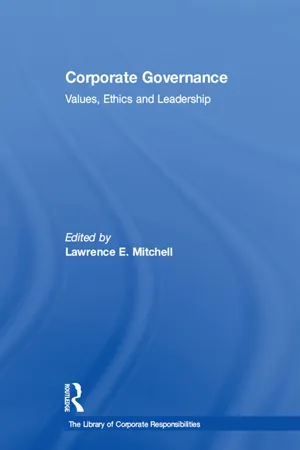
The study of corporate governance is a relatively modern development, with significant attention devoted to the subject only during the last fifty years. The topics covered in this volume include the purpose of the corporation, the board of directors, the role of shareholders, and more contemporary developments like hedge fund activism, the role of sovereign wealth funds, and the development of corporate governance law in what perhaps will become the dominant world economy over the next century, China. The editor has written an introductory essay which briefly describes the intellectual history of the field and analyses the material selected for the volume. The papers which have been selected present what the editor believes to be some of the best and most representative studies of the subjects covered. As a result the volume offers a rounded view of the contemporary state of the some of the dominant issues in corporate governance.
Information
Subtopic
Business GeneralIndex
BusinessPart I
The Purpose of the Corporation
[1]
CORPORATE POWERS AS POWERS IN TRUST *
IT is the thesis of this essay that all powers granted to a corporation or to the management of a corporation, or to any group within the corporation, whether derived from statute or charter or both, are necessarily and at all times exercisable only for the ratable benefit of all the shareholders as their interest appears. That, in consequence, the use of the power is subject to equitable limitation when the power has been exercised to the detriment of such interest, however absolute the grant of power may be in terms, and however correct the technical exercise of it may have been. That many of the rules nominally regulating certain specific uses of corporate powers are only outgrowths of this fundamental equitable limitation, and are consequently subject to be modified, discarded, or strengthened, when necessary in order to achieve such benefit and protect such interest; and that entirely new remedies may be worked out in substitution for or supplemental to existing remedies. And that, in every case, corporate action must be twice tested: first, by the technical rules having to do with the existence and proper exercise of the power; second, by equitable rules somewhat analogous to those which apply in favor of a cestui que trust to the trustee’s exercise of wide powers granted to him in the instrument making him a fiduciary.
The question is not academic. Its solution in the sense suggested would give greater flexibility to corporate managements in certain respects. It would permit them, when the action is actually necessary or beneficial, to do things in the doing of which they are now unduly hampered by technical rules. But where no showing of benefit can be made, and where one group within the corporation is to be sacrificed for the benefit of another, it would, equally, circumscribe the use of certain apparently absolute powers. In this latter aspect it is noteworthy that for years corporate papers and general corporation laws have multiplied powers and made them increasingly absolute; that charters have to an increasing extent included immunity clauses and waivers of “rights.” It seems not to have occurred to draftsmen that, through the very nature of the corporate entity, responsibility goes with power.
Stated thus broadly, the thesis can be supported only by an examination of the law governing every corporate power. As space does not permit this, five of the principal apparently “absolute” corporate powers are here examined. Examination of all other powers would, as far as the writer’s studies have gone, lead to the same result; the five chosen cover a fair cross-section of the field.
A. The power to issue stock is at all times subject to the equitable limitation that such issue must be so accomplished as to protect the ratable interest of existing and prospective shareholders.
Among the rules developed are:
(1) The rule that the incoming shareholder must make a contribution which in good conscience entitles him to participate to the extent allowed by his shares.
The requirement that stock be paid for has two distinct bases in American law. One line of thought required that stock be paid for in order to supply a fund available for the protection of creditors. With this ideology we are not at present concerned.
The second line was definitely based on the theory that every shareholder had an interest in the payment made by every other shareholder upon the issuance of his stock.1 Mathematically this is obvious; but it would by no means necessarily follow that the law would adopt the mathematical rule. Statutory provisions requiring payment for stock in cash or property afford no ground for an assumption as to which of the two lines of thought influenced the legislature. It was left to the courts first to interpret the statutes in this sense, and later to evolve the same result in the absence of statute and even in the face of provisions apparently granting to corporate managements wide latitude as to what and how much consideration should be required to justify the issuing of stock. As long ago as 18762 a requirement by statute that all stocks should be subscribed for “in good faith” caused an Illinois court to hold that stock issued for a nominal consideration was void; and in this case the thrust of the decision was primarily the protection of other shareholders.
Almost at once, however, the question arose in a new form. Statutory provisions generally provided for the issue of stock for “property received.” “ Property” is a word so broad as to include almost every definable fragment of value capable of being transferred. In its wide sense under these provisions stock could be issued for a note of the subscriber (negotiable instruments being certainly personal property), goodwill, contracts for services to be rendered, and a whole range of intangible elements of a similar sort. Commonly these provisions were accompanied by the requirement that the par value of stock (prior to 1912 non-par stock was unknown), if not paid in cash, must be paid in by a transfer of “property.” The courts were at once faced with the problem of determining whether all property could be so received; and if not, of distinguishing between types of property to be accepted and types to be rejected, and giving a reason for the distinction. Greater latitude was introduced at once because, while the measure of cash is always cash, property must be appraised, and there is great leeway for difference in valuation. The judicial reasoning on both questions is by no means clear in its groundwork; but on both issues the results, particularly in retrospect, are astonishingly plain. Thus, courts declared a note of the subscriber insufficient consideration,3 except when it was adequately secured,4 in which case the security element made the note “property” within the terms of the now judicially amended statutes. This was further defined in one case where the security was worthless stock, by throwing out even a secured note of the subscriber. What happened here was that the courts permitted the corporation to issue stock against one type of risk and declined to permit its issue against other types of risk. The obvious rationale of the decisions is that the former reasonably protected both creditors and stockholders; the latter did neither.
The question subsequently came up as to patents, obviously property, as remarked by one court, but
“There is no species of property the value of which is more uncertain than letters patent which secure to the patentee the exclusive right to manufacture the patented article. From the nature of the property, the real value of patents can only be determined after the invention is introduced and in use.”5
Accordingly the quality of the property was referred back to the question of valuation; and in respect to patents this is generally the rule. It will be noticed that this is a less rigid rule, permitting more latitude, and permitting protection of the interests actually involved. A contract for the services of an outsider to help publish a history has been held not “property” within the meaning of these statutes.6 Goodwill — well understood as property in other fields of law, and differing from tangible property only in that it is more difficult to reduce to definite appraisal — has been treated both ways; one case disallowed it completely;7 others left the question open for the determination of the possibility of a demonstrable valuation.8
Once in the valuation field, judicial modification of liberty of action becomes even more striking. Both of the principal rules on the subject — the rule that stock may be issued for property at its “absolute value,” as over and against the rule that stock may be issued for property upon such valuation as reasonable business men would approve under the circumstances9 — merely give the courts the power to correct unconscionable issues of stock, whether they use the value of the consideration or the directors’ morals as the primary test. The attempt to create a rule that the judgment “in good faith” of the board of directors shall be conclusive has received only minor support in the cases;10 but these holdings necessarily force back even further upon the board of directors the decision as to what constitutes a fair and conscionable consideration for the issue.
In determining both the nature of the property for which stock may be issued, and the valuation at which property may be taken to justify the issue of stock, courts have consistently rejected apparently absolute tests set out by statute and carried forward by corporate charters, and have substituted (as they needs must) a test for the conduct of the corporate management. In practically every case this conduct is couched in terms of “good faith,” except where the situation has been carried to the point in which apparently the courts thought that no group in “good faith” could justify its action.
The moment, however, that “good faith” is introduced in the picture the fiduciary principle is raised. The phrase implies good faith towards someone, arising out of some previous relation. The argument has never been made that directors “ in good faith” would believe it desirable for one group of men (not otherwise contributing) to pay one-third the contribution to the corporate capital required from everyone else.11 Nor would such an argument find much favor in any court. The “good faith” phrase is merely a shorthand way of saying that the directors must use their power to test the quality and appraise the value of the consideration offered for stock in such a manner that creditors and shareholders will not be hurt.
This is, in rough outline, the result of the cases down to the advent of non-par stock. With the appearance of this device legal concern for the protection of the creditors largely passed away.12 There remained the proper protection of the interests of the other shareholders; and this consideration at once became paramount. Commencing with the decision that non-par stock could not be issued for nothing, as a bonus,13 there ensued a decision holding that such stock must be issued at approximately equal prices at the same time to all concerned.14 This decision was subsequently modified by the Circuit Court of Appeals into a rule that where there is an inequality of consideration exacted, reasons must appear justifying the board of directors in making the distinction.15 And the test of justification was whether the amount of consideration required was or was not sufficient to operate as a protection to the remaining shareholders.
(2) The rule that after stock has been issued additional stock may be issued only (a) at a price or under circumstances which protect the equities of the existing shareholders or (b) in accordance with a scheme which permits the existing shareholders to protect their equities by subscribing for a ratable amount of the additional stock.
When the stock is without nominal or par value, there is usually direct authority, as clear as can be derived from words, permitting the directors of a corporation to issue stock as they see fit, when they see fit, and for any price they see fit. Prima facie this would appear to be an absolute power. Actually, however, courts have controlled this power almost from the time its implications became apparent. And there is manifestly no difference between the issue of non-par stock and the issue of stock having par value, except that in the latter case statutes and charters prescribe a minimum issue price (the par value) payable in a more or less restricted form (cash, property of approved quality, services actually rendered). The situation is approximately the same in both cases, however, barring only this statutory restriction.
Even statutory restrictions involving a minimum price upon the issue of par value stock have been swept away by the courts under circumstances in which it appeared that the position of the corporation did not permit the issue of par value stock for its par value,16 but in these cases the courts required that it should be made to appear both that the stockholders had assented or were protected under all the circumstances, and that creditors would not be prejudiced. Faced even with an apparent restriction, the courts evolved an equitable principle to the effect that under the circumstances indicated the restriction could be ignored.
Early in the history of corporation law the equitable principle was developed that prima facie the directors, despite their power to issue stock, must so issue it that the stockholders would be given an opportunity to protect their equities by subscribing to ratable shares of new stock. This rule, evolved in 1807 in Gray v. Portland Bank,17 probably was misunderstood by the bar and by courts generally. An examination of the facts in that case makes it plain that the court did not undertake to lay down a piece of judicial legislation requiring the management to offer stock promiscuously to all shareholders. The court did hold that in that particular situation the issue of additional shares without permitting a shareholder to subscribe impaired his equity.18 Judge Sewall observed that an incorporation for a bank was “a trust created with certain limitations and authorities, in which the corporation is the trustee for the management of the property, and each stockhol...
Table of contents
- Cover
- Half Title
- Title Page
- Copyright Page
- Table of Contents
- Acknowledgements
- Series Preface
- Introduction
- PART I THE PURPOSE OF THE CORPORATION
- PART II THE BOARD OF DIRECTORS
- PART III SHAREHOLDERS
- PART IV A LOOK AT THE FUTURE?
- Name Index
Trusted by 375,005 students
Access to over 1.5 million titles for a fair monthly price.
Study more efficiently using our study tools.
Frequently asked questions
Yes, you can cancel anytime from the Subscription tab in your account settings on the Perlego website. Your subscription will stay active until the end of your current billing period. Learn how to cancel your subscription
No, books cannot be downloaded as external files, such as PDFs, for use outside of Perlego. However, you can download books within the Perlego app for offline reading on mobile or tablet. Learn how to download books offline
Perlego offers two plans: Essential and Complete
- Essential is ideal for learners and professionals who enjoy exploring a wide range of subjects. Access the Essential Library with 800,000+ trusted titles and best-sellers across business, personal growth, and the humanities. Includes unlimited reading time and Standard Read Aloud voice.
- Complete: Perfect for advanced learners and researchers needing full, unrestricted access. Unlock 1.5M+ books across hundreds of subjects, including academic and specialized titles. The Complete Plan also includes advanced features like Premium Read Aloud and Research Assistant.
We are an online textbook subscription service, where you can get access to an entire online library for less than the price of a single book per month. With over 1.5 million books across 990+ topics, we’ve got you covered! Learn about our mission
Look out for the read-aloud symbol on your next book to see if you can listen to it. The read-aloud tool reads text aloud for you, highlighting the text as it is being read. You can pause it, speed it up and slow it down. Learn more about Read Aloud
Yes! You can use the Perlego app on both iOS and Android devices to read anytime, anywhere — even offline. Perfect for commutes or when you’re on the go.
Please note we cannot support devices running on iOS 13 and Android 7 or earlier. Learn more about using the app
Please note we cannot support devices running on iOS 13 and Android 7 or earlier. Learn more about using the app
Yes, you can access Corporate Governance by Lawrence E. Mitchell in PDF and/or ePUB format, as well as other popular books in Business & Business General. We have over 1.5 million books available in our catalogue for you to explore.