eBook - ePub
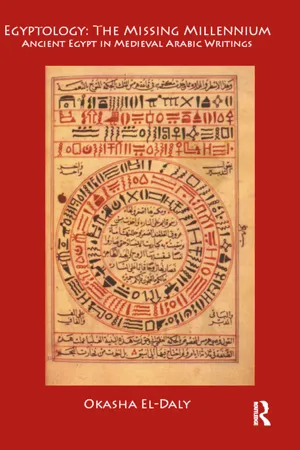
Egyptology: The Missing Millennium
Ancient Egypt in Medieval Arabic Writings
- 258 pages
- English
- ePUB (mobile friendly)
- Available on iOS & Android
eBook - ePub
About this book
Egyptology: The Missing Millennium brings together for the first time the disciplines of Egyptology and Islamic Studies, seeking to overturn the conventional opinion of Western scholars that Moslims/Arabs had no interest in pre-Islamic cultures. This book examines a neglected period of a thousand years in the history of Egyptology, from the Moslem annexation of Egypt in the seventh century CE until the Ottoman conquest in the 16th century. Concentrating on Moslem writers, as it is usually Islam which incurs blame for cutting Egyptians off from their ancient heritage, the author shows not only the existence of a large body of Arabic sources on Ancient Egypt, but also their usefulness to Egyptology today. Using sources as diverse as the accounts of travelers and treasure hunters to books on alchemy, the author shows that the interest in ancient Egyptian scripts continued beyond classical writers, and describes attempts by medieval Arab scholars, mainly alchemists, to decipher the hieroglyph script. He further explores medieval Arab interest in Ancient Egypt, discussing the interpretations of the intact temples, as well as the Arab concept of Egyptian kingship and state administration—including a case study of Queen Cleopatra that shows how the Arabic romance of this queen differs significantly from Western views. This book will be of great interest to academics and students of archaeology, Islamic studies and Egyptology, as well as anyone with a general interest in Egyptian history.
CHAPTER 1
INTRODUCTION
THE MISSING LINK IN EGYPTOLOGY
The discipline we call Egyptology, the study of Egyptian archaeology, is held to be a product of modern Western scholarship. It is also claimed that it was only when Jean-François Champollion and his European successors succeeded in deciphering Egyptian hieroglyphs and reading texts that Egyptology was born. Those concerned with the sources for the study of Ancient Egypt usually list them in this order:
1 ancient Egyptian sources, basically the remains of the material culture;
2 contemporary Near Eastern sources and later classical sources;
3 Renaissance sources from the 15th century onwards;
4 modern Egyptology, excavation and studies.
Standard studies of sources normally include accounts of European travellers to Egypt, but nowhere do we find any kind of reference to the medieval Egyptian/Arab scholarly contribution to these studies (see for example Baines and Malek 1980: 22–29). Even when one single reference is made in all these studies to one medieval Arabic traveller to Egypt, Al-Baghdadi, it comes after the author has already reached the conclusion that there was ‘little interest in Egypt’s ancient past’ (David 2000: 51–61). So we have a gap in our sources of more than a thousand years, between those of the Classical period and those of the European Enlightenment. This book attempts to narrow that gap and show the value of the contributions during this millennium, in particular those of medieval Egyptian writers.
The book is also an inquiry into the image and interpretation of the culture of Ancient Egypt in medieval Arab sources, from the Moslem annexation of Egypt in the 7th century CE until the Ottoman conquest in the 16th century.
THE CURRENT VIEW
Until the late 18th century, little was known in the West about Ancient Egypt, as is illustrated by quotations such as the following:
The long period of ignorance, during which scholars floundered in a morass of esoteric theories, came to an end with the discovery of the Rosetta Stone. (James 1997: 30)
It has also been asserted that continuity from Ancient Egypt to the present was totally absent:
Si la confrontation entre l’Egypte traditionnelle et les cultures grecque et romaine qui s’y sont développées est à la fois un tournant dans l’histoire de l’Egypte et l’occasion d’un renouveau culturel authentique, l’ère chrétienne et, plus tard, l’ère islamique éloignent irrémédiablement l’Egypte de son passé pharaonique. (Valbelle 1994: 38)
In spite of this assertion of discontinuity, Dominique Valbelle follows this alleged fact immediately by recognising that many ancient Egyptian popular practices are still alive today, apparently without seeing any contradiction.
The same can be said of a similar assertion made by Ulrich Haarmann:
Any continuity from ancient to Islamic Egypt was irretrievably and doubly cut off, first by the adoption of Christianity in Egypt in the 4th century and then, three centuries later, by the Islamic conquest. Memories of the world of the pharaohs had long since been forgotten by Egyptians who had been incorporated into the Greek, the Roman, the Byzantine, and, by the 7th century CE, the expanding Islamic world. (Haarmann 2001:191)
These recent views echo an earlier one by no less an authority than Idris Bell:
With good reason did Mommsen call Islam ‘der Henker des Hellenismus’ ‘the executioner of Hellenism’. In this new world of dogmatism and religious bigotry, Christian or Mahommedan, there was no room left for the clear-eyed sanity of Hellas. Egypt had become once more a part of that Oriental world from which the fiery genius of Alexander had separated her for a thousand years. (Bell 1922:155; cf his later version: Bell 1948:134)
These quotations reflect views that were widely held by scholars involved in Egyptology, namely that there was no knowledge of Ancient Egypt, outside the context of European literature, from the Classical to the Enlightenment periods. The quotation from Haarmann is particularly surprising from a scholar of medieval Islamic/Arabic studies. It illustrates a general Eurocentric view that sees the culture of Ancient Egypt through a Western prism. However, such views are not limited to scholars in the West. Even among modern Egyptian scholars we encounter a similar view: for example, El-Shayyal concluded that before the writings on the history of Ancient Egypt by the 19th century Egyptian scholar Rifaca Al-Ṭahṭawi:
Ancient Egyptian history was never given its due appreciation by Muslim historians. First because they knew very little about it, and secondly because that period represented, in their opinion, a period of idolatry which stood in direct contradiction to the monotheism of Islam. (El-Shayyal 1962: 32)
Another eminent Egyptologist, cAbd Al-cAziz Saleh (1980: 39–46), made no mention of any medieval Arab contribution in his massive work on the history of Egypt and Iraq. While citing his sources for the study of Ancient Egypt, he referred to classical sources and then passed directly to the French Expedition at the end of the 18th century. In an earlier book, Saleh (1962: 244) dismissed medieval Arab writers in one single phrase, referring to post-classical writers on Egyptian civilisation as being ‘only associated with myths, magic and fantasies of which they had a greater share than their predecessors’.
This was echoed by Crone and Cook (1977: 114) and Cook (1983), who suggested that medieval Egyptians were not as interested in their ancient heritage as were their counterparts in Iran. It is true that medieval Egyptians do not seem to have displayed a chauvinist nationalism, but they seem no less proud of their past, as can be seen from the list of Egyptian historians who wrote almost exclusively on the history of Egypt from as early as the first century of Islam (Enan 1969, 1991; Donner 1998: 225). They wrote national histories without chauvinist nationalism. This attitude was deeply rooted in the Egyptian mind, which has, as Donald Redford (1986: xvii) put it, ‘a strong sense of its own past’. This can be seen, for example, in a relief from the east wall of the second court of the Ramesseum, West Thebes, where attendants at the annual festival of the god Min are shown carrying statues of kings Menes, Nebhepetre Mentuhotep, Ahmose, Amenhotep I and Thutmose I (Murnane 1995: 694). This Egyptian consciousness of national longevity was displayed to Herodotus by the priests of the temple of Ptah at Memphis, who read a long king-list to their visitor from a papyrus, which listed pharaohs from the first human king Menes onwards (Herodotus II: 100; Moyer 2002: 70). This list was perhaps similar to the famous King-List of Abydos. This interest in the past continued into medieval Egypt.
While Haarmann (1980) suggested that medieval Egyptians had indeed some interest in Ancient Egypt, he summarised their general attitude towards Egyptian antiquities as destroyers, treasure hunters and curious tourists (Haarmann 1996: 622). This is not the case with all medieval Egyptians, as many displayed great pride in the country and its antiquities. This can be seen, for example, in the writings of Ibn Al-Kindi (Faḍail), Al-Idrisi (Anwar), and Al-Qalqashandi (Ṣubḥ 3: 304ff and especially 310).
In medieval Arab sources for the history of Egypt it was the norm to start with a chapter on the virtues and excellences of Egypt, as indeed was the case with their treatment of other countries (Gottheil 1907: 258). Indeed, books were dedicated entirely to these virtues of Egypt, as reflected in their titles (eg Al-Kindi Faḍail; Ibn Zulaq Faḍail).
This same attitude of pride in Egypt and its past can even be seen in accounts of the most religiously pious Arab writers. One example is that of the 10th century geographer/traveller, Al-Muqadasi, who starts his account of Egypt with this sentence:
This is the region of which the pharaoh took pride above all humankind and at the hand of Joseph, maintained the entire world … It is one of the [two] wings of the world and its glories are countless. (Al-Muqadasi Aḥsan: 193)
This was not a romantic conception of Egypt, since on the same page, and also later, Al-Muqadasi is aware of the country’s shortcomings:
When this region is fortunate, then you need not ask about its richness and low prices; but when it [suffers] drought, then Allah is the [only] refuge from its famine, which lasts seven years, so that they (the people) eat dogs and are afflicted with most terrible epidemics. (Al-Muqadasi Aḥsan: 202)
This is a more accurate reflection of the attitude among medieval Arab writers with regard to the past and present glories of Egypt, as well as to its disadvantages.
OBSTACLES THAT FACED THE DEVELOPMENT OF INDIGENOUS EGYPTOLOGY
It is perhaps as a result of the views quoted above that the study of Egyptology, which since Napoleonic times has been led by European and American scholars and institutions, has almost totally ignored the vast number of medieval Arabic sources and other contributions in Arabic written between the 7th and 16th centuries. In 1942 the eminent British Egyptologist HW Fairman wrote that, although Egyptology was an international science, the Egyptian contribution to it was ‘Nil’ (Reid 1985: 244).
It is quite clear that the study by medieval Egyptians and Arabs of Ancient Egypt, its language, religion, monuments and general history, flourished long before the earliest European Renaissance contact Contrary to the prevailing view that Moslems/Arabs/Egyptians had no interest in Ancient Egypt, the sources show not only a keen interest, but also serious scholarship that seeks to understand and benefit from the study of Ancient Egypt.
However, this process of study was discontinued and obstacles were placed in the way of the development of a later indigenous school of Egyptology, for reasons which have been discussed by Mokhtar (1965), Reid (1985, 1990, 2002) and Wood (1998). The main reason was the desire of early Western Egyptologists and others to keep Egyptians out of Egyptology by discouraging them from participation and study, thus leading to their marginalisation and to inevitable Western dominance of the subject. Yet Reid (2002) was able to show in his painstakingly researched recent work that many modern Egyptians are proud of their pharaonic as well as their post-pharaonic heritage.
It must be recognised that there was a trend among some Westerners to object to the teaching or promotion of native Egyptians, and this was not limited to Egyptology, as sciences such as medicine suffered a similar fate (Sonbol 2000: 58). Even today, Arab scholars complain bitterly about the lack of indigenous schools dedicated to writing history from a native viewpoint rather than merely reproducing Western texts (Saidan 1988: 184ff). The same complaint is made by young Egyptian scholars, who complain bitterly about the Western dominance of Egyptology (Saied 1999).
The situation was made worse by the colonial educational authorities, who excluded Egyptian history from the curriculum. For example, in 1905, secondary school history courses almost exclusively concerned European history, with textbooks bearing the following titles (Salamah 1966: 288):
• Outlines of General History by Renouf.
• Landmarks of European History by MacDougal.
• General Sketch of European History by Freeman.
Unfortunately, the effect of this focus on European history lasted long after the end of colonialism, as noted by the Egyptian scholar of the history of science cAbd Al-Ḥalim Muntaṣer, who could not recall ever hearing the name of any Arab scholar in any science during his primary, secondary or university education, but only the names of European scholars (Muntaṣer 1973:80). Sadly, this has also been my own experience whilst studying Egyptology. The eminent Egyptian scientist Rushdi Said complained in his recently published memoirs that his history lessons on the pharaonic period were very few and did not include ‘any ties between us and these ancient [Egyptians]’ (Said 2003: 16). One of the serious implications for Egyptology courses in Egypt is that our ancient history is taught from a Eurocentric viewpoint. Thus, for example, the Persian kings who conquered Egypt in the 5th century BCE are portrayed as being full of hatred towards the Egyptians and their religion, exactly what their contemporary Greek/European enemies wanted to believe (Tuplin 1991: 259f). In fact there is no evidence in our archaeological record of any Persian atrocities (cf Vasunia 2001:21 n 34). It is true that Egyptians did rebel against Persian rule, but they did this with equal vigour against all foreign rulers and occasionally also against some of their own monarchs.
An additional problem during the British Mandate was that teaching took place mainly in English under the instruction of a leading missionary, Mr Dunlop, who was in charge of Egyptian education, and who excluded native Arabic-speaking teachers (Marlowe 1970: 290–92). Indeed, Arabic was treated as a dead language and was taught in the same way that Latin was taught in the West. In addition to all this, the British High Commissioner, Lord Cromer, insisted that Egyptians would have to be christianised if they were to have any hope of being civilised (Cromer 1908 2: 535ff). Under Lord Cromer and his colleagues, the sole aim of education policy was to produce Egyptians who would be suitable only for the lower echelons of government bureaucracy (Lloyd 1933 1:162).
Another reason for the exclusion of Egyptians may have been the desire to claim ancient Egyptians as proto-Europeans (Fletcher and Montserrat 1998: 402) by showing that only Europeans were interested in the study of their history (cf Dittmann 1936). Such a view was not limited to Europeans. Ismael Pasha, the ruler of Egypt between 1863 and 1879, aspired to make Egypt ‘European’, styling himself as a ‘European ruler’, at least in appearance (Vatikiotis 1980: 73; Reid 2002: 96). Prominent native Egyptian scholars such as Ṭaha Ḥusayn and Ahmad Lutfy Al-Sayyid voiced similar views, and attempted to set out the foundations for closer cultural and historical links with Europe by teaching Egyptian history with an emphasis on the Greco-Roman period at the expense of its pharaonic past (Reid 2002: 211). Indeed, in 1938, Ḥusayn wrote a still widely respected book entitled The Future of Culture in Egypt in which he said it was ‘utter nonsense to consider Egypt as part of the East’ (Ḥusayn 1938:24), though he was in fact referring to the Far East (China, Japan and India), which he suggested had nothing in common with Egypt. This may have been a result of his French education with its Hellenistic influence (Barbulesco 2002: 297). But Ḥusayn was wrong. Take the example of India. Sir Flinders Petrie excavated evidence of an Indian presence in Egypt in what he called the ‘Foreign Quarter’ in the southern part of Memphis (Petrie 1909a: 3 (7); 1909b: 13; Harle 1992). Some fascinating insights into cultural exchanges between Egypt and India have already been published which suggest that such contact may date as far back as Egypt’s New Kingdom period – 15th-10th centuries BCE (DuQuesne 1995; Stricker 1997) – and that it flourished from the Greco-Roman period onwards (O’Leary 1957: 96–130; Fynes 1993; Salomon 1991).
It was in this atmosphere that Ahmad Kamal, one of the first native Egyptians in modern Egyptology (Sallam 1998; Saied 2002), explored the historical and linguistic links between Egypt and Arabia, as a contribution to the pan-Arabism/nationalist movement and to the debate about Egypt’s identity (Reid 2002: 212). His massive unpublished work, Dictionary of Ancient Egyptian Language, in 22 volumes, aimed to establish linguistic links between Egyptian and Arabic (Al-Macluf 1923: 306). But Kamal’s attempts to publish this dictionary were frustrated by the French and British Egyptologists who were in charge of Egyptian Antiquities and of university education at that time (Mokhtar 1965; Reid 1985). After his death, promises to publish, by the Ministry of Education and Al-Muqtaṭaf Journal, were never realised (Al-Macluf 1923: 301), though recently the first volume, covering the letter aleph (A), has been published in Cairo (Kamal 2002).
Kamal tried in many of his works to show that the links between Egypt and Arabia were not just linguistic but also cultural and religious. For example, he discussed (eg Kamal 1902) the worship and origin of the same deities in Egypt and Arabia.
The question of the nature of the links between Egypt and its Arabic neighbours are part of a wider debate about Egypt’s cultural identity. The literati often present the argument as a dichotomy, sharpening the contrast between Egypt’s pharaonic heritage and its contemporary Islamic one. In resolving such conflicts, the obvious solution is to appeal to a common origin that transcends divisive issues of creed or political loyalties, as was successfully achieved until the Ottoman invasion of Egypt in the early 16th century. This debate continued to dominate Egypt during the 19th and 20th centuries (Gershoni and Jankowski 1998; Haarmann 1991) and is relevant even today (Hassan 1999).
PREVIOUS RELEVANT WORKS
Although no systematic research seems to have been carried out on the medieval Arabic sources in order to inform the study of Egyptology, there have been a few attempts by scholars who have taken an interest in some aspects of the Arab contribution to our knowledge of Ancient Egypt. They are mainly but not exclusively ‘orientalists’ who, with few exceptions...
Table of contents
- Cover
- Half Title
- Title Page
- Copyright Page
- Table of Contents
- Preface
- Acknowledgments
- List of Figures
- Abbreviations and Notes
- Conventions of Transliteration
- 1 Introduction
- 2 The Making of an Interpretatio Arabica of Ancient Egypt
- 3 Treasure Hunting
- 4 Medieval Arab Archaeological Methods and Descriptions
- 5 Medieval Arab Attempts to Decipher Ancient Egyptian Scripts
- 6 Medieval Arabic Concepts of Ancient Egyptian Religion
- 7 Egyptian Mummia, Mummification and Burial Practices in Medieval Arabic Sources
- 8 Egyptian Science in Medieval Arabic Sources
- 9 Egyptian Kingship and State Administration
- 10 Conclusions
- Figures
- Appendix 1: Biographies of Arab Writers
- Appendix 2: Books on Ancient Egypt Used by AI-Idrisi
- Appendix 3: Primary Arabic Sources
- Bibliography
- Index
Trusted by 375,005 students
Access to over 1.5 million titles for a fair monthly price.
Study more efficiently using our study tools.
Frequently asked questions
Yes, you can cancel anytime from the Subscription tab in your account settings on the Perlego website. Your subscription will stay active until the end of your current billing period. Learn how to cancel your subscription
No, books cannot be downloaded as external files, such as PDFs, for use outside of Perlego. However, you can download books within the Perlego app for offline reading on mobile or tablet. Learn how to download books offline
Perlego offers two plans: Essential and Complete
- Essential is ideal for learners and professionals who enjoy exploring a wide range of subjects. Access the Essential Library with 800,000+ trusted titles and best-sellers across business, personal growth, and the humanities. Includes unlimited reading time and Standard Read Aloud voice.
- Complete: Perfect for advanced learners and researchers needing full, unrestricted access. Unlock 1.5M+ books across hundreds of subjects, including academic and specialized titles. The Complete Plan also includes advanced features like Premium Read Aloud and Research Assistant.
We are an online textbook subscription service, where you can get access to an entire online library for less than the price of a single book per month. With over 1.5 million books across 990+ topics, we’ve got you covered! Learn about our mission
Look out for the read-aloud symbol on your next book to see if you can listen to it. The read-aloud tool reads text aloud for you, highlighting the text as it is being read. You can pause it, speed it up and slow it down. Learn more about Read Aloud
Yes! You can use the Perlego app on both iOS and Android devices to read anytime, anywhere — even offline. Perfect for commutes or when you’re on the go.
Please note we cannot support devices running on iOS 13 and Android 7 or earlier. Learn more about using the app
Please note we cannot support devices running on iOS 13 and Android 7 or earlier. Learn more about using the app
Yes, you can access Egyptology: The Missing Millennium by Okasha El Daly in PDF and/or ePUB format, as well as other popular books in History & Egyptian Ancient History. We have over 1.5 million books available in our catalogue for you to explore.