- 234 pages
- English
- ePUB (mobile friendly)
- Available on iOS & Android
eBook - ePub
International Criminal Justice and the Politics of Compliance
About this book
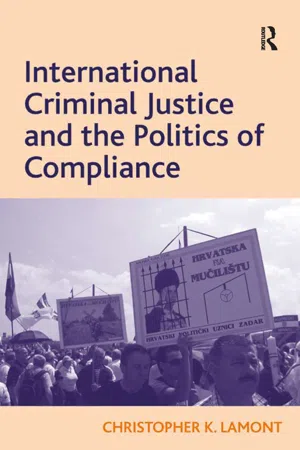
International Criminal Justice and the Politics of Compliance provides a comprehensive study of compliance with legal obligations derived from the International Criminal Tribunal for the former Yugoslavia's (ICTY) Statute and integrates theoretical debates on compliance into international justice scholarship. Through the use of three models of compliance based on coercion, self-interest and norms, Christopher Lamont explores both the domestic politics of war crimes indictments and efforts by external actors such as the European Union, the United States and the Tribunal itself to induce compliance outcomes. He examines whether compliance outcomes do or do not translate into a changed normative understanding of international criminal justice on the part of target states.
Chapter 1
International Criminal Justice and the Politics of State Compliance
Introduction
The United Nations Security Council’s (UNSC) establishment of the International Criminal Tribunal for the former Yugoslavia (ICTY) marked the first time since the Nuremburg and Tokyo military tribunals, held in the immediate aftermath of the Second World War, individuals responsible for serious violations of International Humanitarian Law (IHL) were brought to trial before an international court. The act of bringing individuals to trial before international judicial bodies at Nuremberg and Tokyo for not just the crime of aggression and crimes of war, but also crimes against humanity,1 represented a cursory attempt to move beyond the mere codification of IHL to the creation of a judicial IHL enforcement mechanism. The recognition of jus cogens law, and erga omnes obligations by the post-war military tribunals meant IHL enforcement had been at least partially wrestled from the exclusive jurisdiction of individual states and signaled the beginning of a renegotiation of the relationship between international criminal law and hitherto dominant post-Westphalian conceptions of state sovereignty. While some scholars interpreted the legacy of Nuremberg and Tokyo as providing a foundation for a paradigmatic shift away from state sovereignty based conceptions of international society (Cassese 1998, Hagan 2003: 29-30), this book will impart two key lessons that will demonstrate a need for greater engagement with the question of state interaction with international criminal justice bodies. First, triumphal interpretations of international criminal justice serve to obscure the continued dependency of international criminal justice regimes upon the state system and thus fail to adequately engage with the question of state compliance with tribunal orders.2 After all, Nuremberg and Tokyo’s appeals to jus cogens law and erga omnes obligations did not translate into the creation of a permanent international judicial body with the authority to adjudicate crimes against humanity and violations of the laws of war. Instead, an international criminal justice regime only emerged in February 1993 when the UNSC adopted Resolution 808, which called for the creation of an international criminal tribunal to prosecute individuals for serious violations of IHL on the territory of the former Yugoslavia.3 Second, increasing rates of compliance with international rules should not be interpreted as an indicator of regime legitimacy or norm internalization.4 In the former Yugoslavia, state governments articulated a distinctly different understanding of compliance acts that focused on recasting wartime perpetrators as postwar victims. Moreover, it will be demonstrated in forthcoming chapters that compliance acts in relation to ICTY requests and orders occurred in the context of a complex bargaining process that relied heavily on the deployment of material incentives and disincentives by external actors and not an acceptance of the legitimacy of the ICTY’s prosecutorial mandate.
From Law Creation to Law Enforcement
UNSC Resolution 827 imbued the ICTY with a mandate to prosecute individuals for serious violations of IHL. IHL can be broadly defined as “... a branch of the laws of armed conflict which is concerned with the protection of victims of armed conflict, meaning those rendered hors de combat by injury, sickness or capture, and also civilians” (McCoubrey 1990: 1). It is thus distinct from jus ad bellum considerations, and focuses solely on jus in bello.5 IHL is said to rest upon the assumption that “... the legitimate scope of military action is not unlimited and that those who are or have been rendered non-combatant are entitled to impartial humanitarian concern...” (McCoubrey 1990: 1). It is generally recognized that the legal codification of modern IHL began with the ratification of the first Geneva Convention in 1864, which established legal protections for non-combatants in times of war (McCoubrey 1990: 6); however, codes of conduct during armed conflict have been identified in the writings of Sun Tzu, Herodotus, Homer, and Plato.6 Yet despite this historic recognition of the existence of IHL norms, attempts at norm enforcement through the establishment of a permanent international criminal tribunal in the early 20th century were never realized.7 The interwar failure of the League of Nations to create a permanent international criminal court in the early 1920s for the purpose of bringing individuals to trial for violations of what Baron Descamps described as “the universal law of nations” is illustrative of the extent to which the concept of state sovereignty acted as a barrier to IHL enforcement in the years preceding the Second World War. The League of Nations was effectively blocked in its pursuit of an international criminal court by two legalist objections that were grounded in a defense of early 20th century conceptions sovereignty. The first of these objections held that individuals were not subjects of international law, while the second argued the proposed universal jurisdiction of the court was without legal foundation (Brown 1941: 119, McCormack 1997: 51-52). Rather than being perceived as a mechanism to facilitate conflict amelioration, during the inter-war years universal jurisdiction was regarded as presenting a significant threat to contemporary understandings of state sovereignty and was even decried as, “... a danger to the sovereign rights of states, perhaps even a menace to peace” (McCormack 1997: 51-52).
Legalist objections to the creation of international courts on the grounds of sovereignty were only muted during the course of the Second World War. Indeed, after the horrific atrocities committed across Europe by Nazi Germany were exposed during and after WWII, demands for the punishment of individuals involved in war crimes and other crimes against humanity became too powerful for states to ignore. McCormack notes, “the nature of some Nazi atrocities, even if not the scale or extent of them, was well known relatively early in the war. Consequently, discussion about the need for some form of international tribunal ...was widespread” (1997: 55). Moreover, the scale of Nazi atrocities prompted Justice Robert H. Jackson, the chief US prosecutor at Nuremberg, to note that the creation of the tribunal was legitimized through both the laws of humanity and the dictates of public conscience (May 2005: 35). The appeal to certain “laws of humanity” and “dictates of public conscience” at Nuremberg and Tokyo established the foundation for a new code of international law, the Nuremberg principles, that reconfigured the relationship between the individual, state, and international community, while also recognizing the doctrine of universal jurisdiction for certain crimes considered jus cogens (Bassiouni 2003a: 57-58, Bridge 1964: 1261, Broomhall 2003: 19). Despite Nuremberg and Tokyo being a manifestation of “victor’s justice,” Clark argues the postwar tribunals, “... firmly established in the legal consciousness the proposition that there are certain crimes which are of international concern or are crimes under international law” (1997: 185).8 However, as previously mentioned, rather than heralding the emergence of an international criminal tribunal system, the onset of the Cold War effectively blocked planning for the creation of a permanent international criminal court.9
Nevertheless, the concept of universal jurisdiction combined with the rejection of state immunity enshrined in the Nuremberg principles remains relevant to IR scholars because these principles constitute a challenge to the post-Westphalian state system. By defining crimes against humanity as jus cogens, an erga omnes obligation on all governing authorities to investigate and prosecute such crimes either by local judicial institutions or before an international criminal tribunal was created (Bassiouni 2003a: 167-168, Broomhall 2003: 56). Jus cogens norms therefore establish certain norms of behavior, which restrict the actions of states within their own national jurisdictions (May 2005: 24). Violations of jus cogens norms on the part of a governing authority can oblige the judicial intervention of other states or international tribunals.10 However, at this point it is important to emphasize that there exists no international judicial body imbued with a mandate to exercise universal jurisdiction. The subject of study in this book, the ICTY, was temporally limited to 1991-200511 and geographically limited to the territory of the former Socialist Federal Republic of Yugoslavia. Likewise, the International Criminal Tribunal for Rwanda (ICTR) was temporally limited to prosecuting serious breaches of IHL to a period which spanned a single year and territorially limited to a single state. Even the ICC cannot undertake prosecutions against non-Statute of Rome signatory states without referral by the UNSC, a process that grants de facto immunity from prosecution to states such as Russia, China and the United States.
Ad Hoc Justice
It was only in the 1990s, as the end of the Cold War coincided with the outbreak of genocide and ethnic cleansing in Bosnia-Herzegovina and Rwanda that international criminal tribunals emerged as mechanisms to confront what were perceived as challenges to both existing laws and conscience of humanity. Hagan points to a post-Cold War “opportunity structure” that included increased public awareness and activism in response to atrocities as acting as a catalyst for the reemergence of international criminal justice after nearly a half decade of dormancy (pp. 29-30). Kerr affirms the impact of growing public awareness on demands for justice when recalling how the explosive power of ITN television images broadcast in 1992 of the Omarska camp in Bosnia-Herzegovina, “reminiscent of Auschwitz and Belsen 50 years previously,” stunned UNSC member states into adopting Resolution 771, which demanded an immediate end to violations of IHL in Bosnia-Herzegovina and called upon states and international organizations to begin collecting information on IHL violations across the former Yugoslavia (2004: 34).12
As the post-Cold War international community confronted the explosion of violence in the former Yugoslavia and Rwanda in the 1990s, ad hoc international criminal tribunals became the preferred option for policymakers reluctant to engage in more costly military intervention to prevent or halt attempts at genocide and ethnic cleansing (Scharf 1997: 30-36, Western 2004: 217-231, Williams and Waller 2002: 844); however, unlike their post-Second World War predecessors, the post-Cold War ad hoc tribunals could not depend on an occupying military force to carry out their orders, and instead a complex relationship was negotiated with states or in some instances territories under international civilian and military administrations that fell under tribunal jurisdiction. Despite the fact that the memory of Nuremberg was invoked before the UNSC at the ICTY’s creation in 1993,13 the historic memory of the post-Second World War tribunals is of limited utility when exploring the politics of compliance with international judicial bodies.14 In 1994 the ICTY recognized this in its annual report to the UNSC:
It is well known that the Allied Powers that set up the international tribunals at Nürnberg and Tokyo wielded full authority and control over the territory of Germany and Japan respectively and, in addition, had already apprehended the defendants when the trials commenced. Consequently, those tribunals did not need the cooperation of the defendants’ national authorities or those of other countries for the prosecutors’ investigations and collection of evidence (1994: 27).
As judicial proceedings at Nuremberg and Tokyo commenced only after the total military defeat of Germany and Japan, the post-Second World War military tribunals were not confronted with the task of securing custody of accused persons from adversarial states.15 To be sure, the creation of a judicial body with limited temporal and territorial jurisdiction in the aftermath of an armed conflict where the vanquished parties were judged by representatives of the victorious states proved significantly less problematic than the abortive postwar attempt to establish a permanent international criminal court.16 This was a lesson quickly learned by the postwar International Law Commission (ILC), which was tasked with drafting a statute for an international criminal court under the auspices of the United Nations, as the onset of the Cold War consigned the further development of an international criminal tribunal system to relative dormancy (Ferencz 1980: 15-16, Maogoto 2004: 6).17
Although there has been a deepening entrenchment of an international tribunal system since 1993, the interaction between the states and non-traditional sovereign entities over which international criminal tribunals exercise jurisdiction has not been adequately explored in existing scholarship.18 It is an exploration of tribunal interaction with external bodies whose cooperation is necessary for the fulfillment of tribunal judicial mandates that will form the core of the following book.
Explaining Compliance
The relative absence of literature on state compliance with international criminal tribunal orders requires the creation of a research agenda that will address the relationship between international tribunals and territories over which tribunals exercise jurisdiction. While there is a growing wealth of literature that describes the legal precedents and obligations, which underpin international tribunals (Bassiouni 1992, 2003a, 2003b, Broomhall 2003, Cassese 1998), the interaction between international judicial bodies, states, intergovernmental organizations, and non-traditional sovereign entities requires further study. In fact, studies of state compliance with international legal obligations, which have long provoked intra-theoretical and inter-theoretical debate within and between the disciplines of International Relations (IR) and International Law (IL), remain on the periphery of international criminal justice scholarship.
In order to explain compliance and non-compliance with tribunal orders, this book will explore compliance with ICTY orders, on the part of states, intergovernmental organizations, and non-traditional sovereign entities in the former Yugoslavia. By limiting this study to the ICTY, we can explore compliance on the part of multiple actors that have all interacted with the same legal regime, the Statute of the Tribunal, which imposed a binding legal obligation upon all UN member states to cooperate with the ICTY and comply with Tribunal orders without “undue delay.” The legal obligation to fully cooperate with the ICTY remained constant throughout the period of time under study, and should not be confused with compliance benchmarks articulated by third party enforcement agents that for the most part fell short of full cooperation and instead often demanded the transfer of individual suspects.19 Moreover, assessments of state compliance were made annually by the ICTY, which submitted yearly reports to the UNSC on compliance on the part of both states and international organizations with a presence in the former Yugoslavia.
So as to fully explore the interaction between the ICTY, states, and the diverse range of actors over which the Tribunal exercises jurisdiction, this book includes five case studies and is divided into two constituent parts. Part I consists of the first three case studies and examines state compliance. Each case study includes an exploration of both the domestic and international politics of compliance so as to help disentangle compliance causality. The subject of ...
Table of contents
- Cover
- Title Page
- Copyright Page
- Table of Contents
- List of Figures and Tables
- List of Abbreviations
- Preface
- 1 International Criminal Justice and the Politics of State Compliance
- PART I STATE COMPLIANCE
- PART II COMPLIANCE BEYOND THE STATE
- Appendices
- References
- Index
Trusted by 375,005 students
Access to over 1.5 million titles for a fair monthly price.
Study more efficiently using our study tools.
Frequently asked questions
Yes, you can cancel anytime from the Subscription tab in your account settings on the Perlego website. Your subscription will stay active until the end of your current billing period. Learn how to cancel your subscription
No, books cannot be downloaded as external files, such as PDFs, for use outside of Perlego. However, you can download books within the Perlego app for offline reading on mobile or tablet. Learn how to download books offline
Perlego offers two plans: Essential and Complete
- Essential is ideal for learners and professionals who enjoy exploring a wide range of subjects. Access the Essential Library with 800,000+ trusted titles and best-sellers across business, personal growth, and the humanities. Includes unlimited reading time and Standard Read Aloud voice.
- Complete: Perfect for advanced learners and researchers needing full, unrestricted access. Unlock 1.5M+ books across hundreds of subjects, including academic and specialized titles. The Complete Plan also includes advanced features like Premium Read Aloud and Research Assistant.
We are an online textbook subscription service, where you can get access to an entire online library for less than the price of a single book per month. With over 1.5 million books across 990+ topics, we’ve got you covered! Learn about our mission
Look out for the read-aloud symbol on your next book to see if you can listen to it. The read-aloud tool reads text aloud for you, highlighting the text as it is being read. You can pause it, speed it up and slow it down. Learn more about Read Aloud
Yes! You can use the Perlego app on both iOS and Android devices to read anytime, anywhere — even offline. Perfect for commutes or when you’re on the go.
Please note we cannot support devices running on iOS 13 and Android 7 or earlier. Learn more about using the app
Please note we cannot support devices running on iOS 13 and Android 7 or earlier. Learn more about using the app
Yes, you can access International Criminal Justice and the Politics of Compliance by Christopher K. Lamont in PDF and/or ePUB format, as well as other popular books in Law & Criminal Law. We have over 1.5 million books available in our catalogue for you to explore.