eBook - ePub
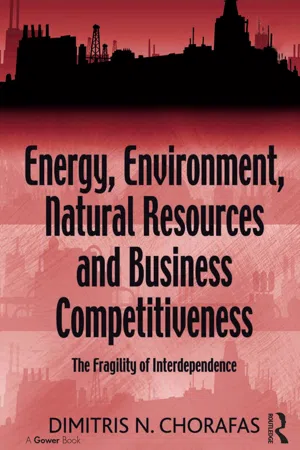
Energy, Environment, Natural Resources and Business Competitiveness
The Fragility of Interdependence
- 386 pages
- English
- ePUB (mobile friendly)
- Available on iOS & Android
eBook - ePub
Energy, Environment, Natural Resources and Business Competitiveness
The Fragility of Interdependence
About this book
Every generation leaves both assets and liabilities to the next. Alert people can see we are going to leave our children and grandchildren with a nearly unsolvable test of energy supplies; waste polluting the air and water; and the appalling problem of a huge and uncontrollable explosion in world population. Energy, Environment, Natural Resources and Business Competitiveness addresses itself to those having a professional, academic or general interest in these issues: - Energy sources, their nature and contribution, - Environmental problems associated to power production and usage, - Financing and control of energy-related projects and processes, - Future direction of agriculture produce now used as energy, - Complex social and technical issues resulting from lack of family planning - and, therefore, of demands for energy, - Impact of energy and an exploding population on pollution, - Truth and hype about the most talked about environmental subjects. In this fourth book for Gower, Dimitris Chorafas reviews Europe, America and Asia's energy needs in the coming decade, pointing out that current policies are inadequate at best, and more likely disastrous for the economy. Governments persist in having their own agenda and priorities as well as plenty of constraints and taboos, yet when he critically examines the challenges Dr Chorafas concludes that no government can solve all current energy problems by acting alone. The book confronts current thinking, and its after-effect on policies and practices. Readers accustomed to mainstream books and articles which blame fossil fuels for a deteriorating world environment will find this a contrary opinion.
PART I The Pillars of a Realistic Energy Policy
Chapter 1 Energy Means Power
DOI: 10.4324/9781315579573-1
1 Nothing Hurts as Much as the Truth
As an old adage has it, ‘Nothing hurts as much as the truth’. The truth is that when we say ‘we want to save planet Earth for future generations’, we are all liars. When the so-called Greens lament about coal-fired plants and nuclear energy, but in wintertime run around their homes in a T-shirt instead of lowering the central heating and putting on an additional pullover, hypocrisy has a ball.
Human nature is such that everyone wants to have his cake and eat it too. Talk about climate change makes good public relations, particularly when accompanied by grand promises, empty words and pizzazz (see also Hollywood’s extravaganza in Chapter 14). The real question, often forgotten in arguments about energy and environmental pollution, is to what degree we are prepared to forego our comfort in order to obtain environmental protection outcomes that are:
- satisfactory,
- measurable, and
- commendable.
This is, of course, a tall order because rapid population growth, urbanization and rising consumption are putting immense pressure on the earth’s natural resources and its environment (see section 2). With raw materials becoming scarcer because of overconsumption and with global warming a threatening force, politicians say that they are ready to tackle the problem – but they don’t really mean it because their talk is not followed by the right decisions and actions.
Many people look at technology as being the solution, but technological advances have unpredictable outcomes. As far as the preservation of energy and the conservation of the environment are concerned, computers and communications are part of the problem. Very few people are aware of how much energy technology consumes, even though this is a real and current issue.
Processing large amounts of data requires a great deal of power. ‘In two to three years we will saturate the electric cables running into the building,’ suggests Alex Szalay of Johns Hopkins University.1 In 2006 the US National Security Agency came close to exceeding its power supply, which would have blown out its electrical infrastructure – cryptographic machinery, networks of computers, huge databases and the wizards mining them included.
Information technology companies are aware of the challenge. This is why firms like Microsoft and Google have had to put some of their enormous data centres next to hydroelectric plants, with the aim of ensuring easy access to enough energy at a reasonable price. But if alternative energy is used to satisfy technology’s power hunger, there will be so much less of it to substitute for coal-fired plants.
Moreover, people are careless in their use of energy. Alan Meier, a scientist at Lawrence Berkeley National Laboratory did a study that showed 10 per cent of electricity in buildings is wasted in appliances and installations that were turned off, but remained on standby power.2 This and plenty of other examples demonstrate that nobody really cares about energy conservation (see also section 7).
As far as pollution is concerned, people are just as lousy with their habits. A case in point is vacations. They travel thousands of miles polluting the atmosphere to enjoy a few days in the South Pacific or attend ‘earth-saving’ global conferences that are more ‘love affairs’ than anything else. Look at Fiascopenhague (Chapter 14). Ecologically speaking, jet travel has been a disaster.
Not that governments are more careful. As the twentieth century came to a close, energy consumption in the United States stood at nearly 2.3 billion tons of oil equivalent. At 0.9 billion, China’s consumption at that time was a fraction of it; but it caught up. Ten years later, in 2009:
- overall US consumption has been slightly lower than in 1999, at about 2.2 billion,
- but China surpassed it by a nod having experienced a 2,444 per cent rise in tons of oil-equivalent power consumption in just a decade.3
Confronted with these vertiginous numbers, the ‘solutions’ proposed by the Greens and other environmentalists are half-baked at best. ‘Innovations’ like alternative energy, electric vehicles, treatment of dirty water and the like have short legs. It’s not that these ideas are wrong, it’s just that they don’t even scratch the surface of the earth’s sustainability problem which is much deeper and can be expressed in four bullet points:
- overpopulation,
- galloping urbanization,
- ever-greater demands for energy, and
- widespread pollution all over the globe.
These four themes correlate among themselves and with other ills. Overpopulation and urbanization have contributed, and continue to contribute, a great deal to global pollution. The same is true of uncontrolled energy consumption and of chemical-based intensive agriculture whose advent has been propelled by the need to feed billions of people who were irresponsibly brought into the world in the first place.
The rapid degradation of the earth’s environment would have been better controlled if environmental protection vigilantes had taken sufficient care to eliminate the roots of the problem rather than cutting some minor branches or doing something merely for show – like the initiative of capping and trading CO2 (Chapter 10). By allowing himself to destabilize the delicate balance of natural forces and resources, man has acted against himself. He has created conditions which definitely favour:
- famine,
- illiteracy,
- illness, and
- unprecedented pollution.
The equilibrium achieved through millennia of natural evolution has been broken. This did not come by chance, but as a result of dangerous transgressions in the domain of demographic instability which (surprisingly) no international conference on environmental protection from Kyoto 1997 to Copenhagen 2009 has ever tackled.
People able to look into the future and with the courage to openly express their opinions say that the largest and fastest-growing developing countries should be the first to exercise birth control (Chapter 13) and that the West should help them do so. These countries are (in alphabetical order): Bangladesh, Brazil, China,4 Colombia, Egypt, India, Iran, Indonesia, Nigeria, Mexico, Pakistan, Thailand and Turkey.5
It does not take a genius to understand the important link between rapid population growth and the increasing scarcity of food, energy and minerals. The negative effects of excessive population growth also show up, in a big way, in the horde of difficulties encountered in economic development, including falling educational standards, widespread, poorly controllable illnesses (like AIDS) and all sorts of breakdowns in social order.
2 The Correlation between Global Population and Energy Demand
Since the dawn of mankind, energy has meant power. This has been one of the reasons why civilization started near or alongside waterways. The energy supply problems faced by one community were shared by every other because energy is the sort of tool which leverages the man’s reach. ‘Man is a tool-using animal,’ wrote the nineteenth-century Scottish historian Thomas Carlyle. ‘Without tools he is nothing, with tools he is all.’
In old times, the vast majority of man’s tools were powered by muscle. Certainly, well before the steam engine, human societies used energy from natural sources such as wood, coal, water and wind. But even if wood and coal were in abundance, the energy they released could not be used much beyond producing heat. In the physical sense of transferred motion, useful work could be done only by:
- wind, and
- moving water.
Wind and moving water, however, are erratic and not always found where they are needed (keep that in mind when we talk about alternative energies in Chapter 5). Therefore, for millennia muscle power remained the main energy source in both transport and production, and was also one the most basic reasons for the practice of slavery. ‘The Northern States are jealous of our slaves and our prosperity; we owe them nothing,’ said to Ralph Waldo Emerson to Achille Murat, son of the ex-King of Naples, nephew of Napoleon and landlord of Liponia in the US South.6
The steam engine changed all that, but did not relieve the need for the further development of energy sources.7 A simple but ingenious device – James Watt’s controller (developed 1782–1784) – harnessed the power of steam, opened new horizons and made it feasible to convert the heat generated by burning coal and wood into an energy form that could do productive work.
The law of unanticipated consequences, however, was at work. Quite unexpectedly, the domestication of energy stimulated the need for more and more of it. Also, by raising Homo sapien’s standard of living it boosted their numbers,8 – further contributing to the exponential growth of energy demands.
- Initially, this was a virtuous cycle of energy production and larger communities working towards improved well-being,
- but as the billions of Homo sapiens multiplied, it turned into a vicious cycle, leading to greater and greater pollution of the earth’s land, air and water supplies.
Today, many politicians, scientists and ordinary people (particularly the young and the Greens) seem convinced that the earth’s climate is changing for the worse because of hydrocarbons. But they fail to see that the real underlying cause is human activity. This is what creates excessive emissions of carbon dioxide and other greenhouse gases.
- If we do not correlate the explosion in human population with skyrocketing energy consumption,
- then we attack the symptoms rather than the core of the disease.
In addition, such one-track thinking blocks the opportunity to look at alternative hypotheses. While emissions are the devil incarnate, according to the majority opinion, a minority remain sceptical. To their mind, dependable data suggest that the earth’s mean temperature is changing because of natural reasons – the more potent being solar radiation – and that the earth may be cooling rather than heating up.
On the basis of longer-term evidence, a growing number of scientists believe that the argument that ‘present-day temperatures are higher than they have been for thousands of years’ is in fact too shaky to be meaningful. Nor is it the first time that the upper limit of the earth’s average temperature range has been broken.
What this means in practical terms is that the scientific community is deeply divided in regard to real origins of global warming. Argument and counterargument can better be appreciated if we understand that in their background lies the nature of science itself. While, in the longer run, science is objective, in the short term scientists, and politicians above all,9 are not necessarily so.
- For politicians, the difference is made by public opinion, and
- for scientists, the doubt arises from missing or biased time series.
The message brought by the bulleted statement above is that arguments will persist for decades. ‘What is truth?’ That was Pontius Pilate’s answer to Jesus’s assertion that: ‘Everyone that is of the truth heareth my voice.’10 This sounds suspiciously like the modern argument over climate change.
Even if challenged, however, existing scientific evidence that climate change is man-made has to be taken seriously because the stakes are so high that delays might be lethal. But at the same time the measures taken must be holistic and global – not partial and half-baked, as is currently the case – including the measures adopted by the various UN environmental conferences.
Even if the theory that present-day climate change is largely due to solar radiation ultimately prevails, the filling of the atmosphere with CO2, methane, ethanol, CFCs and other gases makes a bad situation worse. It also shows that the man-made contribution to the destruction of nature is indeed a serious threat. The greater is the number (in billions) of the earth’s Homo sapiens, the greater will be the disaste...
Table of contents
- Cover Page
- Half Title Page
- Dedication
- Title Page
- Copyright Page
- Contents
- List of Figures
- List of Tables
- Preface
- PART I The Pillars of a Realistic Energy Policy
- Chapter 1 Energy Means Power
- 1 Nothing Hurts as Much as the Truth
- 2 The Correlation between Global Population and Energy Demand
- 3 Current Problems Go Well Beyond Pollution
- 4 Decisions on Energy and on Biocides are Political
- 5 ‘Climategates' Hurt the Cause of Environmentalists
- 6 Scientists against Environmental Alarmism
- 7 The Able Management of Human and Natural Resources
- 8 The Priority should be Energy Conservation
- Chapter 2 The European Energy Policy Dilemma
- 1 The European Union and Energy Supplies
- 2 Big Lies Have Short Legs
- 3 Energy Policy in the European Union
- 4 What the European Union's Energy Plans Have Missed
- 5 Patterns of Energy Usage: An Example from Britain
- 6 Phasing Out Oil: Case Study on Sweden
- 7 Biofuels Can Assure Continuing Delivery of Energy to the European Union
- Chapter 3 Managed Oil Markets
- 1 The Power of Power Cuts
- 2 The Insatiable Public Demand for Oil
- 3 Markets for Energy and the Macro-economy
- 4 Financial Speculation and Oil Markets
- 5 Paper Barrels
- 6 Unconventional Exploration of the Earth's Oil Resources
- 7 Challenges Associated with Unconventional Deepwater Exploration
- 8 The Case of Financial Consequences
- Chapter 4 Nuclear Energy
- 1 Past, Present and Future
- 2 Who Will Pay for the Nuclear Renaissance?
- 3 Nuclear Energy: Love it or Hate it
- 4 Eighty Per Cent of Power Delivered from Nuclear Plants: Case Study on France
- 5 Britain, Germany and Italy at the Crossroads
- 6 A Nuclear Power Take-off in the United States?
- 7 Train, Train and Test
- 8 Managing the Downside of Nuclear Energy
- Chapter 5 Alternative Energy Supplies
- 1 Sustainable Development or Alternative Energy
- 2 Alternative Energy and Decarbonized Energy are not Exactly the Same
- 3 Hydroelectric Power
- 4 Solar Power
- 5 Preferential Tariffs Feed Inflation
- 6 Wind Power17
- 7 Geothermal Power
- 8 Hydrogen as an Energy Source
- 9 Clean Coal and Other Alternative Energies
- PART II Biofuels, The Green and Blue Revolutions, and Agricultural Policy
- Chapter 6 Biofuels and the European Union
- 1 Biomass as Source of Energy
- 2 Self-sufficiency in Energy: Case Study on Brazil
- 3 Many Problems Relate to Intensive Agriculture, and Not Just to Biofuels
- 4 Other Headwinds Encountered by Biofuels
- 5 The New Generation of Biofuels: The Need for International Standards21
- 6 Gas and Biofuels: The Real Challengers
- 7 Wholesale Dependence on the Status Quo: The Wrong Bet
- Chapter 7 The Green and Blue Revolutions that Have Never Been
- 1 Agflation and the Daily Bread
- 2 The Green Revolution? ‘Tell Them I Lied'
- 3 A Second Grand Illusion: The Blue Revolution
- 4 Getting Marine Life Ready for the Table
- 5 Lessons from the Failure of the Blue Revolution
- 6 City versus Farm in Less Developed Countries
- 7 The Destructive Forces of Unstoppable Foreign Aid and Beggars' Policies
- Chapter 8 The European Union's Common Agricultural Policy and its Travails
- 1 Globalization Cannot be Allowed to Destroy Western Farming
- 2 A Bridge Too Far for Globalized Agriculture
- 3 A Common Agricultural Policy?
- 4 From Chaos to Uncertainty: The European Union's Agricultural Goals
- 5 Flaws in the EU Common Agricultural Policy
- 6 Controlling the Global Food Trade's Health Hazards
- 7 Wrong-way Risk with the European Union's Agricultural Subsidies
- PART III Business Consequences of A Deteriorating World Environment
- Chapter 9 Strategic Inflection Points, Business Risks and Opportunities
- 1 Business Consequences of Major Inflection Points
- 2 Shareholder Activism for Environmental Protection
- 3 Global Warming Liability Risks
- 4 Wind Power in the Danish Island of Samsø: A Case Study
- 5 A Counterexample: ‘Gone With the Wind'
- 6 The Future of the Biofuels Industry in the European Union
- 7 Greater Efficiency in Energy Production is Long Overdue
- 8 Capitalizing on Technology and Research Results
- Chapter 10 Producing and Trading Carbon Dioxide
- 1 A Man-made Ecological Collapse
- 2 The Scourge of Booming CO2 and Other GHGs
- 3 The Vatican is Not Alone in Giving Indulgences
- 4 Life, as We Know It, Would Not Have Developed Without an Ozone Layer
- 5 Transportation: The Biggest CO2 Polluter
- 6 The Electric Car's Dark Prospects
- 7 Is There Any Sense in Cap-and-Trade CO2?
- 8 Carbon Tax versus Cap-and-Trade
- Chapter 11 Forests and Oceans The Lungs of the Earth
- 1 Earth's Citizens: Their Responsibilities and Rights
- 2 The Holocaust of Forests
- 3 Game Slaughtered by Words Cannot be Skinned
- 4 Man's Abuse of the Oceans
- 5 Man's Destruction of Antarctic Wilderness
- 6 The Earth's Disappearing Land Assets
- 7 Man-made Mountains of Waste as Tall as Mount Everest19
- Chapter 12 The Scarcity of Clean Water and its Impact
- 1 Water and Energy: Strategic and Scarce Products
- 2 Confronting the Hydra of Clean Water Scarcity
- 3 Water: Prime Ingredient of Life and Daily Necessity
- 4 Downstream Quality Rights and Water Wars
- 5 For Business, the Silver Lining is Infrastructural Renewal
- 6 Investment in Sewage and Water Treatment
- 7 Desalinated Water: An Alternative Clean Water Supply?
- PART IV The World's Salient Problem Has Not Been Solved
- Chapter 13 Human Fertility The Number One Environmental Enemy
- 1 The Self-decimation of Homo Sapiens
- 2 The Correlation between Birth Control and Quality of Life
- 3 Man against Himself19
- 4 Fertility Will not Fall without Licensing the Newborn
- 5 Facing the Challenges of Downsizing
- 6 Establishing the Right Priorities for a Turnaround
- 7 Back to Basics: The Earth's Population must be Commensurate to Resources, Well-educated and Self-sustainable
- Chapter 14 United Nations and its Conferences on Environmental Collapse
- 1 The UN's Entry into Environmental Issues: UNEP and the 1987 Montreal Protocol
- 2 The Road from Rio 1992 to Kyoto 1997
- 3 Hollywood Enters the Environmental Protection Game
- 4 Copenhagen 1995 and Copenhagen 2009
- 5 Fiascopenhague: The End Game
- 6 Money, Money, Money Going Down the Drain
- 7 Imperial China: Reborn at the Copenhagen Circus
- 8 Pax Sinica?
- Chapter 15 Can Science and Technology Solve Mankind's Practical Environmental Problems?
- 1 The Helping Hand of Science
- 2 Disruptive and Sustaining Cleantech
- 3 Intelligent Grids for Power Distribution
- 4 Software and its Impact on Modern Technology
- 5 The Disruptive Impact of Advanced Software
- 6 Environmental and Other Risks Associated with Technology
- 7 Power Consumption Increases with the Spread of Technology
- 8 Conclusion: The Badly Misunderstood Role of Scientists and Technologists
- PART V Appendices
- Appendix A: The Best Way to Judge Progress towards Sustainable Fertility is by Agricultural Self-sufficiency
- Appendix B: Independence in Energy Supplies is as Important as Independence in Food
- Appendix C: Wastage has become Second Nature
- Appendix D: Recycling is Wanting Because Progress in Materials Science is Lop-sided
- Index
Trusted by 375,005 students
Access to over 1.5 million titles for a fair monthly price.
Study more efficiently using our study tools.
Frequently asked questions
Yes, you can cancel anytime from the Subscription tab in your account settings on the Perlego website. Your subscription will stay active until the end of your current billing period. Learn how to cancel your subscription
No, books cannot be downloaded as external files, such as PDFs, for use outside of Perlego. However, you can download books within the Perlego app for offline reading on mobile or tablet. Learn how to download books offline
We are an online textbook subscription service, where you can get access to an entire online library for less than the price of a single book per month. With over 1.5 million books across 990+ topics, we’ve got you covered! Learn about our mission
Look out for the read-aloud symbol on your next book to see if you can listen to it. The read-aloud tool reads text aloud for you, highlighting the text as it is being read. You can pause it, speed it up and slow it down. Learn more about Read Aloud
Yes! You can use the Perlego app on both iOS and Android devices to read anytime, anywhere — even offline. Perfect for commutes or when you’re on the go.
Please note we cannot support devices running on iOS 13 and Android 7 or earlier. Learn more about using the app
Please note we cannot support devices running on iOS 13 and Android 7 or earlier. Learn more about using the app
Yes, you can access Energy, Environment, Natural Resources and Business Competitiveness by Dimitris N. Chorafas in PDF and/or ePUB format, as well as other popular books in Economics & Business General. We have over 1.5 million books available in our catalogue for you to explore.