- 212 pages
- English
- ePUB (mobile friendly)
- Available on iOS & Android
eBook - ePub
About this book
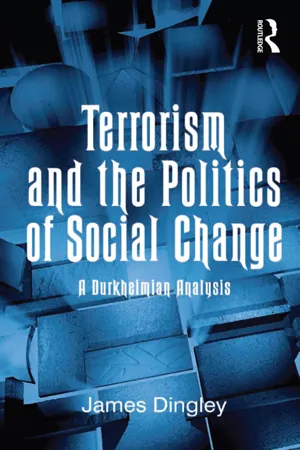
Terrorism and political violence have invariably accompanied the progressive modernization of states; a socio-cultural reaction to the problems of social change and development. To understand this phenomenon, it is necessary to consider the nature of traditional society and how it differs from modernity. Starting with a basic history of modern terrorism, James Dingley uses a Durkheimian sociological framework to dissect the role of social relations, culture and religion in impelling men and women to defend their socio-cultural context with violence against the challenge of external forces. Placing emphasis on a historical and social understanding of violence and key issues such as nationalism, religion, science, the Enlightenment and Romanticism for understanding terrorism in all its forms, this book allows for a more critical examination of terrorism as a response to changes in the organization and cultural goals in a society. It is a decisive contribution to our understanding of the political and social relevance of terrorism as we know and experience it today.
Information
Chapter 1
War and Violence: Understanding the Breeds
Nature and Nature’s laws lay hid in Night:
God said, Let Newton be! And all was Light.
God said, Let Newton be! And all was Light.
Alexander Pope
Newton and Pope may have more significance for the study of terrorism than is generally recognised since both were pillars of the Enlightenment, that crucible of the modern world. For one of the cornerstones of this analysis of terrorism is that it is fundamentally a reaction against the Enlightenment tradition, its values and precepts. This is even more pertinent for any social theory analysis that utilises Durkheim, since Durkheim, like Marx and Weber, was a great defender of the Enlightenment, who waged a constant struggle to provide a rational and scientific basis for society (alternatively ‘nation’ and religion, Dingley, 2008). Throughout I will argue that terrorism is fundamentally a reaction to the world as revealed and re-organised by science (as a culture, way of thinking and analysing both the natural and man-made world and not just something carried out by men in white coats in a laboratory) and science is the great hand-maiden of the Enlightenment.
Science is primarily method, a way of perceiving, interpreting and understanding the world based on reason and rationality, empirical evidence and testability; as such it eschewed traditional religio-magic interpretations of the world that emphasised mysticism, dependence on priestly castes and the submission to priests and swordsmen (Gellner, 1990). Consequently it decried mysticism and knowledge shrouded in superstition, folklore, arcane ritual and dependent on divine revelation and promoted clarity of thought through illuminating reason and evidence. The Enlightenment shifted knowledge to men as individuals, here on earth and it provided the means whereby men could know for themselves without priestly intermediaries, so ushering in ideas of individualism. It has reshaped the world, particularly the western one, man’s understanding of it, his place and being in it and has brought vast benefits in terms of improved health, welfare, standards and conditions of living and material comfort and affluence.
Science has greatly reduced death rates and infant mortality and has led to the progressive freeing of whole groups from women and slaves to working poor and minority ethno-religious groups from servitude in defined roles and places as well as poverty and ignorance. It has led to the ability to control and direct our own environment previously unknown, has led to massive increases in productive capacity and wealth and has freed men from a dependency on nature and natural orders to a world which men themselves create in pursuit of their own liberty.
But many find this disadvantageous. First the more we have the more we want and the more our sensitivities are developed the more sensitive we become, very often to the defects in and abuses of the Enlightened tradition that has provided us with the ability to critique the Enlightenment and its abuses. The great example here must be the Nazi’s for although their politics were the exact opposite of the Enlightenment they were happy to use the products of it, science, to pursue un-enlightened ends. Science is but a tool in the hands of men who are far from perfect or even enlightened, science merely provides us with the means, how we use it is another matter requiring enlightened attitudes, values and politics.
Nor has progress been a simple linear development, the early decades of industrialisation (‘the appliance of science’) in most societies were often ones of appalling slum living and deteriorating health and welfare in the new urban conurbations that accompanied industrialisation. Further, the new cities had usually sucked in their new inhabitants from small (socially and psychologically) cosy villages, with close knit social networks, defined being, place, role and status and a degree of local autonomy. This contrasted with the problems of mass alienation, anomie and socially fragmented living that confronted the new urban ‘huddled masses’. Such masses were often poverty stricken due to below subsistence level wages (Gregg, 1965, Cole and Postgate, 1961) and initially had no health, social security or welfare systems to assist in either daily life or the periods of mass unemployment that frequently confronted them. At least in their villages they had been part of a close community with a benign church and (more or less) occasionally paternalistic landlords as well as their own familial support networks.
Life in the new industrial cities was frequently grim, lonely, brutish and relieved only by its shortness and if this is no longer the case in the West it is, at least partly, because we have been able to export such problems out to the third world. And governing this was the new ‘dismal science’ of economics, of abstract laws that dictated ‘scientifically’ that things had to be, since that was what science had revealed as the true order of things – economic laws of the market. In addition, industry made many of the old trades redundant and craftsmen, previously of high status and relative affluence in their communities, could be made redundant over night and lose everything.
Meanwhile, the old elites equally found themselves losing out: if not necessarily reduced to poverty religion particularly suffered as science provided a whole new knowledge base that replaced it and the old nobility found their economic dominance, and hence social and political, challenged. Religion suffered badly as the churches ability to know, explain and interpret the world was replaced by science and priests and churches declined in importance in the affairs of men. Meanwhile, aristocrats and gentry might retain their lands and incomes but these failed to match up to the new wealth of industry which forced states to cede political power to them, or face the threat of revolution. And whilst land was relatively fixed in terms of productive power industry displayed a potential to grow beyond bounds far surpassing aristocratic resources.
In the early stages of industrialisation only a relatively small group appeared to prosper – the new middle classes, whose large fortunes, opulent and arriviste life styles often jarred heavily with the losses of the newly dispossessed. They also began to develop new cultural habits and tastes in politics and social organisation, such as democracy, individual values and liberal reforms and emphasised a society in which movement, geographic and socio-economic, were key factors, thus undermining old ideas of stability and order in relatively fixed and enclosed collectives for one of individual mobility and change, which reflected their new found aspirations.
Consequently, there was much to be resented and disliked about the Enlightenment in its own western cradle and nursery. Thus one should not be too surprised if the same thing applies when globalisation takes the process out to the rest of the world, which is very much the case. Whether one is looking at the modern sweatshops of Indonesia and India or the massive social dislocation in Algeria, caused by its rapid Soviet style industrialisation in the 1960s and 1970s, or the influx of ‘decadent’ westerners in to contemporary Islamic societies, one is seeing a repeat of European socio-economic history, with the added humiliation that the new is not even indigenous but a western import. Further, many of the beneficiaries are not even natives of a country as profits get repatriated abroad and perhaps only a few of the local elite, often perceived as corrupt, appear to gain any benefit.
This is not to say that the Enlightenment, which is what is implied by westernisation, could not be potentially useful and beneficial, as has been the case in western society, just that as things are currently arranged they are not. Indeed, western, enlightened, ideals and ideas seem not only harmful and loss inducing but even oppressive to many, since it is an alien culture and way of life imposed upon them by foreigners. And it is this, I will argue via Durkheim, which is the core of the terrorist imperative, of violent revolt and resistance against the (enlightened) new; a modernity that displaces and causes great social harm. Terrorism is thus, in the first instance a social problem arising from social and cultural change, impelled by economic, which has its expression in the political. As such this shifts the focus away from psychological and psychiatric efforts at explanations of terrorism, usually found wanting (Horgan, in Silke, 2003).
Indeed the idea of terrorists and terrorism as signs of the abnormal will be rather stood on its head, for the logic of resistance to social change is that normal men (it usually is) are resisting the abnormal. Normal here refers to men well adjusted both in themselves and to their usual social circumstances having to resist the encroachments of the new, or abnormal to them, circumstances disrupting their normal lives, society and culture; violently disrupting their collective being with alien ideas of individualism and rational-economic self-interest. In addition, in pre-modern society violence is much more part of the normal than it is in modern society. Historically speaking the modern western world is almost uniquely nonviolent. Thus the terrorist may well be far more normal, for their environment, than we might care to think. In addition, they may be more rational in their response to our encroachments than we care to believe, since for them to ward off change (modernisation) is to protect vital vested interests; to react violently is to repel that which does violence to the normal.
Too often terrorism is analysed and discussed solely from the perspective of the western victims of it or the groups against whom it is directed, invariably western or pro-western. This is not unreasonable since if ‘we’ are the likely victims we will want to know how to respond and protect ourselves as we go about our normal business (and I would also argue, along with Durkheim, that western scientific method enables us to achieve a better analysis of events than non-scientific explanations). However, we often fail to grasp the fact that terrorism is also in the mind of the terrorist and not just us, it is what they do and how and why they do it; their understanding of their acts are equally important for a proper understanding and adequate response. Simply seeing terrorism from ‘our’ perspective alone leads us down the road of building bigger and more costly Fortress America’s or Britain’s since we fail to see or understand the causes and so fail to prevent the acts and imperatives to them in the first instance.
Fortress America or Britain may seem like a good idea as long as we can stay within the fortress, yet we cannot. We have to import goods and materials from outside the fortress, we have to trade and exchange with the outside world, we have to go to their world and invite them back in to our world to do business, think only of our dependency on ‘their’ oil. Further, this constantly places us on the defensive and leaves the initiative to the terrorist, making us bigger and more vulnerable targets. Fort Sahara, in the middle of the dessert, crammed full of legionnaires and miles away from anywhere quickly became an easy target for Arab tribesmen to lay siege to and storm. This was one reason why Britain and France led the world in anthropology, as imperial powers they found it much more cost effective and beneficial to understand their ‘revolting’ tribes and subjects (Anderson, 1992, Gellner, 1981) than simply building forts that were constantly being cut off and overrun.
Plain tales from the Raj
The above points were graphically brought home to me by my own peregrinations around the outposts of Empire, including, but not implying anything, Northern Ireland, where I live and work. In a recent trip to a NATO conference on terrorism in Ankara I became engaged in several lengthy conversations with a large Pakistani delegation of senior police and military concerning operations up on their North West Frontier (the infamous Khyber Pass region that connects Pakistan with Afghanistan) which I had recently visited. The police were most forthcoming about their primary source of intelligence on local tribes, who were most likely to cause trouble and violence, why and how to respond to them. ‘Simple’, said one superintendent, ‘I go to the old ledgers the British kept on all the tribes, their customs and habits and start from there’. Another military officer was equally forthright about new recruits for the army; which tribes provide the right martial spirit and are not likely to slink off with their new found weapons.
Since virtually nothing had changed in the social and cultural nature of their tribal society since the British had left their records still made admirable reading since they were detailed, concise, accurate and usually beautifully written in neat copper plate in leather bound ledgers. In addition, the British were regarded as having kept as good a peace on the frontier and controlled the tribes as well as anyone and were well remembered as rather successful rulers (as long as they didn’t make the fateful error of invading Afghanistan). Hence, why re-invent the wheel?
The point is simple: British rule was successful because it knew, eventually, its limitations (including Afghanistan) and also because it made detailed anthropological type studies of the local tribes and forces of disorder and violence. The British made the effort to know and understand the people they were dealing with (the contemporary equivalent of the terrorist) and so knew how to make allowances, not to provoke, how to respond, who to respond to, what to respect and when to leave well alone, even to empathise with violent tribes so as not to induce incidents and start uprisings. This was done by having regular officers or commissioners stationed amongst the local population for many years at a time, who developed a detailed knowledge and by recruiting heavily amongst the local population and drawing on their expertise (Raj rule was mostly regarded as a joint effort rather than simply a British one). Many of the officers of Empire provided the basis for anthropology and even became anthropologists in their own right, and later became effective resistance leaders against the Japanese during the war (Bayly and Harper, 2005).
The above takes on even more significance when one recalls that Pakistan is now regarded as on the frontline of counter-terrorism, often involving the same tribes and people who confronted the Raj. Up on the Khyber Pass there is a Pakistan Army base where a plaque records all the invading armies that have come that way, beginning with Alexander the Great, and left that way! But the local population lives on as it has done for over 3,000 years, unchanged and untroubled by the ebb and flow of outside forces; life continues as it always has done and, no doubt, as Allah wills, will continue to do for many thousands of years yet. Why should they change? Why should they conform to new fangled western ideas of liberal democracy or market economics? They have lived without them since time immemorial and have seen off any number of new invaders and ideas, as cultures come and go. The British learnt to leave well enough alone and the Pakistani security forces seem to have maintained a winning formula with equal success, something which needs bearing in mind before western governments get too involved in the region or try to chivvy the Pakistani government into more energetic counter-terrorism in the region. ‘We’ are invading their territory, we are the abnormal wanting to change their normal, that suits them fine, and impose alien ways and ideas.
A similar point can also be made regarding Northern Ireland. In my own discussions with police, army and government in the Province there has been a constant referral to basic British, i.e. ‘mainland’ Great Britain, lack of knowledge about the Province and who and what they were dealing with. Thus, when direct Rule began in 1972 (Hennessey, 1997) none of the UK national parties even organised in the Province, which had its own devolved ‘home rule’ government. Thus mystery and ignorance reigned supreme amongst those trying to rule a divided society plunging into anarchy. And even in the 1990s the situation was not much changed: several members of the local intelligence services informed me in private interviews how Sinn Fein felt they could run rings around the government during the ‘peace process’ negotiations due to the government’s intense lack of knowledge and understanding of the Province (Dingley, 2000), which may help explain a lot of Unionist animosity to the Belfast Agreement (1998).
But to continue the travelogue: there was (it was blown up in 2009) a very good five star western hotel (Pearl-Continental) in Peshawar, the last big city before the Khyber Pass, and as one enters the lobby one is confronted with a large notice instructing guests that the ‘Carrying of Firearms in the Premises is Prohibited’. Not even in Belfast or Londonderry have I seen the equivalent. The point is, as a brief stroll around Peshawar and outlying districts will confirm, the carrying of firearms is quite normal for all men, indeed one is almost improperly dressed if one is not armed, it is the Pearl Continental which is abnormal, because it caters for westerners. This is a violent world both because of the nature of tribal feuds and personal honour and prestige matters in which violence is part of an individual males self-esteem and status and the conduct of individual and tribal disputes since time immemorial. It is also because men live very close to nature and live by hunting or killing their own domestic animals. Blood letting is normal and part of everyday life, indeed fresh poultry for ones dinner from the local open market are so fresh they come kicking, clucking and wings flapping (the purchaser is presumed to know how to do the necessary). Blood letting is normal and close to the surface of everyday life and this extends to humans as much as to animals, something that is also true of most rural societies.
Finally, as I left Peshawar to go up the Khyber Pass I passed a very large mud fort and glimpsed through an open gate the most opulent looking inner mansion which seemed to be made of white marble and had many new top of the range cars parked in its forecourt. This obviously belonged to a very rich and powerful local lord, for even in the west such opulence and wealth would have stood out. I enquired of my host, a most charming Cambridge educated academic, who could possibly own such a magnificent palace, ‘oh’, he said, ‘that belongs to the biggest heroin smuggler in the region’. How did he know, I enquired, rather naively. ‘Well’, he said ‘he is my cousin’. After which he informed me that he would be delighted to introduce me to his cousin and take me for tea with him the next time I was in Peshawar, but could not do it that day since he would have to make an appointment as his cousin was such a busy man, but he would definitely want to meet me.
What struck me most was the normality of the entire situation. It was normal for them, everything about it was normal. In the entire region the only alternative to scraping a living with a herd of goats was smuggling heroin, or smuggling anything for that matter. Heroin was a very lucrative trade, his cousin made a lot of money out of it and so helped support his extended family and community, he provided work, security and income for many more and helped to boost the local economy, so providing even more employment. His wealth and power also helped keep the local peace and supported charity works and he was highly respected by everyone in the region, where ‘scraping a living’ was more than just a folk saying given the barren landscape.
We, in the west, might recoil at the idea of drug barons and smuggling but they did not for very good local reasons. They are making a normal response to their normal conditions and taking advantage of whatever opportunities come along in their normal way. Western morals and values are irrelevant, even positively harmful to survive in their environment. They were not evil, deranged or morally bankrupt, in fact quite the opposite is the case, as anyone who has experienced their local hospitality and strong codes of honour, good manners and conduct will know. Nor am I saying that they are necessarily right or wrong, just that the normal for them is different and so they acquire different habits, values, cultures and understandings of the world attuned to survival in their environment. This environment is essentially pre-industrial and not enlightened, thus enlightened ideas and forms are not relevant to their survival, hence when such values and ideas, let alone social and political organisation begin to invade their world they become a threat, something to be violently resisted.
A similar attitude closer to home is reflected in Harnden’s (1999) reflections on a violent dispute between rival republican groups along Northern Ireland’s rural border with the Republic of Ireland where he witnessed a fracas between them in a car park (cross border smuggling is very lucrative for republican terrorist groups). Harnden wonders if the real problem is just that these are intensely localised, rural collectives who simply wish to get on with their normal ways, resolving disputes as they had done for centuries and equally objecting to any interference from London, Dublin or Belfast. In other words, these are simply men, like feuding Afghan tribes, who wish to be left out of the modern world and do their own thing, be it smuggling or resolving local land disputes via fisticuffs rather than crown courts or whatever.
This, I will argue, is the root of terrorism, whether in Ireland, the Basque Lands, Indonesia, Algeria, Russian Caucuses, Turkey or wherever. It is the violent response to violence being done to the local socio-economic system and culture, or as I shall later put it – the collective. Violence is met with violence because violence, in largely rural, ill-educated or illiterate societies, is often the only known method of response, it is culturally normal and able to have the kind of emotional impact to compensate for a lack of ability in the articulation of grievances, again normal in pre-modern society. Violence also has a kind of primordial recall and instinctive-ness to it that takes men back to un-thought out ways of naturalness, i.e. non-scientific. This is well illustrated in the hunt in traditional Basque socie...
Table of contents
- Cover Page
- Title Page
- Copyright Page
- Contents
- Foreword
- Introduction
- 1 War and Violence: Understanding the Breeds
- 2 Terrorism: Understanding the Heavens
- 3 The Heavens Described
- 4 Making the Man – Terrorism Charted and Defined
- 5 Terrorism in the Modern World
- 6 Durkheim, Sociology and Understanding Terrorism
- Conclusion
- Bibliography
- Index
Trusted by 375,005 students
Access to over 1.5 million titles for a fair monthly price.
Study more efficiently using our study tools.
Frequently asked questions
Yes, you can cancel anytime from the Subscription tab in your account settings on the Perlego website. Your subscription will stay active until the end of your current billing period. Learn how to cancel your subscription
No, books cannot be downloaded as external files, such as PDFs, for use outside of Perlego. However, you can download books within the Perlego app for offline reading on mobile or tablet. Learn how to download books offline
Perlego offers two plans: Essential and Complete
- Essential is ideal for learners and professionals who enjoy exploring a wide range of subjects. Access the Essential Library with 800,000+ trusted titles and best-sellers across business, personal growth, and the humanities. Includes unlimited reading time and Standard Read Aloud voice.
- Complete: Perfect for advanced learners and researchers needing full, unrestricted access. Unlock 1.5M+ books across hundreds of subjects, including academic and specialized titles. The Complete Plan also includes advanced features like Premium Read Aloud and Research Assistant.
We are an online textbook subscription service, where you can get access to an entire online library for less than the price of a single book per month. With over 1.5 million books across 990+ topics, we’ve got you covered! Learn about our mission
Look out for the read-aloud symbol on your next book to see if you can listen to it. The read-aloud tool reads text aloud for you, highlighting the text as it is being read. You can pause it, speed it up and slow it down. Learn more about Read Aloud
Yes! You can use the Perlego app on both iOS and Android devices to read anytime, anywhere — even offline. Perfect for commutes or when you’re on the go.
Please note we cannot support devices running on iOS 13 and Android 7 or earlier. Learn more about using the app
Please note we cannot support devices running on iOS 13 and Android 7 or earlier. Learn more about using the app
Yes, you can access Terrorism and the Politics of Social Change by James Dingley in PDF and/or ePUB format, as well as other popular books in Politics & International Relations & Politics. We have over 1.5 million books available in our catalogue for you to explore.