- 292 pages
- English
- ePUB (mobile friendly)
- Available on iOS & Android
eBook - ePub
About this book
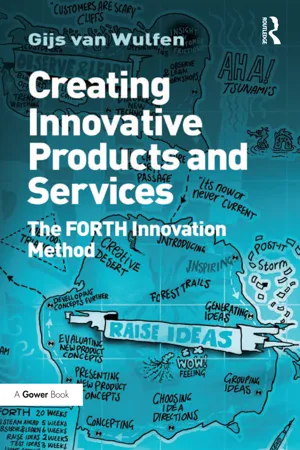
Really new products and services are scarce, yet the need for them is huge. That's why Innovation is an important managerial instrument - but many of us struggle with how to approach it. Gijs van Wulfen's Creating Innovative Products and Services is an essential read for anyone involved in new product or service design, brand development, new business development or organizational development because it 'unfuzzies' the front end of innovation with practical tools, effective checklists and an inspiring innovation route map. Gijs van Wulfen explains how to: ¢ Build a committed ideation team, compile a concrete innovation assignment and identify opportunities; ¢ Explore trends, technology and potential customers, then choose the most positive opportunities and customer insights to transfer to the next step - raise ideas; ¢ Develop twelve new promising innovative product or service concepts; ¢ Check the concepts in qualitative research among potential clients and improve them; ¢ Work the best into a tangible mini business case per product idea, and present them for decision making and adoption in the regular stage gate development process. The effective 5-step FORTH method presented in this book, will jump start your product and service innovations. The success of this practical approach is highlighted in a case study of one of the largest insurance companies in The Netherlands: Univé VGZ IZA Trias and is suitable for both business-to-consumer and business-to-business markets. Creating Innovative Products and Services has been written for directors, managers, advisors and innovation specialists in organisations who are responsible for, or involved in, product innovation. In it you will find practical guidance through every stage.
1 The Difficult Start of Innovation
Not because it is so difficult, don’t we dare, but because we don’t dare, it is so difficult.
(Seneca, Spanish-Roman philosopher)
If you always do what you always did, you will always get what you always got.
(A. Einstein, scientist and inventor)
Gradual growth is the worst enemy of innovation.
(N. Negroponte, Head MIT Media Lab)
1.1 INTRODUCTION
Innovation is not only advisable, it is essential. Organisations who want to grow have to adapt to the rapidly changing environment; to adjust their current products or services to the shifting needs of the customer; to develop a variety of products to reach out to new customer groups or distribution channels; and to invent new products and new business models to conquer new markets. Innovation is a popular theme amongst managers. According to the innovation monitor of the consultant agency The Bridge, ‘the increase in revenue through innovation has risen to the most important strategic priority, bypassing independent growth and growth through purchasing’.1
Even though innovation is the main topic of interest, managers are human and consequently not much is happening. The rose-tinted perspective portrayed by many is over-optimistic in the extreme and this in times when things are not going so well economically.
It seems as if we treat innovation the same way as we treat the environment: everyone is concerned about it but we only do something when it is really necessary. This applies to young as well as experienced managers. Innovation means taking risks, but many are inhibited by the world around them where they are discouraged from making (any) mistakes. In many organisations, innovation is postponed until they really cannot wait any longer. It is not unusual to hear, ‘we will have to innovate’ in the corridors of a company.
And once you start the innovation process there is no certainty that the result will bring about the long-awaited success. Research done in countries such as the United States of America, the United Kingdom and Australia shows that only 45 to 67 per cent of the products launched are successful (in other words performed in accordance with management expectations).2 And I have seen some much lower success rates quoted than this.
Organisations, whether a multi-national company such as Shell, or a large insurance company such as AIG, an enterprise involving public transport such as Deutsche Bahn or an association such as the Red Cross, are organised in order to control their current operational processes and to give account of the results produced by these processes. Should the size and complexity of the organisation increase, innovation becomes more difficult and less effective. The process of innovation seems counter cultural, particularly amongst larger organisations, although I have noticed this phenomenon with smaller organisations as well.
1.2 REALLY NEW SERVICES AND PRODUCTS ARE SCARCE
This book describes the creation process for new product ideas. It is all about the creation of new products or services. But what does that mean? The answer is as simple as the question: new products or services are products or services which did not exist before. A more complex definition is:
A new physical or virtual offer in a specific packaging with a specific brand name that is delivered to a specific group of customers with a certain business model through a specific distribution channel.
This definition has been chosen to include both physical products as well as services in the consumer and business-to-business markets. When relevant for the creation of new products, the method will be adapted to distinguish between both types.
A HUNDRED NEW PRODUCTS AND SERVICES – JUST LIKE THAT
A capsule camera for the inspection of the small intestine, Virgin Galactic space flights, bread which rises when cold, feeding bottle for adults, a sound box made of a carton, the iPad, apartments for pigs, the Fiat 500 Nuova, a Levi jacket with built-in electronics, Ramadan text messages, a T-shirt with protection against GSM rays, Linkedin, the Centre for Fathers, NutriDelight (Procter and Gamble’s enriched orange drinks for developing countries), long-lasting flowers, a burial codicil, Pepsi Raw (100 per cent natural), a smoke-free ashtray, Realitybid.com – an internet site for auctioning houses, push-up snack, the very cheap EasyCruise, an energetic mouse pad, an open fire without a chimney, a self-heating tin (Canned Heat), Siemens HomeDeliverybox, nPower Personal Energy Generator, an indestructible sandwich, Mars snack vendor for dogs, Bolletje rusks with grooves, a ladies’ urinal, Dyson’s washing machine, a whispering trailer, a hybrid bus, a disposable duster, a footrest for skates in the winter, Freeze ice cream, a delivery bicycle for postmen, road surfaces with silencers, The Door (a door without a handle), Bertolli-lunchroom, Smoke Shop 451F, Nintendo Wii Fit, Qool (a low-alcohol wine), TravelJohn (a disposable plastic bag), Philips Wake-up Light, ringing dustbins, Aldi-PC, a web supermarket, a patented reed for synthetic reed roofs, aeroplane pizza, braces which prevent snoring, a plasma scalpel, LG Steam dishwashers, Miss Molly cosmetics for children, salmon pâté for cats during menopause, Green Heinz Ketchup, an inflatable bath for the home, Tupperware shops, a sensor monitor for conscientious office workers, Benecol/Becel for reducing cholesterol, Yotel at Schiphol, Skype, Unsicht-Bar (for eating in the dark), Filter Pen (a straw which purifies polluted water), shoes which generate electricity for GSM and radio, Nikon Coolpix S1000PJ Camera, Perfect Bookmachine, Vitz Vitamin chewing gum, Carbona 2 in 1 Oven Rack and Grill Cleaner, tarmac which can be rolled up like a carpet, fresh orange juice with vodka, Alice internet, TravelChair (a folding chair when travelling), Supersmoker, Twitter, Meridian Sooloos Digital Media System, IKEA house, Procter and Gamble Swiffer Sweeper, Whale tail (propelling system simulating a whale tail), Duo white and brown bread for children, Czeers solar system speed boat, Fire Wire Flexible Grilling Skewer, Coca Cola Zero, Dolby Volume from Dolby, Ideal-payment online, Diesel Flagshipstore, Dove Pro-Age, MyKey by Ford, Pharox lamp, Brondell Perfect Flush for saving water in the toilet, Fishes (durable fish), Design your Heineken, HP Photosmart Premium with Touch smart Web All-in-One Printer, SAAB Biopower Eco clothing, Omo small and powerful washing powder, an automatic paintbrush (Paintpod), Google Android, Vega insurance policy, exotic apple Kanzi and Remington Frizz Therapy Straightening Iron.
The extent to which a product or service can be considered as new varies considerably and is often the topic of discussion. How new is new? This can be looked at from several perspectives but a much-used and significant classification of new products uses three categories:
1. New to the world, for example the first mobile conversation (the USA, July 1946).
2. New to the market, for example Vodafone live! The first UMTS service in the Netherlands (June 2004).3
3. New to the company, for example KPN mobile video telephoning with UMTS (May 2005).4
What is new for one is not necessarily new for the other. The introduction of a new game for Nintendo DS is not as innovative for either Nintendo or its customers when compared with the introduction of the worldwide, greatly distinguished and popular Wii. Studies have shown that the chance for success increases greatly if the new product or service has additional value for the customer and when it distinguishes itself from already existing competitive products. Many new products which are launched on the market are only ‘new to the company’ and usually a variation of, or a successor to, an existing product, or a direct copy of a product from the closest competitor. Research into the introduction of 24,000 new products onto the European market has confirmed this theory. Only 2.2 per cent of all the new products introduced deserve the distinction ‘really new’; the rest are ‘new’ products or, in the terms of the fast-moving consumer goods sector, are ‘line-extensions’, ‘me-too’ or temporary ‘in-out products’.5 The lack of real new products often causes many companies to make small modifications to existing products internally which makes it then ‘politically useful’ to consider them as ‘new products’. I am also guilty of this as I used to record each new article number in the ERP-system as an innovation when only the method of preparation or the packaging design had been changed. Well, if your end-of-year bonus is calculated by the number of new products which you have introduced, wouldn’t you do the same?
1.3 NEW PRODUCTS ARE ESSENTIAL
New products are essential for a company. Your organisation may well operate in mature markets or markets with slow volume growth and where the life cycle of existing products is becoming shorter. Many reasons have been given for this: the customer has changed, the competition has changed and the world has changed. However, if you don’t do anything, new and competitive products will catch up and overtake your products more quickly. A study done by the A.D. Little consultancy has shown that the life cycle of products has decreased by factor of 4.6 Fifty years ago the average life cycle varied between 12 years (cosmetics) and 24 years (medicine). However, currently it has decreased to two years and eight years, respectively. The change in the behaviour of consumers is also accelerating, as can be seen by the figures mentioned below. These figures illustrate how long it takes to penetrate a target group consisting of 50 million users:7
Radio | 38 years |
TV | 13 years |
Internet | 4 years |
iPod | 3 years |
Facebook | 2 years |
Nokia is a company which is keeping up well with a fast-changing world. Henry Tirri, Head of the Nokia Research Centre, describes how Nokia stimulates the innovation flow and embraces innovation.
INNOVATION FLOW
Innovation cycles are accelerating dramatically. The speed at which new solutions reach the market can be a matter of months, if not weeks, and this timeframe is continually shrinking as online service organisations embrace a ‘beta’ culture. The Internet has enabled innovators to share results and garner feedback faster. Feedback from peers, public betas and pilot studies is essential to fuel the accelerated innovation cycle.
Future innovation must also support scale; companies that can scale innovations quickly will succeed by gaining mass-market acceptance almost instantaneously. A willingness to take risks and test ideas fast is vital; we call it the ‘fail fast; scale fast’ mentality, rooted in a culture of conducting pilots and trials. Often it isn’t until you test a product or service that you really understand how customers respond. It is not unusual to see customers using products in unforeseen ways; embracing this can lead to runaway successes.
Nokia Sports Tracker, http://sportstracker.nokia.com/, is one example. Initially designed for runners and walkers, it has been used by everyone from kayakers to motorcyclists. Such unexpected adaptations have prompted Nokia to expand the mandate and functionality of Sports Tracker, conforming to the customers’ needs rather than our preconception of what the service should be.
Collaboration also drives innovation forward at a pace that monetary investment alone can never match. Collaborating with leading research organisations globally, Nokia is building an Open Innovation Network to co-create intellectual property and leverage each organisation’s insight, expertise and resources. Through research partnerships we maintain a continual inflow of fresh thinking, which ensures we are always chal...
Table of contents
- Cover Page
- Title Page
- Copyright Page
- Contents
- List of Figures
- List of Tables
- Foreword
- Preface
- Introduction
- 1 The Difficult Start of Innovation
- 2 Success Factors for the Ideation Phase
- 3 The FORTH Innovation Method
- 4 Full Steam Ahead
- 5 Observe and Learn
- 6 Raise Ideas
- 7 Test Ideas
- 8 Homecoming
- Conclusion
- Appendix I
- Appendix II
- Bibliography
- Glossary
- Index
Trusted by 375,005 students
Access to over 1.5 million titles for a fair monthly price.
Study more efficiently using our study tools.
Frequently asked questions
Yes, you can cancel anytime from the Subscription tab in your account settings on the Perlego website. Your subscription will stay active until the end of your current billing period. Learn how to cancel your subscription
No, books cannot be downloaded as external files, such as PDFs, for use outside of Perlego. However, you can download books within the Perlego app for offline reading on mobile or tablet. Learn how to download books offline
Perlego offers two plans: Essential and Complete
- Essential is ideal for learners and professionals who enjoy exploring a wide range of subjects. Access the Essential Library with 800,000+ trusted titles and best-sellers across business, personal growth, and the humanities. Includes unlimited reading time and Standard Read Aloud voice.
- Complete: Perfect for advanced learners and researchers needing full, unrestricted access. Unlock 1.5M+ books across hundreds of subjects, including academic and specialized titles. The Complete Plan also includes advanced features like Premium Read Aloud and Research Assistant.
We are an online textbook subscription service, where you can get access to an entire online library for less than the price of a single book per month. With over 1.5 million books across 990+ topics, we’ve got you covered! Learn about our mission
Look out for the read-aloud symbol on your next book to see if you can listen to it. The read-aloud tool reads text aloud for you, highlighting the text as it is being read. You can pause it, speed it up and slow it down. Learn more about Read Aloud
Yes! You can use the Perlego app on both iOS and Android devices to read anytime, anywhere — even offline. Perfect for commutes or when you’re on the go.
Please note we cannot support devices running on iOS 13 and Android 7 or earlier. Learn more about using the app
Please note we cannot support devices running on iOS 13 and Android 7 or earlier. Learn more about using the app
Yes, you can access Creating Innovative Products and Services by Gijs van Wulfen in PDF and/or ePUB format, as well as other popular books in Business & Business General. We have over 1.5 million books available in our catalogue for you to explore.