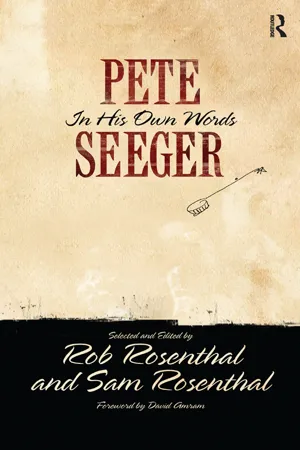
Long an icon of American musical and political life, Pete Seeger has written eloquently in a diverse array of publications but nowhere is his life story more personally chronicled than in these, his private writings, documents and letters stored for decades in his family barn. Pete Seeger: His Life in His Own Words, collects Seeger's letters, notes, published articles, rough drafts, stories and poetry - creating the most intimate picture yet available of Seeger as a musician, an activist and a family man. The book covers the passions, personalities and experiences of a lifetime of struggle - from the pre-WWII labour movement and the Communist Party, to Woody Guthrie, the Civil Rights movement and the struggle against the war in Vietnam. The portrait that emerges is not of a saint, but a flesh-and-blood man, struggling to understand his time and his place.
- 300 pages
- English
- ePUB (mobile friendly)
- Available on iOS & Android
eBook - ePub
Pete Seeger in His Own Words
About this book
Information

Part 1
The Early Years: 1919–1947
1
Growing Up (1919–1934)
“My Family Background,” 1957
Draft of letter to Paul Ross,1 dated
May 10, 1957; found in Seeger files
May 10, 1957; found in Seeger files
Dear Paul,
You wanted some résumé of my family background and life, so I sit me down and try to organize a teeming memory.
First of all, like many people, I have spent much of my youth trying to forget my antecedents. I confess it. I tried to ignore them, to disparage them. I felt they were all upper-class, and I was trying to identify myself with the working people. Now, at the sage and sober age of 38 I have finally come around to assess them more objectively, to be grateful for their strength and character, for their making it possible for me to be alive on this world today, and to realize that a good honest streak of independency has run through them for as much of the last three hundred years as I know about.
Most of them seemed to be teachers, doctors, teachers, preachers, businessmen, teachers, artists, writers, or teachers. The generations seem shot through with pedagogues. In this century, both parents, several brothers, aunts, and uncles have all been teachers. Going back a few generations, we find several doctors, and more teachers. Back further, even a few soldiers, perhaps a lawyer, a hymn writer, and more teachers. Even old Elder Brewster on the Mayflower was as much a scholar as anything else. So: my hat off to them all, and the pursuit of knowledge. “Where men gather to seek truth, that spot is holy ground.” Probably the most financially successful was old great grandpa Charlier, whose select Institute was one of New York’s most elegant a century ago. But then he was the only one also ever brought before a congressional committee and asked how come some rich men’s sons were arranging bribes to congressmen for West Point applications. So maybe it’s just as well most of them weren’t too successful.
As for radicals, Lordy, the family seems shot through with them, too. In earlier centuries, this took the form of religious protest: Pilgrims, puritans—and I’m proud to see a lot of Quakers around, on both sides of the family (and now I find, in Toshi’s family, too). Even great grandpa Charlier was the son of a French Huguenot preacher.
Later, the radicalism took a more political turn. Great-great grandpa Seeger got disgusted with Prussian tyranny, came to America and was an ardent Jeffersonian. Refused to teach any of his sons the German language even. Went around New England orating for the new Republican-Democratic party (in between making his living as a doctor). Another branch of the family were all fervent abolitionists about one generation later. Even the businessman I knew best, my grandfather, had the in-dependence to quit his job in the local bank (Springfield, Mass.) and seek his fortune in Mexico. Made it, or at least got it. Lost a good deal of it, I’m told, when a partner defaulted and a firm went bankrupt. My grandfather spent many years of his life conscientiously paying off every single debt, although he was not legally required to do so.
The main radicals in the 20th Century seem to have been of an aesthetic bent. I won’t mention the respectable relative who took me (at age 14) walking in the New York May Day parade. In those days, as the New Yorker magazine recently remarked, everyone was a social reformer. Sitting around the house without a job, it was the natural thing to do. I will mention my uncle Alan, whom I never knew. He was killed in 1914. He was a Shelley2 type poet. I only found this out recently. As a kid, I was unable to make out his poetry. But now, upon reading it, I find lots of it very good. He was in the famous Harvard class of 1910, along with Lippman,3 Broun,4 and his friend John Reed.5 My grandparents thought him a ne’er-do-well, because he then wouldn’t settle down to the life of a respectable businessman. Instead he went to France, fell in love with the country and the people, and when the First World War broke out, enlisted in the Foreign Legion, and was the second American to be killed. He left behind a slim volume of verse, and some miscellaneous writings, to tell what a wonderful contribution he could have made, had he lived. As I say, I only recently appreciated this. When I (at age 6) was forced to read before the 2nd grade class (mispronouncing almost every word): “I have a rennn—dezzz—voozz with death …” Poor Uncle Alan!
Oh, and in this century, miscellaneous other relatives experimented with Christian Science, yogism, nudism, advocated woman’s suffrage, pacifism, vegetarianism, organic gardening, and one was part of the NY Daily Worker.6 This might all add up to sound like a family full of crackpots, but believe me, they have all have all been well-thought-of members of their communities. It does all point up to a remarkable streak of independence and I, at age 38, take my hat off to it.
Me? I was born in 1919. Never had to go hungry, but witnessed a good deal of family penny pinching. Been at boarding school almost all my life, first starting at aged five. Went for five years to a small private progressive school in Connecticut, where I became a fervent disciple of Ernest Thompson Seton, the Canadian naturalist, whose descriptions of the primitive communist lives of the American Indian communities seemed ideal to me. Loved the woods and hills above all, till I was sixteen. Once argued that I wanted to be a hermit, live by myself on a mountainside, and let the sinful world go its way. (Cracks Toshi now: Yeah, but why ask your wife to do it too?)
“All Mixed Up,” 2009
From Where Have All the Flowers Gone, Revised
Edition, W. W. Norton & Company, 2009
Edition, W. W. Norton & Company, 2009
My mother was a good violinist.7 My father was head of the music department at the University of California, Berkeley. But, he got radicalized by some fellow professors. In 1918 he was making speeches against imperialist war and got fired. Back east he got the great idea to take the music of Bach and Beethoven out to the countryside. He built one of America’s first automobile trailers in his parents’ barn in upstate New York. It looked more like a covered wagon, with a canvas top and [big wheels with] four solid rubber tires, pulled by a Model T Ford. It was to be kind of a one-family Chautauqua8 tour.
But, roads in 1921 were mostly unpaved. The Tin Lizzie [slang for a Model T] pulled the trailer at an average speed of 20 to 25 miles an hour. My mother had to wash my diapers in an iron pot over an open fire. She finally said, “Charlie, this is not going to work.” They returned to New York and got jobs teaching at the Institute of Musical Art (now Juilliard). It was a world of high ideals, long training, great discipline. But, early in life I learned that rules were made to be broken. Henry Cowell,9 the modern composer, was a family friend. When I was six, I remember him playing the piano with his fists.
My mother had hoped that one of her children would play the violin. She bought miniature fiddles for my two older brothers. They rebelled. When I came along my father said, “Oh, let Peter enjoy himself.” But she left musical instruments all around the house. I remember having fun at age four or five making a racket on Autoharp, pennywhistle, marimba, a pull-push accordion, a piano, a pump organ. All by ear.
At age eight I was given a ukulele. Started picking out chords, learning their names. At boarding school I learned popular tunes of the day. Silly words but clever rhymes. Plunk, plunk. My father was researching some of the few collections of folk music available in those days. I learned from him that there were often different versions of the same song. People changed words, melody, made up new verses. This was an important lesson: you can choose the version of the song you want to sing.
“A Laissez-faire Upbringing,” 1972
From The Incompleat Folksinger, Simon and Schuster, 1972
I said I had a laissez-faire upbringing. I’m forever grateful for it. From age eight I was away at boarding school. It was the decade when the term “progressive education” first flowered. Our class would take up a “project” (ancient Egypt, the Middle Ages, etc.). We’d write a play about some event in those times, stage it and act in it. Shop class, English class, even math would be drawn into it. The main thing we all got from it: learning, real learning, is fun.
And summers at home we were forever building things. One summer it was model boats, another summer model airplanes. Music? We made music for the fun of it. My parents, bless them, decided to let me find out for myself what kind of music I liked.
I did get one strict lesson at school, which I’ll not forget. At age fourteen I started a school newspaper, just for the hell of it.10 It was in competition with the official school paper, which was dull, respectable, and always late. Mine was pure Free Enterprise, a mimeographed weekly; I gathered the news, typed it up, sold it for a nickel, and kept the money.
But after a few months I’d had my kicks and decided to quit it. The headmaster called me in. “Peter, I think you ought to continue the paper.” He explained that the wealthy old woman who paid the school’s deficit liked reading it; its informal tone made her feel closer to the school. Her journalist friends, the young Alsop brothers,11 had complimented her on it.
I demurred. It’s a lot of work, says I, and doesn’t leave me as much free time as I’d like. But the headmaster was firm. “Better get your copy for next week’s issue.”
My favorite teacher sided with the headmaster. “You can’t be a butterfly all your life, Peter.” So for two more years I brought it out on schedule. Years later I discovered that this was why I got a complete scholarship to an otherwise rather expensive school. But just as valuable was what I learned in running the Avon Weekly Newsletter: typing, writing, editing, cartooning, and learning how to walk up to a stranger and try to ask the right questions. The goofs I made! Edna St. Vincent Millay12 visited the school when we put on her play Aria Da Capo, an antiwar allegory. (With my hair in curls, I’d played the female lead—Avon was not co-ed).
The English teacher said I should take the opportunity to get an interview with her. “She’s an important modern poet.”
“What the heck will I ask her?”
“Don’t be silly.”
So I found myself seated awkwardly before this demure and beautiful woman, blurting out, “What do you think of Shakespeare?”
“I Would Like to Buy a Big Banjo,” 1932
Letter to Constance de Clyver Edson Seeger from Avon Old Farms boarding school, Fall 1932; found in Seeger files
Dearest Mama,
I’m really awful mad at myself for not writing sooner, I’d put it off and put it off and put it off until I just had to.
I’m getting along pretty well and am fitting in very well with every-thing. Did you get the card of my monthly marks? I got an “A”, a “D”, a few “Cs”, and a “B”. I’ll try to pull ’em up because I know that they aren’t very good.
I’m going to try and write one letter every day to somebody or other at least. Some time along now, pretty soon, there will be what is called a “long weekend” and if one wants to, one may come home for it. May I? I’ll write as soon as I find out when it is.
If one gets on the Dean’s list one may get an extra weekend home and so I’m going to try and get on it.
I think I’ll start a diary. It would be terribly useful only I wouldn’t know what to put in it. And then I’d put off writing something down that night and put it off till evening, the next morning, and so on.
I would like to buy a big banjo and play in the very little jazz band up here that has just been started. I have been practicing on one of the masters’ banjos but it’s awful awkward to keep borrowing it. It’s not half so hard to play one as I thought and I’ve already learned about ten chords the last week and can read “B# dim.” and play something that sounds okay and is technically correct. I’m having lots of fun. The music teacher said that he would go into Hartford with me and help me choose one from a pawn shop and I could use my allowance money to get it if it wasn’t over nine dollars or so. Will you let me get one? Please.
Your loving son,
Peter
Peter
“I’d Like to Buy a Good Banjo,” 1933
Letter to Constance De Clyver ...
Table of contents
- Cover
- Half Title
- Title Page
- Copyright Page
- Table of Contents
- Foreword
- Preface
- Introduction: Pete Seeger, an Appreciation, by Rob Rosenthal and Sam Rosenthal
- Part 1: The Early Years: 1919–1947
- Part 2: Life as a “Folk Singer”
- Part 3: Other Dimensions
- Part 4: Looking Back and Looking Forward
- Index
Trusted by 375,005 students
Access to over 1.5 million titles for a fair monthly price.
Study more efficiently using our study tools.
Frequently asked questions
Yes, you can cancel anytime from the Subscription tab in your account settings on the Perlego website. Your subscription will stay active until the end of your current billing period. Learn how to cancel your subscription
No, books cannot be downloaded as external files, such as PDFs, for use outside of Perlego. However, you can download books within the Perlego app for offline reading on mobile or tablet. Learn how to download books offline
Perlego offers two plans: Essential and Complete
- Essential is ideal for learners and professionals who enjoy exploring a wide range of subjects. Access the Essential Library with 800,000+ trusted titles and best-sellers across business, personal growth, and the humanities. Includes unlimited reading time and Standard Read Aloud voice.
- Complete: Perfect for advanced learners and researchers needing full, unrestricted access. Unlock 1.5M+ books across hundreds of subjects, including academic and specialized titles. The Complete Plan also includes advanced features like Premium Read Aloud and Research Assistant.
We are an online textbook subscription service, where you can get access to an entire online library for less than the price of a single book per month. With over 1.5 million books across 990+ topics, we’ve got you covered! Learn about our mission
Look out for the read-aloud symbol on your next book to see if you can listen to it. The read-aloud tool reads text aloud for you, highlighting the text as it is being read. You can pause it, speed it up and slow it down. Learn more about Read Aloud
Yes! You can use the Perlego app on both iOS and Android devices to read anytime, anywhere — even offline. Perfect for commutes or when you’re on the go.
Please note we cannot support devices running on iOS 13 and Android 7 or earlier. Learn more about using the app
Please note we cannot support devices running on iOS 13 and Android 7 or earlier. Learn more about using the app
Yes, you can access Pete Seeger in His Own Words by Pete Seeger,Rob Rosenthal,Sam Rosenthal in PDF and/or ePUB format, as well as other popular books in Media & Performing Arts & Music Biographies. We have over 1.5 million books available in our catalogue for you to explore.