Strong, effective, and innovative leadership is critical for institutions of higher education, especially for Minority-Serving Institutions (MSIs). Indeed, research and examples have shown leadership instability among some types of MSIs, while discussions and research on effective leadership for other MSIs is noticeably absent from the extant literature. In this volume, noted experts, researchers, and leaders discuss opportunities and challenges for leadership across the full range of MSIs, while creating a dialogue on leadership models and best practices. Chapters explore issues at Historically Black Colleges and Universities (HBCUs), Hispanic Serving Institutions(HSIs), Tribal Colleges and Universities (TCUs), and Asian American and Native American Pacific Islander Serving Institutions (AANAPISIs). This book helps higher education and student affairs scholars and administrators unpack contemporary leadership issues and strategies, and synthesizes best practices to help MSI leaders increase the effectiveness and sustainability of their institutions.
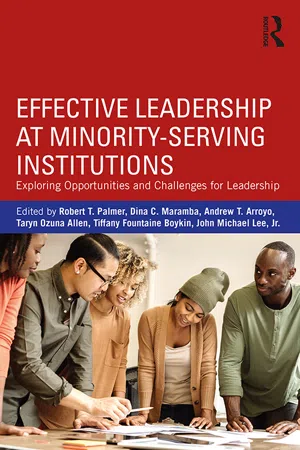
eBook - ePub
Effective Leadership at Minority-Serving Institutions
Exploring Opportunities and Challenges for Leadership
- 232 pages
- English
- ePUB (mobile friendly)
- Available on iOS & Android
eBook - ePub
Effective Leadership at Minority-Serving Institutions
Exploring Opportunities and Challenges for Leadership
About this book
Information
1
Exploring the Need for Leadership at Minority-Serving Institutions
Robert T. Palmer, Andrew T. Arroyo, Dina C. Maramba, Taryn Ozuna Allen and Tiffany Fountaine Boykin
Although Minority-Serving Institutions (MSIs) are comprised of diverse institutional types, which have distinctive histories, missions, and characteristics (Conrad & Gasman, 2015; Cunningham, Park, & Engle, 2014; Gasman, Nguyen, & Conrad, 2015), they share common threads (Conrad & Gasman, 2015; Gasman et al., 2015). For example, MSIs, which consist of Historically Black Colleges and Universities (HBCUs), Hispanic-Serving Institutions (HSIs), Tribal Colleges and Universities (TCUs), Predominantly Black Institutions (PBIs), and Asian American and Native American Pacific Islander Serving Institutions (AANAPISIs), serve high populations of students who are first-generation college students, come from low socio-economic backgrounds, and who are dependent upon financial aid to access and persist through higher education (Flores & Park, 2013). There are currently 650 MSIs and they enroll 3.6 million students at the undergraduate level, which is 20% of all undergraduate students (Conrad & Gasman, 2015; Gasman et al., 2015).
On average, MSIs are more affordable than many Predominantly White Institutions (PWIs), but they are also underresourced despite serving students who arguably need more financial and academic support to help attain their baccalaureate degrees (Cunningham et al., 2014; Gasman et al., 2007). MSIs are noted for doing more with less (Conrad & Gasman, 2015). For example, despite lacking funding parity (Palmer & Griffin, 2009), 2011–12 data revealed MSIs awarded more than 540,000 undergraduate degrees and certificates, which comprised almost 16% of all degrees and 32% of all credentials awarded to minority students at the undergraduate level (Cunningham et al., 2014). MSIs disproportionately graduate the nation’s teachers, doctors, dentists, and judges of color (Gasman, 2008). They have been particularly lauded for their success in graduating minority students with degrees in science, technology, engineering, and mathematics (STEM). Given that many MSIs provide cultural nourishment, facilitate a sense of role modeling, and provide an environment inside and outside the classroom that helps to cultivate students’ self-efficacy, particularly in areas related to success in STEM, Palmer, Maramba, and Gasman (2012) argued MSIs should be viewed as exemplars for helping to increase the achievement of minority students in this discipline.
Another commonality that MSIs share is a lack of research on a multitude of issues pertaining to students, faculty, and staff. This is true when it comes to leadership1 in general and the presidency specifically. While this list is nowhere near exhaustive, there has been a paucity of research around HBCU leadership. For example, HBCU researchers have explored the preparation process for HBCU presidents (Freeman & Gasman, 2014), characteristics of effective leadership for HBCU presidents (Freeman, Commodore, Gasman, & Carter, 2016), and the challenges that impinge upon the success of HBCU presidents (Freeman & Gasman, 2014; Ricard & Brown, 2008; Stewart, 2014; Watson, 2013). Despite this research, scholarship on HBCU leadership in general, and the presidency specifically, is sparse (Freeman & Gasman, 2014; Freeman et al., 2016).
Moreover, research on leadership at other MSIs has received even less focus. Knowing that leadership serves as the linchpin to the success and sustainability of organizations generally, and colleges and universities specifically (Hurtado, Milem, Clayton-Pedersen, & Allen, 1999), discussing leadership at MSIs is critical given the important role they play in educating the future of our nation – historically marginalized students (Transforming Leadership at MSIs, 2015). According to a report on transforming leadership at MSIs, “MSIs need high performing leaders to assist them in overcoming historic barriers, supporting new populations, confronting complex financial constraints, and forging new visions of their evolving roles” (Transforming Leadership at MSIs, 2015, p. 15). This statement is consistent with our rationale for conceptualizing this book.
With this in mind, this book serves several purposes. First, it provides insight into some of the challenges MSI presidents may face. Second, it creates dialogue on leadership models and best practices for MSIs. Third, it synthesizes best practices for MSI leaders to help MSI leaders increase the effectiveness of their institutions. Having established the relevancy of this book, the subsequent sections of this chapter will better contextualize the need for this volume by providing an overview of the aforementioned MSIs and reviewing the literature on leadership in MSIs. This chapter will first focus on HBCUs, followed by HSIs, TCUs, PBIs, and AANAPISIs.
Historically Black Colleges and Universities
Historically Black Colleges and Universities (HBCUs) are classified as educational institutions founded prior to 1964 to provide access to education for Blacks (Gasman, 2008). These institutions were founded with the assistance of White philanthropists, the American Missionary Association, the Freedmen’s Bureau, and Black churches (Nichols, 2004). Cheyney University and Lincoln University, both located in Pennsylvania, were some of the first HBCUs to be established before the Civil War. The Morrill Act of 1890, which required states to establish separate land grant colleges for Blacks if they were precluded from attending existing land grant schools, played a vital role in the development of HBCUs. Specifically, this legislation resulted in the creation of 19 HBCUs in the Southern states (Brown, 2002). Today, there are 105 HBCUs and they enroll approximately 11% of Black students (Gasman, 2013). These institutions are comprised of a rich tapestry of colleges and universities, including public, private, two-year, four-year, selective, and open (Gasman, 2013).
Research has shown that HBCUs have made and continue to make significant contributions to society and to advancement for Blacks specifically (Nichols, 2004; Palmer & Wood, 2012). For example, not only have they provided a gateway to help Blacks advance into the middle class, but they have also produced important leaders, such as Dr. Martin Luther King, Thurgood Marshall, Diane Nash, and Stokely Carmichael, all of whom had a profound impact on the Civil Rights Movement (Nichols, 2004; Palmer & Gasman, 2008). HBCUs are credited for disproportionately graduating Black students who earn bachelor degrees and matriculate into graduate or professional schools (Palmer, Hilton, & Fountaine, 2012). In fact, in 2012, HBCUs awarded nearly 19% of baccalaureate degrees to Black students (Lomax, 2014). Though some may question the relevancy of these illustrious institutions (e.g., Riley, 2010) HBCUs have proven their importance not only by their outcomes, but also by their impact on Black students during their enrollment. Indeed, HBCUs facilitate and engender Black students’ self-efficacy, cultural connectiveness, psychological wellness, and racial uplift (Palmer, 2008; Palmer & Gasman, 2008; Nichols, 2004).
While HBCUs are labeled as historically Black institutions, they have always welcomed students, faculty, and staff from diverse racial and ethnic backgrounds (Arroyo, Palmer, Maramba, & Louis, 2016; Gasman & Nguyen, 2015). In fact, some of the first students to attend Howard University were the daughters of the founder, Olive O. Howard, a White man (Gasman & Nguyen, 2015). Nevertheless, upon their founding until the 1950s, the population of HBCUs was nearly 100% Black. Over the years, however, particularly beginning in the 1980s, the racial and ethnic diversity of HBCUs has increased (Nichols, 2004). According to the Center for Minority-Serving Institutions (CMSIs) as well as data from the National Center for Educational Statistics (2013), Black students currently make up about 76% of the student population at HBCUs while Native Hawaiians, Native Americans, Asian Americans, Latino/as, and Whites comprise, respectively, 0.08%, 0.3%, 1.5%, 3.7%, and 11% of the students enrolled in HBCUs (Palmer, Arroyo, & Maramba, 2016).
Without a doubt, HBCUs are vital institutions. Despite their relevancy, the instability in presidential leadership is one aspect that threatens their survival (Gasman, 2012; Stewart, 2014; Watson, 2013). In 2012, at least 20 “HBCU presidencies were either vacant or recently filled” (Stewart, 2014, para. 1). Moreover, Freeman and Gasman (2014) explained 42% of presidents at HBCUs hold their positions for four years or less. The rapid turnover in HBCU leadership has played out recently. For example, the president of Jackson State University ( JSU), Carolyn Meyers, who was appointed in 2011, was asked to resign by the governing board because of concerns of how she spent JSU’s cash reserve (Diverse Staff, 2016). Moreover, the president of Florida A&M University, Elmira Mangum was voted out by the Board of Trustees in 2016. Mangum had faced constant criticism from the Board since she was hired, and some surmised that her gender was one of the reasons for this (Commodore, 2016; Gasman, 2016; Stewart, 2014).
Furthermore, Willie Larkin, who was appointed the ninth president of Grambling State University in 2015, resigned a year later – in 2016 – amid reports that the University of Louisiana System Board of Supervisors was going to fire him. It is important to point out that Larkin was the third president that Grambling had lost in less than two years (Stuart, 2016). In addition, Gwendolyn Boyd, president of Alabama State University (ASU), was removed by the governing board (Davis, 2016). Similar to her counterpart, Elmira Mangum, some believe that Boyd’s gender played a role in the challenges she experienced with the governing board at ASU (Gasman, 2016). In fact, when she assumed the role of presidency in 2014, there was a clause in Boyd’s contract that prohibited her from having a potential lover spend the night (Rivard, 2014). This clause was unprecedented and there is tremendous doubt that such a stipulation would have been included in her contract if she were a man.
Scholars have characterized the frequent turnover in HBCU leadership as problematic and deeply troubling (Esters et al., 2016; Freeman & Gasman, 2014; Freeman et al., 2016; Gasman, 2012; Watson, 2013). Some scholars have cited factors such as the recycling of ineffective presidents, being micromanaged by the governing boards, lacking fundraising experience, having a dearth of experience running large, complex organizations, alleged fiscal mismanagement, and poor retention rates as problems that contribute to the instability of HBCU presidents (Freeman & Gasman, 2014; Freeman et al., 2016; Gasman, 2012; Schexnider, 2013; Watson, 2013). To help mitigate some of these factors, there have been articles, reports, studies, and organizations formed to help increase the leadership efficacy of those at the helm of HBCUs. For example, CMSIs published a report in 2016, which detailed critical skills that HBCU presidents should possess in order to be effective leaders in the twenty-first century (Esters et al., 2016). Some of the skills mentioned in this report included the importance of HBCU presidents’ understanding of local, state, and federal policy, particularly around areas of funding, using data in their decision making processes, and being familiar with the accreditation process and promoting student engagement. The report also underscored other important skills, such as the willingness of HBCU presidents to develop collaborative partnerships with other MSIs and PWIs, as well as having an expertise in fundraising and institutional finance. Another critical quality that HBCU presidents should possess, the report suggested, is the ability to maintain communication with a variety of stakeholders, such as business, community, and governmental officials, as well as developing a positive relationship with the Board of Trustees.
Freeman et al. (2016) added to the discourse on effective leadership for HBCU presidents. Specifically, through an analysis and qualitative responses from current HBCU presidents, trustees, and presidential consultant firms, they developed a list of essential skills for HBCU presidents to attain in order to be successful in their positions. Interestingly, but not surprisingly, many of the skills listed in their study echo those that Esters et al. (2016) discussed. For example, similar to Esters and colleagues, Freeman et al. discussed the importance of HBCU presidents being skilled at fundraising, communicating with policymakers, having a sense of the political landscape, developing positive relationships with the governing board, and demonstrating a willingness to collaborate. Moreover, Freeman et al. emphasized the critical nature of HBCU presidents making data driven decisions and understanding the accreditation process as well as valuing student engagement. One skill that Freeman and colleagues mentioned that was not articulated in Esters et al.’s report was the significance of HBCUs using social media. They noted that although many HBCU presidents used social media less than presidents at PWIs, many of the HBCU presidents they interviewed saw the value of using this type of media.
In sum, leadership instability is a significant problem at HBCUs, which threatens the future of these venerable institutions. Women presidents at HBCUs, in particular, seem to encounter a lot of challenges and resistance from governing boards (Gasman, 2016), which is one factor that exacerbates the instability among HBCU presidents. While there is some research on HBCU leadership and some organizations may provide workshops on leadership development (e.g. United Negro College Fund, Thurgood Marshall College Fund, and Hampton’s Executive Leadership Summit), much of the extant literature on HBCU leadership has discussed the problems that hinder the success of HBCU presidents rather than characteristics that facilitate their successful outcomes. Chapters in this volume on MSI leadership seek to provide HBCU leaders, particularly those at the presidency, with models, examples, and best practices that have yielded success for college leaders at HBCUs. Specifically, four chapters in this volume are focused on the HBCU context and they explore a range of topics, such as the impact of servant leadership at Paul Quinn College to providing best practices to help HBCU presidents propel their institutions forward.
Hispanic-Serving Institutions
Unlike HBCUs that were established to provide educational opportunities to Blacks due to the blatant racist conditions of the United States, the majority of Hispanic-Serving Institutions2 (HSIs) on the US mainland emerged out of changing demographic trends, and they became federally recognized in 1992 (Gasman & Conrad, 2013). HSIs are colleges and universities (i.e., two-year, four-year, and nonprofit institutions) that have an enrollment of 25% or more of Hispanic students enrolled at the undergraduate level, on a full-time basis (Nellum & Valle, 2015; Núñez, Crisp, & Elizondo, 2016; Núñez, Hoover, Pickett, Stuart-Carruthers, & Vázquez, 2013). There are 409 HSIs in the United States and Puerto Rico (Núñez et al., 2016) and 296 emerging HSIs, (Núñez et al., 2016), which are defined as “institutions that are approaching HSI statuses, with between 15% and 25% Hispanic enrollment” (Núñez et al., 2013, p. 81). Given the continuously changing demographics of the United States, which are primarily driven by the growth in the Latino population, more institutions are certain to be classified as HSIs or emerging HSIs (Núñez et al., 2014). HSIs play a critical role in facilitating access to higher education for Latinos and providing a pathway to degree attainment (Gasman & Conrad, 2013). While they comprise about 12% of all colleges and universities in the higher education system, they educate 60% of Hispanic students in the United States and Puerto Rico (Garcia & Okhidoi, 2015; Nellum & Valle, 2015).
Most HSIs are two-year institutions and the majority are located in 15 states with high populations of Hispanics. A larger proportion of HSIs function as open access institutions and 12% of four-year HSIs (14% on the mainland) are designated as doctoral granting institutions (Núñez et al., 2013). Federal funding for HSIs did not come until 1994, when HSIs were eligible for funding under Title III of the Higher Education Act (HEA) (Núñez et al., 2014). When the HEA was reauthorized in 1998, funding for HSIs was included under Title V (Part A) (Nellum & Valle, 2015), also known as the Developing Hispanic-Serving Institutions program (Núñez et al., 2014). “Title V authorizes eligible institutions to apply for institutional development and planning grants in order to improve and expand their capacity to serve Hispanic and low-income students” (Núñez et al., 2014, p. 7). When the HEA was reauthorized in 2008, HSIs became eligible for Title V (Part B), which expanded funding to graduate education for Hispanics and other low-income students at HSIs (Núñez et al., 2014). While the federal government has devoted more resources to HSIs over the years, given the changing demographics and the growing number of HSIs, federal appr...
Table of contents
- Cover
- Half Title
- Title Page
- Copyright Page
- Table of Contents
- List of tables
- Foreword
- Preface
- Acknowledgements
- 1. Exploring the Need for Leadership at Minority-Serving Institutions
- PART I: Historically Black Colleges and Universities (HBCUs)
- PART II: Hispanic-Serving Institutions (HSIs)
- PART III: Tribal Colleges and Universities (TCUs)
- PART IV: Asian American and Native American Pacific Islander-Serving Institution (AANAPISIs)
- Afterword: Twenty-first Century Leadership at Minority-Serving Institutions
- Contributors
- Index
Trusted by 375,005 students
Access to over 1.5 million titles for a fair monthly price.
Study more efficiently using our study tools.
Frequently asked questions
Yes, you can cancel anytime from the Subscription tab in your account settings on the Perlego website. Your subscription will stay active until the end of your current billing period. Learn how to cancel your subscription
No, books cannot be downloaded as external files, such as PDFs, for use outside of Perlego. However, you can download books within the Perlego app for offline reading on mobile or tablet. Learn how to download books offline
Perlego offers two plans: Essential and Complete
- Essential is ideal for learners and professionals who enjoy exploring a wide range of subjects. Access the Essential Library with 800,000+ trusted titles and best-sellers across business, personal growth, and the humanities. Includes unlimited reading time and Standard Read Aloud voice.
- Complete: Perfect for advanced learners and researchers needing full, unrestricted access. Unlock 1.5M+ books across hundreds of subjects, including academic and specialized titles. The Complete Plan also includes advanced features like Premium Read Aloud and Research Assistant.
We are an online textbook subscription service, where you can get access to an entire online library for less than the price of a single book per month. With over 1.5 million books across 990+ topics, we’ve got you covered! Learn about our mission
Look out for the read-aloud symbol on your next book to see if you can listen to it. The read-aloud tool reads text aloud for you, highlighting the text as it is being read. You can pause it, speed it up and slow it down. Learn more about Read Aloud
Yes! You can use the Perlego app on both iOS and Android devices to read anytime, anywhere — even offline. Perfect for commutes or when you’re on the go.
Please note we cannot support devices running on iOS 13 and Android 7 or earlier. Learn more about using the app
Please note we cannot support devices running on iOS 13 and Android 7 or earlier. Learn more about using the app
Yes, you can access Effective Leadership at Minority-Serving Institutions by Robert T. Palmer, Dina C. Maramba, Andrew T. Arroyo, Taryn Ozuna Allen, Tiffany Fountaine Boykin, John Michael Lee Jr., Robert T. Palmer,Dina C. Maramba,Andrew T. Arroyo,Taryn Ozuna Allen,Tiffany Fountaine Boykin,John Michael Lee Jr. in PDF and/or ePUB format, as well as other popular books in Education & Education General. We have over 1.5 million books available in our catalogue for you to explore.