eBook - ePub
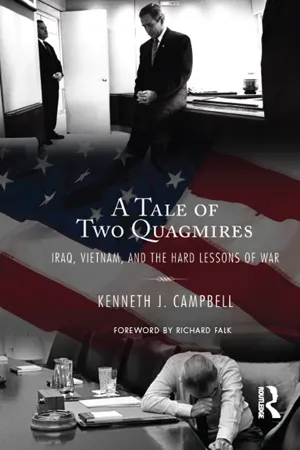
Tale of Two Quagmires
Iraq, Vietnam, and the Hard Lessons of War
- 160 pages
- English
- ePUB (mobile friendly)
- Available on iOS & Android
eBook - ePub
About this book
Is Iraq becoming another Vietnam? Author Kenneth Campbell received a Purple Heart after serving 13 months in Vietnam. He then spent years campaigning to get the US out of the war. Here, Campbell lays out the political similarities of both wars. He traces the chief lessons of Vietnam, which helped America successfully avoid quagmires for thirty years, and explains how neoconservatives within the Bush administration cynically used the tragedy of 9/11 to override the "Vietnam syndrome" and drag America into a new quagmire in Iraq. In view of where the U.S. finds itself today -- unable to stay but unable to leave -- Campbell recommends that America re-dedicate itself to the essential lessons of Vietnam: the danger of imperial arrogance, the limits of military force, the importance of international and constitutional law, and the power of morality.
Information
ONE

THE GREAT DEBATE
I don’t want to talk about Vietnam. This is not Vietnam. This is Iraq!
—L. Paul Bremer
Is Iraq another Vietnam? This question has triggered fierce debate throughout the United States over the past couple of years, and as the Iraq War continues to drag on with no end in sight, the ferocity of the debate has intensified. The national debate over the Vietnam analogy and the Iraq War began with the emergence of the Iraqi insurgency, following the U.S. invasion and occupation of Iraq in 2003. As it became clear that the Iraqi resistance was more than a few “dead-enders” and “Saddamist holdouts,” domestic critics of the U.S. war began to raise the specter of another Vietnam. They argued that Iraq was becoming another quagmire from which the United States will eventually have to withdraw, again, in humiliation and defeat.
Supporters of the war rejected the Vietnam comparison and urged proponents of the analogy to “get over” Vietnam. They contended that there were great differences between the two wars and that, unlike in Vietnam, U.S. forces in Iraq would ultimately prevail. As the Iraq War dragged on through the next three years, the costs in lives and resources rose steadily, as did the volume and intensity of the debate over the Vietnam analogy. Partisans on both sides of the debate believe passionately that they are right, but where is the truth? Are Iraq and Vietnam more similar or more different? And what criteria do we use to judge? The following is a brief examination of some of the best arguments, proffered by some of the best representatives of the two sides of this debate.
NO, IRAQ IS NOT VIETNAM!
Professors Jeffrey Record and Andrew Terrill present a very professional and detailed critique of the Vietnam analogy for the U.S. Army War College. Professor Record was a civilian pacification specialist in Vietnam and is now a national security specialist at the U.S. Air War College in Alabama. Professor Terrill was a career military officer and is now a Middle East specialist at the U.S. Army War College in Pennsylvania. These authors bring an unusual combination of academic training and practical experience to their examination of the Vietnam analogy. In their study they reach the following conclusion:
Careful examination of the evidence reveals that the differences between the two conflicts greatly outnumber the similarities. This is especially true in the strategic and military dimensions of the two wars. There is simply no comparison between the strategic environment, the scale of military operations, the scale of losses incurred, the quality of the enemy resistance, the role of the enemy allies, and the duration of combat.1
However, the authors do include an important caveat: “Such an emphatic judgment, however, may not apply to at least two aspects of the political dimensions of the Iraq and Vietnam wars: attempts at state-building in an alien culture, and sustaining domestic political support in a protracted war against an irregular enemy.”2 Record and Terrill also add an important qualification to their case against comparing Iraq to Vietnam: “The question of whether the Iraq War of 2003 was a war of necessity is one of the key factors bearing on the political sustainability of the ongoing U.S. effort to create a stable, prosperous, and democratic Iraq.”3 The authors do not elaborate on the question of the necessity for the Iraq War. Rather, they appear to accept at face value the Bush administration’s justification for the Iraq War as “part of the larger war on terrorism that was sparked by the horrendous al-Qaeda attacks on the United States of September 11, 2001.”4
One of the most influential critiques of the Vietnam analogy, at least among the intellectual community, is Christopher Hitchens’s Slate magazine article published in early 2005. In this piece, Hitchens writes that Iraq and Vietnam have “nothing whatsoever in common.”5 He contends that, unlike Ho Chi Minh, who emulated the words of Thomas Jefferson and had been an ally of the West, Iraqi insurgents descended from those who took the side of the Axis powers during World War II and now oppose democratic elections on principle. Hitchens goes on to assert that Ho Chi Minh’s Vietnam never invaded its neighbor, never committed genocide, and never sought weapons of mass destruction, as Saddam Hussein’s Iraq had. Hitchens insists that in Vietnam, the Americans committed the worst atrocities, while in Iraq, Saddam and his followers committed the worst atrocities. He points out that in Vietnam during the Kennedy years, the United States favored the Roman Catholic minority, whereas in Iraq, the United States now takes a more ecumenical approach to religious differences. Finally, Christopher Hitchens labels those who see an analogy between Iraq and Vietnam as “narrow,” “shallow,” and “third rate.”6
Next we have Melvin Laird’s late 2005 piece in Foreign Affairs. Laird was President Nixon’s secretary of defense from 1969 to 1973. In his article, Laird states: “The War in Iraq is not ‘another Vietnam,’” but could become one if we fail to learn the lessons of Vietnam. For Laird, the chief lesson of Vietnam is that the policy of “Vietnamization” succeeded and that a similar policy of “Iraqization” can work just as well in Iraq. He goes on to contend that “the truth about Vietnam that revisionist historians conveniently forget is that the United States had not lost when we withdrew in 1973. In fact, we grabbed defeat from the jaws of victory two years later when Congress cut off the funding for South Vietnam that had allowed it to continue to fight on its own.” Furthermore, Laird argues: “The shame of Vietnam is not that we were there in the first place, but that we betrayed our ally in the end. It was Congress that turned its back on the promises of the Paris accord.”7
However, at another point in the article, Laird describes America’s Saigon ally as “corrupt, selfish men who were no more than dictators in the garb of statesmen.” He then proceeds to list the many ways that Iraq is like Vietnam:
• “Both the Vietnam War and the Iraq war were launched based on intelligence failures and possible outright deception.”
• Both began as self-defense and “morphed into nation-building.”
• In both wars, “Our presence is what feeds the insurgency.”
• In Vietnam, “Countless innocent civilians were killed in the indiscriminate hunt for Vietcong among the South Vietnamese peasantry. Our volunteer troops in Iraq are better trained and supervised, yet the potential remains for the slaughter of the innocents.”
• “As with Vietnam, the Iraq war is revealing chinks in our fiscal armor. Only after the Vietnam War ended did its drain on the U.S. economy become apparent.”
• In both wars, most of our closest Western allies refused to join the fight.
• “Americans will not be lied to … as with the Vietnam War, if necessary they will take to the streets to be heard.”
• “Just as the spread of communism was very real in the 1960s, so the spread of radical fundamentalist Islam is very real today.”8
Laird lobbies for continuing the war of “nation-building” in Iraq in part by citing the alleged connection between the Iraq War and 9/11: “Bush has the opportunity to reshape the region. ‘Nation-building’ is not an epithet or a slogan. After the attacks of September 11, 2001, it is our duty.”9
Finally, defense policy specialist Stephen Biddle rejects the Vietnam analogy in an article in the March/April 2006 issue of Foreign Affairs called “Seeing Baghdad, Thinking Saigon.”10 Biddle determines the primary nature of the Iraq War to be a civil war and its secondary nature to be an insurgency against a foreign (U.S.) occupation. Therefore, Biddle contends, the strategy of “Iraqization”—modeled on “Vietnamization” thirty years ago—is the wrong strategy to adopt, because in a civil war, turning over the responsibility for security to indigenous military and police forces will only make the civil war worse. Instead, Biddle contends that U.S. troops must remain in the middle of the civil war in Iraq and attempt to “cap” the communal violence until Iraq’s many political and religious factions can work out an accommodation at some point in the future.
YES, IRAQ IS VIETNAM!
Daniel Ellsberg, a former Marine officer, civilian Vietnam adviser, and purloiner of the top-secret Pentagon Papers, said in remarks made at a Capitol Hill briefing in 2005 that Iraq was similar to Vietnam for several reasons. First, the United States had no real chance of winning in either war because in both cases, the indigenous population viewed the United States as an illegitimate foreign occupier. Second, both wars were sustained by a lie and a charge. The “lie” was that the United States was in both wars to spread “democracy,” when the real reason was imperial dominance. The “charge” was that in both wars, calling for immediate withdrawal was an act of “cowardice,” when in fact it was an act of courage. Because of these lies and charges, the Vietnam War dragged on far longer with higher costs than it might otherwise have. This, Ellsberg contends, is also true of the Iraq War.11
To Sir Lawrence Freedman, professor of war studies at King’s College in London and an internationally respected expert on military strategy, Iraq is similar to Vietnam in that both wars took on the public face of the secretaries of defense running them. To Lawrence Freedman, Robert McNamara and Donald Rumsfeld share the characteristic of personal arrogance in their refusal to heed the advice of their generals. And Freedman believes that, as in Vietnam, launching a war without direct provocation and bogging the United States down in a bungled war in Iraq will leave the United States weaker, not stronger, meaning that Rumsfeld will have left behind an “Iraq syndrome” just as McNamara left behind a “Vietnam syndrome.”12
U.S. Senator Chuck Hagel, a Republican from Nebraska and a former squad leader in Vietnam, said that a “parallel” was emerging between Vietnam and Iraq. He said: “The longer we stay in Iraq, the more similarities will start to develop, meaning essentially that we are getting more and more bogged down, taking more and more casualties, more and more heated dissension and debate in the United States.”13
John Mueller, professor of political science at Ohio State University and author of the 1973 classic study of public opinion and casualties during the Vietnam War, War, Presidents, and Public Opinion,14 wrote in Foreign Affairs that just as during Vietnam, as U.S. casualties in Iraq rose, public support fell. And Mueller, too, predicted a lasting “Iraq syndrome,” just as there was a lasting “Vietnam syndrome.”15
Martin van Creveld, an internationally renowned military historian and a professor at Hebrew University, insisted that there are many important parallels between Iraq and Vietnam. He wrote, “The question is no longer if American forces will be withdrawn, but how soon—and at what cost.” And Creveld recommended that President Bush and his advisers be put on trial for “misleading the American people” into “the most foolish war since Emperor Augustus in 9 b.c. sent his legions into Germany and lost them.”16
Finally, Lt. General William Odom (ret.), director of the National Security Agency during the Reagan administration, wrote that of the many similarities between the wars in Iraq and Vietnam, the most important were the use of “phony intelligence” and “confused war aims.” He argued, however, that the debacle in Iraq is likely to have far more damaging consequences than did Vietnam to U.S. power in the world.17
THE STRATEGIC ESSENCE OF A QUAGMIRE
My own view, having served in the Vietnam War for thirteen months and having studied it for thirty years, is that on the most important level—the strategic political level—Iraq and Vietnam are exactly alike. Both wars were constructed upon, and sustained by, a quicksand of conscious political deception. As such, they were and are quagmires. No matter how many differences there are between Vietnam and Iraq—and there are many—the fact that their strategic political character is identical means that the Iraq War will end in failure, just as Vietnam did more than thirty years ago. So it is not a question of whether the United States will lose the war in Iraq; the war was lost the day the Bush administration decided to invade Iraq. The question is, how much more are Americans prepared to pay for a lost war? In Vietnam, the “tipping point” when the majority of Americans realized the war in Vietnam was not worth fighting came in early 1968, after the Tet Offensive, but it took U.S. leaders five more years to withdraw U.S. troops from Vietnam. The cost for this delay was 20,000 more American lives, 300,000 more Vietnamese lives, and many billions of U.S. tax dollars. It would be unwise to repeat this mistake in Iraq and to delay withdrawal.
According to the American Heritage Dictionary, a quagmire is “a bog having a surface that yields when stepped on,” or “a difficult or precarious situation from which extrication is almost impossible.”18 The first is a physical quagmire; the second is a politico-military quagmire. No one in his or her right mind would intentionally enter a physical quagmire, as it could mean his or her death. If an individual enters a physical quagmire, it is because he or she is deceived by God or Mother Nature into believing that the quagmire’s surface is solid enough to support a person’s weight. However, once entered, it soon becomes...
Table of contents
- Cover
- Half Title
- Title Page
- Copyright Page
- Dedication
- Table of Contents
- Foreword, Richard Falk
- Preface
- 1 The Great Debate
- 2 Personal Encounter with a Quagmire
- 3 The Vietnam Quagmire
- 4 The Lessons of Vietnam
- 5 The Iraq Quagmire
- 6 Last Exit from Baghdad
- Notes
- Bibliography
- Index
- About the Author
Trusted by 375,005 students
Access to over 1.5 million titles for a fair monthly price.
Study more efficiently using our study tools.
Frequently asked questions
Yes, you can cancel anytime from the Subscription tab in your account settings on the Perlego website. Your subscription will stay active until the end of your current billing period. Learn how to cancel your subscription
No, books cannot be downloaded as external files, such as PDFs, for use outside of Perlego. However, you can download books within the Perlego app for offline reading on mobile or tablet. Learn how to download books offline
Perlego offers two plans: Essential and Complete
- Essential is ideal for learners and professionals who enjoy exploring a wide range of subjects. Access the Essential Library with 800,000+ trusted titles and best-sellers across business, personal growth, and the humanities. Includes unlimited reading time and Standard Read Aloud voice.
- Complete: Perfect for advanced learners and researchers needing full, unrestricted access. Unlock 1.5M+ books across hundreds of subjects, including academic and specialized titles. The Complete Plan also includes advanced features like Premium Read Aloud and Research Assistant.
We are an online textbook subscription service, where you can get access to an entire online library for less than the price of a single book per month. With over 1.5 million books across 990+ topics, we’ve got you covered! Learn about our mission
Look out for the read-aloud symbol on your next book to see if you can listen to it. The read-aloud tool reads text aloud for you, highlighting the text as it is being read. You can pause it, speed it up and slow it down. Learn more about Read Aloud
Yes! You can use the Perlego app on both iOS and Android devices to read anytime, anywhere — even offline. Perfect for commutes or when you’re on the go.
Please note we cannot support devices running on iOS 13 and Android 7 or earlier. Learn more about using the app
Please note we cannot support devices running on iOS 13 and Android 7 or earlier. Learn more about using the app
Yes, you can access Tale of Two Quagmires by Kenneth J. Campbell,Richard A. Falk in PDF and/or ePUB format, as well as other popular books in Politics & International Relations & Military & Maritime History. We have over 1.5 million books available in our catalogue for you to explore.