eBook - ePub
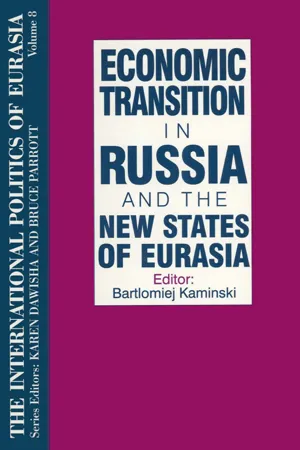
The International Politics of Eurasia: v. 8: Economic Transition in Russia and the New States of Eurasia
- 384 pages
- English
- ePUB (mobile friendly)
- Available on iOS & Android
eBook - ePub
The International Politics of Eurasia: v. 8: Economic Transition in Russia and the New States of Eurasia
About this book
First Published in 1996. This ambitious ten-volume series develops a comprehensive analysis of the evolving world role of the post-Soviet successor states. Each volume considers a different factor influencing the relationship between internal politics and international relations in Russia and in the western and southern tiers of newly independent states. The contributors were chosen not only for their recognized expertise but also to ensure a stimulating diversity of perspectives and a dynamic mix of approaches. This is Volume 8 Economic Transition in Russia and the New States of Eurasia.
Information
1
Introduction
“People who love soft methods and hate iniquity forget this—that reform consists in taking a bone from a dog.
Philosophy will not do it.”
John Jay Chapman, Practical Agitation, ch. 7 (1898)
Before the collapse of communism many countries dismantled their authoritarian regimes and relaxed their administrative grip over economic activity. Under the weight of the debt crisis crippling their economies in the 1980s, many Latin American countries introduced democratic reforms, made leaders accountable to their constituents, and liberalized their economic regimes. In fact, most of the world’s economies have, at different times, paces, and with varying degrees of success, removed administrative controls over prices, liberalized access to their markets, and privatized state-owned enterprises. The distinguished troika of democratization, liberalization, and privatization was on the march even before the collapse of communism.
Thus, the question is whether there is something unique about the transition from communism. What clearly distinguishes the transition from communism is its institutional point of departure. While communist ideologues were rarely right, their view that capitalism and communism “were as different and incompatible as fire and water” accurately reflected the reality.1 Communism was a distinct system. Its institutional design, predicated on the aspiration of the state to control totally both society and the economy, explicitly rejected the relative autonomy of society, state, and economy. Communism was an evolutionary step backward—or rather a continuation of earlier political systems dominated by patrimonial bureaucracies and traditional hierarchies—although it professed progress in its ideology and based its legitimacy on modernization.
What set communism apart from other politico-economic systems was “the unique symbiosis of the state with society and the economy.”2 This symbiosis left no room for the rule of law, democracy, or competitive markets. These concepts were dysfunctional under communism, and—if they existed before the communist takeover—they had to be destroyed with its imposition. In contrast, authoritarian regimes in Latin America and elsewhere recognized private property, had market economies (usually highly distorted with multiple administrative controls), and did not fully destroy the autonomy of their respective societies.
The world that Stalin had built (and later imposed on Central and Eastern Europe) was an antiworld. Its institutional design was based on the rejection of three Western institutional innovations: (1) the market as a mechanism for stimulating and coordinating economic activity; (2) democracy as a mode of governance to mediate between conflicting group and individual interests as well as to assure the accountability of leaders to their constituents; and (3) the rule of law (Rechtsstaat) as a mitigating factor in the discretional intervention by the state. The simultaneous rejection of three major pillars of a modem society made it a logically coherent construct, as one feature supported the existence of another. These three features underpinned “an aspiration to total control by a political center backed by an extensive and active repressive apparatus, and a central role of Marxist-Leninist ideology.”3
Communism evolved over time, but in varying degrees depending on the country. Not surprisingly, its evolution consisted of moving away from Stalin’s system. This retrenchment from aspiration to total control, varying by domain and over time, did not follow any clear-cut blueprint.4 As a consequence, the balance sheet in terms of assets and liabilities was significantly different among countries emerging from communism. Since the Soviet republics had obtained some modicum of independence from Moscow only two or three years before the dissolution of the Soviet Union, the differences among them were, in many respects, less than those between them and the countries of East-Central Europe, although the Baltic states had undertaken many reforms even before they regained their independence.
The transition from communism is systemic: it involves establishing a new politico-economic system. Ideally, this system should be democratic, but this is not enough. Its institutional foundation should have the following features: (1) a credible constitutional design, setting up the laws by which rules are made; (2) a legal and regulatory infrastructure, assuring enforcement of contracts and security of private property;5 (3) the existence of a wide sphere of economic and social activity beyond the direct reach of the state; and (4) available mechanisms and guidelines for an active pursuance of policies designed to contain monopolistic practices and negative externalities.
The ability to move along the institutional path toward a viable market economy would seem to depend on initial institutional conditions, that is, on the extent to which a domestic system had moved away from its Stalinist prototype before the collapse of communism. But the evidence so far has been mixed. On the one hand, the disintegration of communism was the most advanced in Hungary and Poland, and these two countries have scored high in terms of progress in transition. But so have the former Czechoslovakia and the Baltic states, especially Estonia, and in these countries the point of departure was an orthodox, centrally planned economy.
Hence, other legacies and national circumstances may be more important. Compare, for instance, the newly independent states (NIS) that emerged from the dissolution of the Soviet Union with the former communist countries of Central and Eastern Europe (CEEC). Although they all have faced the same institutional challenges, the weight of past legacies has presented the former with far more formidable challenges that serve to complicate the task of transition. First and foremost, the newly independent states (except Russia, where the central administration was located) had to build their states from scratch and establish their economic sovereignty, including domestic currencies, border controls, and so forth.
The weak institutional capacities of the state negatively impact prospects for a quick and smooth transition. Establishing market-supporting institutions and stabilizing the economy paradoxically call for a strong state, albeit one using its powers in a different way and to a different purpose than its communist predecessor. Only the state can provide a legal and regulatory infrastructure, assuring the enforcement of contracts and the security of private property rights, which is indispensable to the development of the private sector. Moreover, the lack of a constitutional design outlining the rights and responsibilities of the levels of general government may undermine public finance and the state’s ability to supply services (see Wallich, chapter 12). Weak institutional capacity creates an environment conducive to corruption and both organized and unorganized crime. Interestingly, Russia, which seemed to be in the best position to establish effective structures for law enforcement, seems to have suffered most from mafiya activities (see Millar, chapter 9).
Except for the Baltic states, NIS experience with communism spanned a longer period of time than that of the CEEC. The duration of communism is negatively correlated with the quality of production structures and human capital. According to some observers (Friedman, chapter 11), the human capital factor has been a major barrier to the development of sound institutional frameworks and economic policies in many newly independent states and has negatively impacted people’s ability to adjust to a new politico-economic environment. It should also be noted that the concentration of political and economic decision making in Moscow offered local elites in other newly independent states little opportunity to gain relevant experience.
The extent to which the newly independent states were isolated from the world economy was also greater than was the case for the CEEC. The newly independent states were part of the same autarkic economy. They were part of a unified budget system that redistributed incomes among the republics of the former Soviet Union. They inherited huge interrepublic trade dependencies, which were reflected in their shares in gross domestic product (GDP), ranging between 13 percent (Russia) and 54 percent (Estonia). In contrast, the CMEA (Council for Mutual Economic Assistance) never succeeded in imposing supranational planning on its members, although it contributed to distortions in the allocation of resources in these countries. As a result, NIS economic structures were more “misdeveloped” than in the CEEC, and the cost of adjustment in terms of lost production capacities was thus potentially much larger. And, since Russia towered over interrepublic exchanges, this made the newly independent states extremely vulnerable to the vicissitudes of Russian foreign economic policy.
The newly independent states inherited highly militarized and energy-wasteful industrial structures and enormous environmental degradation. The Soviet Union spent more resources on the military sector in terms of its share in GDP than did the CEEC. The industrial-military sector was located mostly in Russia and Ukraine. With a contraction in both domestic and international demand for military equipment, the industrial-military sector has faced downsizing and adjustment. In Russia the difficulties involved in the adjustment have been compounded by the dearth of entrepreneurial skills and by ill-conceived government policies, as Yevgeny Kuznetsov’s study convincingly shows (see chapter 14). Very high by world standards, the intensity of energy production was a trademark of all centrally planned economies. But in the newly independent states its wasteful use was exacerbated by energy prices lower than those charged by the Soviet Union in supplying its junior CMEA partners (Korchemkin, chapter 5). The gradual move to world prices created a major terms-of-trade shock for energy net importers. The scale of environmental devastation, especially in Central Asia (Primbetov, chapter 7), has no counterpart in either the European newly independent states or the CEEC.
Another formidable obstacle is the lack of a transportation network that could link the new economies with international markets (Kaminski, chapter 18). The problem is less serious for European newly independent states, but it is especially grave for landlocked Asian newly independent states. For instance, the level of oil exports from Kazakhstan is determined solely by Moscow’s decisions on granting access to its pipeline network (Akhanov and Buranbayeva, chapter 6). But the transportation bottlenecks are not restricted to Central or Transcaucasian Asia. For instance, the limited capacity of gas and oil pipelines and ports of transfer has constrained not only exports from Turkmenistan and Kazakhstan but also those from Russia (Korchemkin, chapter 5).
Last but not least, civil wars or hostilities with neighboring countries have spared the CEEC further economic hardship, whereas military conflicts have inflicted heavy additional costs on Azerbaijan, Armenia, Georgia, and Tajikistan.
Considering these adversities, early expectations of a quick, painless shift to a market-based democracy and a quick turnaround in economic fortunes were ill-conceived at best. Although ultimately the collapse of communism has demonstrated an unprecedented degree of consensus between rulers and ruled as to the systems’ economic nonviability, there was no agreement as to what future economic steps should be taken. The consensus seems to have survived, and the politics of reform has continued to evolve. According to a survey (quoted in Aline Quester and George Quester, chapter 10), there is little support for a return to the old communist system. And this is so despite the fact that most Russians believe their economic situation was better before the dissolution of the Soviet Union.
The hopes of a quick improvement unnecessarily raised societal expectations, which in some countries (for instance in Russia) may have contributed to a political backlash against reforms and a slowdown in their implementation. But in other countries the deterio...
Table of contents
- Cover
- Half Title
- Title Page
- Copyright Page
- Table of Contents
- About the Editors and Contributors
- Preface
- Maps
- 1. Introduction
- 2. Economic Transformation in the Post-Soviet Republics: An Overview
- 3. Economic Transition in Russia, Ukraine, and Belarus: A Comparative Perspective
- 4. Integrating the Unofficial Economy into the Dynamics of Post-Socialist Economies: A Framework of Analysis and Evidence
- 5. Russia’s Oil and Gas Exports to the Former Soviet Union
- 6. Foreign Investment and Trade in Kazakhstan
- 7. Central Asia: Prospects for Regional Integration
- 8. Poverty and Inequality in Transition Economies: What Has Actually Happened
- 9. What’s Wrong with the Mafiya Anyway? An Analysis of the Economics of Organized Crime in Russia
- 10. Post-Communist Economics: Expectations, Entitlements, and Disappointments
- 11. Russia and the Commonwealth of Independent States in the Emerging Structure of the World Economy
- 12. Reforming Intergovernmental Relations: Russia and the Challenge of Fiscal Federalism
- 13. Unemployment and the Labor Market in Transition: A Review of Experience in East Europe and Russia
- 14. Learning to Learn: Emerging Patterns of Enterprise Behavior in the Russian Defense Sector, 1992–95
- 15. Note on Privatization in Moldova
- 16. Note on Privatization in Georgia
- 17. Global Integration and the Convergence of Interests Among Key Actors in the West, Russia, Ukraine, and the Commonwealth of Independent States
- 18. Factors Affecting Trade Reorientation of the Newly Independent States
- Appendix: Project Participants
- Index
Trusted by 375,005 students
Access to over 1.5 million titles for a fair monthly price.
Study more efficiently using our study tools.
Frequently asked questions
Yes, you can cancel anytime from the Subscription tab in your account settings on the Perlego website. Your subscription will stay active until the end of your current billing period. Learn how to cancel your subscription
No, books cannot be downloaded as external files, such as PDFs, for use outside of Perlego. However, you can download books within the Perlego app for offline reading on mobile or tablet. Learn how to download books offline
We are an online textbook subscription service, where you can get access to an entire online library for less than the price of a single book per month. With over 1.5 million books across 990+ topics, we’ve got you covered! Learn about our mission
Look out for the read-aloud symbol on your next book to see if you can listen to it. The read-aloud tool reads text aloud for you, highlighting the text as it is being read. You can pause it, speed it up and slow it down. Learn more about Read Aloud
Yes! You can use the Perlego app on both iOS and Android devices to read anytime, anywhere — even offline. Perfect for commutes or when you’re on the go.
Please note we cannot support devices running on iOS 13 and Android 7 or earlier. Learn more about using the app
Please note we cannot support devices running on iOS 13 and Android 7 or earlier. Learn more about using the app
Yes, you can access The International Politics of Eurasia: v. 8: Economic Transition in Russia and the New States of Eurasia by S. Frederick Starr,Karen Dawisha in PDF and/or ePUB format, as well as other popular books in Economics & International Economics. We have over 1.5 million books available in our catalogue for you to explore.