eBook - ePub
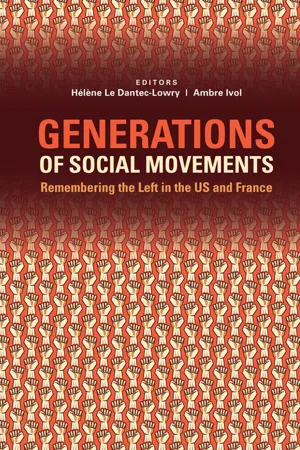
Generations of Social Movements
The Left and Historical Memory in the USA and France
- 293 pages
- English
- ePUB (mobile friendly)
- Available on iOS & Android
eBook - ePub
Generations of Social Movements
The Left and Historical Memory in the USA and France
About this book
French political culture has long been seen as a model of leftist militancy, while the left in the United States is often perceived in terms of organizational discontinuity. Yet, the crisis of social democracy today suggests that at a time when the archetypal European welfare state is in danger, critics and citizens interested in understanding or reviving progressive politics are invited to consider the United States, where modes of creative activism recurrently demonstrate potentialities for a renewed leftist culture. Using a transatlantic perspective, this volume identifies activist influence through the designation or rejection of specific intellectual and militant figures across generations, and it examines various narrative modes used by militants to write their own history.
Trusted by 375,005 students
Access to over 1.5 million titles for a fair monthly price.
Study more efficiently using our study tools.
Information
Print ISBN
9781612057293
Part I
The End of History?
FROM THE FALL OF COMMUNISM TO THE RESURGENCE OF MILITANCY
Chapter One
Thinking about the Left with Stanley Aronowitz
THEORETICAL BLIND SPOTS OF THE AMERICAN LEFT FROM THE 1960S TO THE PRESENT
Stanley Aronowitz (1933–), the New York–based sociologist and public intellectual, has a background in trade union activism stretching back to the early 1950s. Any conversation with him is likely to turn to politics, social movements, and the role of critical thought. He is in perpetual search of the cutting edge of analysis and theorization about the existing capitalist order and its potential for change. This often leads to discussion about today’s movements and their capacity to embody a vision broad and deep enough to engender lasting change. Of this capacity he is highly skeptical, in the light of history, leading him to ask such questions as, How can the left foster modes of critical thinking that give rise to concrete analysis of the contemporary situation? How can it overcome its chronic amnesia and create lasting forms of organization that will allow movements to build on a heritage and exercise greater influence on society’s direction? The following is an interview in two parts.
I. MARXISM, CRITICAL THEORY, PUBLIC INTELLECTUALS (APRIL 2012)
JAMES COHEN: In 1981 you published The Crisis in Historical Materialism. Why did you conceive the project of rethinking Marxism, and more generally of writing about theory, and why at that time?
STANLEY ARONOWITZ: By the 1970s it was clear to me, especially after writing False Promises (1973), that the left—the US left in particular—was facing two major problems. First, it was unable and ill equipped to deal with the crisis of the socialist societies. I had very little hope that the Soviet Union was going to reform from within. The communist and socialist parties of the West were largely imprisoned by their own pasts. The second problem was that Marxism had become ossified. It had failed to come to terms with three new social movements: the youth movement (including the antiwar movement of the 1960s and early 1970s), feminism, and the environmental movement. It had done a reasonable job, theoretically and politically, though not a great job, in addressing the black freedom movement. Regarding other movements, they were abysmal failures. The socialists and the communists—particularly the latter—were still influential on the left even though they were in decline and ideologically sterile.
J.C.: There is a lot in the book about art and culture and everyday life.
S.A.: That was one of the problems. The socialists and the communists never had much of a handle on cultural affairs, with the exception of a few dissident writers of the 1930s, such as Christopher Caudwell. I had been reading Henri Lefebvre’s Critique de la vie quotidienne (2 vols., 1947 and 1961). It was clear to me that neglect of everyday life was part of the problem.
J.C.: Would you continue to define yourself as a Marxist?
S.A.: I don’t use the word—I think Marxism has become a religion! I call myself a historical materialist, and I would identify with critical theory. Do I say I am influenced by [Karl] Marx and a Marxian tradition? Yes. But I have not called myself a Marxist since the 1980s—since The Crisis in Historical Materialism. When that book came out, the editors of Monthly Review—Harry Magdoff, Paul Sweezy, and a few others—organized a study group around the book and came to the conclusion that I wasn’t a Marxist.
Should people read Capital and Marx’s early manuscripts? Obviously. Should they read [Rudolf] Hilferding and [Rosa] Luxemburg? Yes. But the problem is that Marxism as a tendency has been dominated by economism and workerism and by empiricism.
A lot of students come to me and say, “I want to be a Marxist.” I tell them “No, you don’t! What you want to do is study Marx!” I teach the development of sociological theory using the Manuscripts of 1844, The German Ideology, and parts of Capital, but also [Emile] Durkheim, [Georg] Simmel, and [Max] Weber.
In my book How Class Works (2003), you can see why I’m not a Marxist. I make an argument that class is a process of becoming; it is not an existent “thing.” Class “in itself” has no significance until it becomes political. I argue that classes do not necessarily have to be formed in relation to the ownership and control of the means of production in the traditional nineteenth-century way. Marxists still have a lot of trouble with it because they’re stuck in workerism.
Finance capital is now a class with its own project. Industrial capital is not a class in the modern and historical sense. It’s subordinated and integrated by finance capital. (The analysis of course needs to be fleshed out). Otherwise, what you get is “the capitalist class.” But what does that mean? Nothing! Industrial capital is always borrowing and is subordinated because the ownership of companies is mostly via the investment banking sector. The production of capital goods and consumer goods is under the hegemony of finance capital. Since World War II, the idea of industrial capital’s autonomy has been an illusion.
It is to the eternal credit of Paul Sweezy that he organized a debate in the Monthly Review about finance capital versus industrial capital. At least they were aware of it! Sweezy was a very creative guy, within the limits of his economism.
J.C.: How did you first begin to work on theory? Was it when you stopped being a full-time labor organizer and moved into the university?
S.A.: In the 1960s, when I was still a labor organizer, I was mostly a reader of theory. My theoretical writing began in the early 1970s, with “Colonized Leisure, Trivialized Work,” which became chapter 2 of False Promises. In the 1970s I also wrote essays on law, on the new working class and its contradictions. These theoretical concerns were also incorporated into False Promises.
J.C.: A recurring theme in your work is that the US left is struck with amnesia and has serious trouble making connections from generation to generation.
S.A.: The left reflects the general loss of memory of the entire population! How is it possible that the right, in the United States and in several European countries, became the main beneficiary of several successive crises, including the 2007 collapse? One of the reasons is that the left has no ideas. It has a version of Keynesianism as a solution to the major problems, but I don’t think it’s possible to return there. We need to look for alternatives, but where is the discussion of these? The problem is, even most intellectuals are not asking these questions!
J.C.: Hence your recurring interest in the role of public intellectuals. You’ve just finished another book on C. Wright Mills.1 Why Mills?
S.A.: I see him as an exemplary figure who could contribute to a revival of political intellectuals in the United States. We have people who are so deeply tucked into the academy that they’re not even thinking about politics. They’re thinking in disciplinary terms but not in political terms any more.
This is both an American and a Western European problem. There are always individual exceptions, but there’s no broad conversation. For example, when [Georg] Luká’s History and Class Consciousness came out in English translation in 1971, the critical intellectuals I knew were clustered in study groups reading the book, trying to figure out what it could do to help our own situation. Today, honestly, there’s not a single text that stimulates American intellectuals to sit down and say, “What can we learn from this?”
I’m currently teaching, for example, [Bernard] Stiegler on technology. That has no resonance in the United States to speak of. Science and technology are critical domains of study for understanding loss of memory and the problem of privatization of social existence. Hardly anybody is talking about that. American sociology and geography and anthropology are involved to a large extent—with the exception of those who follow Lefebvre—in banal studies of social problems such as poverty and discrimination. It’s not that these are not important, but they are not the political cutting edge. The cutting edge is technology and science.
Then there’s the whole question of the crisis of capitalism—but what does that really mean? The new book on the crisis by Rick Wolff and Steve Resnick2 is repetition of the same old same old! Marxism, Keynesianism, political economy, but there’s no analysis of the current conjuncture.
J.C.: Which main ingredients are missing?
S.A.: Let me give you an example. In Situations 4, no. 2 (2012), Constantin Tsoukalas and I have two long articles. Mine argues that the problem isn’t the economy per se. It looks into the connections between the cultural, the political, and the economic. You have to make these connections to understand what’s going on and what the nature of the debt crisis is. The problem of the debt crisis is not a problem of economics! It’s the problem essentially of a culture that demands that people have one-family houses. It is increasing suburbanization, a certain organization of space, which then generates economic activity that is largely spurious—or, as Marx would say in Capital (vol. 3), fictitious. I discuss that, and Tsoukalas discusses globalized capitalism and the “deregulation of morals.”3
So we’re trying to do things. But the trouble is that the stuff that comes out of the more traditional Marxist understanding of the world is all about the accumulation crisis; it’s all at the level of economic relations. They’ve reached the point of studying financialization, but they never connected that to culture or to patterns of urbanization and suburbanization. Geographers are talking about space and economists about economic activity, but it’s not the critique of political economy. We’re doing what we can to remedy that, but it’s very difficult.
J.C.: I was going to ask how you would rewrite The Crisis in Historical Materialism today, but you’ve just answered the question!
S.A.: One thing that might have to be revised if I were to rewrite that book, given the role of knowledge in the development of late capitalism, is the role of universities. They could play a major role in coming political transformations. In this country we have about 15 million students, half in community colleges and half in senior colleges. The role of knowledge has become more and more important. Upheaval in the universities may play a major role in whatever change takes place—not an exclusive role, but it may, as in May 1968, be a catalyst for much larger mobilizations. But in order for this to happen, you need to have a cadre of political intellectuals, as you had in 1968, with the Situationists, and [Louis] Althusser, and [Henri] Lefebvre in the late 1960s, and we don’t have it.
J.C.: Does it appear to you that the Occupy movement is generating such critical thinking?
S.A.: Well, they like me—I speak to them—and others like me. And they like [Marxist economist] Rick Wolff, who is much more conventional. They do like intellectuals, but they have no generative group of political intellectuals—no [Guy] Debord or [Raoul] Vaneigem or [Henri] Lefebvre or [Jean] Baudrillard. I wrote a book on Mills in order to try to stimulate something. There’s an active generation of students, but as we used to say in the 1960s, they belong to the “action faction.” They believe in less talk, more action. There’s a lot of sentiment against theory.
J.C.: In Europe, when people think of left-wing US intellectuals, many would first think of Noam Chomsky.
S.A.: He owes much of his prestige as a left intellectual to being the “Einstein” of linguistics, whether you agree with him or not in that field. But when it comes to politics, he’s not a theorist at all. He feeds into the worst empiricist and positivist tendencies on the left. He pours facts down everybody’s throats. He exposes; he’s a version of what we earlier called the muckrakers. The idea is that if you learn the truth, then you’ll turn things around. It’s the most naϊve idea imaginable.
J.C.: What do you see that’s interesting coming out of the ecological movement?
S.A.: My impression is it’s on the verge of moving further. Ecology is becoming a major issue. There’s more pressure on the Democrats from voters to do something. But the Democratic Party has been reluctant to pursue a serious program to address climate change. That has to happen, but the Green Party is not going to be the vehicle. It’s going to be up to some of the more independent environmental organizations—Greenpeace and others—to move more into direct action. The Occupy movement may also provide some of the impetus for this—direct action as opposed to legislation.
I don’t see this movement producing much in the way of critical theory. Bill McKibben is probably the furthest to the left of the nationally prominent ecology writers. He’s moved to the left of where he was in his writings about the death of nature twenty years ago. But it’s not theoretical. There’s...
Table of contents
- Cover
- Half Title
- Title Page
- Copyright Page
- Dedication
- Table Contents
- Acknowledgments
- Introduction
- Part I The End of History? From the Fall of Communism to the Resurgence of Militancy
- Part II Reassessing Generations: Designated and Forgotten Heirs in Black and White
- Part III Militant Narrative Modes: The Radical Edge of Leftist Memoirs
- Notes
- Index
- About the Authors
Frequently asked questions
Yes, you can cancel anytime from the Subscription tab in your account settings on the Perlego website. Your subscription will stay active until the end of your current billing period. Learn how to cancel your subscription
No, books cannot be downloaded as external files, such as PDFs, for use outside of Perlego. However, you can download books within the Perlego app for offline reading on mobile or tablet. Learn how to download books offline
Perlego offers two plans: Essential and Complete
- Essential is ideal for learners and professionals who enjoy exploring a wide range of subjects. Access the Essential Library with 800,000+ trusted titles and best-sellers across business, personal growth, and the humanities. Includes unlimited reading time and Standard Read Aloud voice.
- Complete: Perfect for advanced learners and researchers needing full, unrestricted access. Unlock 1.5M+ books across hundreds of subjects, including academic and specialized titles. The Complete Plan also includes advanced features like Premium Read Aloud and Research Assistant.
We are an online textbook subscription service, where you can get access to an entire online library for less than the price of a single book per month. With over 1.5 million books across 990+ topics, we’ve got you covered! Learn about our mission
Look out for the read-aloud symbol on your next book to see if you can listen to it. The read-aloud tool reads text aloud for you, highlighting the text as it is being read. You can pause it, speed it up and slow it down. Learn more about Read Aloud
Yes! You can use the Perlego app on both iOS and Android devices to read anytime, anywhere — even offline. Perfect for commutes or when you’re on the go.
Please note we cannot support devices running on iOS 13 and Android 7 or earlier. Learn more about using the app
Please note we cannot support devices running on iOS 13 and Android 7 or earlier. Learn more about using the app
Yes, you can access Generations of Social Movements by Hélène Le Dantec Lowry,Ambre Ivol in PDF and/or ePUB format. We have over 1.5 million books available in our catalogue for you to explore.