eBook - ePub
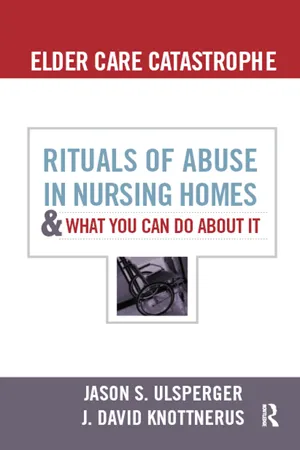
Elder Care Catastrophe
Rituals of Abuse in Nursing Homes and What You Can Do About it
- 192 pages
- English
- ePUB (mobile friendly)
- Available on iOS & Android
eBook - ePub
Elder Care Catastrophe
Rituals of Abuse in Nursing Homes and What You Can Do About it
About this book
Portraying people who have lived and worked in long-term nursing home facilities, Elder Care Catastrophe reveals how organizational dynamics and everyday rituals have unintentionally led to resident neglect and abuse. Backed up by research and grounded in sociological theory, this book offers alternative models for lessening the maltreatment of people living in nursing homes. It provides critical information for family members struggling with nursing home issues, nursing home employees, policy-makers, students and researchers concerned with elder care issues.
Information

CHAPTER 1
JUST WANTING TO DIE
In a hospital they throw you out into the street before you are half cured, but in a nursing home they don’t let you out till you are dead.
George Bernard Shaw
A nursing home bus crushed Mary C. Knight. With her body behind the left rear tire, the driver shifted into reverse. According to the driver, something felt like it was keeping her from backing up. She was right. It was Mary’s left arm and back. The Benton, AR, nursing home resident had just arrived at a vocational program affiliated with her long-term care facility, Arkansas Health Center, when the incident took place. Somehow, staff lost track of where she was after the bus unloaded. According to Arkansas’ Office of Long Term Care, someone heard Mary say the day before that she wanted to die (Managed Care Weekly 2004; Smith 2005).
The courts ordered the elderly Knight to the supervision of Arkansas Health Center after finding her incapable of living in mainstream society. Psychiatrists diagnosed her with dementia, bipolar disorder, and alcohol-dependence issues. Based on these issues, it seems Mary’s death might have been a suicide, a position held by the Arkansas Health Center. However, Mary’s ex-husband thinks differently. He decided to sue the facility, the state of Arkansas, and the vocational program operating under the nursing home’s trust. His attorney believes litigation is necessary because, “Anyone who suggests that this lady was distraught or depressed or suicidal overlooks the fact that she was also committed involuntarily to that institution.” He goes on, “One of the things that you have to do when the state has custody of someone who’s incompetent and insane is they’ve got to take care of them” (Smith 2005).
Mary’s death was another in a long line of mysterious deaths at Arkansas Health Center. In a period of one year, five deaths associated with employee mistakes occurred at the institution. Other questionable events cited by nursing home investigators included staff ritualistically neglecting privacy by failing to knock on resident doors when entering and allowing resident catheter tubes to drag the floor. Again, those were the cited issues. A couple of years before her death, Mary was involved in an undocumented instance involving poor employee supervision. She left a work therapy building on the grounds and came up missing. Someone eventually found her lying on the ground with her pants pulled down. A male resident was allegedly kneeling over her with his penis exposed (Managed Care Weekly 2004).
Unfortunately, incidents such as Mary’s are not rare. They are just a couple of examples of the many acts of neglect and abuse that happen in U.S. nursing homes every year. While elder abuse is common in nursing homes, we do not think it is always something employees want to happen. We believe that in a nursing home’s daily grind, which includes large numbers of rules, regulations, and paperwork, goals for providing compassionate care get lost. In turn, many forms of neglect and abuse occur. Family members, researchers, and policy makers need to start seriously turning their attention to this social problem. This chapter starts building your understanding of America’s elder care catastrophe by discussing elderly population growth, the long-term-care continuum, and the growth of maltreatment in nursing homes. It concludes with an outline briefly stating the purpose of each remaining chapter in the book.
The Age Wave
To understand the relevance of nursing home maltreatment, it is important to know that the United States, a once young country, is getting old. Dychtwald refers to this population shift as the “age wave” (1999:57). The average person in the United States now has more living parents than children and an American woman spends more time caring for her parents than for her own kids (Riekse and Holstege 1996), all because the population aged 65 and older is growing at its most rapid rate ever.
Although it seems strange now, in colonial times, most of the American population was under the age of 16. Many did not make it to old age. Even up until 1900, life expectancy at birth in the United States was around 50 years (Bova and Noble 2007). Two factors kept the population young: elevated fertility rates and high rates of mortality. However, both of these factors flipped during the twentieth century, and a movement occurred involving the desire to control aging processes. The result of these factors was a demographic quake: The winds of aging shifted and the age wave emerged.
Fertility-Rate Shifts
Fertility is the ability to produce children. At the dawn of the twentieth century, the fertility rate was high, with an average of seven births per woman. By the end of the century, it dropped to two births per woman (U.S. Bureau of the Census 1993). People started having fewer children for a variety of reasons. There were more opportunities for women outside of the home and having a multitude of children to care for at home limited those opportunities. Medical advances such as the birth control pill provided women with reliable options for pregnancy prevention (Quadagno 2008). However, the biggest influence on fertility and the age wave involved baby boomers. The shift from a birthing to an aging culture gained momentum after World War II. Millions of service personnel returned from overseas. These soldiers met young women in waiting and the result was an explosion in births. Between 1946 and 1964, the number of births was 70 percent greater than in the previous two decades (U.S. Bureau of the Census 1993).
The baby boom put a large strain on institutions. When boomers reached school age, there was a shortage of schools for them. Hospitals could not meet increased demands for child health care. Dwellings such as apartments did not have enough bedrooms for kids. Baby food ran low, diapers were scarce, and stores could not keep enough toys stocked. When birth rates declined, people realized that the baby boom generation would be a concern at every stage of life. When they reached early adulthood, college enrollments swelled. In the 1970s, they purchased homes and the increased demand prompted a rise in prices. The average cost of a new home went from $26,000 to about $47,000. The power of baby boomers continues to influence American life. Some people think that boomers will sway most political and consumer decisions made in this century (Dychtwald 1999; Quadagno 2008; Siegel 1993).
Mortality Transitions
Mortality involves likelihood of death. In 1900, the chance of dying young was high and the odds of living to old age were low. Around 20 percent of white children and 30 percent of nonwhite children died before turning five. About 60 percent of white females and 30 percent of nonwhite females reached the age of 60. Only half of white males and nearly 30 percent of nonwhite males could expect to live to 60. Now, infants in the United States have a better chance than ever to survive to old age. Whites continue to have an advantage in life expectancy over nonwhites. However, the gap is shrinking. Reaching the age of 60 now is possible for around 90 percent of white males and females. Slightly more than 90 percent of nonwhite females and 80 percent of nonwhite males reach 60 (Serow, Sly, and Wrigley 1990; U.S. Bureau of the Census 1993).
Big declines in death rates occurred in the 1940s and 1970s. During the 1940s, medical technology led to gains against infant and maternal mortality. In other words, more children lived past birth and more mothers made it through the birthing process. In the 1970s, death rates from heart disease declined because of prevention and treatment methods. People were smoking less than before, and new prescription drugs controlled high blood pressure. People were healthier and segments of the population expanded. This included the elderly. In fact, the fastest growing population group is now people 85 years old and older (Quadagno 2008; Treas 1995).
In 1900, 122,000 people aged 85 and older lived in the United States. At the turn of the millennium, that number increased to more than 3 million, and estimates indicate that it will reach nearly 6.5 million by 2020. The number of people over the age of 100 is also increasing at a rapid rate. In 1879, the odds of living to 100 were only 400 to 1. In 1980, the odds increased to 81 to 1. Now, there are more than 50,000 people aged 100 years and older in the United States. With advancing technology, we expect those numbers to continue to rise. The United States will soon have the largest elderly population in the world (Bova and Noble 2007; Riekse and Holstege 1996; Spencer, Goldstein, and Taeuber 1987).
Controlling Aging
We are on the verge of touching the outer limits of the human life span thanks to what we identify as the age control movement. Five breakthroughs continue to push this late-twentieth-century movement. They include super-nutrition, hormone replacement, gene therapy, bionics, and organ cloning.
Super-nutrition involves a diet rich in nutrients but low in calories. A correlation between specific food ingredients and disease prevention indicates that vitamins C and E, beta-carotene, and selenium can reinforce the immune system and prevent heart disease and even cancer (Dychtwald 1999). Hormone replacement involves supplying hormones for which a person is deficient. Regelson (1996) indicates that hormones injected into the body can slow and even stop the aging process. People use estrogen, testosterone, and human growth hormone as hormone supplements. Gene therapy focuses on changing cellular clocks found at the tips of chromosomes, which scientists call telomeres (Lewis 1998). Cells rejuvenate at astronomical rates when they are genetically changed. When dividing, the potential to increase the life span of aging cells exists. This allows an increase in human life span (Bova and Noble 2007). Bionics involves the use of artificial limbs and organs. Cloning involves the creation of human tissue in a laboratory setting and has the ability to benefit elderly people with brain diseases or cancer patients needing healthy cells (Dychtwald 1999).
With these technologies, by the end of the twentieth century life expectancy reached 76 years for males and 83 for females. The average American who lives to age 50 can expect to live even longer than that (Bova and Noble 2007). Regardless of medical breakthroughs, not all people reaching old age will be able to care for themselves. We cannot yet take a human brain and transplant it into a mechanical body in order to function beyond our physical limitations as humans. With the current pace of technology, we wonder if that possibility is far off. Regardless, many of the elderly still require intensive supervision due to cognitive impairment and severe health problems. Coupled with the age wave, we believe this will prompt a rise in the demand for elderly services all along the long-term-care continuum (Ulsperger and Ulsperger 2002).
The Long-Term-Care Continuum
Long-term care involves a range of health supervision, personal care, and social services given over a lengthy amount of time for people who cannot care for themselves. Informal long-term care, which friends and relatives give, is the most common form (Montgomery 1992). The common belief that Americans focus on youth and autonomy while disregarding the needs of the aged is a myth. In the United States, young family members still provide a majority of care for their elderly loved ones (Brody 1984, 1990).
American women provide most informal long-term care for the elderly. Indeed, more than 70 percent of long-term care providers are female family members (Stone, Cafferata, and Sangl 1987). These women pay a high emotional price because women have a hard time distancing themselves from caregiving (Zarit, Todd, and Zarit 1986). Family obligations do lead to care by younger generations, but we think the use of formal long-term care will increase because family size is shrinking and more women are spending time in the labor market (Cicirelli 1990).
Formal Long-Term Care
For people who do not have the capability to care for an aged loved one, a nursing home does not have to be the first option. A variety of alternatives exists, including home care, adult day care, respite care, and assisted living. If a nursing home does not seem right for your situation, any of these programs might fit your level of need.
Home care refers to in-home health and supportive services. This includes professional, paraprofessional, and long-term care in a recipient’s home. Home care is hard to define because it includes a wide range of services. For example, it includes physician and nurse visits as well as house-cleaning services. The use of home-based services is not widespread. At the end of the twentieth century, only three percent of the elderly in the United States reported using a visiting nurse and two percent used home health services and home-delivered meals (Montgomery 1992; Stone 1986). However, the use of such services is increasing (Marrelli and Whittier 2008).
Adult day care involves community programs that provide services to older people. They usually run in daytime hours. Adult day-care facilities vary in terms of emphasis, but two primary models exist. The first is the health rehabilitative model, which offers medical, nursing, and therapy services. The second type is the social psychological model, which involves people recovering from illness and those who typically have dementia. Adult day cares are located in a variety of settings. Charging by the hour and by the day, they operate in churches, senior centers, and hospitals (Giacalone 2001; Montgomery 1992). More than 1,000 exist in the United States averaging a daily enrollment of 24 people (Conrad, Hanrahan, and Hughes 1990; Richardson, Dabelko, and Gregoire 2008).
Respite care involves planned relief. It allows people to drop off elder family members at a facility. With these services, you can essentially pay for hourly temporary care to get a break from the exhaustion that can occur when taking care of a loved one. Family caregivers often show declines in physical and mental health due to chronic fatigue, isolation, and financial stress. Through respite care services, caregivers can take time out to pursue personal interests and relaxation (Mace and Rabins 2006; Scharlach and Frenzel 1986).
Assisted-living facilities are for non-impaired elders needing help with some activities of daily living such as food preparation, bathing, and medications. People in these facilities do not need 24-hour care. They receive meals in a common dining room, but have separate lodging and housekeeping services. Assisted-living facilities have a small staff of at least one nurse, a social worker, and a case manager. They contract health care services to external agencies, which keeps costs low. Often, people in these facilities pay with private funds (Giacalone 2001; Seipke 2008). If you or your aged loved one is not financially secure enough to afford assisted living, or if your elderly loved one needs a higher level of supervision, you might have to consider nursing home options.
The Nursing Home as Long-Term Care
Nursing homes provide a majority of formal long-term care. They treat patients with chronic illnesses. Although they provide less intensive care than general hospitals, they do have trained nursing staff. Medicare and Medicaid certify nursing homes as eligible for reimbursement based on the type of care provided. More than 95 percent of nursing homes receive government reimbursements. By doing so, they subject themselves to inspections carried out by state officials. In addition to providing elders who cannot care for themselves a place to live, nursing homes provide help with what people in the industry call activities of daily living, or ADLs. This includes assistance with anything from dressing to bathing. Nearly 50 percent of people who live in nursing homes have dementia. In fact, more facilities than ever now exclusively serve cognitively impaired populations or have at least one designated area that focuses on them. For example, many nursing homes have Alzheimer’s wings (Carlson and Hsiao 2006; Kahana and Brittis 1992). The average cost for a private room in a nursing home is currently $75,190 per year. A shared room with a partition between the beds averages $66,795 per year (MetLife 2006).
Through the 1980s, levels of care at nursing homes ranged from certified skilled nursing facilities (SNFs) to intermediate care facilities (ICFs). SNFs provided supervision 24 hours per day for residents under the care of a registered nurse. Like assisted living facilities, ICFs provided lower levels of care (Sirrocco 1989). After the Omnibus Budget Reconciliation Act of 1987, also known as the Nursing Home Reform Act, the distinction between SNFs and ICFs blurred. Most agencies now classify all of these institutions as nursing facilities (Carlson and Hsiao 2006; Richardson 1990). Regardless, do not get perplexed over names. As some analysts point out, when facilities do not want people to recognize them as “nursing homes,” they will actively promote other names to avoid any stigma associated with the nursing home label. This can be anything from health care facility to rehabilitation center (for more on this phenomenon see Ulsperger and Paul 2002). To avoid confusion, throughout this book, we simply use the term nursing home.
Facility and Resident Numbers
The number of nursing homes in the United States peaked in 1985, with slightly more than 19,000 facilities. Then new ways of care previously mentioned, such as home health care and assisted living, started replacing services provided by nursing homes and the number of facilities declined. In addition, disability rates for the elderly lowered the number of aged people entering nursing homes. This trend did not last long. Reports indicate that the number of nursing homes was on the rise again in the 1990s. In 1991, the number of nursing homes in the United States neared 16,000 facilities. The Centers for Disease Control, which monitors nursing home health statistics, indicates the number is currently 16,100. Moreover, the presence of the “old-old,” people 85 and older, in society is starting to increase disability prevalence among the elderly again, possibly setting the stage for another sharp increase in the number of nursing homes in the United States (Lakdawalla and Philipson 2002; Gabrel 2000; National Center for Health Statistics 2006; Strahan 1997).
Regardless of national trends, nursing homes themselves are getting larger. Consider the average number of beds per facility. It increased from 75 in the early 1970s, to 107 in 1997. As of 2004, 40 percent of nursing homes had 100 beds or more. Although there may be fewer nursing homes than at the industry’s peak, the ones that exist are bigger than ever. The actual number of residents per facility also increased over the past few decades, receding a little only recently. In the early 1970s, a little more than one million people lived in nursing homes. By 1997, the number was 1,608,700, dipping slightly to 1,492,200 by 2004...
Table of contents
- Cover
- Half Title
- Title Page
- Copyright Page
- Dedication
- Table of Contents
- Preface
- 1 Just Wanting to Die
- 2 Bureaucracy and Rituals in Everyday Life
- 3 A History of Nursing Homes
- 4 Rules over Compassion
- 5 Products Not People
- 6 Tranquilizing the Troublemakers
- 7 I’m No Baby
- 8 Alternatives to Bureaucracy in Nursing Homes
- 9 The Bureaucratic Boom: Are There Other Options?
- Appendix 1 Research Methods
- Appendix 2 A Brief Guide for Nursing Home Selection
- References
- Index
- About the Authors
Trusted by 375,005 students
Access to over 1.5 million titles for a fair monthly price.
Study more efficiently using our study tools.
Frequently asked questions
Yes, you can cancel anytime from the Subscription tab in your account settings on the Perlego website. Your subscription will stay active until the end of your current billing period. Learn how to cancel your subscription
No, books cannot be downloaded as external files, such as PDFs, for use outside of Perlego. However, you can download books within the Perlego app for offline reading on mobile or tablet. Learn how to download books offline
Perlego offers two plans: Essential and Complete
- Essential is ideal for learners and professionals who enjoy exploring a wide range of subjects. Access the Essential Library with 800,000+ trusted titles and best-sellers across business, personal growth, and the humanities. Includes unlimited reading time and Standard Read Aloud voice.
- Complete: Perfect for advanced learners and researchers needing full, unrestricted access. Unlock 1.5M+ books across hundreds of subjects, including academic and specialized titles. The Complete Plan also includes advanced features like Premium Read Aloud and Research Assistant.
We are an online textbook subscription service, where you can get access to an entire online library for less than the price of a single book per month. With over 1.5 million books across 990+ topics, we’ve got you covered! Learn about our mission
Look out for the read-aloud symbol on your next book to see if you can listen to it. The read-aloud tool reads text aloud for you, highlighting the text as it is being read. You can pause it, speed it up and slow it down. Learn more about Read Aloud
Yes! You can use the Perlego app on both iOS and Android devices to read anytime, anywhere — even offline. Perfect for commutes or when you’re on the go.
Please note we cannot support devices running on iOS 13 and Android 7 or earlier. Learn more about using the app
Please note we cannot support devices running on iOS 13 and Android 7 or earlier. Learn more about using the app
Yes, you can access Elder Care Catastrophe by Jason Ulsperger,J. David Knottnerus in PDF and/or ePUB format, as well as other popular books in Social Sciences & Education General. We have over 1.5 million books available in our catalogue for you to explore.