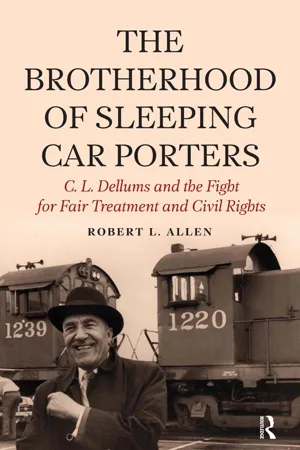
eBook - ePub
Brotherhood of Sleeping Car Porters
C. L. Dellums and the Fight for Fair Treatment and Civil Rights
- 168 pages
- English
- ePUB (mobile friendly)
- Available on iOS & Android
eBook - ePub
Brotherhood of Sleeping Car Porters
C. L. Dellums and the Fight for Fair Treatment and Civil Rights
About this book
The Brotherhood of Sleeping Car Porters created a sea of change in labour and race relations in the US. For the first time in US history, a black labour union played a central role in shaping labor and civil rights policy. Based on interviews and archival research, this new book tells the story of the union and its charismatic leader C.L. Dellums, starting from the BSCP's origins as the first national union of black workers in 1925. In 1937, the BSCP made history when it compelled one of the largest US corporations - the Pullman Company - to recognize and negotiate a contract with a black workers' union. C. L. Dellums was a leading civil rights activist as well as a labor leader. In 1948, he was chosen to be the first West Coast Regional Director of the NAACP. This book is an inspiring testament to both him and the unions transformative impact on US society.

CHAPTER 1
INTRODUCTION
Our reason for [the Brotherhood of Sleeping Car Porters union (BSCP)] going in the AF of L was because as a labor union we belonged inside. We believed then and still believe that the Negro will never really be a first-class citizen until he is in the mainstream and all of its tributaries of American life. Organized labor is one of the mainstreams of American life…. We belonged in the mainstream of the labor movement and the mission was to drive the official discrimination out. We didn’t stop the fight until the color bar was removed from every union’s constitution or ritual. So officially there was no discrimination left in the trade union movement. But obviously there was discrimination left because it is run by American white people. I haven’t found anything yet they run without discrimination—including the church. So the national mission is still here. It will not be solved in my lifetime. But I still hope to make some contribution to it.1—C. L. Dellums, 1971
For five decades Cottrell Laurence Dellums, or “C. L.” as he was known to friends and co-workers, was a key member of the national leadership team of the Brotherhood of Sleeping Car Porters union (BSCP). Dellums and the Brotherhood helped to precipitate a sea change in labor and race relations in California and the nation. Fundamental issues of unfair employment practices, discrimination, and segregation were confronted in new ways by new forces with consequences not just for the African American community but for all people. For the first time in U.S. history a black labor organization played a central role in shaping labor and civil rights policy.
The BSCP, the first national (and international) union of black workers, was founded in 1925 with A. Philip Randolph as president. C. L. Dellums, who worked as a porter in Oakland, became the West Coast organizer and was elected vice president in 1929. He held that position until 1968, when he succeeded Randolph as president. In 1937 the BSCP made history when it compelled one of the largest U.S. corporations—the Pullman Company—to recognize and negotiate a contract with a black workers’ union. This was unprecedented and almost inconceivable in the context of prior U.S. history.
In 1941, at the beginning of World War II, the leadership of the BSCP, with the support of civil rights leaders, pushed President Roosevelt to issue Executive Order 8802 requiring the ending of racial discrimination in defense industries. As a result, for the first time tens of thousands of black men and women would be hired to work alongside whites in wartime plants across the nation. California, especially, would be completely transformed by the dramatic growth of defense industries and with them the formation of new, vibrant African American communities in cities such as San Francisco, Oakland, Richmond, Vallejo, and Los Angeles—communities that would have enormous and enduring impact on the economic, social, and political fabric of the region and indeed the nation.
C. L. Dellums was not only a labor leader. In 1948 he was chosen to be the first West Coast regional director of the National Association for the Advancement of Colored People (NAACP). He also led the long struggle to get a fair employment practices law passed in California. Beginning in 1946 Dellums mobilized labor and community support for what would become a fourteen-year campaign to get the state of California to create a fair employment practices commission (FEPC) to monitor the implementation of antidiscrimination measures throughout the state. The successful struggle for the FEPC was part of the emerging era of civil rights activism and legislative initiatives in California and elsewhere.
It is difficult to overstate the importance of the BSCP and its leadership to the emergence of the modern civil rights era. Leaders of the BSCP, including Dellums in California and E. D. Nixon in Montgomery, who in 1955 helped organize the Montgomery bus boycott, brought their organizing skills to bear in the emerging struggles of the civil rights movement, giving that movement the benefit of years of experience in confronting entrenched power. Indeed, the union played a major role in organizing the 1963 march on Washington that would help secure passage of the historic 1964 Civil Rights Act. The success of the civil rights movement depended on an alliance of labor, civil rights, and other progressive forces. The BSCP was at the center of this alliance-building process, and C. L. Dellums was at the center of the BSCP. His example proved an inspiration for young civil rights workers, including his nephew, Ronald V. Dellums, who went on to become a civil rights activist, U.S. congressman, and mayor of Oakland.
Dellums and Randolph were dedicated organizers who worked extraordinarily well together as a team and they became good friends, but they had dramatically different personalities and temperaments. In comparing the reserved Randolph with pugnacious Dellums, Randolph’s biographer Jervis Anderson wrote that Dellums was “a battler from a different mold.”
Unlike Randolph, Dellums’s style was not to resist with quiet and indomitable will, but to blast away at his enemies; not to cling to principle with an unbreakable grip, but to flail away in defense of it, with his fists if necessary—like the “roughneck” he liked to call himself. Light-skinned and powerfully built, Dellums had a large, shiny, and formidable head, flashing eyes, a toothbrush mustache, and a severe unsmiling face that could look—when he wanted—as truculent as a clenched fist. Unlike Randolph, say, he was not spun from gossamer, but cut from the rough canvas of men like Ashley Totten and Milton Webster [national officers of the BSCP].2
Although he was of mixed ancestry Dellums identified strongly as an African American. He never sought any color privilege, as some light-skinned blacks did, but he was also proud of his mixed heritage. Once when he encountered a white person who boasted that his ancestors came over on the Mayflower, Dellums responded bluntly, “And my ancestors met them!”3 Dellums never shied away from a fight, and his in-your-face attitude combined with debating skills he learned in high school made him a formidable asset in the confrontation with the Pullman Company.
Dellums was a well-known figure in the African American communities of San Francisco, Oakland, and the East Bay. Thomas C. Fleming, the cofounder in 1944 with Dr. Carleton Goodlett of San Francisco’s African American Sun-Reporter newspaper, wrote of him: “Dellums made his living from a billiard parlor located across the street [Seventh Street in West Oakland], which had both pool and billiard tables. He had people running it for him. Up above, he had his office. I knew him very well. He was a handsome man and impeccably dressed. He wore a homburg hat, and his shoes were always polished. The way he spoke, you’d think he was a college professor.”4 According to Fleming, Dellums’s billiard parlor, known as The Stag, was a popular place that attracted celebrities such as the famous tap dancer Bill “Bojangles” Robinson.
Historian Robert O. Self, in American Babylon: Race and the Struggle for Postwar Oakland, declared that “C. L. Dellums was [Oakland’s] most prominent black leader and one of the most important civil rights figures in California. A dapper sophisticate who never backed off the struggle for black equality, he led the West Coast Brotherhood of Sleeping Car Porters for thirty years, and like his friend and mentor A. Philip Randolph, transcended the confines of trade unionism.”5
If Dellums could also swear like a sailor it was because he was a sailor, working on ships for several years after arriving in Oakland from his home in Corsicana, Texas. Though he at times used “rough” language, Dellums usually spoke with the diction of a lawyer, which he once hoped to become. For Dellums language was a tool to advance the struggle.
Tarea Hall Pittman, who worked closely with Dellums during the long campaign to get a fair employment practice law passed in California, was well acquainted with his speaking ability:
This ability to speak forcefully and well became C. L.’s hallmark…. Wherever he went he was solicited by his associates to be spokesman for the group seeking to make a presentation of grievances…. His deportment, his impeccable appearance, his handsome features marked by piercing hazel blue eyes added to his personal magnetism. He demanded to be heard and when he took the floor he was heard and had an uncanny ability to go straight to the heart of the issue. When there was a need to right a wrong, C. L. would represent the persecuted whatever his station in life.6
Dellums epitomized the leadership genius of the BSCP. Dellums and Randolph developed and honed a leadership philosophy and strategy that was powerful and effective. For Dellums, especially, the union was deeply embedded in the community. That is, the Brotherhood regarded the union’s concerns as community concerns and community issues as union issues, especially issues of racial discrimination. The Brotherhood was part and parcel of the African American community. Therein lay the strength of the union and the high regard for its leadership in the African American community. The Brotherhood was embedded not only in the black community in Oakland, it was organically connected—through its leadership and members, regionally and nationally—with the civil rights community, the labor movement, the progressive community and progressive leaders in churches and synagogues, civil liberties groups, and liberal politicians. Dellums was thereby able to mobilize resources for the long and hard struggle with the Pullman Company and the protracted struggle to get a fair employment practices law passed.
In his life and work, we find keys to understanding how a union successfully mobilized its members and tens of thousands of other ordinary working people to change the employment and civil rights policies of the state and the nation. As the unions of today seek to unite workers across racial and ethnic lines, and as more women of all races come into the labor movement, it is notable that community issues such as health care, child care, education, affordable housing, civil rights, immigrants’ rights, and other public policy issues are increasingly seen as union issues. For the labor movement to grow it is no longer possible to separate union issues from community issues. C. L. Dellums understood this crucial reality and he and Randolph developed a strategy for ensuring unity and mutual support between the community and the union. This is a powerful lesson for the labor movement today.
CHAPTER 2
FROM CORSICANA TO CALIFORNIA
Cottrell Dellums was born on January 3, 1900, in Corsicana, Texas. He grew up at a time when racial segregation and discrimination were the law in Texas and throughout the South. Dellums was born into a racially mixed family, and his parents were advocates for racial betterment and racial justice. His father, William, of part Native American and white ancestry, was a small businessman and civil rights activist. His mother, Emma, of similarly mixed ancestry, believed in education as the path to freedom and equality. She named her son Cottrell after a minister in her church in Corsicana. Later, in an act of self-invention, young Dellums gave himself the middle name Laurence,1 likely chosen for Paul Laurence Dunbar, a popular African American poet. Emma loved to read, and she taught her children the power of language through reading, speaking, and debating.
The Dellums family was part of a long history of intermixture between Indians, Africans, Mexicans, and whites in what is now Texas, a complex history in which generations of slavery and racial oppression were relieved by revolutionary moments (e.g., Mexican Independence, Reconstruction) that offered glimpses of racial equality. As a part of Mexico in the nineteenth century, Texas offered a refuge for runaway slaves and multiracial families seeking freedom from oppression. But those days were long past by the time Dellums was born. Instead, a rigid, two-category Jim Crow racial classification system—affirmed by the U.S. Supreme Court in 1896 when it declared that racial segregation did not violate the Fourteenth Amendment—had replaced the more fluid racial practices of New Spain and Mexico. Although racially mixed, Dellums’s parents were both classified by official documents (and self-identified) as Negroes. Consequently, young Dellums grew up within a racially segregated African American community in a white-dominated world.
People of African descent have been present in Texas since it was a part of Nueva España. The earliest recorded black presence in the region was that of Estevanico, a Moor who in 1528 came with Spanish explorers in search of gold. Alternately an enslaved person (first by the Spanish, later by Indians), an interpreter (for the Spanish), and a medicine man (among other Indians), Estevanico traversed thousands of miles of the Southwest before being killed by Zuni Indians. He was the first of thousands of enslaved Africans brought by the Spanish to provide a labor force and help settle the new colony. Sexual relations and intermarriage between Africans, Indians, and Spaniards led to the growth of substantial mixed-race populations of mulattos and mestizos.2
With its 1821 independence from Spain, and the subsequent abolition of slavery and granting of citizenship to former slaves and Indians, Mexico (including Texas) became a destination for runaway slaves, free blacks, and even a handful of interracial couples, all in search of freedom and the possibility of a good life free of harassment.3 Moreover, intermarriage—or, if not marriage, cohabitation—between blacks, Indians, and whites in Texas was not uncommon. American settlers were welcome as long as they obeyed Mexican laws. But Southern slaveholders migrated to Mexican Texas, bringing slaves. Despite Mexican laws prohibiting slavery, the Southerners were determined to turn Texas into slave territory again. With a weak central government far away in Mexico City, white settlers became increasingly powerful. By 1835 the Anglo-American immigrant population in Texas had grown to 35,000 (including 3,000 black slaves), far outnumbering the Mexican population. That year Anglo-Texans (along with some Mexicans alienated by the indifference of Mexico City toward the northern reaches of the country) staged a revolt against the Mexican government. They declared Texas to be independent as the Lone Star Republic. The new republic quickly drafted a constitution that legalized slavery and denied citizenship rights to blacks and Indians.4
But Texas was not independent for long. Many of the white settlers wanted statehood. In 1845, with the annexation of Texas by the United States, the stage was set for a war with Mexico (1846–48). The war was a disaster for Mexico. Under the Treaty of Guadalupe Hidalgo, all of northern Mexico (which included all or parts of what is now Texas, New Mexico, Arizona, California, Nevada, Utah, Wyoming, and Colorado) was ceded to the U.S. For those blacks who had sought freedom in Texas it must have seemed as though the slave system purs...
Table of contents
- Cover
- Half Title
- Title Page
- Copyright Page
- Dedication
- Table of Contents
- Acknowledgments
- Chapter 1 Introduction
- Chapter 2 From Corsicana to California
- Chapter 3 Working for Pullman
- Chapter 4 Building the Brotherhood
- Chapter 5 The Struggle against Pullman for a Contract
- Chapter 6 The NAACP, Community Struggles, and Family Life
- Chapter 7 World War II and Leveraging the Power of the Brotherhood
- Chapter 8 FEPC: Struggle and Success
- Chapter 9 A Life Lived in the Struggle
- Afterword Marva Dellums
- Notes
- References
- Index
- About the Author
Trusted by 375,005 students
Access to over 1.5 million titles for a fair monthly price.
Study more efficiently using our study tools.
Frequently asked questions
Yes, you can cancel anytime from the Subscription tab in your account settings on the Perlego website. Your subscription will stay active until the end of your current billing period. Learn how to cancel your subscription
No, books cannot be downloaded as external files, such as PDFs, for use outside of Perlego. However, you can download books within the Perlego app for offline reading on mobile or tablet. Learn how to download books offline
Perlego offers two plans: Essential and Complete
- Essential is ideal for learners and professionals who enjoy exploring a wide range of subjects. Access the Essential Library with 800,000+ trusted titles and best-sellers across business, personal growth, and the humanities. Includes unlimited reading time and Standard Read Aloud voice.
- Complete: Perfect for advanced learners and researchers needing full, unrestricted access. Unlock 1.5M+ books across hundreds of subjects, including academic and specialized titles. The Complete Plan also includes advanced features like Premium Read Aloud and Research Assistant.
We are an online textbook subscription service, where you can get access to an entire online library for less than the price of a single book per month. With over 1.5 million books across 990+ topics, we’ve got you covered! Learn about our mission
Look out for the read-aloud symbol on your next book to see if you can listen to it. The read-aloud tool reads text aloud for you, highlighting the text as it is being read. You can pause it, speed it up and slow it down. Learn more about Read Aloud
Yes! You can use the Perlego app on both iOS and Android devices to read anytime, anywhere — even offline. Perfect for commutes or when you’re on the go.
Please note we cannot support devices running on iOS 13 and Android 7 or earlier. Learn more about using the app
Please note we cannot support devices running on iOS 13 and Android 7 or earlier. Learn more about using the app
Yes, you can access Brotherhood of Sleeping Car Porters by Robert L Allen in PDF and/or ePUB format, as well as other popular books in History & Social Science Biographies. We have over 1.5 million books available in our catalogue for you to explore.