- 144 pages
- English
- ePUB (mobile friendly)
- Available on iOS & Android
eBook - ePub
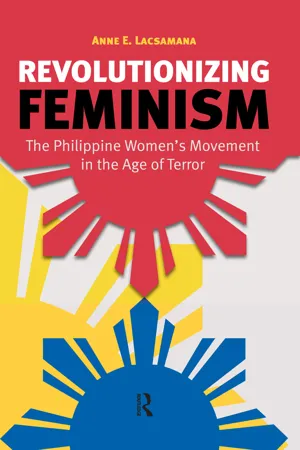
Revolutionizing Feminism
About this book
Revolutionizing Feminism offers the first feminist analysis of the human rights crisis in the Philippines during the Arroyo presidency (2001-2010) and the declaration of the country as the 'second front' in the US-led 'war on terror'. During this period over 1,000 activists, including peasants, journalists and lawyers, were murdered. Lacsamana situates Filipino women within the international division of labour, showing the connection between the 'super-exploitation' of their labour power at home and their migration abroad as domestic workers, nurses, nannies, entertainers, and 'mail-order brides'. In contrast to the cultural turn in feminist theorising that has retreated from the concepts of class and class exploitation, Revolutionizing Feminism seeks to reorient feminist scholarship in order to better understand the material realties of those living in an increasingly unstable and impoverished global south.
Information
Chapter One
STATE OF EMERGENCY
Contemporary Crisis, Historical Roots
Fear history, for no secret can be hidden from it.
—Gregoria de Jesus
For U.S. president George W. Bush and Philippine president Gloria Macapagal-Arroyo, these words of warning issued by Filipina revolutionary Gregoria de Jesus rang true on March 25, 2007, when members of the Permanent People’s Tribunal (PPT) Second Session on the Philippines found both leaders guilty of “gross and systemic violation of human rights, economic plunder, and transgression of Filipino people’s sovereignty” (www.philippinetribunal.org). A symbolic victory for anti-imperialist forces, the tribunal’s verdict was a response to the growing lawlessness and corruption that have come to typify contemporary Philippine life since the election of Macapagal-Arroyo in 2001 and the declaration of the country as the second front in the U.S.-led war on terror in 2002. To date, there have been over 1,100 extrajudicial killings and more than 200 forced disappearances of progressive activists during Arroyo’s tenure. In their verdict, members of the tribunal highlighted the dismal historical record between the United States and the Philippines, indicting the iniquitous relationship between colonizer and colonized. This latest consensus is similar to the one reached in 1980 when the tribunal convened for the First Session on the Philippines and an international panel of experts “condemned the dominant economic and political role of the United States of America in Philippines and in the region, through the implementation of an imperialist policy” (PPT 2007, 5). By highlighting both the history of U.S. interventionism in the Philippines and the collective Filipino resistance such aggression has generated, the PPT’s verdict stands in sharp contrast to prevailing academic accounts that have either declared the death of imperialism or dismissed the class character of the imperial project in favor of more cultural accounts of U.S.-Philippine relations.
The pronouncement by Michael Hardt and Antonio Negri in their widely acclaimed tome Empire that “imperialism is over” and that the “United States does not, and indeed no nation-state can today, form the center of an imperialist project” (2000, xiii–xiv) must have come as a surprise to Filipinos who have lived as U.S. neocolonial subjects since being granted “independence” in 1946. Since the September 11, 2001, attacks on the World Trade Center and the Pentagon and the inclusion of the Philippines in U.S. antiterrorism activities, U.S. militarization of the country has intensified. The Defense Department of the United States and the Department of National Defense of the Republic of the Philippines entered into the Mutual Logistics Support Agreement in 2002 and the Security Engagement Board in 2006, resulting in the deployment of thousands of U.S. soldiers as part of a countrywide “antiterror” campaign against the Abu Sayyaf.
This campaign, otherwise known as Oplan Bantay Laya (Operation Freedom Watch), has extended its reach beyond the Abu Sayyaf to include any person or organization designated a “terrorist” by the state, irrespective of its legal status. U.S. secretary of state Colin Powell justified these expansionary powers of government surveillance and aggression by the Armed Forces of the Philippines (AFP) and the U.S. military against members of the Philippine Left in this declaration on August 9, 2002: “The CPP, a Maoist group, was founded in 1969 with the aim of overthrowing the Philippine government through guerilla warfare. The CPP’s military wing, the New People’s Army, strongly opposes any U.S. military presence in the Philippines and has killed U.S. citizens there. The group has also killed, injured, or kidnapped numerous Philippine citizens, including government officials” (San Juan 2005, 1). The designation by the United States of the CPP and NPA as “terrorists” emboldened the Arroyo regime to commit widespread human rights abuses against progressive activists. As part of the indictment against the Arroyo and Bush administrations, members of the PPT cited a July 21, 2006, article by Philippine Daily Inquirer reporter Armando Doronilla in which he explained:
The blueprint of war outlined in the “orders of battle” of Oplan Bantay Laya envisages decimation of non-military segments of the communist movement. It is therefore a sinister plan for civilian butchery, a strategy which exposes the military and police to fewer risks and casualties than they would face in armed fighting with the communist guerillas. The emphasis of this strategy on “neutralizing” front/legal organizations helps explain why most of the victims of the past five years have been non-combatants and defenseless members of the left. (PPT 2007, 11–12)
The U.S. training and support of the AFP in its counterinsurgency operations are made possible by members of the “Pentagon and Central Intelligence Agency, [which have] been involved in the conceptualization, planning, [and] training of AFP personnel” (2007, 11). To suggest the end of imperialism, or deny the continuing relevance of the United States in governing world affairs, requires ignoring overwhelming evidence to the contrary. Indeed, if the crisis in the Philippines is any indication, Hardt and Negri’s thesis that imperialism has transitioned to a “decentered and deterritorializing apparatus of rule” (2000, xii) known as “empire” is untenable in light of contemporary realities.
In addition to the human rights crisis, Arroyo’s tenure was marred by widespread corruption and electoral fraud since her ascension to power following the ouster of President Joseph Estrada by a second “people power” revolution (commonly known as EDSA II). Audio recordings released in 2005 by the intelligence branch of the AFP reveal Arroyo rigging the vote with former elections commissioner Virgilio Garcillano in the now infamous “Hello, Garci” scandal. The tapes reveal Arroyo and Garcillano plotting to manipulate vote tallies by 1 million to ensure her victory over Fernando Poe Jr. In the May 2007 midterm national elections, incidences of intimidation, military-sponsored violence, and “vote-buying” were rampant throughout the country. Eyewitness accounts from delegates of the People’s International Observers’ Mission, a coalition of twenty-seven participants from twelve countries dispatched to observe the elections, concluded that there was “an intimate relationship between systemic violations of the electoral process in 2007, the ongoing socio-economic crisis in the Philippines rooted in neo-liberal economic policies and the terror of systemic extra-judicial killings” (People’s International Observers’ Mission 2007, 1). Six months later, a group of dissenting generals staged their second revolt in four years at the Peninsula Hotel in Manila, where they once again decried the legitimacy of the Arroyo administration. Although retaliation against the generals and their supporters was swift and ruthless, their publicized denunciation of the Arroyo regime resonates with some of the most recent international assessments of the country’s progress. In June 2008 the World Bank released its annual “World Governance Indicators,” which highlighted the Philippines as “having the worst corruption incidence among East Asia’s ten largest economies” (Oliveros 2008). This report came on the heels of a June 2007 editorial in the Philippine Star that revealed the country had earned the dubious distinction of being one of the “least peaceful countries in the world, ranking 100th among 121 in the first ever Global Peace Index drawn up by the Economic Intelligence Unit.” Given the violence and graft characterizing the Philippines, it is not surprising that the country is also considered to be the “weakest Asian economy after Vietnam and the most vulnerable to rising prices and global economic slowdown” (Oliveros 2008).
To understand this latest phase in Philippine history, the most violent and unstable since the Marcos dictatorship, requires situating it within the historical and unequal context of U.S.-Philippine relations. The current transformation of the country into a virtual killing field by the Arroyo administration’s nine-year reign of impunity is intimately connected to the brutal “pacification” campaign waged by the United States during the oft-forgotten Philippine-American War (1899–1902). In what is considered to be the “first Vietnam,” the United States flexed its imperial strength using a variety of murderous tactics to quell Filipino revolutionary forces. As a result, over 1 million Filipinos were killed by U.S. troops in a depopulation campaign meant to leave nothing but a “howling wilderness” in its wake.
Commenting on the viciousness of this war, historian Howard Zinn explains that “American firepower was overwhelmingly superior to anything the Filipino rebels could put together. Dead Filipinos were piled so high that the Americans used their bodies for breastworks” (1980, 309). So complete was the devastation that Mark Twain, an outspoken critic of U.S. involvement in the Philippines, lamented, “We have pacified some thousands of the islanders and buried them; destroyed their fields; burned their villages, and turned their widows and orphans out of doors; furnished heartbreak by exile to some dozens of disagreeable patriots; subjugated the remaining ten million by Benevolent Assimilation, which is the pious new name of the musket and so, by the Providences of God—and this phrase is the government’s not mine—we are a world power” (quoted in Zinn 1980, 309).
Recently, the barbarism of the Philippine-American War reappeared when news surfaced concerning the illegal use of torture by U.S. troops, specifically waterboarding, in the main theaters of the U.S.-led war on terror: Afghanistan and Iraq. Previously known as the “water cure,” the United States first “perfected” this form of torture on Filipino rebels during its colonial subjugation of the country. In 1900 a U.S. soldier described the process whereby soldiers would lay Filipinos “on their backs, a man standing on each hand and foot, then put a round stick in the mouth and pour a pail of water in the mouth and nose, and if they don’t give up pour in another pail. They swell up like toads. I’ll tell you it is a terrible torture” (Kramer 2008, 1). Twain, among other anti-imperialists, was so disgusted by the use of the water cure that he questioned the logic of government policy: “To make them confess what? Truth? Or lies? How can one know which it is they are telling? For under unendurable pain a man confesses anything that is required of him, true or false, and his evidence is worthless” (Blount 2008, 1). Although 1902 marks the “official” end of the Philippine-American War, armed conflicts between U.S. troops and Filipino citizens continued until 1913.
The traditional historical narrative concerning U.S. involvement in the Philippines has typically pointed to the drive for markets and raw materials as a central reason propelling U.S. colonialists during this period. Senator Alfred J. Beveridge’s speech on the Senate floor in 1900 confirms these aspirations: “But if they did not command China, India, the Orient, the whole Pacific for purposes of offense, defense, and trade, the Philippines are so valuable in themselves that we should hold them. The archipelago is a base for the commerce of the East. It is a base for military and naval operations against the only powers with whom conflict is possible” (Schirmer and Shalom 1987, 25–26). Two years earlier, on the eve of the Philippine-American War, Senator Henry Cabot Lodge explained to President William McKinley that “with our protective tariff wall around the Philippine Islands, its ten million inhabitants, as they advance in civilization, would have to buy our goods, and we should have so much additional market for our home manufactures” (Schirmer and Shalom 1987, 21–22). As these comments by some of the principal architects of empire in the Philippines reveal, the imperative for capitalist expansion at the beginning the twentieth century was the primary force driving U.S. annexation of the country.
Recently, however, a number of academic accounts examining U.S.-Philippine history have emerged to challenge this long-held view. In her influential work Fighting for American Manhood Kristin Hoganson acknowledges that economic “explanations provide a strong rationale for American policies in the Philippines, but they still leave questions” (1998, 13). In her estimation, capitalist motives by U.S. imperialists fail to answer how they were “able to enact their policies over the impassioned protests of anti-imperialists” and why the United States would “forsake its democratic precepts to fight a war of conquest thousand of miles away” (1998, 13). To answer these questions, Hoganson turns to gender and, more specifically, the fear of male degeneracy among U.S. policymakers at the time. Nevertheless, she cautions against simply “adding” gender to the existing historical record, preferring instead to revise the Filipino-American conflict using “gender as a basic building block” (1998, 14). Returning to some of the most notorious imperialists of the time, Senators Beveridge and Lodge, Hoganson deploys her gender analysis to illustrate that worries over “manliness” trumped economic concerns. She writes that “along with manhood, Beveridge also cared about markets, but to him they were a means to an end and not the end itself. In his estimation, the ultimate purpose of commerce was to build character” (1998, 147). For Lodge, she notes, “manly character was not [his] only motive in the Philippines. He spoke also of the ‘great markets of the East’ and ‘our share of the markets of the world.’ But to Lodge, wealth came second to character” (1998, 149). There can be no doubt that gender played a significant role in imperial conquest for both colonizer and colonized. However, to argue, as Hoganson does, that capitalist expansionism was only a mere, secondary concern when compared to preserving the manly character of white men seems difficult to comprehend given the historical and contemporary record of the Philippines.
A different approach to the subject of American “manhood” during this time period can be found in Roxanne Lynn Doty’s Imperial Encounters. In this highly original work, Doty examines and deconstructs the various representational strategies deployed by U.S. colonialists to justify annexation of the Philippines. By arguing that ideas of American manhood combined with race functioned to create a distinctly American identity that could simultaneously differentiate and connect itself with previous European colonial powers, Doty persuasively illustrates how this U.S. version of “white man” “was itself a discursive construction with no positive content, a construction whose meaning depended on the construction of its ‘other.’ ‘White man’ was never absolutely present outside a system of differences” (1996, 48). Deconstructing the discursive practices that constituted American (white) manhood, Doty reveals how differences became naturalized, thus enabling U.S. foreign policy makers to deploy “practices that led to the death of more than a million Filipinos and the subsequent denial of their right to government” (1996, 48). Thus, rather than reducing the entire Philippine-American War to fears over male degeneracy, Doty points to the manner in which gender and race were important strategies used by U.S. imperialists to ensure and justify the social, political, and economic domination of the Philippines.
In this regard, Doty’s analysis also stands apart from Paul Kramer’s The Blood of Government. Similar to Hoganson, Kramer revisits the Philippine-American War and determines that “race” was the fundamental reason behind U.S. imperialism in the Philippines. Differentiating himself from other scholarly assessments that have “emphasized the functionality of race to empire, often as ‘colonial discourse,’” Kramer asserts that his new history highlights “race as a dynamic, contextual, contested, and contingent field of power” (2006, 2). By focusing on what he calls “particular imperial indigenisms,” Kramer’s work departs from the more familiar “colonial discourse” paradigm and its attendant functionalism, which require the “organic expression of a seamless imperial project of military conquest, political control, and economic exploitation [and] its analytic exclusion of colonized peoples whose engagement—in whatever complexes of collaboration, resistance, and mediation—is deemed analytically unnecessary” (2006, 23, 21). In the specific case of U.S. colonialism in the Philippines, Kramer argues that a “novel racial formation” developed between Americans and Filipinos, thereby effectively challenging previous historical narratives that have suggested imperialist discourse was simply the “export” of U.S. racial idioms” (2006, 5). Drawing from the earlier Spanish division of the Philippines into “Christian” and “non-Christian” populations, the new racial formation, according to Kramer, blurs the line between colonizer and colonized. For example, as part of a collaboration with U.S. officials during the colonial period, Filipino elites would often distance themselves from the “non-Christian” population, signaling to Kramer the emergence of an “internal empire” among Hispanicized Filipinos (2006, 5). The various actions of the elites, whom Kramer labels “nationalist colonialists,” reveal the way the “new racial formation was the product of intense contestation and dialogue, a joint American-Filipino venture” (2006, 435). In this rendering of U.S.-Philippine history, the inequality wrought by a brutal dehumanizing imperial regime is erased, replaced by a “mutual imbrication of American and Philippine nation-building across almost four decades of transnational encounters” (2006, 7). By limiting his analyses to the cultural lens of race, Kramer creates an illusion of reciprocity between U.S. colonialists and Filipino elites, going so far as to suggest the latter were equally invested in the colonizing process.
To be sure, Kramer’s focus on the development of a new racial formation between members of the Filipino elites and U.S. imperialists is, as alluded to earlier, a deliberate analytical move to highlight the complexity and contingency of race-making in particular historical contexts. In this respect, his work exhibits the standard characteristics of a postmodern, culturalist, revisionist history of U.S.-Philippine relations. This criticism is certainly not intended to discount the wealth of information Kramer provides readers concerning the numerous ways Filipinos were racialized during this period. Rather, this criticism means to demonstrate the very real limitations such analyses inevitably have when they fail to ground their understandings of race and/or gender within the concrete, material context of capitalist processes. Though he details the “policy of attraction” the United States deployed to ensure a compliant, collaborator class among Filipino “elites,” Kramer’s intent to illustrate their “nationalist-colonialist” aspirations flattens the deep divisions inherent within the asymmetrical relationships that make up imperialist projects. As San Juan states, “In a situation of colonialism, client-patron relationship denotes absence of reciprocity” (2000, 203). Nevertheless, in spite of the overwhelming evidence that points to the dominant role the United States has played and continues to play in the daily life of Philippine affairs, academic accounts continue to revise the historical record to offer more sanitized versions of U.S.-Philippine relations.
Using the events commemorating the fiftieth anniversary of Philippine “independence” as her backdrop in The Star Entangled Banner, Sharon Delmendo provides readers with a series of examples to illustrate the ongoing relationship between the two nations. Written shortly after the United States declared an all-out war against terror following 9/11, Delmendo revisits the Philippine-American War to argue that “many of the fraught definitions of nationalism that first emerged during the beginning of the United States’ entanglement in the Philippines have reemerged as timely and crucial for articulations of American national identity” (2004, 2). The evolution of U.S. nationalism, according to Delmendo, is intimately connected to the development of Philippine nationalism and vice versa. Unlike studies that have failed to acknowledge how U.S. and Philippine nationalisms have been “more deeply knotted together in a dynamic both more mutually indebted to and repudiating of each other,” Delmendo’s text seeks to illuminate the way “Filipino and American nationalisms have been most intertwined, even mutually constitutive” (2004, 20) of each other. Reminiscent of Kramer, Delmendo neutralizes the unequal relationship between colonizer and colonized because the “Philippine-American engagement has never been one of simple conquest or resistance successful or not, but one of mutual cultural and ideological entanglement that as yet has not been adequately appreciated” (2004, 20). The so-called mutuality between the two nations is best exemplified for Delmendo when the Philippine and American flags became entangled during the celebration of Philippine “independence.”
Drawing on the work of Benedict Anderson’s Imagined Communities (1983), Delmendo creates her own theoretical model of nationalism based on “identity, values, and the state” to expose Philippine and U.S. “co-created” nationalisms (2004, 14, 16). Analytically, Delmendo’s framework for understanding “nationalism” casts the United States and the Philippines in the roles of diplomatic “partners” working in a synergistic relationship based on joint goals and commensurate visions. Erasing the very real differences between U.S. imperialism and Filipino anti-imperialist nationalism (what she describes as “anti-Americanism”), Delmendo cleanses the historical record, neutering the colonialist ambitions of the United States.
Nowhere is this more evident than in her concluding chapter, where she recounts the horrors of Samar when U.S. general Jacob Smith ordered his troops to reduce the island to a “howling wilderness.” The Samar campaign, particularly Smith’s directive to kill everyone above the age of ten, has been widely referenced by scholars seeking to highlight the brutality of U.S. colonialism. Reexamining the event to produce a more “balanced” version, however, Delmendo points to inaccuracies on both sides of the historical landscape. On the one hand, the alleged attack and dismemberment of the U.S. soldiers making...
Table of contents
- Cover
- Half Title
- Title
- Copyright
- Dedication
- Contents
- Acknowledgments
- Introduction
- 1 State of Emergency: Contemporary Crisis, Historical Roots
- 2 Notes on the “Woman Question”: Nationalist Feminism in the Philippines
- 3 From Balikbayans to “Supermaids”: The Gendering of the Philippine Export State
- 4 Prostituted Women: Revisiting the Sex Work Debates in Feminist Theory
- 5 Empire on Trial: The Subic Rape Case and the Struggle for Philippine Women’s Liberation
- Conclusion
- Bibliography
- Index
- About the Author
Trusted by 375,005 students
Access to over 1.5 million titles for a fair monthly price.
Study more efficiently using our study tools.
Frequently asked questions
Yes, you can cancel anytime from the Subscription tab in your account settings on the Perlego website. Your subscription will stay active until the end of your current billing period. Learn how to cancel your subscription
No, books cannot be downloaded as external files, such as PDFs, for use outside of Perlego. However, you can download books within the Perlego app for offline reading on mobile or tablet. Learn how to download books offline
Perlego offers two plans: Essential and Complete
- Essential is ideal for learners and professionals who enjoy exploring a wide range of subjects. Access the Essential Library with 800,000+ trusted titles and best-sellers across business, personal growth, and the humanities. Includes unlimited reading time and Standard Read Aloud voice.
- Complete: Perfect for advanced learners and researchers needing full, unrestricted access. Unlock 1.5M+ books across hundreds of subjects, including academic and specialized titles. The Complete Plan also includes advanced features like Premium Read Aloud and Research Assistant.
We are an online textbook subscription service, where you can get access to an entire online library for less than the price of a single book per month. With over 1.5 million books across 990+ topics, we’ve got you covered! Learn about our mission
Look out for the read-aloud symbol on your next book to see if you can listen to it. The read-aloud tool reads text aloud for you, highlighting the text as it is being read. You can pause it, speed it up and slow it down. Learn more about Read Aloud
Yes! You can use the Perlego app on both iOS and Android devices to read anytime, anywhere — even offline. Perfect for commutes or when you’re on the go.
Please note we cannot support devices running on iOS 13 and Android 7 or earlier. Learn more about using the app
Please note we cannot support devices running on iOS 13 and Android 7 or earlier. Learn more about using the app
Yes, you can access Revolutionizing Feminism by Anne E. Lacsamana in PDF and/or ePUB format, as well as other popular books in Social Sciences & Human Rights. We have over 1.5 million books available in our catalogue for you to explore.