eBook - ePub
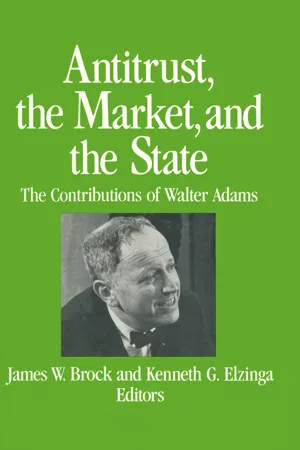
Antitrust, the Market and the State
Contributions of Walter Adams
- 320 pages
- English
- ePUB (mobile friendly)
- Available on iOS & Android
eBook - ePub
About this book
Using the metaphor of the socially constructed organization of space, this text takes a broad view of the evolution of urban America, from its historical roots to the present. It examines how policies respond to and affect the organization of space, and it looks to the future of American cities.
Fundamentals
1
Corporate Giantism, Ethics, and the Public Interest
Toward the turn of the century, in that Gilded Age which Walt Whitman called "cankered, crude, superstitious, and rotten," in that era of "flippant people with hearts of rags and souls of chalk," Lincoln Steffens reported on the ethics of city government. He found that everything the cities owned—rights, privileges, franchises, and real property—was subject to sale by the people's elected representatives. Boodling and corruption were widespread, and their source was at the top, not the bottom of society.
In St. Louis, said Steffens, "with few exceptions, no ordinance has been passed wherein valuable privileges or franchises are granted until those interested have paid the legislators the money demanded for action in the particular case. Combines in both branches of the Municipal Assembly are formed by members sufficient in number to control legislation. To one member of this combine is delegated the authority to act for the combine, and to receive and to distribute to each member the money agreed upon as the price of his vote in support of, or opposition to, a pending measure. So long has this practice existed that such members have come to regard the receipt of money for action on pending measures as a legitimate perquisite of a legislator."1 In Pittsburgh, the machine's idea "was not to corrupt the city government, but to be it; not to hire votes in councils; but to own councilmen."2 In other cities, the pattern was substantially the same.
Most appalling about this corruption, according to Steffens, was that it involved "not thieves, gamblers, and common women, but influential citizens, capitalists, and great corporations."3 The big business man, he found, was "buying boodlers in St. Louis, defending grafters in Minneapolis, originating corruption in Pittsburgh, sharing with bosses in Philadelphia, deploring reform in Chicago, and beating good government with corruption funds in New York. He is a self-righteous fraud, this big business man," Steffens concluded. "He is the chief source of corruption, and it were a boon if he would neglect politics."4
Of course, the big business man was active not only in the government sector of the economy, but also in the private sector. While railroads and gas companies were buying valuable rights-of-way and franchises, free-wheeling, swashbuckling buccaneers were building industrial empires. In tobacco and oil, steel and agricultural machinery, enterprising, visionary architects were constructing trusts, consolidations, and holding companies. In an era of unrestrained, unregulated, rambunctious laissez-faire—when the umpire was trained only to look the other way—it is not surprising that the rules of sportsmanship and fair play were observed mainly in the breach. There were empires to be built, and the robber barons built them by fair means and foul. As the Supreme Court later found, the Tobacco Trust achieved its pre-eminence by such techniques as local price discrimination, fighting brands, bogus independents, exclusive and preclusive dealer arrangements, brand imitation, coupon and premium systems, abstention-from-competition agreements, and the utilization of monopoly profits to eliminate independents.5 To this and other trusts of the time, the objective of the competitive game was the euthanasia of competitors.
To be sure, there was an ennobling purpose behind this process. From pulpit and rostrum, in the success literature and academic liturgy, contemporary apologists explained how rugged individualism was consistent with the laws of God and nature, the process of natural selection, and the mechanics of deterministic inevitability. In the lexicon of Social Darwinism, the status quo was endowed with sacrosanct qualities, and its maintenance justified in philanthropic terms. According to the gospel of the times, as articulated by Andrew Carnegie, the man of wealth was under obligation "to set an example of modest, unostentatious living, shunning display and extravagance" and after providing for his own needs "to consider all surplus revenues which come to him simply as trust funds, which he is called upon to administer." The man of wealth, said Carnegie, must serve as "the mere agent and trustee for his poorer brethren, bringing to their service his superior wisdom, experience, and ability to administer, doing for them better than they would or could do for themselves."6 This naturalistic version of the Puritan code of worldly asceticism—this Pauline doctrine of stewardship—found spiritual reinforcement in the observation of Bishop William Lawrence that"... in the long run, it is only to the man of morality that wealth comes.... Godliness is in league with riches."7 No wonder that Carnegie presumed to speak, not for an economic class, but for an entire generation.
The Corporate “Soul”
It is both comic and tragic that, in our own day, the apologetic of managenalism is still anchored on this notion of stewardship and conscience as an ameliorator of great power. As most executives, cosmeticized by modern law or business schools, will readily explain, the age of the robber barons is gone. Their carnivorous instinct is civilized by the appearance of a social conscience—that delightful and ethereal fiction which Mr. Berle calls the corporate soul. The modern executive, we are told, is no longer animated by the archaic drive for profits; instead, he is conscious of his multiple responsibilities to the secular trinity of stockholders, workers, and consumers. In a pluralistic society, he quite appropriately has come to be possessed of a "plural" soul. As Morris Sayre, former president of the Corn Products Refining Company, put it: "An active social conscience ... and individual recognition of social responsibilities will compel us, as individuals, to test every managerial practice, measure every policy by a single yardstick. Not 'what does it mean for me' but rather 'what will this mean to my workers as people, to my customers, to my suppliers, to my stockholders, to the community in which my plant is located, to my government, to the industry of which I am a part, to the economy as a whole?"8
A.A. Berle, Jr., modern high priest of the stewardship principle, argues as follows: if only there were "a keeper of conscience, to whom appeal can be made, by whom inquiry and a fair hearing must be provided, and from whom a humanely fair decision can be had," the present concentration of economic power would not only be tolerable but workable. The corporate conscience could then function in our economy much like the royal or baronial conscience did in feudal times. It was in the 11th century, Mr. Berle reminds us, that Duke Rollo, the Northman, showed "statesmanship enough to see that justice must go with power." He made it a practice, therefore, to go "in person from place to place in Normandy, directly that all who had suffered wrong at the hand of his neighbor, or even from the Duke himself, should cry, 'Ha! Rollo!' whereupon the Duke [had to] listen to his cause, deciding it according to the law of God and good conscience." Under this system, the power of the sovereign and his lords was never disputed, but decisions were based on "conceptions of right, and morality, and justice," as well as on power. "From these even the king was not exempt."9 Could not the corporate conscience be an equally effective check on the admittedly gargantuan power of collective enterprises, industrial concentrates, and oligarchical holdings?
No detailed recitation of concentration statistics is necessary to brand this view as Kafkaesque fantasy. The doctrine, however generously one may choose to interpret it, still suffers from rather obvious and fatal defects. (1) The corporate soul, at best, is a permissive rather than compulsive control mechanism. It allows for such wide discretion as to accommodate the broadest spectrum of managerial choices. It permits action in the public interest; it does not systematically and predictably compel it. Unlike the invisible hand of Adam Smith or the heavy hand of government, it does not provide an organizing principle for social decision making. It tells no one what society wants done—what goods should be produced, in what quantities, with what techniques, and for whose consumption. In short, it does not solve the problem of allocating society's resources in accordance with society's preference scales. (2) The corporate soul offers no meaningful and practical economic guidelines. What should possessors of great market power like U.S. Steel, General Motors, or du Pont do with it? Labor wants higher wages, fringe benefits, and uninterrupted employment. Customers want fair, low, equitable, non-discriminatory prices and uninterrupted production. Stockholders want incentive-producing, i.e. higher, profits. The White House wants high production, full employment, stable prices, remunerative wages, and healthy profits. The management, in soulful contemplation, is admonished to promote equity, stability, and progress. The result, says Ben W. Lewis, is that "management—as allocator, distributor, stabilizer, trustee, conservator, prophet and chaplain, as well as manager—consults its conscience. The diagnosis of the attending psychiatrist will be 'multiple schizophrenia'—the management's personality will not be split, it will be shredded and powdered!"10 (3) The corporate soul offers no meaningful and practical ethical guidelines. In the modern economy which is a highly interdependent network of large bureaucratic organizations, and the diffusion of personal responsibility that goes with it, how are the Ten Commandments to be made a living reality? How is a code of conduct, covering the intensely personal relationship of man with his God, and man's social relationships in groups no larger than a family and an area no wider than a neighborhood—how is such a code to be made a guideline for Organization Man? "Granted," as Tawney observed, "that I should love my neighbor as myself, the questions which, under modern conditions of large-scale organization, remain for solution are, Who precisely is my neighbor? and, How exactly am I to make my love for him effective in practice?"11 (4) The corporate soul is at odds both with the Calvinist and Catholic conceptions of man. In the Calvinist view, original sin has left man totally and hopelessly depraved; he is incapable of goodness, or of influencing to the slightest degree by good works his election or reprobation. He may be saved to virtue but not by virtue. He is an abominable creature in the eyes of God—unworthy of trust, discretion, or authority. In the Catholic view, man inherits Original Sin, and though this guilt may be removed by the sacrament of baptism, he is still left with the reliquiae peccati (the remnants of sin). Even baptism, therefore, does not remove man's concupiscence—his disposition to sin.12 Either view, I think, points to the conclusion that where power is great, temptation strong, incentives enticing, and sanctions feeble, man's predisposition to corruption—to sin, if you please—will assert itself. And this makes it important that such power be under strict and effective control. (5) The corporate soul does not grapple with the question of responsibility and accountability. How and by whom are its possessors anointed? To whom are they accountable? How can they be punished for non-feasance or malfeasance? Put differently, if justice is to depend on someone shouting "Ha! Rollo!," to whom shall the cry be addressed and how is the addressee to be chosen? What if Rollo cannot hear or refuses to hear? How can he be forced to listen? How can he be forced to act? In a democracy, these questions cannot be left unanswered. (6) The corporate soul, finally, is just one of several proposals for dealing with concentrated power. Its efficacy must be measured in comparison with alternative solutions before it is embraced as a safeguard of the public interest.
The Corporate “Soul” in Action
Two recent examples should illustrate the ephemeral nature of the corporate soul as a mechanism for controlling power and safeguarding the public interest.
The “Regulated” Sector
The first, involving the award of Channel 10, Miami, by the Federal Communications Commission, deals with the regulated sector of the economy. It demonstrates that where government is the dispenser of valuable rights, the incentives and proclivities for corruption are as strong today as in the days of Lincoln Steffens. The facts of this case—as revealed by a Congressional Committee, a federal circuit court, and later by the Commission itself13—indicate that at least one member of the Commission should have disqualified himself from ruling in the case; that various applicants for Channel 10 "influenced or attempted to influence" a member of the Commission; that these applicants "directly or indirectly secured, aided, confirmed, ratified, or knew of... misconduct or improprieties in connection with the proceedings";14 in short, that the case involved a "corrupt tampering with the adjudicatory process itself."15 Commissioner Mack, later indicted for bribery for his role in this case, was approached by men who knew him since boyhood, who were credited with having gotten him into a fraternity, and who supported him in past political campaigns. One was a vice president of the Florida Power and Light Company, another an ex-Mayor of Miami who had recommended him for a State regulatory post, another the Chairman of the Florida Railroad and Public Utility Commission, another a lifelong friend who had made interest-free loans to him payable on demand. Two were U.S. Senators who had sponsored Mack for appointment to the F.C.C. Despite the surreptitious efforts of these men "to influence an official charged with the duty of deciding contested issues upon an open record in accord with basic principles of our jurisprudence,"16 however, Commissioner Mack did not disqualify himself from the proceedings. On the contrary, he ignored these improprieties which "eat at the very heart of our system of government—due process, fair play, open proceedings, unbiased, uninfluenced decision."17 (How different his conduct from that of Lord Chief Justice Coke who shortly after his appointment to the bench in 1606 told his friends and neighbors: "It is true ...
Table of contents
- Cover
- Half Title
- Title
- Copyright
- Dedication
- Contents
- Foreword
- Preface
- Part I: Fundamentals
- Part II: Selected Industry Studies
- Part III: Selected Policy Studies
- Part IV: A Public Philosophy
- Publications of Walter Adams
- Index
Trusted by 375,005 students
Access to over 1.5 million titles for a fair monthly price.
Study more efficiently using our study tools.
Frequently asked questions
Yes, you can cancel anytime from the Subscription tab in your account settings on the Perlego website. Your subscription will stay active until the end of your current billing period. Learn how to cancel your subscription
No, books cannot be downloaded as external files, such as PDFs, for use outside of Perlego. However, you can download books within the Perlego app for offline reading on mobile or tablet. Learn how to download books offline
Perlego offers two plans: Essential and Complete
- Essential is ideal for learners and professionals who enjoy exploring a wide range of subjects. Access the Essential Library with 800,000+ trusted titles and best-sellers across business, personal growth, and the humanities. Includes unlimited reading time and Standard Read Aloud voice.
- Complete: Perfect for advanced learners and researchers needing full, unrestricted access. Unlock 1.5M+ books across hundreds of subjects, including academic and specialized titles. The Complete Plan also includes advanced features like Premium Read Aloud and Research Assistant.
We are an online textbook subscription service, where you can get access to an entire online library for less than the price of a single book per month. With over 1.5 million books across 990+ topics, we’ve got you covered! Learn about our mission
Look out for the read-aloud symbol on your next book to see if you can listen to it. The read-aloud tool reads text aloud for you, highlighting the text as it is being read. You can pause it, speed it up and slow it down. Learn more about Read Aloud
Yes! You can use the Perlego app on both iOS and Android devices to read anytime, anywhere — even offline. Perfect for commutes or when you’re on the go.
Please note we cannot support devices running on iOS 13 and Android 7 or earlier. Learn more about using the app
Please note we cannot support devices running on iOS 13 and Android 7 or earlier. Learn more about using the app
Yes, you can access Antitrust, the Market and the State by James W. Brock,Kenneth G. Elzinga in PDF and/or ePUB format, as well as other popular books in Law & Business General. We have over 1.5 million books available in our catalogue for you to explore.