- 319 pages
- English
- ePUB (mobile friendly)
- Available on iOS & Android
eBook - ePub
About this book
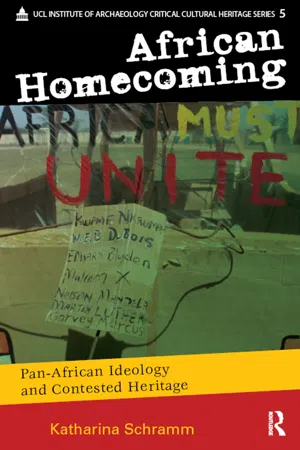
African Americans and others in the African diaspora have increasingly "come home" to Africa to visit the sites at which their ancestors were enslaved and shipped. In this nuanced analysis of homecoming, Katharina Schramm analyzes how a shared rhetoric of the (Pan-)African family is produced among African hosts and Diasporan returnees and at the same time contested in practice. She examines the varying interpretations and appropriations of significant sites (e.g. the slave forts), events (e.g. Emancipation Day) and discourses (e.g. repatriation) in Ghana to highlight these dynamics. From this, she develops her notions of diaspora, home, homecoming, memory and identity that reflect the complexity and multiple reverberations of these cultural encounters beyond the sphere of roots tourism.
Information

1 Introduction
African Diasporic Homecoming and the Ambivalence of Belonging
DOI: 10.4324/9781315435411-2
Sound scatters light through darkened ages, come to / shed the silence of a trance – / your name // bears silence past dreaming, past ages past, / past reckoning years, past recreating / past abandonment // Come over children’s voices one muted glance calls / come. Come anyway, / come one step across chasms come between // come home. (Abena P. A. Busia, “Sound Scatters Light,” in Testimonies of Exile) 1
Poetry from Busia, Abena P. A., “For ‘Freeman,’ 1988,” in Testimonies of Exile. Accra: Woeli 1990, p. 58 (P.O.B. K601; Accra New Town, Accra, Ghana).
Richard Wright’s account of his Gold Coast journey marks a broader discourse over an African (American) identity paradigm, the shape of which is not clearly delineated but rather flickering and blurry. It is uttered from a position of twofold exile. First, there is the exile of a Black American intellectual, who, just like his contemporaries James Baldwin and Louis Armstrong, took refuge from the racism of United States provenance to the seemingly more tolerant, and therefore at least tolerable, climate of cosmopolitan Paris in Europe. 2 But, as Paul Gilroy has pointed out, this relocation was not just the result of a flight from the pressures that racism had forced on him. It was also linked to a search for selfhood that would help to transcend the very boundaries of “race” in a broad, anti-imperialist alliance. Gilroy describes the idiom in which the latter desire finds its expression as the “ambivalence of community” (Gilroy 1993: 146; cf. Campbell 2006: 296–312). This ambivalence appears as a state of betwixt and between. On the one hand, there is Wright’s skepticism regarding the biological essence of the “race”-concept. Yet, on the other hand, despite such profound doubts in the physical reality of “race,” Wright acknowledges the specificity of the Black (American) situation. To Wright, this particularity is rooted in the history of the transatlantic slave trade as well as contemporary politics, and it produces the permanent challenge of situating oneself within that contextual framework.
His mixed feelings regarding the suggestion to visit Africa can therefore be traced to a second exilic proposition, namely, that of the African diasporic condition. Here, exile began with the exodus of Africans from the continent as a result of the slave trade. The biblical references that reverberate in the notion of exodus are crucial here, because they metaphorically link the fate of Black people to that of the Jews and the associated diasporic history of traumatic dispersal and eventual return to a (mythical) center or homeland. Richard Wright was cognizant of that linkage. And despite the fact that he felt continuously alienated during his journey through the Gold Coast and consequently doubted the possibility of an intrinsic connection between him and the African “homeland” and its inhabitants, the very questions that he posed at the beginning of Black Power testify to his awareness of the complex historical and political entanglement that accounted for his own presence in America, and later Europe, in the first place.
What eventually helped Wright to make the decision to venture on his African journey was primarily his interest in the radical political transformation from colonialism to freedom, for which the Gold Coast stood in 1953. Formally still a colony, the country could boast of a Black Prime Minister and an all-African cabinet. All signs suggested that full independence was within close reach. These developments were compatible with Wright’s own internationalist outlook. Being a radical modernist, he was less concerned with the idea of a spiritual reawakening that could be sought in ancient African “traditions.” In an open letter to Prime Minister Kwame Nkrumah, he therefore urged him that “african life must be militarized!” (1954: 347, original emphasis) and called on Africans to leave behind any ballast that might interfere with progress, including “tribal culture that militated against cohesiveness of action” (1954: 343).
Wright regarded the past that he saw embodied in the remnants of “tribal culture” as well as in the relics of the slave trade as a source of antagonism dividing Africans and diasporans. At the same time, however, he saw it as an ultimate point of connection from which one ought to advance into a joint future. Wright could not emphatically speak of “homecoming” to describe his experience; yet the yearning for home as a coming to terms with one’s own historical and political placement is noticeable in his writing.
More than fifty years later, after numerous people from the diaspora had traveled to Ghana or even stayed on, another African-American author published her own account of a journey through this country. Saidiya Hartman, in Lose Your Mother, ventures on a search for strangers, investigating the history of the slave trade and the impact it has made on her own (diasporic) identity. She outwardly rejects the comforting illusion of homecoming as the achievement of closure. Instead, she emphasizes the finality of rupture and loss: “Neither blood nor belonging accounted for my presence in Ghana, only the path of strangers impelled toward the sea” (2007: 7). To her, Africa and Ghana do not represent the “Motherland” in the sense of rekindled kinship but rather in the sense of the place where those kinship ties were broken and the slaves’ mothers were forever lost.
What she shares with Wright is a profound skepticism of the grandeur of African chieftaincy. Whereas Wright saw the institution as a remnant of a premodern past that needed to be overcome, Hartman contrasts the involvement of the great empires and their rulers in the slave trade with the fate of the commoners, the strangers, those who were not among the powerful—especially in the northern part of Ghana. The commonality that she seeks is with those who suffered from and fought against the slave trade; but she also accepts that this unity is not immediately recognized or to be taken for granted.
Those two journeys serve as chronological cornerstones for my narrative. Whereas Wright’s book marks the beginning of a long engagement of diasporans with independent Ghana, Hartman writes on the background of this specific history of diasporic return, especially in its late-twentieth-century guise. Return, here, should not be understood in a literal but rather in a metaphorical sense, because it is characteristic of a prominent public discourse, widespread among Ghanaian and diasporan stakeholders, that speaks of roots, kinship, shared heritage, and the possibility of a cultural and psychological renaissance. Hartman’s explicitly critical stance toward these issues makes the contours of the popular homecoming-discourse stand out even more.
African Homecoming is an investigation into how this public discourse has emerged in the first place and how it is acted out and negotiated in practice, mainly in the fields of tourism, politics, and everyday communications. Three interconnected aspects are of particular importance in this endeavor. First, there is the idea of Africa as the Motherland—an imaginary place where references to a prelapsarian past and heritage in both its bucolic as well as its glorious manifestations converge with the memory of the slave trade as traumatic rupture. Second, there is the notion of homecoming, in which diasporic identity is seemingly dissolved, yet actually affirmed. These two signifiers cumulate in a third term, namely, that of the African family, which mixes the genealogies of race and kinship and carries the ambiguities of both. When I use those emic terms, I do not take them at face value but rather aim at unraveling their contested meaning by approaching them from different angles.
My initial interest in homecoming started from the perspective of the Ghanaian nation-state and its renewed rhetorical self-location within a Pan-African setting that categorically embraced the classical African diaspora 3 as a frame of reference. The invitation to African descendants to “come home,” if articulated by an African state, extends the conceptual scope of diaspora while at the same time concretizing it. 4 Home as an imaginary place is thus thoroughly transformed, and Africa ceases to be solely an inspiration for social movement outside its geographical limits (cf. Lemelle & Kelley 1994). Instead, it is turned into a concrete site of encounter between various people and ideas. Even if the national boundaries of Ghana may be of secondary importance for the articulation of a “homing desire” (Brah 1996: 180) on part of diasporan returnees, they provide a very concrete historical and institutional framework against which this desire gets constantly checked (see Markowitz 2004: 26). Consequently, the analysis of that encounter, which the present study attempts, is tantamount to a grounding of diaspora-theory in the sphere of social interaction.
Heritage/Politics
A major theme in the affirmation of the African family is the idea of a shared heritage that extends back to the time before the transatlantic slave trade. The spectrum of identifications reaches from a tale of cultural origins in Ancient Egypt (cf. Asante 1990; Diop 1974) to the more general manifestations of an African “way of life” as it is expressed in clothes, food, and, for that matter, African values. The underlying ideology of Black commonality can be regarded as a globalized cultural form that is reiterated in various cultural, political, and religious idioms, as, for example, in Rastafarianism, Afrocentric popular culture, and the cultural nationalism of postcolonial African nation-states. Although all these expressions of Africanness rely on a shared symbolic repertoire, there is also potential for disruption and conflict, since heterogeneous actors may stake different claims on that heritage (or disagree on what it should comprise).
This dynamic of a shared rhetoric and divergent practices becomes even further complicated in the homecoming-enterprise that is under discussion here, because homecoming constitutes an arena where individual, local, national, and transnational/diasporic imaginations of belonging intersect. Heritage plays an important role on all these scales. Moreover, it “is capable of being interpreted differently within any one culture at any one time, as well as between cultures and through time” (Graham 2002: 1004). This interpretative scope and the tensions that go along with it become strikingly evident in homecoming, when cultural symbols from Ghana are recast as expressions of an authentic African heritage.
In this process of appropriating particular cultural elements from their initial contexts of production and turning them into heritage, multiple reifications occur, as artifacts and performances are first identified, then purified, objectified, and canonized as heritage (cf. Kirshenblatt-Gimblett 1998: 64; Rowlands & de Jong 2008: 24). From a multitude of cultural articulations a few have been selected to represent the repertoire of a distinctively Ghanaian national culture (see Schramm 2000a). The produced patrimony simultaneously serves purposes of political legitimation and social inclusion but also encompasses the “commodification and marketing of place products” (Ashworth & Graham 2007: 3) in the highly competitive tourism sphere. Diasporic homecoming takes place in-between those poles; it is characterized by the constant oscillation between insider and outsider perspective, cultural identification and tourist gaze, political incorporation and alienation.
In his policy-oriented analysis of the contemporary heritage industry as a whole, Gregory Ashworth has remarked that
a successful foreign heritage tourism is dependent not on the sale of the heritage of the destination country to visitors from the consumer country but, on the contrary, on the resale in a different guise of the consumers’ own heritage in an unexpected context within the destination country. (1994: 24)
In other words, in order to be satisfying, a visit must speak to the traveler’s needs and anticipations. Because homecoming builds on the assumption of a shared heritage and as such combines a personal identity quest (cf. Timothy 1997) with collective political aspirations, the congruence of expectation and experience is often overwhelming to the visitors—leading to very emotional responses. This emotional depth is also noticeable whenever there is a mismatch of imagination and reality on the ground. And the situation gets even more complicated, because the disturbing referent of the slave trade continuously disrupts any nostalgic appropriations of the past and gives rise to conflicts over adequate representation (see Dann & Seaton 2001; Handler, Gable, & Lawson 1992).
The problem of heritage display and authentication, so central to many discussions in the academic field (cf. Bruner 1994; Bruner & Kirshenblatt-Gimblett 1994; Handler & Gable 1997; Kirshenblatt-Gimblett 1998), is dealt with extensively throughout this book. Of central concern in this endeavor are the processes of meaning-making by which the past is made relevant to the present for and by different individuals and groups of people (cf. Bond & Gilliam 1994).
The official discourse of homecoming as it is articulated by diasporan visitors as well as by their Ghanaian hosts builds on an image of Africa as the source of an identity that was once whole but got suddenly and radically disturbed by the slave trade and the forced settlement of Africans in the New World. African Americans’ visit to the continent, and especially to the slave dungeons, is often presented as a chance for healing and reintegration of that fragmented (African) self. Notions of a pure African heritage play an important role in this conception of homecoming. What I am interested in are the constructive processes by which such essentialisms are produced, reaffirmed, and contested in cultural representation. If Ferdinand de Jong and Michael Rowlands state that “heritage may provide a technology for healing” (2008: 133) in postconflict societies, this book concerns the question of the scope and limits of such healing. I consequently pay attention to the inconsistencies and contradictions that unavoidably open up between rhetoric and practice. Thereby, the inner dynamics of (Pan-African) ideology can be reconstructed. In such an approach, which looks at the breaks and asks about the reasons for their occurrence, ideology ceases to be a monolithic bloc. Instead, it is understood as a creative process, which is, above all, constantly renegotiated and performed in new varieties. Thus this approach looks at the multiple ways in which people act as political, economic, social, and cultural agents. Through their actions people either affirm or oppose, even reject, the premises of ideology. Just like my interlocutors, therefore, I move beyond ideology as discourse and ask about its translation into the concrete. The multiple diasporic dimensions of homecoming play a major role in this interpretation.
Circumscribing Diaspora
In a recent article, Rogers Brubaker dem...
Table of contents
- Cover Page
- Half Title Page
- Title Page
- Copyright Page
- Table of Contents
- List of Illustrations
- Series Editor’s Foreword by Beverley Butler
- Acknowledgments
- Prologue Confronting the Past
- Chapter One Introduction: African Diasporic Homecoming and the Ambivalence of Belonging
- Chapter Two The Layout of an Ideology: Claiming the African Heritage in Early Pan-Africanism
- Chapter Three Early Connections: Pan-Africanism and Ghana’s Independence
- Chapter Four History Cast in Stone: Representing the Slave Trade at Ghana’s Forts and Castles
- Chapter Five Confronting the Past: Touring Cape Coast Castle
- Chapter Six Pilgrimage Tourism: Homecoming as a Spiritual Journey
- Chapter Seven Emancipation Day: A Route to Understanding Homecoming
- Chapter Eight “The Re-Emergence of African Civilization—Uniting the African Family”: Claiming a Common Heritage in PANAFEST
- Chapter Nine Pan-Africanism as a Resource: Contested Relationships of Belonging in the Practice of Homecoming
- Chapter Ten Conclusion
- Appendix List of Abbreviations
- Notes
- References
- Index
- About the Author
Trusted by 375,005 students
Access to over 1.5 million titles for a fair monthly price.
Study more efficiently using our study tools.
Frequently asked questions
Yes, you can cancel anytime from the Subscription tab in your account settings on the Perlego website. Your subscription will stay active until the end of your current billing period. Learn how to cancel your subscription
No, books cannot be downloaded as external files, such as PDFs, for use outside of Perlego. However, you can download books within the Perlego app for offline reading on mobile or tablet. Learn how to download books offline
Perlego offers two plans: Essential and Complete
- Essential is ideal for learners and professionals who enjoy exploring a wide range of subjects. Access the Essential Library with 800,000+ trusted titles and best-sellers across business, personal growth, and the humanities. Includes unlimited reading time and Standard Read Aloud voice.
- Complete: Perfect for advanced learners and researchers needing full, unrestricted access. Unlock 1.5M+ books across hundreds of subjects, including academic and specialized titles. The Complete Plan also includes advanced features like Premium Read Aloud and Research Assistant.
We are an online textbook subscription service, where you can get access to an entire online library for less than the price of a single book per month. With over 1.5 million books across 990+ topics, we’ve got you covered! Learn about our mission
Look out for the read-aloud symbol on your next book to see if you can listen to it. The read-aloud tool reads text aloud for you, highlighting the text as it is being read. You can pause it, speed it up and slow it down. Learn more about Read Aloud
Yes! You can use the Perlego app on both iOS and Android devices to read anytime, anywhere — even offline. Perfect for commutes or when you’re on the go.
Please note we cannot support devices running on iOS 13 and Android 7 or earlier. Learn more about using the app
Please note we cannot support devices running on iOS 13 and Android 7 or earlier. Learn more about using the app
Yes, you can access African Homecoming by Katharina Schramm in PDF and/or ePUB format, as well as other popular books in Social Sciences & Anthropology. We have over 1.5 million books available in our catalogue for you to explore.