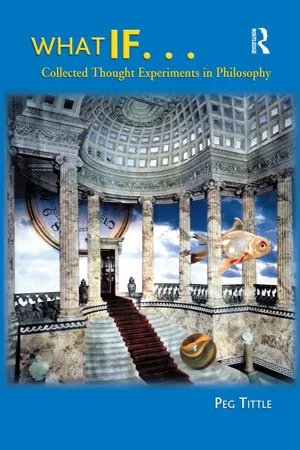
What If. . .Collected Thought Experiments in Philosophy is a brief collection of over 100 classic and contemporary "thought experiments," each exploring an important philosophical argument. These thought experiments introduce students to the kind of disciplined thought required in philosophy, and awaken their intellectual curiosity. Featuring a clear and conversational writing style that doesn't dilute the ideas, the value of the book is in its simplicity–in both format and tone. Each thought experiment is accompanied by commentary from the author that explains its importance and provides thought-provoking questions, all encapsulated on two pages.
- 256 pages
- English
- ePUB (mobile friendly)
- Available on iOS & Android
eBook - ePub
About this book
Information
ZENO’S ACHILLES
Imagine a race between a runner named Achilles and a tortoise. The tortoise is given a head start of some distance, and they both start at the same time. Achilles must, of course, first cover the distance between the starting line and the tortoise’s starting point, but during that time the tortoise will have moved ahead a bit; then Achilles must cover the distance between the tortoise’s starting point and the point to which the tortoise has moved, during which time the tortoise will have moved ahead a bit further; and so on and so on. Whenever Achilles reaches the point at which the tortoise was, the tortoise will have moved a bit further ahead, so though Achilles will continue to narrow the distance between himself and the tortoise, he will never catch up to the tortoise. But surely that can’t be right!
Furthermore, tortoise or no tortoise, Achilles will never reach the finish line for the same reason. How can that be?
Further still, before he can cover the whole distance, he must cover the first half; before he covers the first half, he must cover the first half of that; and so on. In fact, it looks like Achilles might not even get started!
Source: Attributed to Zeno, c. 500 BCE, by Aristotle. Original articulation of the problem not available; this is a composite of several contemporary articulations.
Zeno’s paradoxes (there are several) inquire into the nature of space, time, motion, continuity, and infinity. This one seems to show that motion is impossible. Or does it merely show that basic mathematics (arithmetic and geometry) can’t account for motion through time and space? (Or has Zeno simply not correctly accounted for the difference in speed or, as Lewis Carroll suggests, for the fact that the distances to be covered by Achilles are constantly diminishing in length?) Can the paradox be explained with contemporary math (calculus) and physics? If so, does that mean contemporary math and physics defy logic—or the world as we know it (in which Achilles would certainly finish the race)?
The paradox seems to arise only because reality is divided into separate parts (as advocated, for example, by the Pythagoreans). So does Zeno’s thought experiment prove, as he intended, that reality is singular and unchanging (as advocated, for example, by Parmenides)? (See “Shoemaker’s Time-Freezing World.”) Or does it, as some philosophers suggest, show that reality contains contradictions?
Perhaps the problem is inherent in the experiment itself. It postulates an infinite sequence of actions (covering half the distance, then half again, then half again), then suggests it odd that a finite action (reaching the finish line) can’t be achieved. Given the terms, is that so odd? Especially when that finite action is set at the outermost boundary of the infinite series? That is, if the point from which the first half had been calculated is set elsewhere—specifically, at a point equidistant past the finish line—then Achilles would finish. (Wouldn’t he?)
Then again, an infinite journey is not the same as an infinite number of journeys. It’s not the distance between points A and B that’s infinite, but the number of times that distance can be divided. So might Achilles complete the finite journey from starting line to finish line and, in so doing, complete the infinite number of journeys in between (the half journey, the quarter journey, the eighth journey, and so on)? (Would that be a paradox?)
Perhaps there is a confusion here between logical possibility and physical possibility. For surely, logically speaking, if Achilles can do “X” (run from one point to another), he can do “ X + 1” (run from that point to yet another), and so on. Then again, even logically speaking, how can he complete (that is, come to the end of) an infinite sequence of tasks—doesn’t “infinite” mean “without end”?
LUCRETIUS’S SPEAR
[I]f we should theorize that the whole of space were limited, then if a man ran out to the last limits and hurled a flying spear, would you prefer that, whirled by might and muscle, the spear flew on and on, as it was thrown, or do you think something would stop and block it?
Source: Lucretius. De Rerum Natura. Book I: 968–973. c. 95–55 BCE. Frank O. Copley, trans. New York: W. W. Norton, 1977. 23–24.
Part of a larger discussion about the nature of reality, this thought experiment leads Lucretius to conclude that space is infinite: on the one hand, if the spear hits a barrier or an edge, Lucretius reasoned, then there must be something beyond that edge, so space is infinite (“There can be no end to anything without something beyond to mark that end” [960–961]); on the other hand, if it doesn’t hit a barrier and the spear goes on forever, then, again, space is infinite.
Is there something wrong with Lucretius’s thought experiment? How can opposite results lead to the same conclusion? Or must his conclusion that space is infinite be accepted?
BERKELEY’S IMPOSSIBILITY OF CONCEIVING THE UNCONCEIVED
But, say you, surely there is nothing easier than for me to imagine trees, for instance, in a park, or books existing in a closet, and nobody by to perceive them. … But do not you yourself perceive or think of them all the while? This therefore is nothing to the purpose; it only shews you have the power of imagining or forming ideas in your mind: but it doth not shew that you can conceive it possible the objects of your thought may exist without the mind. To make out this, it is necessary that you conceive them existing unconceived or unthought of. … But … the mind … is deluded to think it can and doth conceive bodies existing unthought of or without the mind.
Source: George Berkeley. Of the Principles of Human Knowledge. 1710. As reprinted in The English Philosophers from Bacon to Mill. Edwin A. Burtt, ed. New York: Random House, 1939. 509–579. 530.
According to Berkeley, the result of this thought experiment—our inability to conceive of something that is unconceived—is sufficient proof against the existence of material substance. Hence his famous esse est percipi—“to be is to be perceived.” It’s not that trees and books and such disappear when we leave the room (though how would we know?)—they were never there as physical objects in the first place. (If a tree falls in the forest and there’s no one around to hear it, does it make a sound? What tree?) When we perceive an object, Berkeley says, we’re not really experiencing the object itself—we’re experiencing only our sensations. “A cherry,” for example, “is nothing but a congeries of sensible impressions, or ideas perceived by various senses, which ideas are united into one thing (or have one name given them) by the mind because they are observed to attend each other … take away the sensations of softness, moisture, redness, tartness, and you take away the cherry” (Three Dialogues Between Hylas and Philonous). The fact that an object can seem both small and large depending on how far away from it you are (or that water can seem both warm and cool depending on how hot or cold your hand is when you immerse it) suggests further that the object itself has no definite intrinsic quality; so we can’t, and shouldn’t, postulate that it actually—physically, materially—exists. Thus, Berkeley refutes materialism (the view that objects exist external to us, in space), advocating instead immaterialism.
But is it impossible to conceive the unconceived? And if so, does that prove objects don’t physically exist? If you take away the sensations, do you take away the cherry—or just the experience of the cherry?
Further, how is it, one might ask, that we all seem to have the same sensations at the same time—say, when we all walk into the wall that’s not really there? Berkeley’s answer is that there’s a god that makes it so. Postulating such a god is, to his mind, more reasonable than postulating the existence of material objects. Is it? Why? (Or why not?) And what are the moral implications for this god, and for us, if this is so—that is, if there is some god putting all our ideas into our head?
NIETZCHE’S ETERNAL RECURRENCE
What if some day or night a demon were to steal after you into your loneliest loneliness and say to you: “This life as you now live it and have lived it, you will have to live once more and innumerable times more; and there will be nothing new in it, but every pain and every joy and every thought and sigh and everything unutterably small or great in your life will have to return to you, all in the same succession and sequence—even this spider and this moonlight between the trees, and even this moment and I myself. The eternal hourglass of existence is turned upside down again and again, and you with it, speck of dust!”
Would you not throw yourself down and gnash your teeth and curse the demon who spoke thus? Or have you once experienced a tremendous moment when you would have answered him: “You are a god and never have I heard anything more divine!”
Source: Friedrich Nietzsche. The Gay Science. Section 341. 1882. Walter Kaufmann, trans. New York: Random House, 1974. 273.
While the possibility of eternal recurrence—a rather special sort of infinity—is considered by most to be (merely) an intriguing “what-if?” motivating an examination of one’s life, Nietzsche actually considered it to be “the most scientific of all hypotheses” (The Will to Power, note 55) because it follows from the denial of a god: (1) if there is no god, there is no creation or beginning, and, therefore, time is infinite; (2) the number of things and arrangements of things is finite; therefore, (3) events must repeat themselves, infinitely—hence, eternal recurrence. (Is that argument sound?)
Nietzsche expects that most people would be appalled to discover they had to live their life over and over and over again, and indeed Nietzsche himself considered eternal recurrence to be at first glance horrible. However, denying eternal recurrence is a sign of weakness, Nietzsche says, whereas accepting it requires a certain courage and strength, to say “Yes!” to life as it is, with its pain as well as its joys.
Furthermore, he says, “The question in each and every thing, ‘Do you desire this once more and innumerable times more?’” (section 341) will either crush you or lead you to transform your life—what if one were to live life as if it were to recur ete...
Table of contents
- Cover
- Title Page
- Copyright Page
- Table of Contents
- Preface
- Introduction
- Half Title
- 1 Metaphysics
- 2 Philosophy of Mind
- 3 Personal Identity
- 4 Philosophy of Language
- 5 Epistemology
- 6 Logic
- 7 Ethics
- 8 Social and Political Philosophy
- 9 Aesthetics
- 10 Just One More …
- Index by Author
- Index by Date of Publication
- Index by Keyword
Trusted by 375,005 students
Access to over 1.5 million titles for a fair monthly price.
Study more efficiently using our study tools.
Frequently asked questions
Yes, you can cancel anytime from the Subscription tab in your account settings on the Perlego website. Your subscription will stay active until the end of your current billing period. Learn how to cancel your subscription
No, books cannot be downloaded as external files, such as PDFs, for use outside of Perlego. However, you can download books within the Perlego app for offline reading on mobile or tablet. Learn how to download books offline
Perlego offers two plans: Essential and Complete
- Essential is ideal for learners and professionals who enjoy exploring a wide range of subjects. Access the Essential Library with 800,000+ trusted titles and best-sellers across business, personal growth, and the humanities. Includes unlimited reading time and Standard Read Aloud voice.
- Complete: Perfect for advanced learners and researchers needing full, unrestricted access. Unlock 1.5M+ books across hundreds of subjects, including academic and specialized titles. The Complete Plan also includes advanced features like Premium Read Aloud and Research Assistant.
We are an online textbook subscription service, where you can get access to an entire online library for less than the price of a single book per month. With over 1.5 million books across 990+ topics, we’ve got you covered! Learn about our mission
Look out for the read-aloud symbol on your next book to see if you can listen to it. The read-aloud tool reads text aloud for you, highlighting the text as it is being read. You can pause it, speed it up and slow it down. Learn more about Read Aloud
Yes! You can use the Perlego app on both iOS and Android devices to read anytime, anywhere — even offline. Perfect for commutes or when you’re on the go.
Please note we cannot support devices running on iOS 13 and Android 7 or earlier. Learn more about using the app
Please note we cannot support devices running on iOS 13 and Android 7 or earlier. Learn more about using the app
Yes, you can access What If... by Peg Tittle in PDF and/or ePUB format, as well as other popular books in Philosophy & Epistemology in Philosophy. We have over 1.5 million books available in our catalogue for you to explore.