eBook - ePub
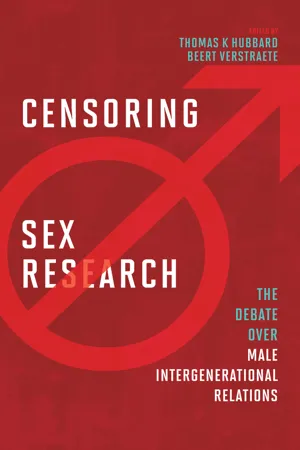
Censoring Sex Research
The Debate over Male Intergenerational Relations
- 334 pages
- English
- ePUB (mobile friendly)
- Available on iOS & Android
eBook - ePub
Censoring Sex Research
The Debate over Male Intergenerational Relations
About this book
This volume sheds light on one of the most explosive episodes of censure of academic scholarship in recent decades. Bruce Rind, a former psychology professor at Temple University, investigated sexual relations between male adults and adolescents through history and across cultures, from highly institutionalized relationships in Ancient Greece and Rome, to 33 contemporary cultures including the USA, and among various species. His conclusions that these relations, when consensual, are not always negative was radical, but based in his research findings. Even before publication of an invited article on the topic, he was subjected to intensive attacks, censured, and censored. This book presents a substantially extended version of Rind's original, unpublished article, plus 12 scholarly responses to his work that argue for or against Rind's conclusions or offer useful context on his work. For anyone interested in sex research and the academic freedom issues surrounding it, whether supportive of or vehemently opposed to Rind's ideas, this book is a must-read.
Information
Chapter 1
Pederasty: An Integration of Empirical, Historical, Sociological, Cross-Cultural, Cross-Species, and Evolutionary Evidence and Perspectives
Bruce Rind
Introduction
Pederasty, defined as sexual relations between men and adolescent boys, is severely condemned in our society. It is generally seen as just another type of child sexual abuse with equivalent effects. In particular, it is widely assumed to be a highly dysfunctional interaction between a youth and a man, intrinsically traumatizing and damaging for the former, and a reflection of severe pathology and dangerousness in the case of the latter. This thinking is strongly emotionally held and culturally entrenched, and to challenge it is to invite disbelief and attack. Yet, from a scholarly and scientific point of view, there is substantial basis for such challenge. In many other cultures across time and place, pederasty was viewed as functional, youths' successful development was attributed to the practice, and men's disposition for the behavior was considered normal and even noble. In our own society, substantial empirical evidence shows that positive response on the part of the youth does occur and is not uncommon. Finally, cross-species evidence suggests that pederasty has an evolved basis, because it is common in primates and a variety of subprimate species.
In 2005, in an invited article written for the Journal of Homosexuality, I provided a brief sketch discussing these points. The article was attacked by a right-wing website, whereupon the publisher quickly censored the article before it was put into print. But the censoring came, as well, from pressure exerted by left-leaning personnel connected with other scholarly or scientific journals, which the publisher also published. Attacks from like-thinking colleagues in my own department at the university followed, in which the article was described as "beyond the pale," even while "academic freedom" was reaffirmed as a sacred value. As anticensorship counterattacks by other scholars mounted, the publisher eventually agreed to publish a revised, more detailed article by me. When the article was completed in 2009, the new publisher of the Journal of Homosexuality refused to publish it, declining to say why, despite repeated requests, except to assert that its decision was one of "judgment," not censorship.
The politically charged atmosphere surrounding the censoring of these articles is a blot on the scientific enterprise and on scientific publishing. The articles were descriptive and explanatory, not prescriptive. They were scholarly, drawing upon widely diverse academic sources, including many articles in previous volumes of the Journal of Homosexuality. The current chapter was devised not merely to publish the suppressed evidence and conclusions, but to oppose censorship that stems from panic or political correctness. Such censorship corrupts any science topic it touches.
Caveats
The study presented in this chapter, as well as the previous two versions, deals with functional explanations for pederasty. This approach follows not only the evidence but previous scholarship, where such explanations have already been introduced. Offering functional explanations for pederasty can prompt people to write them off as advocacy for the behavior, rather than valid science. This is what happened in response to the first version of the current study. It is important to emphasize, however, that functional explanation falls in the domain of science, advocacy falls in the domain of politics, and the two are distinct and have no necessary connection. For example, Zeitzen (2008) reviewed polygamy from a cross-cultural perspective and documented that its frequent practice in many other cultures was functional under the circumstances of those cultures. Gat (2006) reviewed war from zoological, historical, anthropological, and evolutionary perspectives and concluded that, in humans, it has an evolved adaptive function. Neither author was advocating the behavior for our society, but each was offering a functional explanation for an age-old phenomenon to improve scientific understanding relative to earlier explanations that were inadequate, in part, because they were explicitly or implicitly tied to prevailing values and morals. The same applies to functional explanations for pederasty. It is an age-old phenomenon. Much evidence indicates that it has been functional within particular cultural settings, which suggests that function is an element of its nature. This conclusion takes us beyond moral discourse to improve our objective understanding of the behavior. But the conclusion is not an advocacy for the behavior in our society, whose cultural setting is very different.
To clarify these points further, it is useful to consider three fallacies discussed by Cardoso and Werner (2004). The naturalist fallacy is showing that a behavior occurs in other species and concluding that it is, therefore, moral for humans. The relativistic fallacy cites a behavior's occurrence in other cultures as morally acceptable and then concludes that it, therefore, should be moral in ours. The moralistic fallacy is the reverse of the naturalistic fallacy in that it derives what "is" from what "ought to be," but frequently in contradiction to what actually is. Accordingly, it would be fallacious to show that pederasty is commonplace in other species and other cultures and to conclude that it should be seen as moral in our society (naturalistic and relativistic fallacies). On the other hand, it is no less fallacious to begin with the fact that pederasty is seen as immoral in our society and then to read into it all sorts of pathologies that may well not be objectively true (moralistic fallacy).
For practical purposes, our society is currently so vehemently opposed to pederasty that there is little chance that it could be influenced into changing its attitudes, values, or practices regarding this behavior by arguments committing the naturalistic or relativistic fallacies. On the other hand, the moralistic fallacy is a serious problem, because it has had a dominating, biasing impact on scientific understanding of pederasty (as discussed later), which is an important rationale for this study.
Methodology
How do we judge scientifically whether a particular class of sexual behaviors is normal or abnormal, healthy or pathological? In our society several centuries ago, this task was assigned to clerics, but with the advance of medicine, clinicians became the designated authorities. As Foucault (1978) and Szasz (1990) noted, however, when the clinician replaced the cleric in this role, he merely substituted sickness for sin and did little or nothing to bring science into the classifications. Similarly, Kinsey, Pomeroy, and Martin (1948), writing decades earlier, complained that clinicians' classification of normal and abnormal sexual behavior, still in the mid-twentieth century, too often was "little more than a rationalization of the mores masquerading under the guise of objective science" (p. 203). They sharply criticized clinicians for drawing upon morals coupled with anomalous clinical and legal case studies to deduce what constituted abnormal sexual behavior across the human species.
Kinsey et al.'s (1948) remedy was to expand the database with large numbers of individuals from widely divergent segments of the general population, individuals who did not have problems by definition, as clinical patients do. Ford and Beach (1951) then argued that the scope needed even further broadening because culture so profoundly affects sexual behavior. To determine whether a pattern obtained for a particular type of sexual behavior, they conducted an extensive cross-cultural review. To determine whether observed human sexual behavior patterns were reinvented from one culture to the next or had deeper biological roots, they argued for and then conducted an extensive cross-species analysis. Bullough (1976) added that historical analysis is also essential, because it can help correct for the all-too-common bias in both lay persons and professionals of assuming that dominant sexual behavior patterns in present-day society, as well as personal preferences, are not only natural but inevitable whereas other variations are abnormal, when historical perspective may show otherwise.
The broader perspectives and approaches of Kinsey et al. (1948), Ford and Beach (1951), and Bullough (1976) contradicted clinical theorizing on abnormal sexual behavior in many areas (e.g., masturbation, homosexuality, sexual behavior among immature individuals). The broad perspective is more compatible with valid science, because it directly deals with issues of external validity (i.e., generalizability) and improves internal validity (i.e., causation) by taking into account multiple relevant factors that can influence sexual behavior patterns. Additionally, the broad perspective understands that morals are culturally constructed1 and therefore does not conflate morality with normalcy, as the narrow clinical approach too often has done (Foucault, 1978; Szasz, 1990).
To illustrate the shortcomings of the clinical approach, consider the case of homosexuality. Half a century ago, both lay persons and professionals generally reacted to homosexual behavior in adulthood with "disgust, anger, and hostility" (Hooker, 1957, p. 18), reactions deeply rooted in antihomosexual sentiments indoctrinated through centuries of Christian moral teachings (Crompton, 2003). The mainstream clinical view was that this behavior represented a "severe emotional disorder," which clinicians claimed to have verified through examinations of homosexuals obtained almost entirely from clinical, forensic, and prison settings (Hooker, 1957, p. 18). As Kinsey et al. (1948) did, Hooker argued for the need to study homosexuals outside these settings, where they were not maladjusted by definition. She recruited a convenience sample of homosexuals who had not had clinical or legal dealings, along with a matched sample of heterosexuals, and administered to them a battery of tests of psychological adjustment. She found that her homosexual subjects were as well adjusted as her heterosexual controls. She acknowledged straightforwardly that her homosexual sample was highly selected, but noted that this posed no problem, because her goal was to test the repeated claim of clinicians that all homosexuals were maladjusted. Citing Ford and Beach's (1951) cross-cultural and cross-species survey, she speculated that homosexuality may be a sexual deviation that is "within the normal range" (p. 30), and she criticized clinicians for being unable to consider or accept this possibility.
Notably, Hooker's thesis came to be more and more supported, and clinicians' pronouncements of pathology more and more discredited, as research on homosexual behavior greatly expanded after gay liberation four decades ago. This research came from nonclinical empirical, sociological, historical, cross-cultural, cross-species, and evolutionary perspectives, and its emergence was enabled by the new cultural attitude that researchers were no longer expected or obligated to verify pathology regarding homosexual behavior and to support the intervention engine of the state. That is, researchers were freed from reliance on clinical-forensic samples, where conclusions of pathology were preordained. Some of the more significant examples of this research include Dover's (1978) study of ancient Greek homosexuality, Bell, Weinberg, and Hammersmith's (1981) large-scale nonclinical empirical study critically assessing a multitude of causal explanations for homosexuality, Herdt's (1984) survey of ritualized homosexuality in Melanesia, Greenberg's (1988) historical, anthropological, and sociological review of homosexuality, Bagemihl's (1999) zoological review of homosexual behavior in hundreds of species of mammals and birds, Crompton's (2003) historical review of homosexual behavior in high civilizations, and Sommer and Vasey's (2006) collection of zoological studies accompanied by evolutionary analyses.
The studies and reviews by Hooker (1957), Kinsey et al. (1948), Ford and Beach (1951), and Bullough (1976), as well as the multitude of post-gay liberation research just discussed, offer several important lessons for examining any form of sexual behavior, even and especially those disapproved of today. First, it is erroneous to extrapolate from clinical samples to the general population (i.e., the clinical fallacy). Second, when a form of sexual behavior is shrouded in disgust stemming from moral disapproval, before assuming that disgust is a primary reaction, that the behavior is a primary pathology, and that negative correlates associated with the behavior constitute primary damage, it is important to examine other cultures with different sexual moralities and practices. Third, the broader the perspective and the empirical database are, the better the scientific judgment will be regarding the pathological or non-pathological nature of a particular sexual behavior pattern. Fourth, understanding human sexual behavior patterns can be improved through cross-species comparisons, especially with primates, particularly when there is continuity or overlap in these patterns.2 And fifth, the last point leads directly to evolutionary considerations in examining dysfunction, function, or neutrality in particular types of sexual behavior (cf. Wakefield, 1992).
Finally, it is important to emphasize that, in light of cross-cultural research on male homosexuality in societies tolerating or encouraging this behavior, and in view of the radically changed environment of widespread tolerance in our society today regarding this behavior, in which homosexual persons are often normal in adjustment or untroubled by their sexuality, it becomes clear that homosexual patients' difficulties with their sexuality in the past were not the primary effects of their homosexuality but interaction effects with a culture that severely stigmatized and disadvantaged them. For currently disapproved sexualities, it is important to take into account and distinguish between primary and interaction negative effects.
The “Harmful Dysfunction Approach” to Mental Disorder
I...
Table of contents
- Cover
- Half Title
- Title
- Copyright
- Contents
- Foreword
- Introduction
- 1. Pederasty: An Integration of Empirical, Historical, Sociological, Cross-Cultural, Cross-Species, and Evolutionary Perspectives
- 2. More Speech or Less? Censoring Social Science
- 3. Intergenerational Sexualities: A Case Study on the Colonization of Late Modern Sexual Subjects and Researcher Agendas
- 4. Blinded by Science: A Critique of Rind's Views on Pederasty
- 5. A Critique of the Academic Process and Application of Evolutionary Theory in Pederasty: An Integration of Empirical, Historical, Sociological, Cross-Cultural, Cross-Species, and Evolutionary Perspectives by Dr. Bruce Rind
- 6. Same Sex, Different Ages: On Pederasty in Gay History
- 7. "Here's to You, Mr. Robinson": Men Who Have Sexual Relations with Male Minors
- 8. Harming Children in the Name of "Child Protection": How Minors Who Have Sex with Other Minors are Abused by the Law and Therapy
- 9. The Sex Offender System: Punishing homo sacer, the New Internal Enemy
- 10. Blinded by Politics and Morality—A Reply to McAnulty and Wright
- Index
- About the Contributors
Trusted by 375,005 students
Access to over 1.5 million titles for a fair monthly price.
Study more efficiently using our study tools.
Frequently asked questions
Yes, you can cancel anytime from the Subscription tab in your account settings on the Perlego website. Your subscription will stay active until the end of your current billing period. Learn how to cancel your subscription
No, books cannot be downloaded as external files, such as PDFs, for use outside of Perlego. However, you can download books within the Perlego app for offline reading on mobile or tablet. Learn how to download books offline
Perlego offers two plans: Essential and Complete
- Essential is ideal for learners and professionals who enjoy exploring a wide range of subjects. Access the Essential Library with 800,000+ trusted titles and best-sellers across business, personal growth, and the humanities. Includes unlimited reading time and Standard Read Aloud voice.
- Complete: Perfect for advanced learners and researchers needing full, unrestricted access. Unlock 1.5M+ books across hundreds of subjects, including academic and specialized titles. The Complete Plan also includes advanced features like Premium Read Aloud and Research Assistant.
We are an online textbook subscription service, where you can get access to an entire online library for less than the price of a single book per month. With over 1.5 million books across 990+ topics, we’ve got you covered! Learn about our mission
Look out for the read-aloud symbol on your next book to see if you can listen to it. The read-aloud tool reads text aloud for you, highlighting the text as it is being read. You can pause it, speed it up and slow it down. Learn more about Read Aloud
Yes! You can use the Perlego app on both iOS and Android devices to read anytime, anywhere — even offline. Perfect for commutes or when you’re on the go.
Please note we cannot support devices running on iOS 13 and Android 7 or earlier. Learn more about using the app
Please note we cannot support devices running on iOS 13 and Android 7 or earlier. Learn more about using the app
Yes, you can access Censoring Sex Research by Thomas K Hubbard, Beert Verstraete, Thomas K Hubbard,Beert Verstraete in PDF and/or ePUB format, as well as other popular books in Social Sciences & Anthropology. We have over 1.5 million books available in our catalogue for you to explore.