Grounded in critical heritage studies and drawing on a Pacific Northwest Coast case study, Maritime Heritage in Crisis explores the causes and consequences of the contemporary destruction of Indigenous heritage sites in maritime settings. Maritime heritage landscapes are undergoing a period of unprecedented crisis: these areas are severely impacted by coastal development, continued population growth and climate change. Indigenous heritage sites are thought to be particularly vulnerable to these changes and cultural resource management is frequently positioned as a community's first line of defense, yet there is increasing evidence that this archaeological technique is an ineffective means of protection.
Exploring themes of colonial dislocation and displacement, Hutchings positions North American archaeology as neoliberal statecraft: a tool of government designed to promote and permit the systematic clearance of Indigenous heritage landscapes in advance of economic development. Presenting the institution of archaeology and cultural resource management as a grave threat to Indigenous maritime heritage, Maritime Heritage in Crisis offers an important lesson on the relationship between neoliberal heritage regimes and global ecological breakdown.
The human history of coastal regions around the world has been under assault for decades, from forces that include dam building, coastal modifications, the destruction of wetlands, marine erosion, population growth and rampant development, looting, and other processes. Global warming will exacerbate the destruction of cultural resources in coastal zones through accelerated sea level rise, intensified storm cycles, and related coastal erosion.
(Erlandson 2012: 137)
Indigenous maritime heritage is under assault worldwide, and archaeology is part of the problem, not the solution. In this book, I connect (i) the maritime heritage crisis to the global ecological crisis; (ii) archaeology to the maritime heritage crisis; and (iii) archaeology to the neoliberal state. The maritime heritage and global ecological crises are correlated insofar as they represent the same process and principle. The process is industrial capitalism, grounded in and motivated by the all-pervasive and seemingly irrepressible Western ideology of growth, development, and progress. The principle is that Western society’s current system of natural and cultural heritage stewardship—that is, “resource management,” including archaeology and cultural resource management (CRM)—is fatally flawed, for it works in service of the forces driving the crisis. For professional archaeologists, my claim approximates blasphemy. For Indigenous peoples, it approximates history.
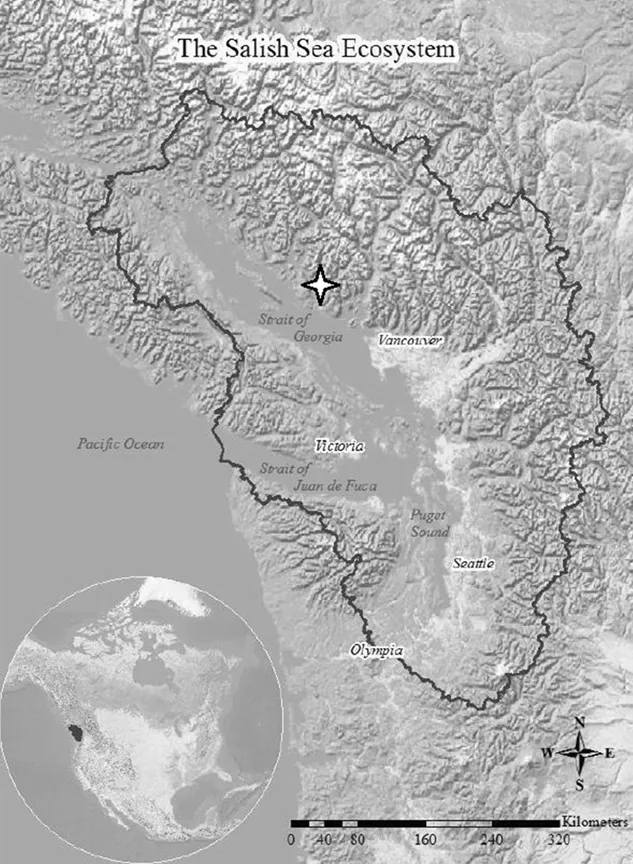
To demonstrate these connections, I examine the maritime heritage crisis as it is playing out in the Salish Sea watershed, a 110,000 kilometers2 (42,000 miles2) basin on North America’s Pacific Northwest Coast. As shown in Figure 1.1, the basin includes the major metropolitan centers of Seattle, Washington, USA, and Vancouver, British Columbia, Canada. In particular, I focus on the crisis in shíshálh (Sechelt) First Nation territory, located an hour-long ferry ride north of Vancouver, which has long been exploited by outsiders for its natural resources and recreational opportunities. Today, shíshálh First Nation territory is known to most as the “Sunshine Coast,” the product of an early real estate naming ploy aimed at drawing potential homebuyers (settlers) to the area. In connecting the shíshálh maritime heritage crisis to Vancouver, the regional center of economic power, and Victoria, the regional center of political power, I connect it to the global economy, thus the global ecological crisis.
In Chapter One, I explain my rationale for writing this book. I introduce the global ecological crisis and define maritime heritage, linking both in the context of Indigenous heritage and the “miner’s canary.” I end by discussing the book’s organization.
Figure 1.1Located in North America’s Pacific Northwest Coast, the transnational Salish Sea basin ecosystem includes the major economic centers Seattle, Washington (USA), and Vancouver, British Columbia (Canada), and political centers Olympia and Victoria, respectively. The shíshálh Coast study area, located northwest of Vancouver and denoted by the white star, is accessible only by airplane or an hour-long ferry ride.
Source: Adapted from United States Environmental Protection Agency/Environment Canada (2013).
Rationale
This study initially (and naively) set out in 2007 to “solve” the maritime heritage crisis for the Pacific Northwest Coast. The crisis, as I had originally framed it, is that sea level rise over the next century will destroy a vast number of the region’s coastal archaeological sites. As a geoarchaeologist specializing in ancient coastal change, and with my experience in coastal CRM, I felt I was well-situated to quantify and explicate this “problem.” Indeed, a mainstream “solution” to the crisis was rather easy to come by. Since the 1990s, European heritage specialists have developed a meticulously researched, seemingly rock-solid response.
Buttressed by the methods of scientific archaeology, humanized through maritime cultural landscape theory, and organized under the logic of CRM, I quickly concluded that the solution had been found. My research program was, for all intents and purposes, set to military precision: (i) phase one: Desk-top survey; (ii) phase two: Field survey; and (iii) phase three: Valuation. Then, soon after, a great unease set about me.
The disquiet emerged from the seeming normalcy and simplicity of the European model (English Heritage 2007), which has since, and not to my surprise, been imported for use in North America (Westley et al. 2011). I did not have a good grasp of why I felt it to be problematic; however, I knew it did not correlate to what I was reading and thinking at the time. Here is one example from John Bellamy Foster’s (2009: 11) book The Ecological Revolution: Making Peace with the Planet:
We live in a time in which the confrontation of reality with reason requires us to ask apocalyptic questions: Is the planet facing a major ecological collapse? Is civilization on the edge of the abyss? Is the survival of the human species itself in doubt? What makes the raising of these questions rational and necessary, today, is that scientific research is consistently telling us that if current trends continue, even for a century, the results for the earth and its inhabitants will be a collapse of the world as we know it.
Another example, this from Fathali Moghaddam’s (2010: 1) The New Global Insecurity: How Terrorism, Environmental Collapse, Economic Inequalities, and Resource Shortages Are Changing Our World, vastly complicates what it means to manage resources in the late modern period:
Hard time times bring hard questions. Calamitous wars, international terrorism, environmental degradation and global warming, interconnected global economic depression—the twenty-first century has given birth to hard times, and we now labor under hard questions. How will we manage a world severely challenged by shrinking resources, ballooning population, huge and increasing income inequalities, terrorism, torture, and environmental collapse?
Against Foster and Moghaddam, the European response seems trite because it does not allow for “hard questions” about the true scope, scale, and interconnectedness of “the problem.”
Then the proverbial lightning bolt struck, setting off an irreversible chain reaction. In 2010, I acquired a copy of Raymond Rogers’ (1998) Solving History: The Challenge of Environmental Activism, and at once my understanding of the problem began to change. “It is very clear,” writes Rogers (1998: x), that heritage problems are “not about ‘resolving issues’; they are about coming to terms with particular histories associated with modern economic development, which in turn, require a challenge directed at specific interests which have been the beneficiaries of that development.” In light of Rogers’ focus on social power, I asked: What is archaeology? What is CRM? What exactly are “resources?” And for whom, exactly, are those resources being managed? Who are the “beneficiaries?” What exactly do we mean by “management?” By “development?” What role do archaeologists and other heritage specialists/experts play in all this? Ultimately, what is “the problem?”
My fruitful engagement with Solving History induced me to dust off and reread my copy of Rogers’ (1995) The Oceans Are Emptying: Fish Wars and Sustainability. There I made the second key connection, this one more fully illuminating my aforementioned unease. Rogers identifies two different ways of thinking about heritage problems (1995: 153). The first is what he calls the “strategic, instrumental, and technical approach” (what I refer to here as the “SIT” approach). This approach is typically science- and planning-oriented and “does not call the modern human project related to science, technology and capitalism into question.” Rather, it focuses on “monitoring activities and reforming certain practices which are deemed to have negative consequences” for heritage (1995: 153). Known alternatively as the “problem-solving approach,” the SIT (and wait) approach represents the vast majority of proposed “solutions” to heritage crises. For Moghaddam, this course of “trying to find technical solutions to moral problems is misguided” (1997: 8), yet “educators—the very people who should be able to lead us out of this path of increasing specialization—have themselves fallen victim” (2010: 7).
In opposition to the SIT approach is one based on social and cultural analysis. This alternative, the “sociohistorical approach,” begins with the recognition that “the structures of everyday life and the structures that cause [heritage] problems are one and the same” (Rogers 1995: 153). It is, therefore, “all but impossible to separate what is causing [heritage] problems from the texture of a whole society.” According to Rogers:
Discussions from this perspective relate to the hegemonic domination of current realities and reject the concept that, since [heritage] problems are connected with the fabric of everyday life, it is possible to develop and maintain a regulatory perspective which can mitigate problems, since regulation itself can be part of the problem. In other words, dealing with [heritage] issues may require more than solving problems, it may be necessary to solve history by making everyday life problematic in order to deal with [heritage] problems.
(1995: 153)
Among other things, Rogers’ sociohistorical approach led me to problematize and reconsider my own “everyday life,” which then, as now, is archaeology. Further, it led me to question whether archaeology and CRM might be “part of the problem.”
As a result, I found it necessary to retheorize the institution of archaeology. This includes (re)defining archaeology as the sum of academic archaeology (theoretical archaeology) and CRM (applied archaeology). Because “[t]eaching is the act by which the culture of archaeology is reproduced” (Hutchings and La Salle 2014: 7), academic archaeologists are directly responsible for how the practice of cultural resource management unfolds—this, because “they alone discipline professional archaeologists in the skill-set of compliance” (Hutchings and La Salle 2015a: 20). My focus on the larger institution of archaeology/CRM opened the doors to a wide range of discourses around states, institutions, and heritage stewardship.
Given my position in these new uncharted waters, a fresh course was needed. It is at this point that I adopted a critical heritage approach (Biro 2011; Smith 2004). Rather than bridging geology and archaeology to understand the crisis, I began using critical theory, with its emphasis on social power, as a frame to better understand the history and context of the crisis. This new tack led me directly to the harbor that is modern capitalism. I have remained moored there ever since. It is a dark and stormy place.
Global Ecological Breakdown
The nation that destroys its soil destroys itself.
(Roosevelt 1937: n.p.)
Roosevelt’s sentiment is a powerful one, equally applicable at both national and planetary scales. Yet, landowners the world over are currently engaged in an “orgy of soil destruction so intense that, according to the UN’s Food and Agriculture Organisation, the world on average has just 60 more years of growing crops” (Monbiot 2015). Roosevelt’s sentiment is not limited to just soil.
The nation that destroys its seas destroys itself. Jeremy Jackson and Karen Alexander (2011: 2) paint this bleak picture of the state of the marine environment:
Since [1950], the oceans as we knew them have begun to die. Most of the largest fish are gone and, according to the latest conservative estimate, more than 80 percent of the world’s major industrial fisheries have crashed or are over- or fully exploited. Sports fishers pay more and more money to catch fewer and smaller fish. Apex predators like tuna, salmon, and swordfish—and the people who eat them—are increasingly full of mercury, dioxins, and PCBs. Gigantic amounts of plastic are trapped in ocean gyres, and dead zones of hypoxic waters have increased from a few dozen in the 1950s to more than four hundred today. Reef corals are dying en masse from outbreaks of bleaching and disease fueled by rising temperatures, and the acidification of surface waters due to increased carbon dioxide threatens virtually all sea life with calcareous skeletons, including corals, shellfish, and plankton.
As a result, “entire ecosystems are in danger of extinction.” Estuaries and coastal seas, along with coral reefs, are “critically endangered.”
In this book, and in light of Box 1.1, I use the term global ecological crisis to refer to the socioenvironmental consequences of the acceleration in human activity from the start of the industrial revolution in 1750 to the present day (International Geosphere?Biosphere Project 2015; Steffen et al. 2015). As the most dramatic changes have occurred since 1950, that year marks the beginning of the Great Acceleration, the period when major planetary changes became directly linked to the global economic system:
The Great Acceleration marks the phenomenal growth of the global socio-economic system, the human part of the Earth System. It is difficult to overestimate the scale and speed of change. In little over two generations—or a single lifetime—humanity (or until very recently a small fraction of it) has become a planetary-scale geological force. Hitherto human activities were insignificant compared with the biophysical Earth System, and the two could operate independently. However, it is now impossible to view one as separate from the other.
(Steffen et al. 2015: 93–4)
The Great Acceleration corresponds thematically and temporally with late modernity. An extension of modernity, it is defined by “complex, global capitalist economies and a shift from state support and welfare to the private provision of services” (Harris 2004: 3). According to James C. Scott (1998: 4), late modernity is best thought of as...
Table of contents
Cover
Half Title
Title Page
Copyright Page
Dedication
Epigraph
Table of Contents
List of Figures
List of Tables
List of Boxes
Preface
List of Abbreviations
1 The Maritime Heritage Crisis
2 Coastal Change
3 Cultural Resource Management
4 The shíshálh Coast Study
5 Problematizing the Heritage Crisis
6 Looking Forward, Looking Back
Appendix: The Club of Rome’s Forty-Nine Critical Continuous Problems
References
Index
Trusted by 375,005 students
Access to over 1.5 million titles for a fair monthly price.
Study more efficiently using our study tools.
Frequently asked questions
Yes, you can cancel anytime from the Subscription tab in your account settings on the Perlego website. Your subscription will stay active until the end of your current billing period. Learn how to cancel your subscription
No, books cannot be downloaded as external files, such as PDFs, for use outside of Perlego. However, you can download books within the Perlego app for offline reading on mobile or tablet. Learn how to download books offline
Perlego offers two plans: Essential and Complete
Essential is ideal for learners and professionals who enjoy exploring a wide range of subjects. Access the Essential Library with 800,000+ trusted titles and best-sellers across business, personal growth, and the humanities. Includes unlimited reading time and Standard Read Aloud voice.
Complete: Perfect for advanced learners and researchers needing full, unrestricted access. Unlock 1.5M+ books across hundreds of subjects, including academic and specialized titles. The Complete Plan also includes advanced features like Premium Read Aloud and Research Assistant.
Both plans are available with monthly, semester, or annual billing cycles.
We are an online textbook subscription service, where you can get access to an entire online library for less than the price of a single book per month. With over 1.5 million books across 990+ topics, we’ve got you covered! Learn about our mission
Look out for the read-aloud symbol on your next book to see if you can listen to it. The read-aloud tool reads text aloud for you, highlighting the text as it is being read. You can pause it, speed it up and slow it down. Learn more about Read Aloud
Yes! You can use the Perlego app on both iOS and Android devices to read anytime, anywhere — even offline. Perfect for commutes or when you’re on the go. Please note we cannot support devices running on iOS 13 and Android 7 or earlier. Learn more about using the app
Yes, you can access Maritime Heritage in Crisis by Richard M. Hutchings in PDF and/or ePUB format, as well as other popular books in Social Sciences & Colonialism & Post-Colonialism. We have over 1.5 million books available in our catalogue for you to explore.