Jane Austen's six complete novels and her juvenilia are examined in the context of civil society and gender. Steiner's study uses a variety of contexts to appraise Austen's work: Scottish Enlightenment theories of societal development, early-Romantic discourses on gender roles, modern sociological theories on the civilizing process.
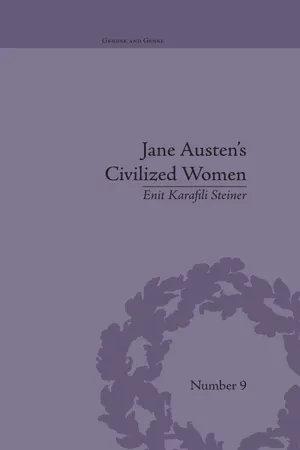
eBook - ePub
Jane Austen's Civilized Women
Morality, Gender and the Civilizing Process
- 240 pages
- English
- ePUB (mobile friendly)
- Available on iOS & Android
eBook - ePub
About this book
Information
1
The Juvenilia: Untying the Knots
Austen’s writing career started at the age of twelve. Between 1787 and 1793 and before becoming a published author, she wrote twenty-seven pieces in prose, drama and verse and organized them in three volumes to which critics now refer as the juvenilia.1 Unlike Fanny Burney, who destroyed the writings of her youth when she turned fifteen, Austen held on to her early work and revised it as late as in 1809. She clearly considered it as much a part of her artistic achievement as her mature novels. Originally, the pieces of the juvenilia were read to the family, which explains also the dedication of each production to family members and close friends.2 As Jan Fergus points out, Austen had a clear audience in mind, an intimate circle of family and friends.3 If we agree with John McAleer, the juvenilia offer a source of information about the novelist’s literary formation and ‘what interested her during a pivotal stage of her existence’.4
The juvenilia are a fitting starting point, because they lend themselves to two fundamental aspects pursued in this book: first, being composed over a period of six years, the juvenilia invite the critic to investigate the diachronic evolution of Austen’s fiction. The first aspect then can be described as the ‘processual’ character that clears away the temptation to see as a fixed state what in fact is dynamic. The ‘processual’ encourages the search for continuities between earlier and later representations, thus avoiding the pitfall of isolated considerations. It also leads to the second aspect, namely the ‘relational’ character, which testifies to the embeddedness of Austen’s juvenilia in her body of work and in the literary heritage, as well as to her relational understanding of human existence. The ‘processual’ and ‘relational’ are associated with Norbert Elias, who argues that the civilizing process needs to be approached as the self’s psychological processes or ‘psychogenesis’, as well as the collective processes of social development or in Elias’s word ‘sociogenesis’.5 In fact, what we call society is nothing but the figuration of the different functions that people have for each other, while social changes are first and foremost due to the transformation of these interrelated functions:
in this way each individual person is really tied; he is tied by living in permanent dependence on other people … And it is this network of the functions which people have for each other, it and nothing else, that we call ‘society’. It represents a special kind of sphere. Its structures are what we call ‘social structures’.6
Elias suggests that the emergence of those social structures that characterize civil society reflect the transformation of the behavioural life of individuals and of their functions within the figurations they form with each other. In The Civilizing Process: Sociogenetic and Psychogenetic Investigations, Elias traces back the rise of Western civilization by connecting the social changes recorded in history with the changes of subjectivity and intersubjectivity.
As regards the present book, the emergence of ‘civilized women’ can be traced back through the uncovering of changes in the structure of female personality and women’s positioning within the figurations they form with other humans. First, this chapter argues that the juvenilia provide the foundation for Austen’s later definition of human autonomy, because they register the profound awareness that human development operates within a figuration of human interdependencies and that the study of the structure of relations between individuals best reveals the psyche of the individual person.7 The focus on interdependencies, as Seyla Benhabib argues, considers ‘the moral point of view as the contingent achievement of interactive forms of rationality rather than as the timeless standpoint of a legislative reason’.8 This distinction is the first step towards considering Austen’s fiction as a work that looks forward to practices that regulate a more balanced gender power ratio and acknowledge particularistic claims. This kind of morality is the result of embedded and embodied moral agents who engage in interactive processes: it is dynamic, rather than static; ‘processual’ rather than fixed; ‘relational’ rather than isolated. Second, I address the relational aspect of the work and then examine how it evolves from the earliest productions of the juvenilia to the latest. In the later pieces of the juvenilia, outward bodily violence is reduced and physical threat is solely meditated, which speaks for the processual character of the three volumes, where the characters undergo stages of behavioural life that one can locate in the civilizing process. I link the reduction of violence with the increase of what Elias calls rationality, the faculty of introspection that makes possible a self-monitored (yet not self-sufficient) projection of the future. I read this as Austen’s investment in emancipatory gender politics, rather than, as influential critics have argued, as her distancing from unconventional ideas. The chapter closes with a reading of the short story ‘Henry and Eliza’, suggesting that Austen locates this emancipatory thrust in the female body whose existence needs to be interpreted and recovered through the unravelling of those discourses that under the guise of the natural place themselves beyond investigation.
Processual and Relational Consciousness
The interaction between individuals is of interest to the novelist from the start. The opening sentence of the juvenilia and the first line of ‘Frederic and Elfrida’ ushers the reader into what will be Austen’s point of departure during her entire career – the family setting: ‘The Uncle of Elfrida was the Father of Frederic; in other words, they were first cousins by the Father’s side’ (J 4). As a matter of fact, ‘Frederic and Elfrida were first cousins by the Father’s side’ would have been an easier formulation to follow, but it would have failed to convey the linkage that typifies human existence. Linkage is something that humanity has in common with literature. Ellen Martin puts forward the metonymy of literature as ‘a web of knots with people and places, events and objects, tied up in a way that lures us to untie and analyse their connections, but also guarantees that we will never complete the task’.9 On our quest for knowledge, Austen’s somewhat twisted language invites us to question, investigate and better comprehend these ties. The very opening sentence of the juvenilia implies that human identity is embedded and an accurate knowledge about it can be gained by taking into account those other subjects from whom the individual acquires knowledge. The same is implied in ‘Jack and Alice’, the second novel of the juvenilia, in which we learn that Mr Johnson ‘was determined to celebrate his next Birth day by giving a Masquerade to his Children and Freinds’ (J 13). Just as the individual is born into a family and needs it for his/her survival, so the family is situated within a neighbourhood. In ‘Amelia Webster’ numerous letters are exchanged between friends who are bound to each other by their love for their friends’ siblings. At the end, the reader can hardly keep a record of the entanglements between these young people. A similar constellation can be found in ‘Lesley Castle’ where a set of sisters are in constant correspondence with their intimate female friends. The focus on a network of relationships that shapes individual knowledge persists.
The implication here is that Austen envisions human subjectivity not in a vacuum, which is the approach of traditional theories of knowledge as opposed to non-reductionist sociological theories which build upon a knower who is embedded in a group as a subject of knowledge. According to Elias:
No one can know anything without acquiring knowledge from others. Without starting from a group of knowers sharing a common fund of knowledge and, as part of it, a group-specific language as a medium indispensable for acquiring any other knowledge, a theory of knowledge remains an artifice that is bound to mislead.10
This is also Austen’s approach to subjectivity as she explores the civilized habitus without ever losing sight of the ‘we’ that contribute to its construction. If Austen shows interest in the relationship between the ‘I’ and the ‘we’, then it is no wonder that the courtship plot has a particular appeal for her. She does this to the dismay of some feminist critics who argue that heterosexual love undermines women’s interests.11 Yet, I want to opt for another reading and explain Austen’s attention to courtship as being at once generated by self-love and love for the other. As Carol Gilligan’s felicitous phrase goes, in love ‘the “I” becomes part of a “we”, rather than erasing the sense of self, calls it fully into existence. Like voice is called forth by resonance.’12
Hence, courtship responds to the human urge of giving and receiving affection. Most of the juvenilia address the desire of young ladies for romance, which is portrayed as a legitimate drive as in the case of ‘Frederic and Elfrida’, about whom we are told that ‘Being both born in one day and being brought up at the same school, it was not wonderful that they should look on each other with something more than bare politeness’ (J 4). When Laura in ‘Love and Freindship’ learns from her servant Mary that a young gentleman and his male servant have lost their way and are asking permission to warm themselves in the cottage where Laura lives with her parents, the young heroine, full of ‘natural sensibility’, eagerly asks for her father’s permission: ‘Won’t you admit them?’ (J 107). She is granted this wish and soon afterwards leaves the cottage with the stranger forever. Not only is Laura’s sexual desire acknowledged, but so is that of her servant, Mary. In a scant sentence, we learn that her servant introduces the young gentleman to the hosts, but ‘The [male] servant she kept to herself’ (J 107). The teenage writer seems to assert in straightforward words that sexual attraction transcends social standing. Neither can it be subdued by rules of propriety as in ‘Edgar and Emma’, where the heroine has such an urge to see Edgar that she takes quite drastic actions to learn his whereabouts from his mother: ‘Mrs Willmot, you do not stir from this House till you let me know how all the rest of the family do, particularly your eldest son’ (J 36). One can hardly understand John Halperin’s dismissive treatment of this bold, admittedly too romantic a heroine, when he asserts that she ‘does little but cry’.13 Here we meet with a young girl who longs for companionship and takes the matter into her own hands. Emma bids adieu to Rousseau’s standard of female meekness or to the model of ‘damsel in distress’.
The juvenilia approve of women’s pursuing men romantically. The repression of desire for propriety’s sake is ridiculed in ‘Frederic and Elfrida’, where the lovers ‘were both determined not to transgress the rules of Propriety by owning their attachment either to the object beloved, or to any one else’ – the author’s mockery is the natural consequence of this unnatural repression (J 4). Elfrida and Frederic postpone their wedding for over eighteen years and it’s not until Elfrida witnesses Frederic’s growing partiality for a young girl – who could be his daughter – that she recurs to artifice in order to amend her wrong decision: ‘She accordingly fainted and was in such a hurry to have a succession of fainting fits, that she had scarcely patience enough to recover from one before she fell into another’ (J 12). Not only does propriety call for artifice, but it is debilitating for women because it reduces them to an existence at men’s mercy, like Elfrida who can marry only after she succeeds in awakening Frederic’s pity. As the author puts it, her fainting fits were not in vain, because when needed ‘Frederic was as bold as brass yet in other respects his heart was as soft as cotton’, soft being a notoriously feminine attribute by which Austen points up a debilitating feminization of body politics (J 12).
Most of the juvenilia’s heroines ignore the rules of propriety. In fact, most of them are bold and regard their drives as prerogatives upon which it is only natural to act. Accordingly, friendships, as well as love, happen mostly at first sight and connections are established instinctively, as best illustrated in the encounter of Laura and Sophia in ‘Love and Freindship’. The two young ladies of sensibility ‘instantly unfolded to each other the most inward Secrets of our Hearts’ (J 114, my emphasis). When they meet with an elderly man they feel ‘an instinctive Sympathy that whispered to my Heart, that he was my Grandfather’ (J 120). Of course, these are common topics of romance and I agree with Frances Beer’s remark that Laura and Sophia stand for ‘the sentimental ideal of spontaneous attachment’, which Austen makes fun of.14 Austen draws on other such topics, like the element of story-telling, where one character is asked by another to relate the story of her life. The novelist found numerous examples in the literature of her time. It suffices to mention Arabella in Lennox’s The Female Quixote (1752), who is so notoriously interested in the adventures of others that one has to invent them in order to win her friendship. Story-telling functions as an instrument of socialization in which younger women identify with more experienced ones and are taught to imbibe the rules that define a woman’s place. Yet, the fact that Austen parodies these elements does not simply mean that she rejects them. As Jan Fergus splendidly points out, this is one of ‘the most remarkable aspects of Austen’s youthful sense of herself: her ability to laugh at her most cherished feelings, to view them ironically, without relinquishing them’.15 Margaret Anne Doody advances a similar argument when analysing Charlotte Lennox’s attitude towards the genre of romance, claiming that the writer of The Female Quixote knows the genre too well and consequently enjoys it too much to simply want to ridicule it.16 In line with these interpretations, I believe that Austen’s interest goes beyond parody. Echoing Hume’s philosophy of the prevalence of feeling over reason, the spontaneity of friendship and love in the juvenilia gives voice to human drives instead of socially conditioned choices. Austen may approach these themes tongue-in-cheek, but she never abandons them.
Doody takes great pleasure in the general desire for self-gratification embodied by the heroines of the juvenilia and celebrates their universe for being one where moral punishment does not exist.17 It is true that the juvenilia are full of women who are more powerful, more assertive and entertaining than men.18 An example is Lucy in ‘Jack and Alice’ who falls for the stunning and megalomaniac Charles Adams and is ‘determined to make a bold push’ and thus writes him ‘a very kind letter, offering him with great tenderness’ her hand and heart (J 24). Not only does she assume the role of the male suitor, but she is not discouraged even after Charles’s absolute refusal, which she explains away as ‘the effect of his modesty’, a statement that delightfully anticipates Mr Collins’s proposal to Elizabeth Bennet in Pride and Prejudice, only with such reversed gender roles as can be found in the radical novels of 1790s and early 1800s (Mary Hays’s Emma in the Memoirs of Emma Courtney is one of these women who initiate romance). Another sassy example of self-gratification and lack of moral concern is Cassandra of the novel ‘The Beautiful Cassandra’ who walked alone about the town, ‘devoured six ices, refused to pay for them, knocked down the Pastry Cook and walked away’ (J 54). Far from being intimidated, she asks for the service of a hackney coach, for which she cannot pay and runs away after having placed her bonnet on the coachman’s head. Only after rambling in the streets for seven hours, does she return home to her mother’s arms whispering to herself: ‘This is a day well spent’ (J 56). A similar moral insensibility towards theft is depicted in ‘Love and Freindship’, where Sophia and Laura think it ‘a proper treatment of so vile a Wretch as Macdonald to deprive him of Money’ (J 125). Once they are caught red-handed, no feeling of guilt haunts them. On the contrary, they expect Macdonald, their pupil’s father, to ‘exculpate himself from the crime’ of having broken in on Sophia’s retirement ‘insolently’ (J 126). Eliza, in ‘Henry and Eliza’, steals a fifty-pound note from her adoptive parents and soon afterwards clandestinely marries the son-in-law-to-be of her employer, the Duchess of F. All she leaves behind is a note:
‘Madam’
‘We are married and gone’.
‘Henry and Eliza Cecil’ (J 41)
Ironically, Austen assures the readers before relating Eliza’s misfortunes that her parents’ ‘first and principal care, was to incite in her a Love of Virtue and a Hatred of Vice’ (J 38). In the light of Eliza’s adventures, this statement reveals both the limitations of such an education and the domination of inner impulses.
The appreciation of fearless female self-gratification has been prominent in the criti...
Table of contents
- Cover
- Half Title
- Title
- Copyright
- CONTENTS
- Acknowledgements
- Dedication
- Introduction
- 1 The Juvenilia: Untying the Knots
- 2 Lady Susan and Northanger Abbey: Riot in the Brain
- 3 Sense and Sensibility and Pride and Prejudice: Allowing for Difference
- 4 Mansfield Park: Emancipating ‘Puny’ Fanny Price
- 5 Emma: The Art of Quarrelling
- 6 Persuasion: Developing an ‘Elasticity of Mind’
- Afterword
- Notes
- Works Cited
- Index
Trusted by 375,005 students
Access to over 1.5 million titles for a fair monthly price.
Study more efficiently using our study tools.
Frequently asked questions
Yes, you can cancel anytime from the Subscription tab in your account settings on the Perlego website. Your subscription will stay active until the end of your current billing period. Learn how to cancel your subscription
No, books cannot be downloaded as external files, such as PDFs, for use outside of Perlego. However, you can download books within the Perlego app for offline reading on mobile or tablet. Learn how to download books offline
Perlego offers two plans: Essential and Complete
- Essential is ideal for learners and professionals who enjoy exploring a wide range of subjects. Access the Essential Library with 800,000+ trusted titles and best-sellers across business, personal growth, and the humanities. Includes unlimited reading time and Standard Read Aloud voice.
- Complete: Perfect for advanced learners and researchers needing full, unrestricted access. Unlock 1.5M+ books across hundreds of subjects, including academic and specialized titles. The Complete Plan also includes advanced features like Premium Read Aloud and Research Assistant.
We are an online textbook subscription service, where you can get access to an entire online library for less than the price of a single book per month. With over 1.5 million books across 990+ topics, we’ve got you covered! Learn about our mission
Look out for the read-aloud symbol on your next book to see if you can listen to it. The read-aloud tool reads text aloud for you, highlighting the text as it is being read. You can pause it, speed it up and slow it down. Learn more about Read Aloud
Yes! You can use the Perlego app on both iOS and Android devices to read anytime, anywhere — even offline. Perfect for commutes or when you’re on the go.
Please note we cannot support devices running on iOS 13 and Android 7 or earlier. Learn more about using the app
Please note we cannot support devices running on iOS 13 and Android 7 or earlier. Learn more about using the app
Yes, you can access Jane Austen's Civilized Women by Enit Karafili Steiner in PDF and/or ePUB format, as well as other popular books in Literature & English Literary Criticism. We have over 1.5 million books available in our catalogue for you to explore.