eBook - ePub
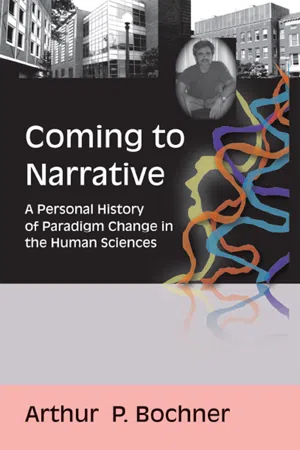
Coming to Narrative
A Personal History of Paradigm Change in the Human Sciences
- 350 pages
- English
- ePUB (mobile friendly)
- Available on iOS & Android
eBook - ePub
About this book
Reflecting on a 50 year university career, Distinguished Professor Arthur Bochner, former President of the National Communication Association, discloses a lived history, both academic and personal, that has paralleled many of the paradigm shifts in the human sciences inspired by the turn toward narrative. He shows how the human sciences—especially in his own areas of interpersonal, family, and communication theory—have evolved from sciences directed toward prediction and control to interpretive ones focused on the search for meaning through qualitative, narrative, and ethnographic modes of inquiry. He outlines the theoretical contributions of such luminaries as Bateson, Laing, Goffman, Henry, Gergen, and Richardson in this transformation. Using diverse forms of narration, Bochner seamlessly layers theory and story, interweaving his professional and personal life with the social and historical contexts in which they developed.
Information
Chapter One Drifting Toward an Academic Life
Narrative Legacies
DOI: 10.4324/9781315432090-1

I don’t seek to tell the best story. I seek to tell a story that once was. I seek to fill a place that once had meaning with meaning againBonnie Rough, “Writing Lost Stories” (2007)
“I’m Ray Tucker. I’ll be your PhD advisor, at least temporarily,” the professor says, motioning me into his office. “Come in and sit down here next to my desk.”
He’s wearing a gray suit and narrow, maroon tie, and his slick black hair is combed straight back off his forehead from ear to ear. Immediately I’m conscious of my ratty-looking jeans and T-shirt. My long, unkempt hair covers my forehead in the front and crawls down my neck in the back. I sit, crossing my legs tightly to prevent them from shaking.
“I’m honored to meet you,” I say. “I thought I’d stop by to introduce myself while I’m in town.”
“I’m glad you did, so we can get acquainted and get you ready for your first term.”
He has a broad, handsome face, a grin both inviting and natural. I appreciate his effort to relax me, but it doesn’t soften my edginess. His strong voice resonates with self-confidence, and when he speaks he looks directly into my eyes as if he’s trying to look through me. I think about what one of my graduate student cohorts at Syracuse had told me: “Tucker’s the professor you’ll want to study with at Bowling Green. His dissertation at Northwestern was directed by Donald Campbell, who wrote the definitive book on experimental design. He’s one of the top empiricists in the field.” He also warned that “Tucker has no tolerance for bullshit. He’s a quick study and very demanding.”
“What course will you be teaching in the fall?” I ask.
“I’m offering Communication Theory,” he responds. “I’ve just finished a sabbatical at Harvard, where I was introduced to cybernetics and systems theory [Bertalanffy, 1969; J. Miller, 1978; Weiner, 1954]. I want my class to dig into these areas.”
I’ve never heard of systems theory or cybernetics. I don’t want to expose my ignorance, but I better say something. “That sounds interesting,” I mumble, hoping he doesn’t ask me precisely what I think is interesting about these topics.
“So you think you may want to take my course?”
“Yes, I do.” I say, assuming no is not an option.
“I’m glad to hear that, Art, but a little surprised too,” he says, flickering an inviting smile my way. “I saw where you had coached the debate team at Syracuse University, and I know that department is strong in rhetoric and public address.” His comment makes me aware that he’s already checked into my background. I worry what that could mean: Doesn’t he want me to take his class? His cheerful grin contradicts the challenge implied by his words. Maybe I should follow his lead, be frank and direct
“I did take mostly rhetoric and public address courses at Syracuse,” I admit, “and I did well in those courses, but I’m thinking of going in a different direction for my PhD.”
“Why?”
“Frankly, I’m tired of studying dead orators, which is mostly what we did in rhetoric and public address courses. Rhetorical criticism was challenging, but I never felt as though I cared enough about the speakers or the issues. They seemed important to my professors, but they didn’t speak to my life.” I’m startled by my own words. I’ve just dismissed the vast majority of what I had studied during my master’s degree.
“You mean public address didn’t touch you where you live?”
“That’s right, it didn’t,” I acknowledge, wondering precisely what he means.
“Well, if it’s any consolation, I felt the same way when I was in graduate school. At Northwestern, they made me take a number of courses that weren’t meaningful to me. I recall complaining to my advisor about it.”
“What did he say?”
“He told me to find something that mattered to me and devote myself to it. That’s what got me through the highs and lows of my PhD program. So I give the same advice to my students. I tell them to find something they’re passionate about.” He pauses and then looks me in the eyes again. “How about you, Art? What do you really care about?”
So much for casual conversation. No beating round the bush for Ray Tucker. Our first conversation, and he wants to know what really matters to me. The question he posed would haunt me for a long time: What did I care about? Why was I here? How did I get to this place at this time?
Narrative Inheritance
My father emigrated from Eastern Europe in 1920, one of more than two million Jews who came to America in the first quarter of the twentieth century (see Cohen and Soyer, 2008; Howe, 1976). When he arrived with his father and two brothers at Ellis Island, Dad was eleven years old, penniless, and spoke no English. His father—my grandfather—went to work as a huckster, peddling fruits and vegetables by horse and buggy. Already poor in “the old country,” my father’s family confronted new forms of cultural and social impoverishment. Stigmatized by the Yiddish jargon he spoke, the odd clothing he wore, and the dirty home environment in which he lived, my father internalized deep-seated feelings of inferiority and social awkwardness that he never overcame.
A childhood of deprivation, humiliation, and discrimination took its toll. I recall stories my father told about being easily deceived and tricked by classmates. “‘Greenhorn, greenhorn,’ they would tease, and in the winter they’d throw snowballs and make fun of me,” he told me. “Greenhorn” was used derogatorily to refer to immigrants who couldn’t speak English (Cohen and Soyer, 2008). “We were considered ignorant, uncultured, and gullible.”
There was more than a grain of truth to one of my father’s favorite little jingles: “When I was young and in my prime I wasn’t worth a single dime.” At school he felt like an outsider; at home he was pressured to grow up fast and help support a family of seven riddled in poverty. “When I turned sixteen, my father insisted that I get a job and bring some money into the family,” he told me. “I dropped out of high school after tenth grade and started working full time. I learned quickly that companies like Heinz and Westinghouse wouldn’t hire Jews. I had to lie on applications in order to pass as gentile at work. I lost my job at Westinghouse because I called in sick over the High Holy Days. When I came back, they fired me for no other reason but being Jewish.”
I was born in July 1945, about the same time that news began to spread about what the Allies were finding in the European countryside: wagons full of corpses in Dachau; half-dead and sick survivors in the small camp at Buchenwald; hundreds of dead bodies lined up in front of the ruined buildings at Nordhausen; open mass graves at Bergen-Belsen (Brink, 2000; Caplan, 2009). The extent of the Nazis’ extermination camps, their solution to “the Jewish problem,” boggled the mind. It took a person’s breath away even to imagine such sadistic and coldblooded acts of brutality and evil.
Though he rarely spoke in detail about his childhood or about the Holocaust, my father taught us that hatred and persecution of Jews was common and widespread. As the son of working-class, Jewish parents, growing up in the aftermath of the Holocaust, I heard countless stories of unbearable suffering, poverty, and sacrifice. As a youngster, these stories baffled me. I felt terrible about how much suffering the people of my father’s generation and the Jews in the Holocaust had endured, and I had no doubt that Jewish people had been persecuted for centuries. Nevertheless, the schools I attended were populated mainly by Jewish children, and we lived in a predominantly Jewish neighborhood that was protected for the most part from any explicit exposure to anti-Semitism. Ironically, as one of the poorest families in the neighborhood and one of the few headed by a father who worked with his hands—my father was a self-employed sign painter—we felt singled out and looked down upon not only by Gentiles but also by the wealthier Jewish people who surrounded us. In retrospect, I see now that “greenhorns” like my father were doubly persecuted. They were not only ostracized by a mainstream culture that felt threatened by a scale of poverty never seen before in America but also by the middle-class, assimilated Jews who saw the impoverished Jewish immigrants as an embarrassment and worried that these uncultured immigrants would inspire a new wave of anti-Semitism (Baum, Hyman, and Michel, 1976).
I grew up not knowing where I belonged. A child is supposed to feel at home in his family, but I didn’t. Quite often, my parents spoke Yiddish around the house, whereas the three of us—my brother, sister, and I—never learned more than a few Yiddish expressions. Early on, my parents tried to instill in us a moral and religious Jewish sensibility. For ten years, I attended Hebrew School four days a week (after regular school hours) and Sunday school on the weekends. There I learned to read Hebrew fluently and gained thorough exposure to Jewish traditions and history. But the progressive reforms taking hold in the secular world of the Jewish community in which we lived did not reinforce what I was taught at the Hebrew Institute about being a Jew. Many of the Jews in Squirrel Hill, where we resided, were only marginally Jewish. They didn’t go to synagogue on Saturdays, adhere to Jewish dietary restrictions, or insist on a traditional Jewish education for their children. While my parents clung stubbornly to the traditions and doctrines in which they had been raised, the majority of Jewish people in my neighborhood aligned with new forms of Jewish identity that made it easier for them to move freely and inconspicuously within the non-Jewish culture in which they were immersed. They still professed to being Jewish, but theirs was a low-profile Judaism. Eventually, my parents yielded to the pressure, abandoning any attachment to the restrictive doctrines of Orthodox Judaism.
I was comfortable identifying myself as Jewish, yet I felt alienated and different from most of the other low-profile Jewish children at Taylor Allderdice High School. They wore nicer clothes, lived in bigger and more attractive homes, and got driven to and from school in expensive new cars. At school, I felt different from the other kids—poorer, less at ease with myself, more Jewish. At home, I also felt out of sync—my parents belonged to a different time and culture. My brother was five years older, and my twin sister and I too often felt more like rivals than friends. I didn’t want to be like the other kids at school, but I didn’t want to be like my parents or siblings, either.
My father passed down the despair of growing up poor, insecure, and out of place. His life revolved around work—hard, tiring, exhausting work. Ironically, working was the one pleasure he’d encountered in life. He showed little interest in recreation, leisure, or play. After all, he had witnessed the consequences of anti-Semitism and endured the Great Depression. These weren’t abstract concepts; they were lived experiences etched on his body and submerged in his unconscious. In order to survive, he shut himself off from the risk of exposure to outside influences. If he felt an obligation to his children, it was to prepare us for the harsh realities of life. When he made himself available to us, which wasn’t often, he would tell stories about the hardships endured in the “old country” and the deplorable conditions in which he and other Jewish immigrants began their lives in America.
By the time I was a senior in high school, I had heard the same family stories over and over again, and the tragic lessons of these stories had taken shape within me, however unconsciously. The moral of these stories was to be prepared to face discrimination, injustice, and suffering. Life was a problem and a struggle, not a mystery or adventure. I should expect to suffer, to fall, to face setbacks and make sacrifices. Work is what gives meaning to life. After you fall, you can rise again through hard, honest work and self-sacrifice.
I admired my father’s ability, integrity, and self-discipline, but I didn’t want to live a life anything like his. I felt terrible about the scars he carried from his childhood and respectful of the life he had toiled to make for himself and for us. As I grew older, I realized it was important not to forget that these events had occurred and the pain and suffering my parents’ generation had endured. Fortunately, I never had to face the loneliness, isolation, and estrangement that my father must have felt at every turn. But unfortunately, this difference drove a wedge between us. There simply was no way to transform my parents’ memories into my experiences. The world I was growing up in was not the same world my parents had encountered and remembered, the one that had shaped their meanings and values. My parents, especially my father, seemed to be in a perpetual state of high anxiety, just trying to get by, waiting for the next shoe to drop. They experienced little joy and showed only marginal commitment to anything other than hard work, sacrifice, and a few remaining Jewish traditions. My father often referred to himself as someone who “worked like a slave.” Unwittingly, he equated work with coercion and sacrifice, and he made a clear distinction between work and play even while showing a loving attachment and commitment to his work. “You can’t play today—you have to work,” he would say. In fact, I can’t recall ever seeing him in a playful or kibitzing state.
I didn’t want to be a slave to work. As a kid, I loved to play and hated to work. I enjoyed a good belly laugh and took great pleasure at using my wit to make other people laugh. Was there any work that could also be play, fun, or enjoyable? Would work always feel like a form of slavery and coercion, or could one love work as much as play? Could work be play? Must work always be riddled with contradictions? What choices were open to me?
An Audacious Project on the Urge for Meaning
One day, shortly after the start of my senior year in high school, I was browsing books in the library and picked a copy of Albert Camus’s The Myth of Sisyphus (1955) from the shelf. Turning to the first page, I read,
There is only one great philosophical question, suicide. Deciding whether life is worth living is to answer the fundamental question of philosophy.
Those first two sentences startled me. What makes life worth living? If this was the question fundamental to philosophy, then I wanted to be a philosopher. I felt as though Camus had seen through me, uncovering the deepest feelings and fears rumbling beneath the surface of my consciousness. Would I always feel like an outsider, unlike my parents but also different from the kids in my neighborhood with whom I grew up? In high school, I felt pressure to conform, but I never felt at ease with other kids, and my feeble attempts to fit in often ended in humiliation or shame. The social world of high school felt meaningless and alienating. I didn’t like or respect most of the other kids, so why was I trying to be like them? I didn’t want to spend the rest of my life feeling so far apart from what surrounded me, but I didn’t know what to do to feel more immersed and authentic. What made a person’s life meaningful and worth living?
I decided to write my senior thesis on Camus, an audacious choice for a seventeen-year-old, but one I eagerly embraced. When I thought about Sisyphus perpetually rolling a rock up a hill, I began to understand my father’s attachment and commitment to work in a new light. For the first time, I could appreciate the satisfaction he drew from his work. My father chose to throw himself passionately into his work in order to resist alienation, fear, and meaninglessness. Even if there was no rhyme or reason to the course of his life, he still could do something meaningful. He could work hard every day, do his best—paint beautiful signs—and exceed his clients’ expectations. He could keep the ball rolling up the hill.
“One must imagine Sisyphus happy,” wrote Camus (1955), because he continues to struggle to achieve new heights. This is what “fills one’s heart,” a human being deciding to rise above the pointless struggles of life by accepting rather than denying his plight. “Life may be tragic and absurd,” I wrote in my thesis, “but it need not be faced with pessimism or misery, not if one gains awareness that life has value in its own right. Sisyphus understands the futility of his situation, yet still expresses an intense passion for life, which makes it possible to imagine him happy. He recognizes that the only real thing is human experience.”
For Camus, all that was real—all that could be known—was what one could feel in his heart or touch in the world. There is no truth beyond experience. Every attempt at cosmic explanation is a threat to freedom. Sisyphus accepts the absurdity of his fate without reservations, acknowledging that the experience of living is all that can give life meaning, not some leap of faith designed to relieve him of the burdens of his own life. Sisyphus finds meaning in “the struggle itself.” He is not heroic but ordinary, a mythic figure representing the fate everyone must endure. His struggle—the one we all face—is a defiant battle against meaninglessness. We cannot know why we are here or what cosmic meaning the universe possesses. Fortunately, we don’t need answers to these questions to make our lives meaningful. It is what we create ourselves, what we experience and do, that gives meaning to our lives. As George Cotlin (2005, p. 228) observed in Existential America, “In this world, all that defines us as human, all that connects us to humanity or to the human condition, is our willingness, no matter the odds, to stand up for something. Only by such a commitment do we push away the absurd, if only for a moment. And only by such a commitment do we escape the imposition of alienation and find human solidarity.”
Camus gave me a framework for thinking about the connection between death and life. My only prior exposure to ideas about death and dying had come through my Hebrew education. I didn’t know what to believe. In Sunday school, my teachers taught that good Jews were God-fearing and that a Judgment Day would come, implying that the soul survives death. Beyond these lessons...
Table of contents
- Cover Page
- Half-Title Page
- Title Page
- Copyright Page
- Table of Contents
- Acknowledgments
- Preface: On the Road to Meaning
- Chapter One Drifting Toward an Academic Life: Narrative Legacies
- Chapter Two Graduate Student Socialization: On Becoming a Divided Self
- Chapter Three Staging a Dissertation: Entry into a Professor’s Way of Life
- Chapter Four Raising Consciousness and Teaching Things That Matter
- Chapter Five Double Bind: Selling Out or Risking Ruin
- Chapter Six Paradigms Shift: Dark Side of the Moon
- Chapter Seven Taking Chances
- Chapter Eight Between Obligation and Inspiration
- Chapter Nine Disconnecting and Connecting
- Chapter Ten Life's Forward Momentum
- Chapter Eleven A Twist of Fate
- Chapter Twelve Healing a Divided Self: Narrative Means to Academic Ends
- Chapter Thirteen Finishing Touches
- Epilogue Story-Truth
- References
- Index
- About the Author
Trusted by 375,005 students
Access to over 1.5 million titles for a fair monthly price.
Study more efficiently using our study tools.
Frequently asked questions
Yes, you can cancel anytime from the Subscription tab in your account settings on the Perlego website. Your subscription will stay active until the end of your current billing period. Learn how to cancel your subscription
No, books cannot be downloaded as external files, such as PDFs, for use outside of Perlego. However, you can download books within the Perlego app for offline reading on mobile or tablet. Learn how to download books offline
Perlego offers two plans: Essential and Complete
- Essential is ideal for learners and professionals who enjoy exploring a wide range of subjects. Access the Essential Library with 800,000+ trusted titles and best-sellers across business, personal growth, and the humanities. Includes unlimited reading time and Standard Read Aloud voice.
- Complete: Perfect for advanced learners and researchers needing full, unrestricted access. Unlock 1.5M+ books across hundreds of subjects, including academic and specialized titles. The Complete Plan also includes advanced features like Premium Read Aloud and Research Assistant.
We are an online textbook subscription service, where you can get access to an entire online library for less than the price of a single book per month. With over 1.5 million books across 990+ topics, we’ve got you covered! Learn about our mission
Look out for the read-aloud symbol on your next book to see if you can listen to it. The read-aloud tool reads text aloud for you, highlighting the text as it is being read. You can pause it, speed it up and slow it down. Learn more about Read Aloud
Yes! You can use the Perlego app on both iOS and Android devices to read anytime, anywhere — even offline. Perfect for commutes or when you’re on the go.
Please note we cannot support devices running on iOS 13 and Android 7 or earlier. Learn more about using the app
Please note we cannot support devices running on iOS 13 and Android 7 or earlier. Learn more about using the app
Yes, you can access Coming to Narrative by Arthur P Bochner in PDF and/or ePUB format, as well as other popular books in Languages & Linguistics & Communication Studies. We have over 1.5 million books available in our catalogue for you to explore.