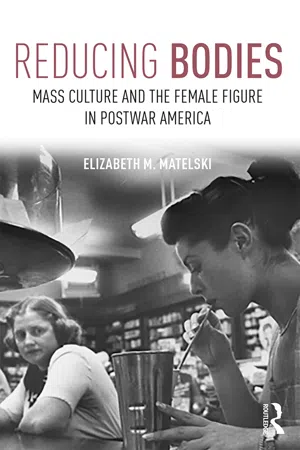
Reducing Bodies: Mass Culture and the Female Figure in Postwar America explores the ways in which women in the years following World War II refashioned their bodies—through reducing diets, exercise, and plastic surgery—and asks what insights these changing beauty standards can offer into gender dynamics in postwar America. Drawing on novel and untapped sources, including insurance industry records, this engaging study considers questions of gender, health, and race and provides historical context for the emergence of fat studies and contemporary conversations of the "obesity epidemic."
eBook - ePub
Reducing Bodies
Mass Culture and the Female Figure in Postwar America
- 176 pages
- English
- ePUB (mobile friendly)
- Available on iOS & Android
eBook - ePub
1
Creating a Cultural Ideal
The Fashion Industry and Hollywood
The disposition for looking well is ruining half the young people in the world—causing them to study their glasses, and paint or patch, instead of pursuing that which is lasting and solid—the cultivation of the mind. It is always a mark of a weak mind, if not a bad heart, to hear a person praise or blame another on the ground alone that they are handsome or homely.
—Godey’s Lady’s Book, 1831
Beauty and its pursuit have not always been considered appropriate topics of discussion. In the early nineteenth century, conversations concerning the body were deemed impolite. Women and girls preoccupied with their appearance were characterized as self-indulgent and vain. Nonetheless, dialogue surrounding ideal body types appeared in a variety of print sources, popular culture, and medical journals, such as concerns about the size of specific body parts.1
Women were particularly affected during America’s transition into a quantified weight culture, manipulating their figures through diet, fashion, and exercise. Competing models offered a spectrum of ideal body types and varying opinions about the role of fitness and weight management in achieving these desired forms. In the antebellum period, a frail, waifish woman, the subject of historian Barbara Welter’s important essay, “The Cult of True Womanhood, 1820–1860,” dominated middle- and upper-class circles.2 Referred to as the “Currier & Ives” woman or the “steel-engraved lady” by others, the ideal white woman was slight, with small hands and feet, and appeared pale and fragile. Food, femininity, and sexual appetite were inexorably linked. Etiquette books advised young women to eat scantily in public; a ravenous appetite indicated moral turpitude. Fat historian Sander Gilman notes that, already by the end of the eighteenth century, the medical community and popular culture attributed fat to a “weakness of will.”3Slimness was also a sign of social status; a physically frail and weak woman literally depended on her working husband for her livelihood.4 So popular was this physical ideal that the mid-nineteenth century witnessed the birth of contemporary anorexia nervosa.5
Although accounts of women starving themselves can be found as far back as the Middle Ages with the holy ascetics, a new kind of “fasting girl” emerged in the nineteenth century. Anorexia nervosa was the result of not only a new authority given to doctors in the period, but also larger changes in bourgeois life. The self-restraint necessary to achieve this body type was a characteristic valued in antebellum society. Food refusal and its accompanying slimness were signs of social status as thin, frail women were unfit for productive work. Additionally, advice books of the era cautioned their female readers to be careful of what and how much they ate. Hunger and gluttonous eating were connected to sexuality and desire; therefore, by demonstrating a modest appetite, a woman exhibited her own sexual virtue. Historian Joan Jacobs Brumberg makes clear that modern anorexia nervosa existed well before the mass preoccupation with reducing in the twentieth century.6 Yet, because prescriptive literature was aimed largely at young, white, middle-class women, this ideal had a limited impact. In the twentieth century this changed, however, when mass media targeted broader audiences, irrespective of class and race.
The “steel-engraving woman” of antebellum America did not command complete hegemony over female forms throughout the nineteenth century; this so-called “Victorianism” was challenged almost as soon as it appeared in the 1850s. A new wave of sensuality in the post–Civil War era brought with it new repression best illustrated by Anthony Comstock and “real” Victorianism. Moreover, a number of popular medical writers claimed that fat promoted health.7 By the 1860s, a number of alternative prototypes—each presenting a more active, vigorous model—challenged the frail, thin ideal. With the stateside appearance of the burlesque troop the British Blondes in 1868 and the mass popularity of theatrical actress Lillian Russell, a more buxom model of beauty replaced the delicate ideal in the latter half of the nineteenth century. Russell was rumored to weigh 200 pounds, but was probably closer to 165–180 pounds at the height of her career.8 These figures marked the beginnings of popular culture’s influence on women’s body esteem, beyond medical advice and prescriptive literature like Godey’s Lady’s Book. The “voluptuous” ideal waned in popularity by the late 1890s in favor of the tall, athletic “Gibson Girl,” a patrician woman popularized by the drawings of Life illustrator Charles Dana Gibson. A hybrid of the two previous body ideals, the “Gibson Girl” possessed the lithe features of the “steel-engraving lady” with the ample bust and hips of the heartier ideal. Corsets went out of fashion in favor of form-fitting dresses that encouraged slenderness. Historian Lois Banner notes that with Gibson’s figure type, America successfully challenged Europe’s control over popular standards of beauty and created a new international ideal.9 The new idyllic woman in 1894 was five foot four inches tall and weighed 140 pounds.10
Between 1890 and 1910, middle-class America initiated the battle against body fat when several factors—changing gender roles, consumerism, economic status, medicine, modernity, and mortality—simultaneously collided. Social stigma against fat predated any health concerns about “overweight” and “obesity.”11 The first penny scale appeared in the United States in 1885, transforming the way Americans thought about weight. The new weighing machine debuted in drug and grocery stores and expanded to street corners, movie theaters, banks, office buildings, railroad stations, and subways.12 With the ability to measure one’s body weight to the nearest pound, weight transitioned from a qualitative subject to a quantitative evaluation.13 273. Being fat or thin often has little to do with one’s shape or size, but rather an assumed identity directly attached to the body. America became a weight-watching culture when people increasingly believed that the body was tied to the self. Criminologists used weight to identify character types, insurance companies and actuaries tied weight to risk and mortality, and the fashion industry used weight as a litmus test for beauty.14
In 1908, Parisian designer Paul Poiret introduced a revolutionary silhouette that shifted visual interest to the legs and away from the Victorian hourglass. The result was a new ideal that featured slender, long limbs and a relatively flat chest. Women of the period bound their breasts with “correctors” or “flatteners” in attempts to appear fashionably shapeless and androgynous. Attractiveness was no longer determined by the shape of a woman’s torso, but by the appearance of her face and legs. The shortening of hemlines, resulting in a new display of the body, required that fashionable women manage their diets and practice self-discipline. Woods Hutchinson, medical professor and one-time president of the American Academy of Medicine, predicted, “The longed-for slender and boyish figure is becoming a menace, not only to the present, but also the future generations.”15 What would later be referred to as the “Flapper look” had an influence on even the most staunchly middle-class women. Rather than writing letters back home about happy weight gain and plentiful meals, as the previous generation had, young college women instead worried about gaining weight and discussed their various diet plans.16
This relatively shapeless body type remained dominant throughout the 1910s and 1920s, particularly with the popularity of boyishly framed movie actresses like Mary Pickford and Clara Bow. The new mass media of the movies disseminated beauty ideals to an even broader audience and had a particularly strong influence among teenagers and white-collar working women. The movies played a crucial role in the development of a teen girl culture that continued through the 1950s by providing feminine role models and promoting standards of fashion, beauty, language, and the body.17 Moreover, for the first time, popular serial fiction like Grace Harlow and Nancy Drew, aimed at younger girls, featured a chubby character who served as a comedic foil to the slender, well-liked protagonist.18 The 1920s also witnessed the advent of another source of beauty ideals—the Miss America pageant. The contest’s first winner, Margaret Gorman, stood at five feet one inch and weighed 108 pounds. Sixty years later, Gorman’s beauty queen counterparts weighed approximately the same, but were five inches taller with waists three inches smaller.19
Hemlines fell and narrow waistlines returned in the 1930s. During the Great Depression, a new, more mature, and less playful beauty ideal came into being and remained popular through the war years, culminating in a return to the voluptuousness that recalled late nineteenth-century fashion. Popular actresses like Jean Harlow, Mae West, and Greta Garbo highlighted the re-emphasis on breast size and curves. By the early 1930s, the basic beauty institutions of American culture had been established—fashion, cosmetics, modeling, beauty contests, and Hollywood. No new medium for disseminating beauty would appear until the mass production of televisions in the 1950s.
In addition to the mass media, the introduction of ready-to-wear clothing and the creation of standardized dress sizes also shaped women’s weight consciousness. Paris still dominated design, but American mass-produced imitations made fashionable clothes widely available by the end of World War I.20 Although most women’s clothing remained custom-made well into the 1920s, store-bought clothes contributed to women’s anxieties about their bodies. The manufacturers of ready-to-wear clothing standardized specific body shapes with their numerical sizes; if one failed to fit the pre-made patterns, a woman could perceive that there was something wrong with her figure. Between 1939 and 1940, the National Bureau of Home Economics in the Department of Agriculture collected the measurements of more than fifteen thousand white women to help clothing manufacturers better develop their ready-to-wear clothing. Technicians recorded fifty-nine measurements for each female volunteer to ensure the most accurate results. The compilation was the first large-scale scientific study of women’s body measurements ever recorded. The results informed manufacturers that the “average” American woman between the ages of 25 and 29 stood just under five feet three inches tall and weighed 124.7 pounds, with a bust-to-waist-to-hip measurement of 34.2–27.3–37.8.21 Despite the shift to a more voluptuous ideal in the 1930s, this version of the “average” American woman was significantly slimmer than even the Gibson girl ideal at the turn of the century.
It is tempting to attribute the already entrenched influence of beauty culture on the slenderizing of American women in the early decades of the twentieth century. However, manufacturers of ready-to-wear clothing potentially created standardized figures based on skewed data. Participants in the 1939 clothing study were given a nominal fee for volunteering, which may have influenced the overall results. As the country had not yet pulled itself out of the Great Depression, the study’s female volunteers originated from the most impoverished populations, using the token compensation toward food for their families. This likely complicated the representative figure of the “average woman” as the social conditions may have distorted the collected data toward underweight body types. However, if the class status of volunteers goes unquestioned, then these figures illustrate how disseminators of beauty culture had already taken a strong hold of American women’s body esteem, even prior to World War II. In the 1930s, size 14 became more popular than size 18, and the “dieter’s goal” became size 12.22 In the 1940s, stores increasingly ordered more size 10s than ever before, and by 1956, size ranges began with size 8.23 In the late 1950s, department-store buyers reported that, since 1939, the “average” woman had shrunk by three to four dress sizes.24 Men’s clothiers, however, continued to sell the same sizes as they had the previous twenty years.25 In this way, male fashion did not necessitate weight control. Fashion standards had a broader audience in postwar America. By comparison, in the nineteenth century, fashion was generally limited to the upper classes. Until the mid to late nineteenth century, the country’s population was largely rural; therefore, local community standards, rather than urban fashionabilty, influenced the majority of women.26 As standardized ready-to-wear clothing became more available in the postwar years, women now had the time and the money to keep up with the latest fashion trends. Instead of seeing ready-to-wear clothing as a loss of individuality, American women interpreted it as an easy way to stay fashionably up to date.
At the close of World War II, American feminine beauty ideals were in flux. Betty Friedan famously argued that, during this time, American women fell victim to a “feminine mystique” that instructed them to pursue femininity and to avoid situations that threatened to strip them of it. Although the universal validity of Friedan’s claims has been challenged, in regard to body image, the author-housewife was not exaggerating.27 The postwar period saw the re-emergence of feminine ideals similar to the antebellum “Cult of True Womanhood” to combat the paranoia that American women had become overly masculine during the war.28 Although this was not a complete return to beauty and domestic ideals from the so-called Victorian era, the postwar ideal focused once again on family togetherness with women at the center of the home. Young women married earlier than their mothers had a genera...
Table of contents
- Cover
- Half-Title
- Title
- Copyright
- Dedication
- Contents
- Acknowledgements
- Introduction
- 1 Creating a Cultural Ideal
- 2 “We Must, We Must, We Must Increase Our Bust”
- 3 “The Longer the Belt Line, the Shorter the Life Line”
- 4 Re-Shaping America
- 5 What Men Want
- 6 (Big and) Black Is Beautiful
- 7 Not over ’Til the Fat Lady Sings
- 8 Barbie Gets a New Body
- Bibliography
- Notes
- Index
Trusted by 375,005 students
Access to over 1.5 million titles for a fair monthly price.
Study more efficiently using our study tools.
Frequently asked questions
Yes, you can cancel anytime from the Subscription tab in your account settings on the Perlego website. Your subscription will stay active until the end of your current billing period. Learn how to cancel your subscription
No, books cannot be downloaded as external files, such as PDFs, for use outside of Perlego. However, you can download books within the Perlego app for offline reading on mobile or tablet. Learn how to download books offline
Perlego offers two plans: Essential and Complete
- Essential is ideal for learners and professionals who enjoy exploring a wide range of subjects. Access the Essential Library with 800,000+ trusted titles and best-sellers across business, personal growth, and the humanities. Includes unlimited reading time and Standard Read Aloud voice.
- Complete: Perfect for advanced learners and researchers needing full, unrestricted access. Unlock 1.5M+ books across hundreds of subjects, including academic and specialized titles. The Complete Plan also includes advanced features like Premium Read Aloud and Research Assistant.
We are an online textbook subscription service, where you can get access to an entire online library for less than the price of a single book per month. With over 1.5 million books across 990+ topics, we’ve got you covered! Learn about our mission
Look out for the read-aloud symbol on your next book to see if you can listen to it. The read-aloud tool reads text aloud for you, highlighting the text as it is being read. You can pause it, speed it up and slow it down. Learn more about Read Aloud
Yes! You can use the Perlego app on both iOS and Android devices to read anytime, anywhere — even offline. Perfect for commutes or when you’re on the go.
Please note we cannot support devices running on iOS 13 and Android 7 or earlier. Learn more about using the app
Please note we cannot support devices running on iOS 13 and Android 7 or earlier. Learn more about using the app
Yes, you can access Reducing Bodies by Elizabeth M. Matelski in PDF and/or ePUB format, as well as other popular books in History & North American History. We have over 1.5 million books available in our catalogue for you to explore.