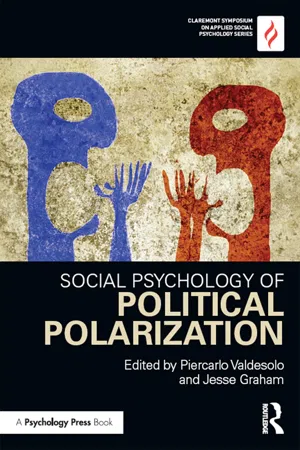
The 21st-century political landscape has been defined by deep ideological polarization, and as a result scientific inquiry into the psychological mechanisms underlying this divide has taken on increased relevance. The topic is by no means new to social psychology. Classic literature on intergroup conflict shows how pervasive and intractable these group conflicts can be, how readily they can emerge from even minimal group identities, and the hedonic rewards reaped from adopting an "us vs. them" perspective. Indeed, this literature paints a bleak picture for the efficacy of any interventions geared toward reducing intergroup discord. But advances in the psychology of moral judgments and behavior, in particular greater understanding of how moral concerns might inform the creation and stability of political identities, offer new ways forward in understanding partisan divides. This volume brings together leading researchers in moral and political psychology, offering new perspectives on the moral roots of political ideology, and exciting new opportunities for the development of more effective applied interventions.
eBook - ePub
Social Psychology of Political Polarization
- 216 pages
- English
- ePUB (mobile friendly)
- Available on iOS & Android
eBook - ePub
Social Psychology of Political Polarization
About this book
Information
SECTION II Psychological Mechanisms of Ideological Divides
DOI: 10.4324/9781315644387-5
3 IDEOLOGICAL DIFFERENCES IN THE EXPANSE OF EMPATHY
DOI: 10.4324/9781315644387-6
The American political landscape of the 21st century has largely been characterized by culture wars between liberals and conservatives. On policy issues as diverse as economic regulation, defense spending, abortion, marriage equality, and health care, ideological differences have become increasingly pronounced, as reflected in political legislation, public opinion, and news coverage. The 112th Congress, which governed from January 2011 through January 2013, is on record as the most ideologically polarized Congress ever (Carroll, Lewis, Lo, McCarty, Poole, & Rosenthal, 2013). Eight of the most ideologically divided years (as measured by presidential approval rating gaps between Democrats and Republicans) have occurred since 2004, making George W. Bush and Barack Obama the most polarizing presidents ever (Jones, 2013). This polarization is also evident in the political press that documents and spurs on this phenomenon, with media bias and media partisanship also approaching record levels (Groeling, 2013). One clear meme that exacerbates these divisions is the perceived “Empathy Gap,” whereby liberals are seen as more caring (Davis, Smith, & Marsden, 2007; Iyer, Koleva, Graham, Ditto, & Haidt, 2012; Krauthammer, 2012; McCue & Gopoian, 2001), even as conservatives are equally generous with their time and money (Brooks, 2007).
As disagreement between left-wing individuals and right-wing individuals has grown, so too has psychological research attempting to document and explain this disagreement. A cursory search for the term “political psychology” in Google Scholar reveals 9,370 entries from 1900–2000, a figure that has more than doubled in just the first 14 years of the 21st century. Much of recent political psychology has indeed focused on explaining ideological differences in terms of cognition, perception, motivation, behavior, and psychological ability (see Jost, Federico, & Napier, 2009, and Stone et al., in press, for reviews). In line with this tradition of research, we suggest in this chapter that empathy, “other-oriented emotion elicited by and congruent with the perceived welfare of someone in need” (Batson, 2011, p. 11), is a primary factor that distinguishes liberals and conservatives. In a recent study of people’s moral stereotypes about liberals and conservatives (comparing perceived to actual moral stances across a wide range of moral concerns), it was found that “the largest inaccuracies were in liberals’ underestimations of conservatives’ harm and fairness concerns, and liberals further exaggerated the political differences by overestimating their own such concerns” (Graham, Nosek, & Haidt, 2012, p. e50092). Although participants across the political spectrum (especially liberals) tended to stereotype conservatives as being relatively lacking in empathy with some evidence (described below) supporting this perception, we propose that liberals and conservatives do not differ in their capacity for empathy or willingness to empathize with others. Rather, the present research suggests that liberals and conservatives differ in terms of the targets toward whom they expend their empathy, with liberals expressing empathy to a greater degree toward larger social circles and conservatives expressing empathy toward smaller circles.
We begin by describing what is known about the relationship between ideology and empathy. We then summarize existing research on other psychological differences between liberals and conservatives that provide support for our existing hypotheses. Next, we describe preliminary studies testing these hypotheses, and provide suggestions for how our studies can inform work on political conflict.
Empathy and Ideology
Popular media representations of liberals and conservatives tend to depict liberals (and, by proxy, Democrats) as the far more empathic group of people. The term “bleeding heart liberal” commonly refers to individuals with liberal political leanings, and signifies the belief that liberals tend to sympathize excessively with the plight of the poor, the underprivileged, and others in need. Former Democratic president Bill Clinton epitomized this stereotype when he famously uttered, “I feel your pain” in 1992 (in fact Clinton made this remark angrily in the midst of a heated debate about the AIDS crisis). In 2006, the Democratic presidential candidate Barack Obama bemoaned the nation’s “empathy deficit” in a commencement speech at Northwestern University.
Beyond anecdotal evidence, some empirical evidence also suggests that liberals are more empathic than conservatives. One piece of evidence for this comes from the General Social Survey (GSS; see Davis, Smith, & Marsden, 2007), a large-scale nationally representative survey of U.S. households collected by the National Opinion Research Center. From 2002 to 2004, the GSS administered a seven-item empathy scale that measured general empathy toward others (Davis, 1994; e.g., “I would describe myself as a pretty soft-hearted person”) in conjunction with numerous questions about support for various policies. Scores on this measure were positively related with support for policies that are typically supported by political liberals, including increased government spending for health care, Blacks, children, social security, welfare, and the poor; increased government efforts to help the poor, the sick, the elderly, and Blacks; increased efforts toward reducing wealth income inequality; and increased government action in general. These results suggest that individuals who endorse politically liberal policies are also those who report experiencing more empathy. Other empirical research that has employed measures of general empathy and measures of political ideology also shows that liberalism is correlated with self-reported empathy (Iyer et al., 2012; McCue & Gopoian, 2001).
Empirical research has also examined the association between empathic concern and social dominance orientation (SDO), an individual difference variable that reflects the endorsement of social hierarchy and that is also typically associated with political conservatism (Pratto, Sidanius, Stallworth, & Malle, 1994; Sidanius & Pratto, 2001). Numerous studies have confirmed that self-reported empathy and SDO are negatively associated with each other (Bäckström & Björklund, 2007; McFarland, 2010; Sidanius et al., 2013) and some research suggests that SDO is negatively associated with brain activity in regions associated with empathy (Cheon, Im, Harada, Kim, Mathur, Scimeca et al., 2011). Thus, the preference for social hierarchy, a key component of conservative ideology, has clearly been linked to lower empathy in general.
One additional domain of research that provides evidence for a relationship between empathy and political ideology is research employing life narrative interviews. In a study of liberal and conservative Christians (McAdams et al., 2008), participants were interviewed about major life events and their interviews were coded for various psychological themes. The life narratives of political conservatives tended to center on authority figures, moral rules, and self-discipline, whereas the life narratives of political liberals tended to center on nurturance, openness, and empathy. Liberals were more likely than conservatives to display the ability to sympathize with another individual’s emotional state. Similarly, research on adolescents who describe themselves as liberal or conservative shows that liberals tend to describe themselves in more sympathetic terms (Eisenberg-Berg & Mussen, 1978). Consistent with work on self-reported empathy, this type of research suggests that liberals possess greater general empathy than conservatives.
Although the research on political ideology and empathy suggests differences in absolute empathy between liberals and conservatives, this research is not fully conclusive, as the vast majority of studies appear to assess empathy at a general level rather than empathy toward specific targets. We suggest the possibility that rather than liberals and conservatives differing in terms of the degree of empathy they possess, they instead differ in terms of the targets of that empathy. We next review existing evidence from a variety of research programs suggesting that liberals and conservatives expend their empathy toward more global and local targets, respectively. That is, liberals tend to empathize with larger, farther, less structured, and more encompassing social circles whereas conservatives tend to empathize with smaller, closer, more well-defined, and less encompassing social circles.
Cognitive–Motivational Styles
A broad program of research has suggested that differences in political stances between liberals and conservatives may stem from differences in more basic cognitive–motivational styles. A landmark article by Jost, Glaser, Kruglanski, and Sulloway (2003) reviewed evidence suggesting that conservatives exhibit a higher need for closure, order, and structure, a greater intolerance for ambiguity, and lower integrative complexity than liberals. This meta-analysis revealed that political conservatism might reflect stable individual differences in the tendency to seek safety, structure, and stability; to view ambiguity or changes to the status quo as threatening; and to exhibit closed-mindedness toward novelty. Political liberalism, on the other hand, thus reflected a greater comfort with lack of structure, greater openness to new experiences, and a stronger tendency to seek out novel situations.
These different cognitive–motivational profiles translate into different ways of viewing the social world as well. For example, high levels of intolerance to change, novelty, and instability contribute to group-centrism, a pattern behavior that manifests in high levels of adherence to group norms, ingroup preference, rejection of individuals who deviate from the group, and resistance to change within the group (Kruglanski, Pierro, Mannetti, & De Grada, 2006). Thus, based on these cognitive–motivational differences among liberals and conservatives, we would predict that the expression of empathy would follow a similar pattern. Conservatives, in their tendencies toward closure, order, and stability should expend empathy toward smaller, more well-defined, and less permeable social circles. Liberals, in their tendencies toward openness, tolerance for ambiguity, and desire for change should seek larger, less well-defined, and more permeable social circles.
Personality Traits
Research on the dominant personality traits of liberals and conservatives reveals a very similar pattern to the work on cognitive and motivational styles. A series of studies has revealed consistent findings on how “Big Five” personality traits map on to ideological positions, showing that liberals score higher on openness whereas conservatives score higher on conscientiousness (Carney, Jost, Gosling, & Potter, 2008; Goldberg & Rosolack, 1994; Jost, 2006; Rentfrow, Jost, Gosling, & Potter, 2009). Again, these findings suggest a greater willingness among liberals to extend empathy outward whereas the vigilance associated with conservatism suggests a greater tendency to extend empathy only toward one’s inner social circle. More recent work has examined agreeableness among liberals and conservatives, showing that both liberals and conse...
Table of contents
- Cover Page
- Half Title Page
- Title Page
- Copyright Page
- Table of Contents
- List of Illustrations
- Contributors
- Introduction: Ideological Divides, in Society and in Social Psychology
- Section I Ideological Divides in Society
- Section II Psychological Mechanisms of Ideological Divides
- Section III Ideological Divides in Social Psychology
- Index
Trusted by 375,005 students
Access to over 1.5 million titles for a fair monthly price.
Study more efficiently using our study tools.
Frequently asked questions
Yes, you can cancel anytime from the Subscription tab in your account settings on the Perlego website. Your subscription will stay active until the end of your current billing period. Learn how to cancel your subscription
No, books cannot be downloaded as external files, such as PDFs, for use outside of Perlego. However, you can download books within the Perlego app for offline reading on mobile or tablet. Learn how to download books offline
We are an online textbook subscription service, where you can get access to an entire online library for less than the price of a single book per month. With over 1.5 million books across 990+ topics, we’ve got you covered! Learn about our mission
Look out for the read-aloud symbol on your next book to see if you can listen to it. The read-aloud tool reads text aloud for you, highlighting the text as it is being read. You can pause it, speed it up and slow it down. Learn more about Read Aloud
Yes! You can use the Perlego app on both iOS and Android devices to read anytime, anywhere — even offline. Perfect for commutes or when you’re on the go.
Please note we cannot support devices running on iOS 13 and Android 7 or earlier. Learn more about using the app
Please note we cannot support devices running on iOS 13 and Android 7 or earlier. Learn more about using the app
Yes, you can access Social Psychology of Political Polarization by Piercarlo Valdesolo, Jesse Graham, Piercarlo Valdesolo,Jesse Graham in PDF and/or ePUB format, as well as other popular books in Psychology & Conservatism & Liberalism. We have over 1.5 million books available in our catalogue for you to explore.