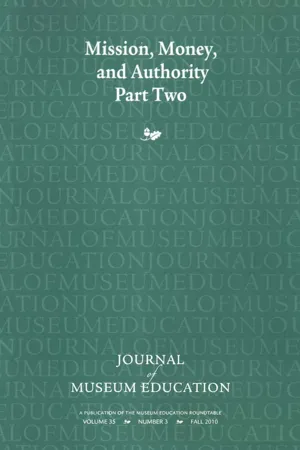
Sponsored by the Museum Education Roundtable, this is volume 35, Number 3 of the Journal of Museum Education (JME) Part Two of Mission, Money, and Authority, published in the fall of 2010. This edition includes articles on insistent questions in our learning age, the museum's economic footprint, putting art into work revenue, when education meets admissions, generating museum education programs for knowledge and three case studies on money and the mission.
eBook - ePub
Mission, Money, and Authority, Part Two
Journal of Museum Education 35:3 Thematic Issue
- 70 pages
- English
- ePUB (mobile friendly)
- Available on iOS & Android
eBook - ePub
Mission, Money, and Authority, Part Two
Journal of Museum Education 35:3 Thematic Issue
What Is Your Museum’s Economic Footprint?

Abstract Across the United States, museums are considered an integral part of the community fabric and an important factor in the quality of life, “Arts and culture helps foster creativity, bridges class divides, retains college graduates, recruits companies, and raises the quality of life.”1 But across the nation, museums contribute far more than just culture–they drive local and state economies. Nationally, the arts and culture sector generates $166.2 billion in economic activity, including $104 billion in household income and $29.6 billion in tax revenue annually; it also supports 5.7 million jobs.2 Knowing one’s economic footprint permits institutions to concretely demonstrate their positive economic impact on a community, which is increasingly important for museums and cultural attractions as they endeavor to demonstrate the many benefits they offer communities.3And, in a time of economic recession and increased demand and requirements for funding, this information provides power. Further, a positive economic footprint imparts authority to museums when talking with local and national politicians, funders, and community members. Arts and cultural organizations not only contribute to the educational health of communities; they generate funds that add to the economic health of local, state, and national communities as well.
This paper examines the Denver Metro Community as a case study for understanding the value and importance of identifying one’s economic footprint. However, the formulas included in the paper can be applied to any area of the country and to any museum, allowing each institution to determine their individual economic footprint.
DEFINING PUBLIC WORTH–A TRADITIONAL MODEL
Traditionally, museums define themselves by particular services they deliver to their community; for example, they provide an ideal place for exploration and learning in an informal, hands-on, educational environment. Their exhibitions, offerings, and programs encourage active participation and promote different learning modalities and skills.4 Cultural institutions also collect, preserve, and actively display (through objects and live performances) the core of what shapes our culture. As places of study, cultural institutions offer access to ideas, innovations, historical and current research materials, and knowledge that furthers scientific research and our collective understanding of our society, our world, and our universe. The ability to interact with, view, and study materials and documents that relate to one’s own past and interests also furthers an individual’s understanding of themselves, shaping personal identity and rooting people to the larger society and history. Museums also shape local and national identity, as our art and culture defines our identity as Americans.
In addition, cultural organizations provide a space for entertainment; a place where people can leave the everyday and move into another world for a while. They offer a place for families to gather and explore together, a meeting place for people to enjoy and discuss, and sometimes an opportunity to escape somewhere by oneself to contemplate.5 Attendance numbers attest to the popularity of cultural institutions in America. Whether people visit to be entertained, educated, or a combination of both, they come in droves; the American Association of Museum’s 2006 Museum Financial Information report found that American museums saw 600 million visitors annually between 2003 and 2005.6
A NEW DEFINITION OF PUBLIC WORTH–ECONOMIC FOOTPRINT
In the first decade of the 21st century, museums are once again asking themselves about their role in society; what is their public value? Stringent new guidelines from funders are requiring definable outcomes that can be tested and measured. And in tough economic times, nonprofits are being asked to demonstrate their value to the public as a requisite for further funding.7 Although art and cultural institutions define themselves as educational entities, they are also economic machines that positively impact their local communities and the larger region. Put another way, a museum’s economic footprint is an important cornerstone of their public value in the 21st century:
… the nonprofit arts and culture industry is … an economic driver in … communities–a growth industry that supports jobs, generates government revenue, and is the cornerstone of tourism.8
And as such, it is imperative that institutions understand and define their role within the local, regional, and national economy. Economic models, such as the one discussed below, provide museum staff the tools they need to determine their economic, and therefore, public worth.
Cultural organizations provide regions a competitive advantage when marketing a town or geographic area. Museums play a crucial role in attracting residents, tourists, and funding from corporations, private foundations, and government agencies.9 Chambers of Commerce, booster clubs, and city and regional organizations develop marketing campaigns that tout the cultural richness of an area as a reason to visit and invest in a community. And most importantly, in the economic realm, cultural institutions are businesses and economic drivers for a community. In addition to curators, educators, and preparators, cultural organizations also employ managers, marketers, and accountants–just like any other business. They exchange money for goods and services and produce a product for the community to consume.
The arts are a business and a large one at that–$166.2 billion a year nationally. At 5.7 million employees, arts and cultural institutions are one of the largest employers in the country.10 Nonprofit arts and culture organizations support more jobs than there are accountants and auditors, public safety officers, even lawyers, and just slightly fewer than elementary school teachers.11 They help to drive the economic life of a region and directly and indirectly impact the economic health of a community. Art and cultural organizations are employers, producers, and consumers–directly contributing to the economy on each of those levels. Direct spending refers largely to the jobs an organization creates. A cultural institution directly contributes to the economy through payroll to employees, through the employment of contractors, and the supplies it must buy to support its offerings and mission. Audience members also directly contribute to the economy through parking fees and café and gift shop purchases, for example. Indirect spending refers to subsequent rounds of spending. For example, an employee at an arts institution receives a paycheck for his/her services. Then they spend those wages on such things as food, rent, clothing, and movie tickets. This infusion of money back into local and national businesses represents how an arts organization indirectly fuels the economy.12
SCIENTIFIC AND CULTURAL FACILITIES DISTRICT–DENVER, CO
In 2007, arts and cultural institutions in the Denver Metro region contributed $1,691,000,000, or close to 1.7 billion dollars, to the economy.13 A combination of operating expenditures, audience expenditures, and capital expenditures through direct and indirect activities account for the economic impact to this region of approximately of 2.7 million people.14 The institutional members of the Scientific and Cultural Facilities District (SCFD) include a wide range of organizations, from small theater groups, choirs and orchestras to larger nature and science centers, art museums, zoos.15 Created by legislation and voter approval in 1988, the SCFD represents a commitment by the Denver Metro Community to arts and cultural institutions. In 1982, the state legislature ended direct financial support for Denver’s four regional institutions: the Denver Art Museum, the Denver Botanic Gardens, the Denver Museum of Natural History (now the Denver Museum of Nature & Science) and the Denver Zoo. From this challenge, a unique idea arose: charge a 0.1% sales tax to support an arts district. Voters reaffirmed their support of the SCFD tax in 1994 and again in 2004 with 65% voter approval.16 This commitment to arts and culture by the people of Denver County is apparent when you examine the numbers. In 2008, there were 16.4 millioni17 attendees to an arts and cultural institution in the Denver Metro region, compared with just over 4.6 million visitors to professional sporting events; four times more people attend cultural institutions.18 This number ofvisitors equates to just over six arts events per resident in one year’s time.
In addition to the number of patrons, the astounding figure of $1.7 billion truly represents the strength and extent of the economic impact cultural organizations provide a community. A portion of this figure results from direct operating costs, i.e., the amount each institution pays its employees. In the Denver Metro region, th...
Table of contents
- Cover
- Half Title
- Copyright Page
- Title Page
- Table of Contents
- From the Co-Editors-in-Chief
- Insistent Questions in Our Learning Age
- Advocacy for Education in Museums
- What Is Your Museum’s Economic Footprint?
- Pulling Museum Education Purse Strings
- Integrating Service and Experience
- Putting Art to Work
- Three Case Studies
Trusted by 375,005 students
Access to over 1.5 million titles for a fair monthly price.
Study more efficiently using our study tools.
Frequently asked questions
Yes, you can cancel anytime from the Subscription tab in your account settings on the Perlego website. Your subscription will stay active until the end of your current billing period. Learn how to cancel your subscription
No, books cannot be downloaded as external files, such as PDFs, for use outside of Perlego. However, you can download books within the Perlego app for offline reading on mobile or tablet. Learn how to download books offline
Perlego offers two plans: Essential and Complete
- Essential is ideal for learners and professionals who enjoy exploring a wide range of subjects. Access the Essential Library with 800,000+ trusted titles and best-sellers across business, personal growth, and the humanities. Includes unlimited reading time and Standard Read Aloud voice.
- Complete: Perfect for advanced learners and researchers needing full, unrestricted access. Unlock 1.5M+ books across hundreds of subjects, including academic and specialized titles. The Complete Plan also includes advanced features like Premium Read Aloud and Research Assistant.
We are an online textbook subscription service, where you can get access to an entire online library for less than the price of a single book per month. With over 1.5 million books across 990+ topics, we’ve got you covered! Learn about our mission
Look out for the read-aloud symbol on your next book to see if you can listen to it. The read-aloud tool reads text aloud for you, highlighting the text as it is being read. You can pause it, speed it up and slow it down. Learn more about Read Aloud
Yes! You can use the Perlego app on both iOS and Android devices to read anytime, anywhere — even offline. Perfect for commutes or when you’re on the go.
Please note we cannot support devices running on iOS 13 and Android 7 or earlier. Learn more about using the app
Please note we cannot support devices running on iOS 13 and Android 7 or earlier. Learn more about using the app
Yes, you can access Mission, Money, and Authority, Part Two by Cynthia Robinson,Tina R Nolan in PDF and/or ePUB format, as well as other popular books in Business & Museum Administration. We have over 1.5 million books available in our catalogue for you to explore.