eBook - ePub
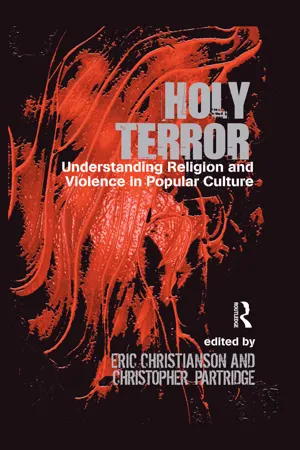
Holy Terror
Understanding Religion and Violence in Popular Culture
- 256 pages
- English
- ePUB (mobile friendly)
- Available on iOS & Android
eBook - ePub
Holy Terror
Understanding Religion and Violence in Popular Culture
About this book
The authors of religious scriptures had little difficulty enhancing sacred narratives with the rhetoric of violence. The phenomenon continues in the habitual linkage of violence and religion in contemporary film, music and literature. 'Holy Terror' brings together scholars of religious studies, biblical studies, film studies and sociology to examine the social function of violence in popular discourse. The book questions how violent rhetoric shapes belief and values, how audience empathy with violent protagonists can be understood, and the significance of the association of violence with particular religious groups and ideas. A range of phenomena are analysed, including terrorism in Scripture, apocalyptic texts in film and violence in sport.
Information
In the Discourse of Terrorism
1
Seeing Beyond Fear of Terrorism on the Web
Introduction
In this chapter I investigate how the Web was used for the visual expression of non-violent resistance in the wake of the July 2005 bombings in London.1 In particular, I will show how one website became a digital gallery for displaying and viewing responses to the attacks. I will look at the communicative ripples caused by this site, including the development of one other site which accepted the posting of more explicit religious imagery. These atrocities, which killed 52 people and injured over 700, inevitably provoked a wide range of responses. Every conceivable form of media carried the story, offering a host of interpretations. The revelation that these explosions were caused by religiously motivated and “home-grown” suicide bombers led to considerable soul searching in Britain. In both the international and local news media they received far more attention than the “daily” bombings in Iraq. Many religious leaders used sermons, radio broadcasts, television interviews and newspaper articles to condemn the London bombings.
It was the Web, however, that provided the opportunity for the most extensive and long-lasting form of popular response. With its open and easy access it became an ideal location for thousands of people to express their feelings about these suicide attacks and other forms of terrorism. In a few rare cases, some even took the chance to do what was very rarely permitted on the mainstream media: offer support for the bombings. In the cases that we are about to consider I will show how the Web became a place where a vast number of people could express powerful emotions, including fear, anger and defiance, through a creative combination of images and words. These were often highly imaginative and sometimes comic expressions of non-violent resistance to terrorism. There are intriguing parallels to the responses after other terrorist attacks. For example, in 2001 following the September 11 attacks, “hundreds of thousands of people began posting online prayers, lighting virtual candles, and entering into religiously based dialogue in an attempt to cope with the tragedy” (Helland 2004, 33 and 2002, 297). There were also diverse reactions within “Cyber Islamic Environments” where a few extremists celebrated, while many others unequivocally condemned them on religious grounds (Bunt 2003, 67–123). This chapter will primarily consider less explicitly religious online responses to another series of terrorist atrocities.
There is a rapidly growing body of research into religious uses of the Web.2 While several researchers have found that boundaries between religions and within religious traditions can be both asserted and blurred on the Web,3 other researchers have claimed that increasing numbers of people use it as a space for defining and moulding their own identities,4 as well as affirming old communities and forming new ones.5 How to detect the presence of a “virtual community” or “community online,” however, is a contested practice. Some studies have suggested that “virtual communities are nothing more than pseudocommunities,” while others assert that “it is simply assumed too often that ‘community’ is present, without really specifying why or how” (Dawson 2004, 77). Probably the most extensive recent investigations into the relationship between community and identity in online religion are to be found in Heidi Campbell’s Exploring Religious Community Online (2005) and Douglas Cowan’s Cyberhenge: Modern Pagans on the Internet (2005).6 Grounded in detailed empirical data, they provide nuanced accounts of how Christian groups and Pagan groups use the internet for both identity construction and community formation.
I will analyse how people from all over the world left their own distinctive visual marks on the Web as a way of expressing non-violent resistance against terrorism. I also ask the question: to what extent can this posting of images, and words, be described as the formation of a new online community of defiance? Or is this practice merely like using a supermarket noticeboard to pin pictures of a bike for sale or a lost cat? The only differences being: electricity, global reach and the seriousness of the subject. Or is this something between these two extremes? Perhaps it might be more accurate to see it either as a virtual art gallery which has few regulations and never-ending walls openly available to amateur digital artists or a virtual gathering point, with posted images becoming catalysts for debate and discussion. Even if it is not a fully fledged community does this collective enterprise go beyond what Wellman and others have described as “networked individualism” (Wellman and Hogan 2004, 72–75) to become a network of resistance? My contention is that to describe this either as the creation of a fully-fledged online community or simply as an electronic noticeboard is to over-simplify what is both a fluid and a social network built upon a set of practices, which is better described, borrowing a Durkheimian phrase, as a “collective representation” in the face of shared trauma.7
In order both to test this thesis out and to understand this dynamic phenomenon it will be useful initially to set out a taxonomy of visual postings. The aim here will be to establish a nomenclature for describing the different ways in which primarily visual posting sites are used and function. Users absorb, interpret, process, adapt and post their own images at these sites.8 What are the different uses that images are put to on the Web? We shall see how they are used to defy, to console, to encourage, to explain and to exhort. It will become clear that these images are put to a number of different rhetorical uses, from expressing heart-felt emotion to asserting identity. In this context, we shall see how the visual signs of identity and the markers of community become far less fixed and stable through their exposure in the public domain of the World Wide Web. They are highly elastic signs. With the advent of digital technologies, pictures and photographs have become easy to manipulate and to send rapidly around the globe. In the age of sailing ships, to transport a framed picture between continents would have taken several weeks of costly and potentially dangerous travel, while today, for those with access to the appropriate technology, it can be transported in a few seconds across thousands of miles by no more than a few taps on a keyboard and several clicks of a plastic mouse.
In this essay, I therefore examine a selection of specially created pictures which were posted from all over the world to several websites to affirm defiance against these attacks and other forms of terrorism. In particular, I describe in detail the different kinds of images that were posted up on the ground-breaking We Are Not Afraid site. I then consider how another more explicitly religious site was used to affirm popular forms of non-violent resistance against terrorism. Some became the electronic home for photographs, while others housed written opinion pieces or poems. Given that religious beliefs were inextricably connected with these attacks it is neither surprising that some users tried to employ religious imagery, nor, given the constraints imposed by the site organizers, that others posted a vast kaleidoscope of secular imagery to express their resistance. The merging of sacred and secular symbols is not a particularly new practice, but the use of digitally altered photographs as non-violent statements against terrorist violence is more original. They clearly emerge from a diversity of social settings, where different “doxas” and “sets of dispositions” are to be found.9
The Origins of the “We’re Not Afraid” Site
“We’re Not Afraid” rapidly grew into a website that attracted thousands of images of resistance against terrorism posted from all over the globe. Within two months it had received over 33 million hits. It began when Alfie Dennan,10 a London-based Web developer, received a photo from a friend, Adam Stacey, showing how he had escaped the smoke caused by the bomb on the King’s Cross train with a sock covering his mouth. Within thirty minutes of the London bombings on 7 July 2005, Dennan posted this photo on his Web log (or blog). In a little over two hours the BBC and other news organizations started to use this image. The result was that Dennan’s Web log rapidly received numerous messages of support. Encouraged by these responses Dennan, along with several of his friends, set up a website on 7 July called “We’re Not Afraid.” Initially, it was simple images of themselves, their families and friends with the copy: “We are not afraid” imposed onto the digital pictures. Within days the site was overwhelmed with images at first from the UK, and later from all over the world.11 With an estimated four million hits in the first few days of its existence the site swiftly snowballed into a global phenomenon. It is now possible to purchase, through this avowedly nonprofit site, a wide selection of merchandise, including hats, mugs and T-shirts with “We are not afraid” emblazoned on the product. An exhibition of selected images was held in central London in the autumn of 2005. Even though the site itself is no longer actively maintained it still has over twenty thousand images, acting as a memorial to an extraordinary outpouring of non-violent virtual responses to terrorist attacks.
Images of Defiance
Many of the images were sent in as acts of defiance against the London bombers. In the first few days the earliest postings were often, though not exclusively, sombre. The founder of the site, Alfie Dennan, stares impassively out from the screen holding a piece of white A4 paper, simply written with a blue felt pen: “We’re Not Afraid!” Not is double-underlined. The practice of posting images onto the Web as an act of defiance can clearly be seen in several of the pictures sent in by victims of the actual attacks. One survivor posted a picture of himself lying and bandaged in a hospital bed. On 12 July “Mark M. from Finsbury Park, London” wrote: “I was on the tube on the first carriage at Russell Square. I am not afraid.” The words are almost overwhelmed by the striking photo of his face with small white medical tape on his forehead and cheek. The previous day a red-tinted picture was posted, showing a young woman with glasses looking down, with the words in black typed over the image: “Yesterday I lost my friend in London, today I am not afraid.” Through such statements and depictions victims were able to assert their courage in the face of heartbreak. Other early postings included pictures of babies, children, pets and even more ironically large animals at the Zoo. Alongside pictures of suffering, images of innocence were used as non-violent statements of defiance.
It was not long before some contributors to the site became more adventurous and creative in their depictions. Tube signs and maps were adapted to incorporate the four key words. One woman is photographed sitting on the tube reading a paper; the headline is digitally changed to: “We are not afraid.” Buses, taxis and even a yacht were also adorned by this simple statement. While the images of the vehicles were digitally changed to incorporate the statement, the yachtsmen claim to have actually painted the logo on the side of their boat for the Cowes race in the Solent (UK). Following the failed bombings on 21 July an old tube ticket is apparently embossed with the claim: “We’re still not afraid.” Like many of the submissions, this is a sophisticated piece of forgery as the typescript looks identical to the font used in the un-tampered parts of the ticket. The word “still” is to be found on a number of postings after the abortive 21 July attacks. Again the site became a space to express words of defiance in an original visual guise. Intemperate language is rarely permitted on the site, though some participants portray themselves literally “flipping the finger” or making a “V” sign to the camera. This non-verbal communication epitomizes the response to the attacks that is at the core of many of these examples of Web art.
Almost a month later a British man sent in the hazy photo of people in the smoke-filled tunnel walking down the tube line in semi-darkness, with only emergency lights illuminating their way to safety. The usual headline of “We’re not afraid” is adorned with a series of eight exclamation marks. In the foreground a man is holding up a mobile phone while trying to capture the scene digitally. The merging of communication technologies and the ability of mobile phones to be used as cameras has turned every phone user into a potential amateur photojournalist. The phones themselves have become objects used to express defiance and resistance. One user sent in a picture of his Nokia phone, on which the following message could be seen: “We are still not afraid: we will never let terrorism dictate the way that we live. We refuse to live in fear. Terror will never win.” In a further example of playful defiance, familiar Microsoft Window pop-ups were changed to ask the question: “Are You Afraid?” A boxed “No” makes the response clear.
Here then is an interesting qualification to the suggestion that this site was dominated by pictures of the self or those people or animals closest to the sender. Technological extensions of personality, redolent of McLuhan’s theory about the “extensions” of humanity through media (McLuhan 1964) are also found posted at the We’re Not Afraid site. These images of defiance draw upon a range of visual resources to make their point. The human face recurs again and again: sometimes smiling, sometimes angry and sometimes quizzical. Pictures of new media or other technological objects are rarer and often make use of additional words to reinforce the visual impact of the picture. Defiance takes on many guises and appears to be a driving force behind the posting of many of these images.
Images of Solidarity
Closely related to a rhetoric of defiance is an assertion of solidarity. Several contributors sent in images of the Twin Towers in Manhattan, sometimes in pristine condition and sometimes following the terrorist attacks. In one case, above the towers was not only the “We Are Not Afraid” statement, but also this list of cities: New York, Madrid, Moscow and London. The obvious attempt here is to locate the London attacks in a history of recent terrorism. In passing it is worth noticing which cities are excluded from this list and what an apparently Western frame is provided for understanding where terrorism is happening. Another, hauntingly picturesque, shot of a marina in the foreground and smoke billowing from Two Towers in the background is supplemented with the declaration: “This did not make us afraid. It made us more compassionate more loving & more unified!!!!”
Experience of terrorist attacks allows contributors to go beyond statements of sympathy to assertions of solidarity. In the highly visual world of this site, where as we shall see religious imagery is normally not allowed, numerous non-religious images are used to try and speak of peaceful solidarity. This could be described as an expression of civil religion, which emerges from the grass roots and where in this case the symbols of nation are intertwined with the symbols of faith.12
Images to Counter Fear
Many of these pictures reflect on the nature of fear and bravery itself. Some attempt explicitly to encourage the viewer’s self-confidence. For instance, a man from Newcastle (UK) sent in a picture of a kitten looking into a mirror, who sees not itself, but a lion with a large mane. Consider the statement to the left of the mirror: “Look inside yourself. You are brave. You are strong. You are courageous.” This sounds almost as if it has been taken from a “power of positive thinking” CD or book. The assumption here is that courage appears to come not from an external source but from within. At the bottom of the picture the claim of individual strength is qualified: “together we will be unafraid.” Given that confidence is a fragile commodity, which terrorists aim to undermine, this kind of picture is a humorous visual reflection upon the belief that positive thinking can transform the timid viewer into a lion-heart. This makes an intriguing contrast with late medieval Western imagery which frequently shows several devotional figures kneeling in prayer, not before a figure of strength such as a lion, but beneath a suffering and bloodied semi-naked man. Nevertheless, vulnerable images have their own attraction and are also to be found all over the website. As observed earlier, the figures which are used almost like totems to counter fear are often children, partners or pets. They do not obviously suffer; and they are without obvious political power. Their charisma is heightened partly through their weakness and innocence in the face of terror.
Images of Popular Encouragement
Such encouraging sentiments are also to be found in pictures which appropriate images from popular culture. More specifically, the creative use of cultural icons is to be found in visual quotation from popular television programmes. For example, images from The Teletubbies, and characters from The Simpsons, are used several times. As if he is writing punishment lines, Homer Simpson’s son, Bart, is pictured writing “We are not afra...
Table of contents
- Cover
- Half Title
- Title
- Copyright
- Contents
- Introduction
- Part One: In the Discourse of Terrorism
- Part Two: In Cinema
- Part Three: A Case Study: The Violence of The Passion of the Christ
- Part Four: In Sport
- Notes
- Bibliography
- Filmography
- Index
Trusted by 375,005 students
Access to over 1.5 million titles for a fair monthly price.
Study more efficiently using our study tools.
Frequently asked questions
Yes, you can cancel anytime from the Subscription tab in your account settings on the Perlego website. Your subscription will stay active until the end of your current billing period. Learn how to cancel your subscription
No, books cannot be downloaded as external files, such as PDFs, for use outside of Perlego. However, you can download books within the Perlego app for offline reading on mobile or tablet. Learn how to download books offline
Perlego offers two plans: Essential and Complete
- Essential is ideal for learners and professionals who enjoy exploring a wide range of subjects. Access the Essential Library with 800,000+ trusted titles and best-sellers across business, personal growth, and the humanities. Includes unlimited reading time and Standard Read Aloud voice.
- Complete: Perfect for advanced learners and researchers needing full, unrestricted access. Unlock 1.5M+ books across hundreds of subjects, including academic and specialized titles. The Complete Plan also includes advanced features like Premium Read Aloud and Research Assistant.
We are an online textbook subscription service, where you can get access to an entire online library for less than the price of a single book per month. With over 1.5 million books across 990+ topics, we’ve got you covered! Learn about our mission
Look out for the read-aloud symbol on your next book to see if you can listen to it. The read-aloud tool reads text aloud for you, highlighting the text as it is being read. You can pause it, speed it up and slow it down. Learn more about Read Aloud
Yes! You can use the Perlego app on both iOS and Android devices to read anytime, anywhere — even offline. Perfect for commutes or when you’re on the go.
Please note we cannot support devices running on iOS 13 and Android 7 or earlier. Learn more about using the app
Please note we cannot support devices running on iOS 13 and Android 7 or earlier. Learn more about using the app
Yes, you can access Holy Terror by Eric S. Christianson,Christopher Partridge in PDF and/or ePUB format, as well as other popular books in Theology & Religion & Film History & Criticism. We have over 1.5 million books available in our catalogue for you to explore.