eBook - ePub
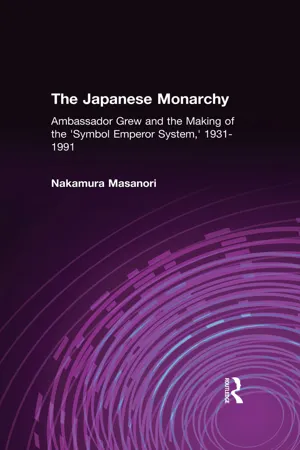
The Japanese Monarchy, 1931-91
Ambassador Grew and the Making of the "Symbol Emperor System"
- 224 pages
- English
- ePUB (mobile friendly)
- Available on iOS & Android
eBook - ePub
The Japanese Monarchy, 1931-91
Ambassador Grew and the Making of the "Symbol Emperor System"
About this book
"The Japanese Monarchy, 1931-1991", which created a sensation when first published in Japanese, clarifies US policies toward Japan's symbol emperor system before, during and after World War II. As American ambassador to Japan from 1932 to 1945, Joseph Clark Grew had contacts with groups close to the emperor as well as leading "moderates". Returning to the US after the outbreak of the war, he made many speeches, first condemning Japanese aggression, but later changing his theme from war to peace, even to suggesting that the emperor would be a key asset in stabilising Japanese society after the war, a view which was widely criticised at the time. Later, as under secretary of state, Grew came to play an important role in the formation of postwar US policy on Japan and the emperor. His view that the emperor was a pacifist who opposed and sought to end the war with the US and that thus postwar Japan should be reconstructed with the emperor and the moderates at the centre, was later adopted in the decision of Douglas MacArthur's occupation to preserve the emperor system. That the evolution of an ambassador's convictions could have such a significant impact, even to this day, on postwar US-Japan relations vividly illustrates the importance of truly understanding the history and culture of another country, whether friend or foe.
Trusted by 375,005 students
Access to over 1.5 million titles for a fair monthly price.
Study more efficiently using our study tools.
Information
Subtopic
World War IIIndex
History1
Report from Tokyo
A Condemnation of Japanese Militarism
A Fanatical Enemy
GREW and his staff returned to the United States on August 25, 1942, having been confined to the embassy in Tokyo for over six months after the outbreak of war. Anti-Japanese feeling at home had reached a peak with the attack on Pearl Harbor, and given Grew's ten years' experience of Japan and his detailed understanding of the Japanese situation, there was great anticipation as to what he had to say. Grew was deluged with requests for speaking engagements, but in view of his public position as special adviser to the secretary of state, his speeches had to conform to official views of the war. At a meeting with Secretary Hull on September 25, 1942, Grew was instructed to confirm the content and schedule of his speeches with the head of the Office of War Information (OWI), Elmer Davis. From his return home up to the end of 1943, Grew traveled the length and breadth of the United States and gave as many as 250 lectures, following an itinerary planned in detail by the OWI.
A selection of these speeches was published as a book in 1942, under the title Report from Tokyo—A Message to the American People. Grew noted in a letter to his friend Fredrick Kam, on February 3,1943, that Report from Tokyo had sold as many as 130,000 copies in the first few weeks of its publication.
The major distinction between this book and Ten Years in Japan, published later in 1944, was its open condemnation of Japan, in particular, the cruelty and violence of the Japanese military. Grew called the American people to action, quoting in his preface the following words from the diary of PFC Martin Treptow, written in 1918 just before his death on the western front in France. "I will work; I will save; I will sacrifice; I will endure; I will fight cheerfully and do my utmost; as if the whole struggle depended on me alone."1
Grew therefore hoped that those flaming words of his should constitute a guiding torch that every red-blooded American should take up and carry with proud determination to victory."
In his opening paragraph, Grew set out the aims behind the publication of Report from Tokyo.
The purpose of this book is to overcome a fallacy in the thinking of a large proportion of my fellow countrymen about our war with Japan. That thinking, so far as I have been able to gauge it since my return from Tokyo on August 25, 1942, is clearly influenced by preconceived but unfounded assumptions as to Japan's comparative weakness and vulnerability in war. Such thinking is not only erroneous; it constitutes a grave danger to our fighting spirit, our war effort and our united will to win. If persisted in, it will be a serious obstacle to our ultimate victory.2
Certainly, the optimistic view prevailed among Americans that once the Nazis were out of the way, the "Japs" would be no problem. Consequently, up to the summer of 1943, Grew used his lecture tour to explain the dangers of such complacent thinking, taking as his theme the first rule of warfare: "know your enemy."
Grew's first opportunity to address the American public came just five days after his return home with a radio broadcast for CBS on August 30, 1942. In this speech, entitled "Return from Japan," Grew focused on the brutality of the Japanese authorities and the particularly aggressive nature of the Japanese military.
Grew and his staff had arrived back in New York on the trader Gripsholm almost nine months after Pearl Harbor, accompanied by American missionaries, teachers, journalists, and businessmen. Since the start of the Pacific War, they had all been accused of spying and had suffered barbaric torture at the hands of the Japanese authorities. During the journey home, three elderly Americans described their experience of water torture: their hands had been bound, they had been forced to lie face up, and water had been poured down their throats and noses. One elderly missionary had also suffered a broken rib after being kicked in the chest by a policeman. When he had said he was afraid that one of his ribs was broken, "One of the Japanese police asked where the broken rib was and began to feel his body. As the Japanese came to the broken bone he said, 'Is that the place?' and when the man answered, 'Yes,' the policeman hauled off with his fist and hit that broken rib as hard as he could."3 (From the same radio broadcast.)
Relating such vivid episodes was an effective way to persuade the American people of the barbarity of the Japanese regime. Grew further emphasized the importance of this belligerent trait, which ran throughout the Japanese armed forces: "This spirit, recognized by competent military men as the most vital intangible factor in achieving victory, has been nourished and perpetuated since the foundation of the modern Japanese Army."4 This would make the war against Japan the toughest fight of all: "When they struck, they made no provision for failure; they left no road open for retreat. They struck with all the force and power at their command. And they will continue to fight in the same manner until they are utterly crushed."5
In his efforts to temper the general optimism that prevailed throughout the United States, Grew often described the Japanese military with phrases such as "the all-out, do-or-die fanatical spirit of the Japanese military machine" and "The Japanese are fanatic, last-ditch, no-surrender fighters."
Having just returned from a decade in Japan, Grew drew a wide audience with his radio broadcasts for CBS, following which he went on an intense speaking tour of America, giving lectures under such titles as "Why War Came," "The Extent of the Japanese Challenge," and "How We Must Fight to Defeat Japan."
"The Well of Liberty" Runs Dry
"To await the hoped-for discrediting in Japan of the Japanese Army and the Japanese military system is to await the millennium. The Japanese Army is no protuberance like the tail of a dog that might be cut off to prevent the tail from wagging the dog: it is inextricably bound up with the fabric of the entire nation."6 This quotation comes from an entry in Grew's diary of December 1,1939, which he often used in his aforementioned speeches. Until August 1943, when he began to turn toward the theme of peace, Grew constantly asserted that the military machine had penetrated into the heart of every sphere of Japanese society.
The Japanese people have been accustomed to regimentation since the very birth of their nation. There are Japanese living today who were born when their country was still a feudal land, when every feudal lord held the power of life and death over his so-called common people. We in the West shook off feudalism many centuries ago. In Japan it existed so recently that it has left a vast heritage of almost prostrate subservience to birth and authority. The men who rule Japan today have taken full advantage of the docility of the Japanese people to create a formidable military and economic machine.7
Japanese workers, subordinated by low wages and police oppression, were consistently denied freedom of expression. Alluding to Benjamin Franklin's observation that no one realizes there is a shortage of water until the well runs dry, Grew commented that he had "spent the last ten years in a country where the well of liberty has always been dry."8 It was generally the Japanese peasantry who had to pay the price, both in the form of taxes and through the loss of their children in the war—their life of poverty formed the basis of Japan's competition in the world market. Moreover, the precarious situation of the Japanese middle classes could only be secured through state control. "When I arrived in Japan in 1932, Japanese business was still a model of comparative efficiency, drive, and inventiveness. By 1941, it had become an adjunct to the military regime."9
The whole philosophy of Japanese education also centered on an absolute obedience to the military. "If the visitor stayed long enough, he would soon come to realize that for Japan the years of peace were but years of preparation, and that from early childhood Japanese children were being reared for war, and reared with the thought that their greatest good fortune would be to die on the field of battle."10 Further, in reference to emperor worship, Grew commented that "The people of Japan are wholly united in their support of the armed forces and of this war simply because it is declared to be the will of the Emperor. To oppose the will of the Throne, the will of the Son of Heaven, is unthinkable in Japan. Disloyalty to the Emperor, too, would shame their own ancestors; and ancestor worship, the patriotic faith called Shintoism, is the fundamental faith of the entire country."11
As has been seen, for Grew, Japanese militarism was no mere appendage of Japanese society, but rather a complete authoritarian structure that had permeated throughout Japanese life. The total dissolution of the military would therefore demand the dismantling and reorientation of the country's entire political and social systems.
Yet despite such views, Grew also told his audiences of how he had made many friends during his ten years in Japan, among them people of excellent character for whom he had nothing but the greatest respect. "They are not the people who brought on this war. As patriots they will fight for their Emperor and country, to the last ditch if necessary, but they did not want this war and it was not they who began it."12
Moreover, Grew opposed the idea suggested to him in a letter from one of his audience, James A. Scherer, in October 1942, that the Imperial Palace should have been bombed in the U.S. Air Force raid on Tokyo on April 18 of that year. Grew replied:
. . . I think that such action, under the circumstances then obtaining, would have . . . more solidly united the entire Japanese people against us. . . . There are a great many Japanese who, regardless of the war, entertain no intensive hatred against the United States and the American people. . . . I do not, therefore, follow your argument that the bombing of the Emperor's palace, whether or not the Emperor himself had been injured or killed, would have put Japan out of the war once and for all.
Nevertheless, in 1942 Grew was naturally unable to express such opinions openly, and he rarely referred to his Japanese friends who opposed the war—the liberals and moderates. G. William Gahagan at the OWI warned him that audiences would feel let down by any expression of goodwill toward Japanese moderates. Grew agreed that, in the present climate, it would clearly not be wise to say anything that dampened "the angry and fighting mood" of his listeners. Accordingly, until the following summer of 1943, Grew concentrated his speech making on the condemnation of Japanese militarism, and it was against this background that Report from Tokyo was published.
Grew's Ghost-Writer
On comparing Report from Tokyo in detail with Ten Years in Japan, it is evident that the former is laced with vehement criticism of Japanese militarism and the Japanese people as a whole, while the latter adopts a sudden change of tone, expressing a high opinion of the emperor and the moderates. While the speeches compiled in Report from Tokyo were made during the very height of anti-Japanese feeling in the United States, directly after Pearl Harbor, I have felt for some time that this alone could not sufficiently explain the discrepancy between the tone of the two books.
On this point, I have recently obtained important information that has helped me to solve this puzzle, namely the records of Paul Linebarger. While most of Linebarger's documents are kept in Stanford University's Hoover Institution on War, Revolution and Peace, the material pertaining to his relationship with Grew is to be found in the library of Hitotsubashi University in Japan. I was surprised to find that a considerable number of the speeches Grew made during his lecture tour of the United States were in fact written for him by Linebarger. Of Report from Tokyo, one-third was composed by Linebarger and a quarter by another writer, Bradford Smith. Let us look briefly at Linebarger's career.
Paul Linebarger (1913-1966), a China expert and graduate of George Washington University, served in the Office of War Information during the Pacific War. His father, Paul M. W. Linebarger, was a friend of Sun Yat-sen and had taken part in China's 1911 Revolution. The young Paul learned Chinese from Sun's wife and gained a great knowledge of China through his many trips there with his father.
Even from this short account one can see that, in direct contrast to Grew, Linebarger would have held a pro-China, anti-Japan stance. It is said that the OWI chose him as a ghost-writer for the drafts of Grew's speeches on account of the outstanding ability he had demonstrated in propaganda warfare, but I also feel that he was used to ensure that the speeches of the pro-Japanese Grew remained in line with American policy.
Taking a fresh look at Report from Tokyo from this angle and reading through Grew's correspondence with Linebarger, it becomes clear that the whole of Grew's speech making in 1942-43 formed part of the State Department's and OWI's propaganda war against Japan. Although Linebarger and the other speech writers naturally referred to material provided by Grew, they went beyond this to incorporate the OWI's own views in the final speeches. This explains why the tone of Report from Tokyo is overwhelmingly hostile toward Japan, containing so...
Table of contents
- Cover Page
- Half Title page
- Title Page
- Copyright Page
- Contents
- Preface
- Introduction The Making of Ten Years in Japan
- 1 Report from Tokyo A Condemnation of Japanese Militarism
- 2 The Theme of Peace The Key Role of the Emperor System
- 3 The Chicago Speech Grew Comes Under Fire
- 4 The Publication of Ten Years in Japan
- 5 The Moderates Makino Nobuaki, Kabayama Aisuke, Yoshida Shigeru
- 6 The Formation of Postwar Policy for Japan Grew's Plan
- 7 The Potsdam Declaration Grew's Struggle
- 8 Grew and MacArthur
- 9 Origins of the "Symbol" Three Sources
- 10 Establishment of the Symbol Emperor System
- 11 The Enterprise State and the Emperor System
- Appendix 1 The Origins of the "Symbol" and Its Future: Thoughts on the Symbol Emperor System*
- Appendix 2 The Third Way, or the Path Not Taken
- Endnotes
- Index
- List of Contributors
Frequently asked questions
Yes, you can cancel anytime from the Subscription tab in your account settings on the Perlego website. Your subscription will stay active until the end of your current billing period. Learn how to cancel your subscription
No, books cannot be downloaded as external files, such as PDFs, for use outside of Perlego. However, you can download books within the Perlego app for offline reading on mobile or tablet. Learn how to download books offline
Perlego offers two plans: Essential and Complete
- Essential is ideal for learners and professionals who enjoy exploring a wide range of subjects. Access the Essential Library with 800,000+ trusted titles and best-sellers across business, personal growth, and the humanities. Includes unlimited reading time and Standard Read Aloud voice.
- Complete: Perfect for advanced learners and researchers needing full, unrestricted access. Unlock 1.5M+ books across hundreds of subjects, including academic and specialized titles. The Complete Plan also includes advanced features like Premium Read Aloud and Research Assistant.
We are an online textbook subscription service, where you can get access to an entire online library for less than the price of a single book per month. With over 1.5 million books across 990+ topics, we’ve got you covered! Learn about our mission
Look out for the read-aloud symbol on your next book to see if you can listen to it. The read-aloud tool reads text aloud for you, highlighting the text as it is being read. You can pause it, speed it up and slow it down. Learn more about Read Aloud
Yes! You can use the Perlego app on both iOS and Android devices to read anytime, anywhere — even offline. Perfect for commutes or when you’re on the go.
Please note we cannot support devices running on iOS 13 and Android 7 or earlier. Learn more about using the app
Please note we cannot support devices running on iOS 13 and Android 7 or earlier. Learn more about using the app
Yes, you can access The Japanese Monarchy, 1931-91 by Masanori Nakamura in PDF and/or ePUB format, as well as other popular books in History & World War II. We have over 1.5 million books available in our catalogue for you to explore.