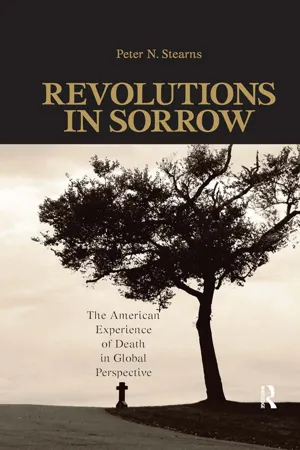
eBook - ePub
Revolutions in Sorrow
The American Experience of Death in Global Perspective
- 201 pages
- English
- ePUB (mobile friendly)
- Available on iOS & Android
eBook - ePub
About this book
Huge changes have occurred in both the physical facts of death and in the cultural modes that guide our reactions to it. These changes also affect policy issues ranging from punishments for crimes to birth control to the conduct of war. This book explores the impacts of these changes upon both personal experience and social policy and places developments in the United States in an international comparative context.The book opens with an overview of traditional patterns of death and related cultural practices in agricultural civilizations, along with changes brought by Christianity. Attitudes and practices in colonial America are traced and compared to other societies. After setting this historical context, the book examines the immense changes that occurred in the nineteenth century: new cultural reactions to death, expressed in changing death rituals and cemetery design; the unprecedented reduction later in the century of infant mortality; the relocation of death from home to hospital; the redefinition of death as a taboo subject. The book's final segment relates changes in death culture and experience to the contentious debates of the twentieth century over the death penalty, abortion, and the practice of war. The book is designed to use historical and comparative perspectives to stimulate debate about the strengths and weaknesses of cultural practices and policies related to death.
CHAPTER 1
Introduction: Why Death? Why the United States?
In his novel No Longer at Ease, the Nigerian author Chinua Achebe describes the following crisis: Obi, raised in a village but now prospering as a white-collar worker in the city of Lagos in the 1920s, has come to enjoy his work routine and lifestyle, including regular dances and a fair amount of womanizing. Then his mother dies. He sends money back for the funeral, but, due to his job and his dating schedule, he just does not have time to go himself. To the villagers, his behavior is a “thing of shame”—for he should have gone home not just for the funeral but for an extended period of mourning. As one old man put it: “This boy that we are all talking about, what has he done? He was told that his mother died and he did not care. It is a strange and surprising thing.”1
In the United States, books on manners and etiquette from the late nineteenth to the early twentieth centuries had elaborate sections designed to show the proper courtesy toward a family that had just suffered a death. Visits, leaving cards to show concern, and assurances of sympathy were vital in a society in which death remained common and in which carefully prescribed etiquette was an important part of respectable life. By the 1940s, however, etiquette books changed dramatically: The emphasis changed to assert that a grieving individual must not impose on others. Extensive discussion of a loss through death was considered rude, and friends and acquaintances were not expected to put up with too much. By this point, psychologists were increasingly identifying part of their practice as “grief work,” in which individuals who could not easily get over a death gained professional help to get their emotions under control. The social context for death had been virtually stood on its head. The issues were not the same as those in Africa, although there was some connection; the larger point was the apparent necessity, in otherwise very different contemporary societies, to reconsider basic aspects of the ways death should be approached. Fundamental changes were occurring in accepted encounters with death, from urban Nigeria to the suburban United States.2
Death is a human constant, happening eventually to everyone and figuring prominently in every human culture. But response to death can be organized very differently, depending on social values. Its incidence varies greatly as well, by social class, sometimes by gender, and certainly by historical time. So death is also a historical topic, important in itself and revealing a great deal about the nature and impact of social change. Basic developments like urbanization or redefinitions of manners change the reception of death—and Africa and the United States are hardly the only societies to experience this kind of impact in recent decades.
This book focuses on the modern experience of death, and particularly on crucial changes that occurred after 1880, comparing American developments with patterns in Western Europe and a few other societies. It does not offer a comprehensive survey of all the interesting variations and changes concerning death, in all times, all places. But, building from a brief discussion of some characteristic premodern beliefs and practices, it does convey the important modern challenges and tensions that continue to affect the treatment of death today. Fundamental changes have occurred in encounters with death, from urban Nigeria to suburban Russia.3
The United States has participated strongly in many of the major changes surrounding death over the past two centuries. It has seen the death rate retreat massively for key groups such as children. Causes of death have changed, moving away from communicable toward degenerative diseases. Rituals have been transformed, from death as a domestic experience to an initial transition toward elaborate mourning and then to a contemporary effort to reduce emotionality.
Some of these changes have been shared with other regions, particularly of course other urban, industrial societies like Western Europe or Japan. But the United States also has put its own stamp on the modern evolution of death—among other things, showing a somewhat unexpected conservatism when it came to alterations of ritual, while tolerating unusually high cost levels, where efforts both to fight death and to deal with its aftermath were involved. Looking at the United States in a global context helps pinpoint not only some important developments in modern history but also some particular national features that demand explanation—and in the eyes of some social critics, also cry out for reform.
Death is not only a personal and social experience, involving physical facts and cultural beliefs. It is also something that societies administer, through such practices as infanticide, punishment, and war. It is interesting that existing studies of death, often quite good, rarely go beyond discussing single societies to make more global comparisons and linkages, and they almost never consider these extensions of the subject. Yet ideas about death, and changes in ideas, have significant bearing on these wider reaches of the topic. Here, too, comparison is vital, and global consequences are very real.
Changes in the experience and attitudes toward death form the central part of the modern story, and of the comparisons between U.S. and global evolutions, but there is more. As the modern culture concerning death shifted, ideas about using death as a punishment for crime altered as well—moving away from patterns human societies had emphasized for thousands of years. The United States participated in this process and sometimes took a lead in developing new global standards. But here, too, the national course showed some distinctive features, and by the later twentieth century, the nation seemed to be moving away from dominant global standards. This is another anomaly to be explained, and a significant one; here, too, is an important component of the relationship between the United States and the rest of the contemporary world.
Unquestionably, American death expectations have had an impact well beyond the nation’s borders. Associated with the steady rise of U.S. power in the world, and the frequent military involvements that seem to come along with world power, U.S. attitudes toward death have helped reshape both the nature and the impact of contemporary warfare, for example, by generating truly extraordinary efforts to recover casualties long after conflicts have ended. Reaction to U.S. deaths has become part of the military and diplomatic interactions of the contemporary world.
A final category in which there have been significant changes in the experience of and attitudes toward death involves issues of birth control, and particularly abortion, where the United States has differed on occasion—particularly, on recent occasion—from standards of many other societies. Here, too, finally, the United States and its distinctiveness have affected global patterns.
This book looks at changes and continuities in the various manifestations of death and their spillovers into military policy, punishment, and birth control. The changes have been substantial, a true indication of how different the modern experience is from that of the past, despite the inevitability of death in all times and all places. The United States has both participated in and resisted some of the larger global trends: Comparison is vital to establish how and why the nation stands out in some respects as well as to determine what the global framework has become. Aspects of U.S. reactions to death—particularly its reliance on the death penalty—now draw substantial international criticism. However, the United States has also influenced the global scene, particularly in the military strategies designed to minimize U.S. deaths, but also in arenas such as birth control and even funeral practices. The interplay between the nation and the larger trends is both complex and intriguing.
Death might seem an odd subject for a history—although in fact, because modern transformations have been so significant, there is a rich literature on key features of the phenomenon. It also might seem gloomy or starkly unpleasant—one of the frequent current comments on death in places like the United States is that it has become so removed from normal experience that many people shy away from discussing it. Although we will see that this judgment is oversimplistic, it is probably true that greater attention to death’s history can contribute to some personal as well as social perspective. The obvious fact is that death is not just a part of life; attitudes toward it form a key component of the way societies function. It affects policy as well as personality. It influences global relationships, sometimes in unexpected ways. Death has always inspired awe and fear, and it still does. It should inspire interest and understanding as well.
Death also, perhaps unexpectedly, provides insight into some key questions about the United States in a world history context. Is the United States a separate civilization—an approach often known as U.S. exceptionalism—or is it part of a wider Western orbit? How much has the United States been influenced by global trends, not just today but in the past? How has the United States contributed to world history in turn, as the nation has attained increased power, and how does it approach the wider world? An analysis of death is not the only way to answer these questions, but its history does offer some telling specifics.
Death, though not a familiar historical topic, in fact has participated in some of the great changes of modern times. It also contributes toward answering basic comparative questions about the relationships among major societies and about the consequences of international power.
Beginning roughly two centuries ago, major changes in attitudes and practices associated with death began to take shape in a number of countries, including the United States. Earlier forms of death acceptance were rethought, in favor of a new emotionalism associated with death and a new desire to find ways to reduce death’s incidence and impact. Ultimately, the raw facts of death changed as well, as mortality rates dropped first in the most advanced industrial societies, then globally. Death and modern society mixed less easily than had been the case in prior tradition.
A new emphasis on fighting or downplaying death had a number of advantages. Virtually no one living today would wish to go back to the experiences of and approaches to death that occurred even in the nineteenth century. Yet the fundamental shifts had drawbacks as well, which must be explored as part of understanding the modern condition. Some of the drawbacks are economic: Fighting death can be extremely costly. But the more interesting qualifications are psychological, where the effort to combat death creates unexpected new vulnerabilities.
Furthermore, the current dominant trend toward mounting new resistance to death and its hold on the imagination was not always straightforward. For example, even as many societies recalibrated their stance on death, modern military technology created unparalleled opportunities to cause death: It has been hard to reconcile the two trends. Other practices—such as the punishment of criminals—might compete with the dominant trend toward reducing the number of deaths. In many cases, including the United States, the enjoyment of fictional accounts of death seems to have increased, even as actual death rates decline—another incongruence that must be addressed. The complexities of death trends, and their consequences, provide ample challenge for analysis.
The United States has been a leader in many modern changes in ways of looking at death, but it has also resisted some. U.S. wealth and space have created some distinctive twists on the basic modern story: No other major society has been able to afford the types of cemeteries Americans began to develop more than a century and a half ago. More recently, the U.S. impulse to find ways to resist death has paralleled the equally compelling increase in the nation’s power to deliver death through the most advanced military armaments. The nation’s inconsistencies on death—not necessarily greater than those of other societies, but distinctive—have become unusually influential in the world at large.
Notes
1. Chinua Achebe, No Longer at Ease (New York, 1961).
2. Amy Vanderbilt, Amy Vanderbilt’s Complete Book of Etiquette: A Guide to Gracious Living (New York, 1966).
3. For a fascinating discussion of the growing modern discomfort with death, see Arthur Erwin Imhof, Lost Worlds: How Our European Ancestors Coped with Everyday Life and Why Life Is So Hard Today (Charlottesville, VA, 1996). The classic study, although much disputed, is Philippe Ariès, The Hour of Our Death (New York, 1981).
CHAPTER 2
Traditional Patterns of Death
Gilgamesh answered her, “And why should not my cheeks be starved and my face drawn? Despair is in my heart and my face is the face of one who has made a long journey, it was burned with heat and with cold. Why should I not wander over the pastures in search of the wind? My friend, my younger brother, he who hunted the wild ass of the wilderness and the panther of the plains, my friend, my younger brother who seized and killed the Bull of Heaven and overthrew Humbaba in the cedar forest, my friend who was very dear to me and who endured dangers beside me, Enkidu my brother, whom I loved, the end of mortality has overtaken him. I wept for him seven days and nights until the worm fastened on him. Because of my brother I am afraid of death, because of my brother I stray through the wilderness and cannot rest. His fate lies heavy upon me. How can I be silent, how can I rest? He is dust and I too shall die and be laid in the earth forever. But now, young woman, maker of wine, since I have seen your face, do not let me see the face of death which I dread so much.”She answered, “Gilgamesh, where are you hurrying to? You will never find that life for which you are searching. When the gods created man they allotted to him death, but life they retained in their own keeping. As for you, Gilgamesh, fill your belly with good things … dance and be merry, feast and rejoice. Let your clothes be fresh, bathe yourself in water, cherish the little child that holds your hand, and make your wife happy in your embrace; for this too is the lot of man.”—The Epic of Gilgamesh1
The members of the human species are, as far as we know, the only living creatures aware at some level, from a fairly early age, that they will die, and the only creatures as well who are organized into societies that spend a good bit of time dealing with death in one form or another—organizing beliefs about it, trying to prevent it, developing rituals to accommodate its impact, even deliberately using it in punishment. Members of other species sometimes develop a perception that they are dying—sometimes, as with elephants, wandering away from the group to complete the process. Some seem to react with sadness when death occurs—dogs even lamenting the death of a master or mistress—across species lines. But the generalized awareness, the consciousness of death even when it is not immediately present, and the deep need to explain and ritualize the experience, seem to be distinctly human. It is not surprising that debates over death figure strongly in the world’s first known piece of literature, the Mesopotamian Gilgamesh epic of the third millennium BCE.
A serious practical issue also confronts human society, further contributing to the awareness of death: the need to dispose of dead bodies. Quite apart from the offensive sights and smells of corpses—which might vary a bit among different cultures but surely display some overall commonalities—bodies pose a health risk, as breeding grounds for bacteria and disease. Since humans have always been social—gathered in groups, which raises the potentiality for group exposure to contamination—it became clear well before recorded history that some means of disposing of corpses was essential. This need, combined with fearful awareness of death, further contributed to death beliefs and rituals, however varied their specific forms.
There is debate about when the ...
Table of contents
- Cover
- Half Title
- Title Page
- Copyright Page
- Dedication
- Table of Contents
- Acknowledgments
- Series Preface
- Chapter 1 Introduction: Why Death? Why the United States?
- Chapter 2 Traditional Patterns of Death
- Chapter 3 New Emotions and Rituals in Death: The United States and Western Society
- Chapter 4 The Administration of Death in the Nineteenth Century
- Chapter 5 The Death Revolution in Western Society and Its Global Implications
- Chapter 6 Death as Taboo: The American Case
- Chapter 7 The Comparative Context: Global Patterns of Change
- Chapter 8 From Personal Death to Social Policies
- Chapter 9 Abortion Disputes and Contemporary Death Culture
- Chapter 10 The Death Penalty and Its Enemies: New Global Divisions
- Chapter 11 Contemporary War and Contemporary Death
- Chapter 12 Conclusion
- Suggestions for Further Reading
- Index
- About the Author
Trusted by 375,005 students
Access to over 1.5 million titles for a fair monthly price.
Study more efficiently using our study tools.
Frequently asked questions
Yes, you can cancel anytime from the Subscription tab in your account settings on the Perlego website. Your subscription will stay active until the end of your current billing period. Learn how to cancel your subscription
No, books cannot be downloaded as external files, such as PDFs, for use outside of Perlego. However, you can download books within the Perlego app for offline reading on mobile or tablet. Learn how to download books offline
Perlego offers two plans: Essential and Complete
- Essential is ideal for learners and professionals who enjoy exploring a wide range of subjects. Access the Essential Library with 800,000+ trusted titles and best-sellers across business, personal growth, and the humanities. Includes unlimited reading time and Standard Read Aloud voice.
- Complete: Perfect for advanced learners and researchers needing full, unrestricted access. Unlock 1.5M+ books across hundreds of subjects, including academic and specialized titles. The Complete Plan also includes advanced features like Premium Read Aloud and Research Assistant.
We are an online textbook subscription service, where you can get access to an entire online library for less than the price of a single book per month. With over 1.5 million books across 990+ topics, we’ve got you covered! Learn about our mission
Look out for the read-aloud symbol on your next book to see if you can listen to it. The read-aloud tool reads text aloud for you, highlighting the text as it is being read. You can pause it, speed it up and slow it down. Learn more about Read Aloud
Yes! You can use the Perlego app on both iOS and Android devices to read anytime, anywhere — even offline. Perfect for commutes or when you’re on the go.
Please note we cannot support devices running on iOS 13 and Android 7 or earlier. Learn more about using the app
Please note we cannot support devices running on iOS 13 and Android 7 or earlier. Learn more about using the app
Yes, you can access Revolutions in Sorrow by Peter N. Stearns in PDF and/or ePUB format, as well as other popular books in History & Social History. We have over 1.5 million books available in our catalogue for you to explore.