eBook - ePub
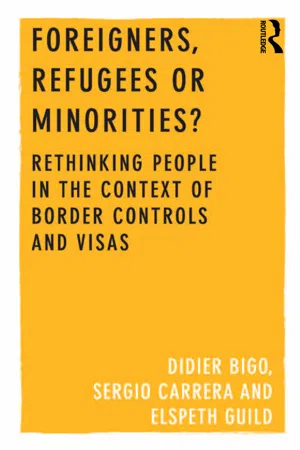
Foreigners, Refugees or Minorities?
Rethinking People in the Context of Border Controls and Visas
- 280 pages
- English
- ePUB (mobile friendly)
- Available on iOS & Android
eBook - ePub
Foreigners, Refugees or Minorities?
Rethinking People in the Context of Border Controls and Visas
About this book
When immigration policy and the treatment of Roma collide in international relations there are surprising consequences which are revelatory of the underlying tensions between internal and external policies in the European Union. This book examines the relationship of citizenship, ethnicity and international relations and how these three aspects of the State, its people and its neighbours relate to one another. It studies the wide issue of international relations, citizenship and minority discrimination through the lens of the case study of European Roma who seek refugee status in Canada on account of their persecution in Europe. The volume assesses the relationships among citizenship, state protection and persecution and minority status, and how they can intersect with and destabilize foreign affairs. The central background to the book is the European treatment of Roma, their linkages with visa and asylum policies and their human rights repercussions . The various contributions reveal how modern liberal democracies can find themselves in contradictory positions concerning their citizens - when these are looking for protection abroad - and foreigners - in search of international protection - as a consequence of visa and pre-border surveillance policies and practices.
Information
Chapter 1 Introduction International Relations, Citizenship and Minority Discrimination: Setting the Scene
Elspeth Guild and Sergio Carrera
DOI: 10.4324/9781315582801-1
1 Introduction
This volume examines the relationship of citizenship, ethnicity and international relations and how these three aspects of the State, its people and its neighbours relate to one another. The book takes as its starting place the borders of sovereignty in Europe and their collusion through the movement of people with other border controls and policies. One of the most highly contentious issues in Europe and North America is mobility of people and border controls. Over the past 20 years, in both parts of the world, State actors have accepted increasing responsibility for regulating the status of people on their territory. The resulting categorisations of people (citizen versus foreigner, immigrant versus refugee) have moved into our daily vocabularies. One of the most important discursive techniques to justify the division of rights, benefits and entitlements between different categories of people present on the territory, and which is amply deployed on both sides of the Atlantic, is the language of illegal immigration.
A second, and once again highly contentious, issue in Europe is the treatment of excluded minorities, and in particular the Roma. Since the fall of the Berlin Wall in 1989 and the opening up of borders between East and Western Europe, the situation of the Roma both in their countries of nationality and in other European countries has been politically divisive and practically intractable. Even in their countries of origin, the Roma are often the object of discourses which castigate them as foreigners and immigrants, seeking a transfer of the fairly well constituted anti-immigrant framework to the Roma notwithstanding their status as citizens of European countries (and now the European Union, EU).
When these two policy areas (irregular immigration and the treatment of Roma) collide in international relations there are surprising consequences which are revelatory of the underlying tensions between internal and external politics and policies in the EU. This book examines the wide issue of international relations, citizenship and minority discrimination through the lens of the case study of European Roma who seek refugee status in Canada on account of their persecution in Europe, which we call ‘the EU–Canada visa and Roma 2009 affair’. It assesses the relationships among citizenship, state protection and persecution and minority status, and how they can intersect with and destabilise international relations. Taking the example of European Roma who apply for asylum in Canada (and who have been recognised as refugees), the book reveals how liberal democracies which are committed to human rights protection can find themselves in oppositional positions when their citizens are seeking protection from their own authorities but elsewhere in the liberal democratic world. The question of identity, protection, persecution and international relations is examined from a variety of different perspectives. The role of security as an organising principle in international relations among liberal democracies is revealed through the case study as a highly contested concept. On the one hand there are state claims to the legitimacy of security actions, and on the other, the individual asylum seekers and members of a minority group claim security as their term to prevent their return.
The starting place of this book is the ethnic minority in Europe loosely called ‘the Roma’. While most of them have citizenship of European states (mainly in Central and Eastern Europe), they remain the subject of controversy and social exclusion in many parts of Europe, which has resulted in their flight and application for refugee status in Canada. The consequence for international relations has been an increase in the use of mandatory visas for some EU nationals on the basis of nationality; friction in EU relations with Canada as a result of the negative impact internally in those Member States of the EU which have been subjected to or are threatened with a new mandatory visa requirement and a boomerang effect as regards the exclusion of Roma in some EU countries. The intersection of international relations, ethnicity and the breakdown of citizenship as the organising principle in the treatment by states of foreigners is particularly clearly visible from the chapters composing this volume.
The central background to the book is the European treatment of Roma, but to understand this first we must provide some background on Roma in the context of the EU, and specifically as a litmus test of the EU’s promise to all citizens of the Union of the right of free movement of persons. This will be then followed by a brief summary of the main issues and policy dilemmas stemming from the EU–Canada visa and Roma 2009 affair, which indeed constitutes one of the main controversies examined in this collective volume. This introductory chapter will end with an outline of the structure and contributions composing the body of the book.
2 The Roma and the EU
2.1 Who Are the Roma?
The word ‘Roma’ appeared in European and North American newspapers and magazines with increasing frequency after 1989 and the fall of the Berlin Wall. The transformation of former Soviet Bloc citizens into nationals of liberal democratic states (some of which may never have had, in the twentieth century, independent political recognition, such as Slovakia) took place very rapidly between 1989 and 1994 fuelled by a rise in national pride. This new-found nationalism had a downside – lurking within nationalism is always the spectre of the other, the excluded. Roma as a category began to fill this gap as ‘the other’ against whom the national identity is formed.1 There is nothing new about the demonisation of Roma in Europe. This group were among those targeted by the Nazis for extermination as ‘sub-human’. The long history of European racism against Roma intertwines at a number of junctions with anti-Semitism, but it is distinct from it.2
The formulation of Roma as the other in Europe is fraught with difficulties. According to the website of one of the main Roma organisations in Europe, Dosta:
The Roma are not an homogeneous ethnic group: there are the Roma (85% of the total), the Sinté (often called Manouches in France – 4%) and the Kalé (or Gitans – 10%); then there are the Gypsies (or Romanichals in Great Britain – 0,5%) as well as a Kalé community there: all this without counting the other diverse groups of Roma (much fewer in number but nevertheless Roma still like other Roma). In Europe, 80 per cent of the Roma are sedentarised and do not carry out commercial nomadism.3
An alternative definition is provided by the Council of Europe,4 which has been particularly active in documenting and seeking to improve the treatment of Roma among its Member States. According to the Council of Europe’s Roma factsheet:
The Roma consist of various groups, which are labelled with different ethnonymes – self designations as well as external designations: Arlije, Calé, Gurbet, Kaale, Kalderaš, Lovara, Manuš, Sepecides, Sinti, Ursari, etc.; many groups also use the self-designation Roma. Usually all these groups are summarised – sometimes even together with population groups of non Indian origin – by the pejorative denomination ‘Gypsies’, which – out of descriptive reasons and without negative connotations – is sometimes also used in the factsheets.5
While there is a Romani language it is by no means spoken by all those groups which are lumped together under the heading Roma, nor in all countries where people categorised as Roma live.
Many of the most pressing human rights violations in Europe which target Roma are around the lack of mobility of this group, who are often romanticised as nomads. Various far right and neo-fascist groups purporting to ethnically clean their neighbourhoods attack people they consider to be Roma and their homes seeking to drive them out of the region. The fact that people have settled and want to remain where they are is the ‘offence’ in the eyes of the persecutors. These people should be mobile and as mobile people should leave the district and go elsewhere. It is the lack of mobility which the Roma manifest which is the focus of racist abuse and human rights violations.
2.2 How Many Roma Are There in Europe and Where Are They?
According to the Council of Europe’s factsheet on Roma official estimates of Roma in Europe vary between 2,281,577 and 2,581,577 out of a total population of almost 800 million.6 The same source indicates that the unofficial estimates are between 6,105,600 and 8,625,150. Two things are particularly interesting about the numbers. The first is the claim to scientific accuracy through precision. The official estimates seem very sure about those last 577 people though there may be 300,000 more or less in the middle. This indicates two official appreciations going on: first, officials in Europe are keen to establish that they have a monopoly over the numbers of Roma on their territory. To purport to be able to count people down to the last seven is an extraordinary claim which is rarely if ever made about any large group. Most European countries struggle to keep abreast of the numbers of their citizens in general terms let alone with single digit accuracy.7 Many Member States have laws which prohibit the collection of personal ethnic data (such as France) which means there is no official estimate.
The second element which is worth noting about the data is the size of the variation which exists even in the official data. On the one hand it purports to be extremely accurate, while on the other there is a 300,000 person variable inside the official figures. When it comes to the unofficial figures the variation is extremely wide: between 6 and 8.5 million. This indicates a substantial degree of uncertainty about the category.8 This can be explained in a number of ways. First, for the variation to be so high it must be difficult to establish with accuracy, and in the absence of cooperation from the individual him or herself, whether someone is or is not a Roma. The category must lack objectively verifiable cohesion for such a wide difference to exist among the estimates. A degree of self-designation must be at work as regards the category. Second, there are a lot of people whom researchers think may be Roma but who prefer not to be counted as such. The variation between the official figures and the unofficial ones are clearly an indication of this reluctance on the part of the target population. Clearly it is not necessarily a good career or life-enhancing move to categorise oneself as Roma in a Europe where Roma are the target of racial abuse and very serious human rights violations.9 The rise of extremist groups in a number of Central and Eastern European states in particular has resulted in increasing targeting of people allocated the category of Roma. In Hungary, the Jobbik Party, which received 12 per cent of the vote in the 2010 elections, is notorious for its anti-Roma rhetoric and the tacit (if not overt) encouragement of abuse of Roma as the source of criminality.10
However, for Roma seeking asylum, being a category is critical. Where people have been driven from their homes by racist attack and abuse in Europe and seek asylum in Canada, being Roma is particularly important.11 First the category of Roma will need to be established as a coherent one in order for the 1951 UN Convention relating to the Status of Refugees and its 1967 protocol to apply. Article 1A requires a refugee to fear persecution on the ground of race, religion, nationality, membership of a particular social group or political opinion. If Roma is not a coherent category which can be brought within one of the five grounds then the individuals will not be refugees and not entitled to international protection under the Refugee Convention. Thus from keeping one’s status a secret to both claiming it and shouting it from the rooftops requires only the intervention of the Atlantic Ocean.
According to what data is available, the distribution of Roma in Europe is quite difficult to determine. For instance, the state with the highest unofficial estimate of Roma is Romania at between 1.8 and 2.5 million. However the official data for Roma in Romania puts the figure at 535,250. In the face of such an astonishing range, it is very hard to imagine what is, or whether there is, an accurate figure at all. A variation of over half a million people even in the unofficial estimates compared with official figures of barely over half a million in total makes no sense at all. It is hard to categorise this information as data. For Hungary one encounters a similar problem. The official figure is 190,046 Roma (note those six individuals counted at the end). The unofficial figure is 550,000–600,000. The variation is so extreme as to make no sense. In Bulgaria the official figure is 370,908 and the unofficial one 700,000–800,000. Spain, one of the countries with a purportedly large Roma population, has officially between 325,000 and 450,000 Roma and unofficially the same range as Bulgaria (unofficially). The Czech Republic officially states that it has 11,716 (presumably going down every day as Czech Roma seek asylum in Canada); unofficially it is estimated to have between 250,000 and 300,000.
Clearly there are statistical politics at work here probably on both sides, inflating and deflating the estimates. However, the range of estimates does not only go in the direction of officially denying the existence of Roma. In Italy the official estimate is 130,000 Roma while the unofficial one is between 90,000 and 110,000. Similarly in Greece, the official number is between 150,000 and 300,000 while the unofficial one is between 160,000 and 200,000. Latvia considers that it had 7,955 (that precision again), while unofficial sources place the figure at between 2,000 and 3,500. A number of European countries’ figures of their Roma populations converge at the top or bottom end of the unofficial statistics – Sweden considers it has 20,000 while unofficially it is estimated to have between 15,000 and 20,000. The UK on the other hand estimates that it has 90,000 Roma while unofficial estimates are between 90,000and 120,000.
The figures regarding Roma are difficult to analyse as they are much influenced by national and local struggles. One suspects that funding arrangements for action against social exclusion between national and local authorities may explain some of these variations. Others defy facile explanation. Social exclusion, however, seems to be a central characteristic allocated to Roma who get counted. It may be that those who are less likely to be counted as Roma are those who have escaped extreme social exclusion and found paid employment which places them above the poverty line. As the economic crisis in Europe which began in 2008 continues, increasing numbers of Europeans are falling in...
Table of contents
- Cover Page
- Half Title Page
- Title Page
- Copyright Page
- Contents
- List of Tables
- List of Abbreviation
- List of Contributors
- Acknowledgements
- 1 Introduction. International Relations, Citizenship and Minority Discrimination: Setting the Scene
- 2 When Montesquieu Goes Transnational: The Roma as an Excuse, Visas as Preventive Logic, Judges as Sites of Resistance
- SECTION 1 Roma, The European Union and International Relations
- SECTION 2 The EU–Canada Visa and Roma 2009 Affair
- SECTION 3 The Visa and Surveillance Logics: Policing at a Distance
- Bibliography
- Index
Trusted by 375,005 students
Access to over 1.5 million titles for a fair monthly price.
Study more efficiently using our study tools.
Frequently asked questions
Yes, you can cancel anytime from the Subscription tab in your account settings on the Perlego website. Your subscription will stay active until the end of your current billing period. Learn how to cancel your subscription
No, books cannot be downloaded as external files, such as PDFs, for use outside of Perlego. However, you can download books within the Perlego app for offline reading on mobile or tablet. Learn how to download books offline
Perlego offers two plans: Essential and Complete
- Essential is ideal for learners and professionals who enjoy exploring a wide range of subjects. Access the Essential Library with 800,000+ trusted titles and best-sellers across business, personal growth, and the humanities. Includes unlimited reading time and Standard Read Aloud voice.
- Complete: Perfect for advanced learners and researchers needing full, unrestricted access. Unlock 1.5M+ books across hundreds of subjects, including academic and specialized titles. The Complete Plan also includes advanced features like Premium Read Aloud and Research Assistant.
We are an online textbook subscription service, where you can get access to an entire online library for less than the price of a single book per month. With over 1.5 million books across 990+ topics, we’ve got you covered! Learn about our mission
Look out for the read-aloud symbol on your next book to see if you can listen to it. The read-aloud tool reads text aloud for you, highlighting the text as it is being read. You can pause it, speed it up and slow it down. Learn more about Read Aloud
Yes! You can use the Perlego app on both iOS and Android devices to read anytime, anywhere — even offline. Perfect for commutes or when you’re on the go.
Please note we cannot support devices running on iOS 13 and Android 7 or earlier. Learn more about using the app
Please note we cannot support devices running on iOS 13 and Android 7 or earlier. Learn more about using the app
Yes, you can access Foreigners, Refugees or Minorities? by Didier Bigo, Sergio Carrera in PDF and/or ePUB format, as well as other popular books in Social Sciences & Politics. We have over 1.5 million books available in our catalogue for you to explore.