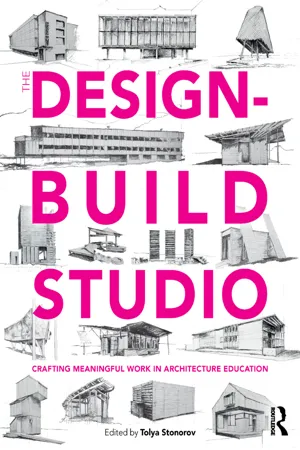
The Design-Build Studio examines sixteen international community driven design-build case studies through process and product, with preceding chapters on community involvement, digital and handcraft methodologies and a graphic Time Map. Together these projects serve as a field guide to the current trends in academic design-build studios, a window into the different processes and methodologies being taught and realized today. Design-build supports the idea that building, making and designing are intrinsic to each other: knowledge of one strengthens and informs the expression of the other. Hands-on learning through the act of building what you design translates theories and ideas into real world experience. The work chronicled in this book reveals how this type of applied knowledge grounds us in the physicality of the world in which we live.
eBook - ePub
The Design-Build Studio
Crafting Meaningful Work in Architecture Education
- 270 pages
- English
- ePUB (mobile friendly)
- Available on iOS & Android
eBook - ePub
About this book
Information
Chapter 1
Time Map
Graphic History of the Academic Design-Build Studio Case Studies
Time Map
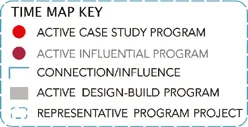
The Case Study Time Map is a family tree of sorts. Each design-build case study program in this book is shown at the year it began. An iconic project for each program is drawn in the dashed rounded rectangles above. Any key design-build influence or important connection is also placed at the year it began and the connections between these programs are drawn in blue. The red dots are placed at the year the program commenced (with a corresponding number in the center) and continue for as long as the program stayed active. The gray 10% transparent tone shows the rise in the number of academic design-build programs over the years.
The history of the design-build studio is a complicated and sometimes convoluted one. This graphic time map locates the influences and inspirations of the programs specifically chronicled in this book, but it does not assume to be comprehensive.1 If the relationships between the programs that are documented here appear complex, it is representative of the interconnectedness of this movement. It is important to note that at one point in the history of this movement, almost everyone involved knew each other. Because there are so many programs now, this can no longer be said. However, we are at least all related, if not directly, then through our relationships with a common ancestry. We are also connected in how we choose to pursue the making of buildings and in how we ask ourselves questions. Are we artists or technicians? Which should guide our process, the idea or the artifact? Are we true Modernists or are we an extension of a long tradition? Do we follow the trajectory of the machine or do we live solidly in the realm of hand making? These dichotomies, seemingly as centrifugal as Nietzsche’s classic Dionysian and Apollonian, try to find resolution in the Design-Build movement. Living romantically on site while constructing rationally and critically derived forms, we live both metaphorically in the Bauhauses of the cathedral builders and the radical space of Ant-Farm’s media burn. We are the utopian children of Buckminster Fuller, dreaming of the universe while practically reasoning over the cost and weight of each nail, following every Btu.
Design-Build was born out of a tradition of radical pioneers. Therefore, it is not surprising that the design-build process lives and breathes in the research wings of architecture schools. In some cases it continues to change the methods we all use. In many cases it makes us all more inclusive and pluralistic. What cannot be refuted, is that by bringing the once radical notion of design-build into the academy, and into the lives of students, we have indelibly altered the landscape of what is possible.
Suggested Reading
EDBKN/European DesignBuild Knowledge Network Consortium. (1 June 2016). dbXchange.eu. Accessed: 5 June 2016.
Goodman, Anna Gloria. A History of Community Design/Build in the United States in Four Moments. Globalizing Architecture/ Flows and Disruptions: Papers from the 102nd Annual Meeting of the ACSA, 2014, 503–512.
Inventing Abstraction, 1910–1925, Museum of Modern Art, New York, 23 December 2012–15 April 2013, Organized by Leah Dickerman, Curator, with Masha Chlenova, Curatorial Assistant. 2012. www.moma.org/interactives/exhibitions/2012/inventingabstraction/?page=home.
Lloyd Kahn, Shelter, Shelter Publications; 2nd edition (May 1, 2000)
Note
1 All information is based on communication with the case study authors and individual research.
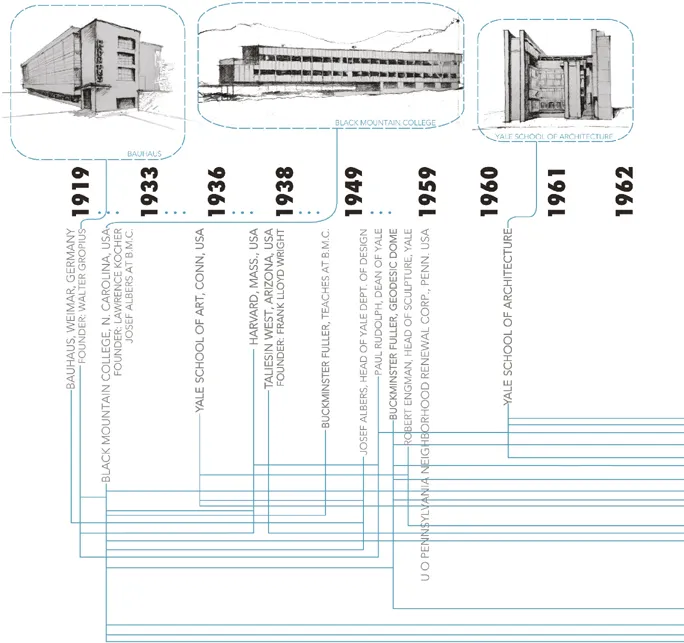
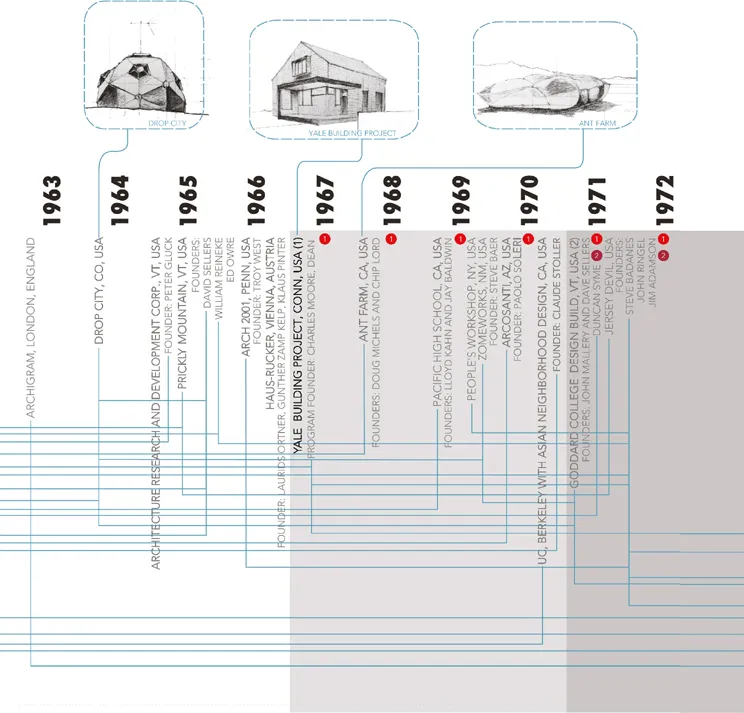
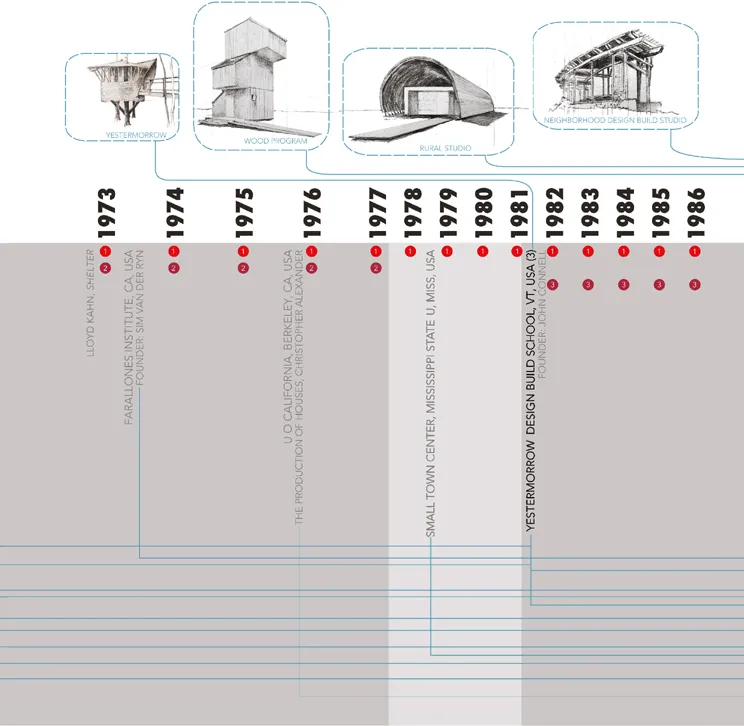
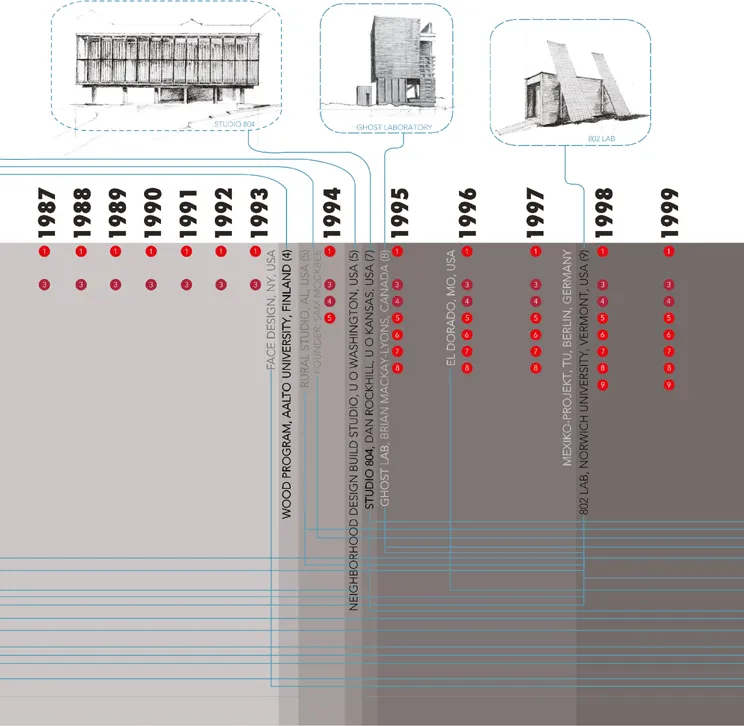
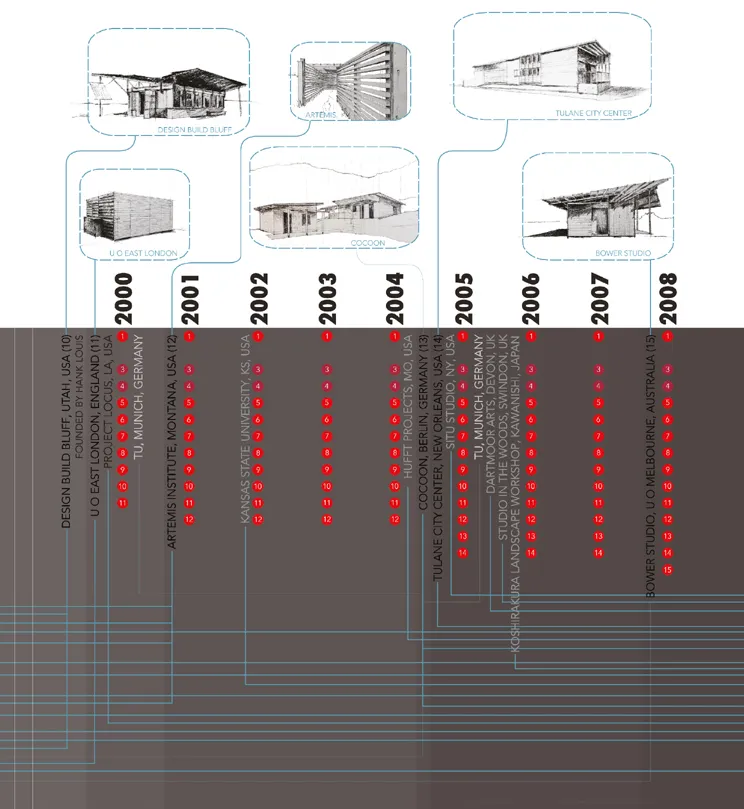
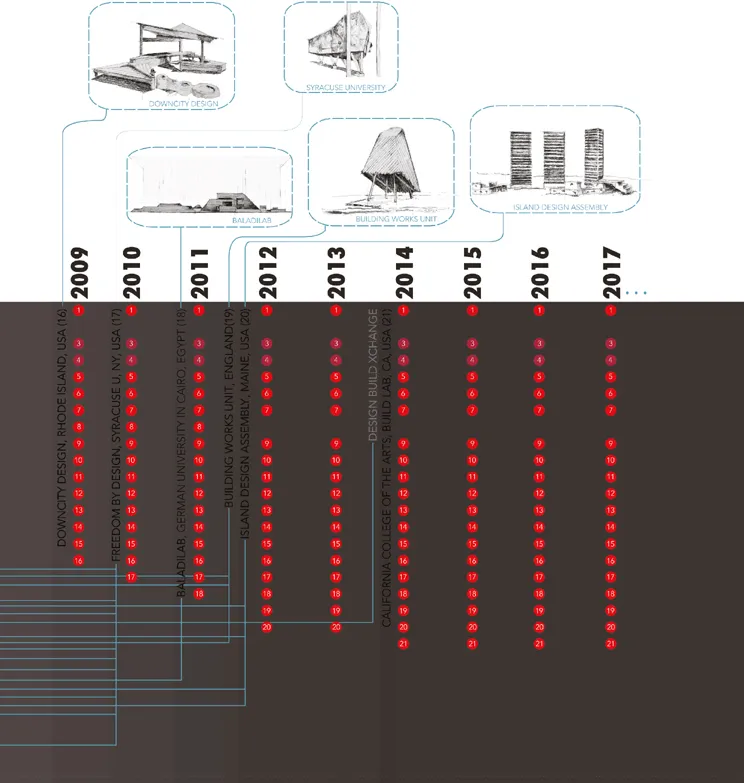
Figure 1.1 Case Study Time Map
Chapter 2
The Future of Community Engagement
Perceptions of Social Responsibility
When architects talk about community engagement what do they really mean? The image conjured for many is a humanitarian abroad, or locally a weekend volunteer, with a shovel in hand and pencil behind the ear. The cumulative effect of these service-oriented idealizations is that community engagement stays at the periphery of contemporary practice, happening only in spare time, if at all.
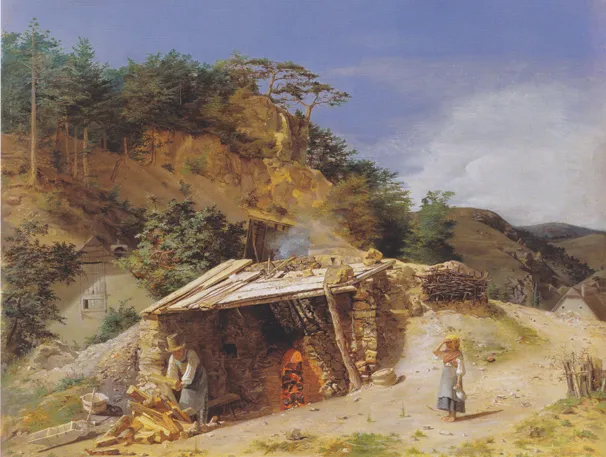
Figure 2.1 “Lime Kiln in the Hinterbrühl” by Ferdinand Georg Waldmüller was painted in 1845, and depicts, for its time, a conventional scene of pre-industrial building material production
In contrast, pre-modern building production was for most regions necessarily homegrown, informed by the availability of materials at hand and inherited technical expertise. Assuming a group’s political sovereignty, most traditional societies’space making was a relatively accessible activity, supported communally, and formally representative of one’s own culture. Even up until the end of the 19th century, the cultivation of building materials was considered a social responsibility. A decree in Great Britain, for example, required that lime pits where lime was being slaked had to have been soaked for a generation before the lime could be used.1 These plasters were unique according to the geology from which they were harvested, and required for each a particular sensitivity, a kind of craftsman dialect. The transition from lime plaster to concrete as a common building material mirrors well the influence of industrial-scale production to conform building practice towards uniformity and formal abstraction. This influence prevailed to the extent that today a small-scale harvest of materials directly from the land, or the overlay of traditional cosmologies in a b...
Table of contents
- Cover
- Half Title
- Title Page
- Copyright Page
- Dedication
- Table of Contents
- List of Contributors
- Foreword
- Acknowledgments
- Introduction
- 1 Time Map: Graphic History of the Academic Design-Build Studio Case Studies
- 2 The Future of Community Engagement
- 3 Manifesto for Handwork: Quality, Material, and Ideas
- 4 Manifesto for Digital Fabrication: Control, Craft, and Agency
- 5 Case Studies: Fast Build – Less than One Semester Programs
- 6 Case Studies: Build – Semester-Long Programs
- 7 Case Studies: Long Build – Semester-Plus Programs
- Conclusion
- List of Image Credits
- Bibliography
- Index
Trusted by 375,005 students
Access to over 1.5 million titles for a fair monthly price.
Study more efficiently using our study tools.
Frequently asked questions
Yes, you can cancel anytime from the Subscription tab in your account settings on the Perlego website. Your subscription will stay active until the end of your current billing period. Learn how to cancel your subscription
No, books cannot be downloaded as external files, such as PDFs, for use outside of Perlego. However, you can download books within the Perlego app for offline reading on mobile or tablet. Learn how to download books offline
Perlego offers two plans: Essential and Complete
- Essential is ideal for learners and professionals who enjoy exploring a wide range of subjects. Access the Essential Library with 800,000+ trusted titles and best-sellers across business, personal growth, and the humanities. Includes unlimited reading time and Standard Read Aloud voice.
- Complete: Perfect for advanced learners and researchers needing full, unrestricted access. Unlock 1.5M+ books across hundreds of subjects, including academic and specialized titles. The Complete Plan also includes advanced features like Premium Read Aloud and Research Assistant.
We are an online textbook subscription service, where you can get access to an entire online library for less than the price of a single book per month. With over 1.5 million books across 990+ topics, we’ve got you covered! Learn about our mission
Look out for the read-aloud symbol on your next book to see if you can listen to it. The read-aloud tool reads text aloud for you, highlighting the text as it is being read. You can pause it, speed it up and slow it down. Learn more about Read Aloud
Yes! You can use the Perlego app on both iOS and Android devices to read anytime, anywhere — even offline. Perfect for commutes or when you’re on the go.
Please note we cannot support devices running on iOS 13 and Android 7 or earlier. Learn more about using the app
Please note we cannot support devices running on iOS 13 and Android 7 or earlier. Learn more about using the app
Yes, you can access The Design-Build Studio by Tolya Stonorov in PDF and/or ePUB format, as well as other popular books in Architecture & Architecture General. We have over 1.5 million books available in our catalogue for you to explore.