Exploring the unity of the practice of prayer and the practice of theology, this book draws together insights from world-class theologians including Rowan Williams, Andrew Louth, Frances Young, Margaret R. Miles, Sebastian Brock, and Nicholaï Sakharov. Offering glimpses of the prayer-life and witness that undergirds theological endeavour, some authors approach the topic in a deeply personal way while others express the unity of prayer and the theologian in a traditionally scholarly manner. No matter what the denomination of the Christian theologian - Greek or Russian Orthodox, Roman Catholic, Anglican, Methodist - authors demonstrate that the discipline of theology cannot properly be practiced apart from the prayer life of the theologian. The prayer of the theologian shapes her or his approach to theology. Whether it be preaching, teaching, writing or research, the deep soundings of prayer inform and embrace all.
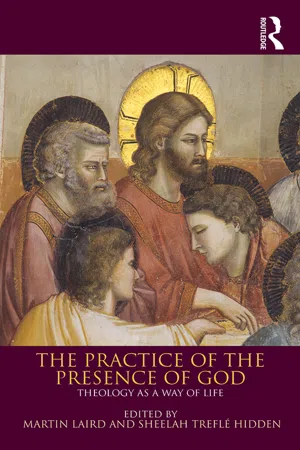
eBook - ePub
The Practice of the Presence of God
Theology as a Way of Life
- 168 pages
- English
- ePUB (mobile friendly)
- Available on iOS & Android
eBook - ePub
The Practice of the Presence of God
Theology as a Way of Life
About this book
Information
Part 1
Foundational soundings
1Theology as a way of life
Rowan Williams
1.
Theology is what we call any serious attempt to represent and explore the meanings of the word ‘God’, which is presumably what Wittgenstein meant in his throwaway remark that theology was a kind of ‘grammar’.1 ‘Grammar’ (he has just said) tells us what sort of object we are talking about, it has to do with the ‘essence’ of a subject of discourse. And so it entails following out –for example – what sort of criteria are being used to make sure two people are talking about the same thing. Any grammatical study will involve looking hard at how usages of words are established, refined, modified, narrowed or broadened, how a recognizable shared use comes into focus. So, if theology is grammar, it is not going to be able to get away from narratives. This is not to say that the only proper kind of theological talk is story-telling, as some have over-enthusiastically claimed – only that exploring what theological language means obliges us to look and listen.2 At the beginning of his Summa theologiae,3 Thomas Aquinas argues that ‘sacred teaching’ can and should be treated as an ordered body of knowledge, a science, but one that arises out of scriptural narrative: it does not deal primarily with narrative, but narrative is what establishes why and how we should rely on ‘those through whom God’s revelation comes to us’.
Theology, then, is an ordered style of reflection and discovery, a putting in order of what we have come to know, grounded in the inspection and interrogation of ways of life, practices. Where and how do people claim to know God, in what circumstances do they say that they have discovered something or that something has been shown to them? It is inseparable from events in which human understanding and capacity somehow ‘move on’, grow and shift. To take the obvious analogy, musicology is not a series of descriptions of concerts, but actual practices, shifts in perception, shifts in what is possible or thinkable for a practising musician or a whole culture of practising musicians, innovations in performance and analytic description of performance, the technological development of instruments – all of this is what grounds musicology as science. You can discuss a piece of composition in terms of its patterns and ‘values’, but what makes such a discussion possible is this cluster of happenings and movements and changes which constitutes musical knowledge in action. And just as with music we are talking about a coming-to-know that is inseparably to do with both mental and bodily happening, so with theology: we are not examining intellectual history alone but that kind of making sense that goes on in material life (and thus also historical and communal life) as well as the analysis of ideas.
When we say that composers ‘solve a problem’ in their work, we don’t mean that they come up with a formula to answer a question, but that they identify the actions that will resolve a clash or collision of sound. And in theology we could speak of ‘solving problems’ not simply as a clarifying of concepts, but as the process in which concepts are brought into clearer focus through reflection on what practitioners do. In so many theological controversies across the centuries, we can see the circulating relationship between liturgical and sacramental practice and the formulation of ideas – a theological development being promoted on the grounds of doing better justice to the language of the liturgy, a liturgical practice being criticized because of a sharper focus on certain conceptual issues and perhaps ruled out precisely because of its ability to prompt faulty theology.4
An observer external to the life of religious communities would be in a position to see something of how these relations worked – would indeed be in a position, sometimes, to trace or at least suggest connections that ‘insiders’ might miss, often to the embarrassment of the latter. Does such and such a doctrinal idiom imply a practice of authority that silences women? Does a particular devotional habit make it easier to articulate a theological rationale for slavery or absolute monarchy? A good theologian, precisely because such a person is committed to understanding the interaction of practice and doctrine, will not simply deny or ignore this hermeneutic of suspicion. However, what distinguishes the theologian as such from the expert analyst of the habits of religious practitioners is that the theologian begins from within a community wanting to know more of how it knows God. For the theologian, the task is not only about ‘representing and exploring’ what ‘God’ means, it is also about the representation and exploration of the self.
How do I, how do we, come to the point of claiming to know? Dealing with that question is what makes theology inexorably a matter of self-knowledge – in a way that is not true for the phenomenologist of religion observing what people of faith do. And if I am examining what has made a conviction possible and plausible for me and for us, it becomes imperative to test what we say about ourselves for arbitrary or self-serving elements. We may never arrive at a genuinely detached account of who we are and how we learn, but we can at least develop habits that will make it more possible to see where we think we have learned, but have actually projected our needs and worked to their agenda.
At this level, theology is always bound up with the practice of repentance, in the sense that the theologian, in seeking to check such illusions about the process of learning and to identify those false representations of God which turn out to be self-serving, must be deeply attentive to his or her own history – to a particular relation to the past, to the community and its language, to the body in its gendered, mortal, socially constrained character, and to other bodies similarly configured. The theologian is committed to self-awareness, consciousness of limits and consciousness of the pitfalls of self-representation. That is why theology classically insists so much on the receptive and contemplative dimension. The practice of theology as a way of life moves in and out of silence and in and out of intense self-scrutiny; not in order to produce an anxious perfectionism, but so as to rein in the confident speculative spirit that will so readily assume we can ‘know’ God without changing our fundamental spiritual attitudes. And in this connection, it needs to be said that a ‘theological life’ or a ‘theological event’ may be something that occurs in all sorts of contexts well outside the limits of what most would call professional theology. It is in this sense, that Jon Sobrino, for example, can speak of the life and martyrdom of Archbishop Oscar Romero of El Salvador as a ‘theological event’5 – a series of happenings in which the Word of God and the language of human suffering come together as an inseparable event of meaning in the world, and in which the simply personal vision or thought of the preacher or theologian recede. One might equally well say of the life of any saint, in fact, that it is a theological event, where human acting and receiving become a manifestation of divine meaning or purpose and thus bring decisive change into the world.
2.
Theology as a way of life, therefore, involves at least three significant elements. It must be accompanied by a real growth in ‘literacy’ about oneself – a willingness to recognize the patterns of desire and imagination which, for good or ill, shape what is said. It must be marked by a profound patience with what resists being said, a patience both with my own inarticulacy and with the stumbling articulation of those with whom I am speaking. And it must, therefore, be committed to a conversational engagement with others seeking the same level of meaning, an openness to the discernment of others inside and outside the community (because not everyone who seeks this level of meaning, the level at which God’s purposes and human speech and action coincide, will automatically share the same believing vocabulary).
To say this should not imply that all theological activity reduces to penitence, self-examination, silence and the invitation to shared discernment; there are contexts in which it is right and necessary to affirm, to take the risk of ‘staking’ the truth (however imperfect) of a doctrine or perception. Theology includes, crucially, the doxological and liturgical function, which is as much a feature of this ‘way of life’ as any amount of scrutiny and reticence. But it remains true that a doxological theology which is not critically aware of its own fragile position – like the hazelnut in the hands of Christ in Julian of Norwich’s ‘showing’, fragile and tiny but ultimately secure as an object of love – will be liable to distortion; it may become what Luther castigated as a ‘theology of glory’, an assertion of the triumph of the theologizing mind as opposed to the theology of the cross which is drawn back to dispossession. And for an entire community to be practising theology is for it to be practising a theologically informed worship which leads both to individual self-examination and to shared reflection; all of it, within the context of a worshipping practice which is ‘theological’, because it takes it for granted that it celebrates and enacts a state of affairs not brought about by human words or actions.
This reminds us that the reason we do theology at all is precisely that a state of affairs has been brought about that is surprising – new, unmerited, disproportionate to any effort of ours. In living theologically, we seek to enlarge our minds and hearts a little further towards the dimension of this new state of affairs – recognizing, of course, that we shall never arrive at a full correspondence with it, since this new state of affairs is, ultimately, a divine state of affairs, ‘how it is with God’. What is new, in the language of Christian Scripture, is that we are set free to address God and to relate to God in the same way that Jesus did (and does). Our new state of affairs is ‘filiation’, the condition of being made a son or daughter of the Father of Jesus; this is what is indentified by the New Testament writers as the fresh and distinctive thing which marks out the community of believers, the corporate Body of Christ. The God we are seeking to talk about is a God who characteristically adopts, who gratuitously welcomes all comers into the place eternally occupied by the Word or Son. In other words, this is a God who is known as someone who can be addressed in a certain way – known in the second rather than the third person. A theology, a reflection that seeks to clarify the ‘grammar’ of such a God, is necessarily embedded in ‘second-person’ practices. In seeking to know better how it knows God, it acknowledges that God is known in the gift and process of adoption and in growth in that relation. As such, it is nourished by two fundamental moments – a divine act of welcome that springs us from the traps of self and a continuing divine act of ‘acclimatization’ or ‘assimilation’ that establishes our new identity as related in this particular way to the Father of Jesus. And if that is the case, the test of an authentic and effective theology is the degree to which it represents and opens up to these ...
Table of contents
- Cover
- Half Title
- Title Page
- Copyright Page
- Contents
- List of contributors
- Preface
- Acknowledgements
- Introduction. Oracles, prophets, and dwellers in silence: Hints of the ‘pati divina’ in the theology that is being birthed
- Part 1 Foundational soundings
- Part 2 Personal accounts of a theological life
- Part 3 Theological and liturgical retrievals
- Index
Trusted by 375,005 students
Access to over 1.5 million titles for a fair monthly price.
Study more efficiently using our study tools.
Frequently asked questions
Yes, you can cancel anytime from the Subscription tab in your account settings on the Perlego website. Your subscription will stay active until the end of your current billing period. Learn how to cancel your subscription
No, books cannot be downloaded as external files, such as PDFs, for use outside of Perlego. However, you can download books within the Perlego app for offline reading on mobile or tablet. Learn how to download books offline
Perlego offers two plans: Essential and Complete
- Essential is ideal for learners and professionals who enjoy exploring a wide range of subjects. Access the Essential Library with 800,000+ trusted titles and best-sellers across business, personal growth, and the humanities. Includes unlimited reading time and Standard Read Aloud voice.
- Complete: Perfect for advanced learners and researchers needing full, unrestricted access. Unlock 1.5M+ books across hundreds of subjects, including academic and specialized titles. The Complete Plan also includes advanced features like Premium Read Aloud and Research Assistant.
We are an online textbook subscription service, where you can get access to an entire online library for less than the price of a single book per month. With over 1.5 million books across 990+ topics, we’ve got you covered! Learn about our mission
Look out for the read-aloud symbol on your next book to see if you can listen to it. The read-aloud tool reads text aloud for you, highlighting the text as it is being read. You can pause it, speed it up and slow it down. Learn more about Read Aloud
Yes! You can use the Perlego app on both iOS and Android devices to read anytime, anywhere — even offline. Perfect for commutes or when you’re on the go.
Please note we cannot support devices running on iOS 13 and Android 7 or earlier. Learn more about using the app
Please note we cannot support devices running on iOS 13 and Android 7 or earlier. Learn more about using the app
Yes, you can access The Practice of the Presence of God by Martin Laird, Sheelah Treflé Hidden, Martin Laird,Sheelah Treflé Hidden in PDF and/or ePUB format, as well as other popular books in Theology & Religion & Christian Rituals & Practice. We have over 1.5 million books available in our catalogue for you to explore.