Making Climate Compatible Development Happen introduces readers to the concept of climate compatible development (CCD) through exploring what it might look like, how it could be achieved in practice and identifying challenges and dilemmas raised by CCD. The book brings together research that explores the assumptions underlying CCD and applies the concept in a range of geographic and sectoral settings.
The volume makes a significant contribution to the theorisation and evidence-base for how development efforts can be made more climate resilient and with lower greenhouse gas emissions than a 'business as usual' approach. It provides critical reflections on the vision and conceptualisation of CCD, exploring how to encourage it, and what trade-offs and challenges may be encountered. The contributions discuss the feasibility of achieving CCD, mechanisms that may support progress towards it, challenges that may be experienced and the roles of, and impacts on, different stakeholder groups. Following a critical reflection on the concept of CCD, the potential nature of, and barriers to, CCD, it is examined in relation to agriculture, renewable energy, forestry, pastoralism, coastal areas and fisheries, with case studies taken from countries including Ghana, India, Kenya, Mongolia, Mozambique and Peru.
The book provides a valuable cross-sectoral and international critical reflection on the theory and practice of CCD, and will be a resource for postgraduates, established scholars and undergraduates from any social science discipline, policymakers and practitioners studying or working on areas related to the interface between environment (climate change) and international development.
According to the 2014 Fifth Assessment Report of the Intergovernmental Panel on Climate Change (IPCC):
Warming of the climate system is unequivocal, and since the 1950s, many of the observed changes are unprecedented over decades to millennia. The atmosphere and ocean have warmed, the amounts of snow and ice have diminished, and sea level has risen.
(IPCC, 2014: 2)
This warming is evidenced by the estimated increase in average global temperature of 0.85°C between 1880 and 2012 (IPCC, 2014), with the 2015 Paris Agreement of the United Nations Framework Convention on Climate Change aiming to keep the increase to below 2°C above pre-industrial levels.
Climate change presents multiple challenges to developing countries due to the more limited resources available to prepare for and respond to the increasing occurrence of extreme weather events, including drought and increased precipitation, the effects of sea level rise and of higher temperatures, with consequences for water availability, crop productivity and food security. Developing country governments and development partners, including donor agencies, international organisations and non-governmental organisations (NGOs), have responded to these challenges by adopting a range of approaches. Such approaches include the development of climate change strategies and action plans that identify areas of particular vulnerability and need for adaptation. Responses to climate change have tended to seek to integrate climate change concerns into existing development policy and practice, sometimes referred to as ‘climate change mainstreaming’ or ‘climate policy integration’. Whether this is sufficient in enabling communities and countries to adapt in the face of multiple sources of change, including temperature increase, sea level rise and changing weather patterns, is contested. Development pathways, it has been argued, cannot continue ‘as usual’ but must be reconsidered and reconfigured (Eriksen et al., 2014; Pelling, 2011; Olsson et al., 2014).
The 2015 Paris Agreement supported calls for changes to development pathways, urging for financial support for ‘a pathway towards climate resilience and low greenhouse gas emissions development’ (UNFCCC, 2015: 22). This book is concerned with exploring the potential for such responses to climate change in a development context that seek the ‘triple wins’ of mitigation, adaptation and development. The strategy of seeking ‘triple wins’ has been referred to as ‘climate compatible development’ (CCD). The book offers both a theoretical deconstruction of the concept and reflections on the practical application of CCD approaches in a range of sectors and geographical locations. This chapter introduces thinking behind the concept and its relationship to similar concepts and approaches; in particular, it identifies key themes and concerns arising from literature on mitigation and adaptation from a development perspective and then reflects on key themes within writing and practice in international development. The chapter draws on initial applications of CCD to identify key themes and issues, providing an overall introduction to the case study chapters. The chapter concludes by explaining the rationale and structure of the book, providing a brief overview of each contribution. The book responds to the recognition that CCD is an attractive term as it encourages attention to opportunities for capturing mitigation, adaptation and development gains simultaneously. However, as yet, there has been limited adoption of the concept, concern expressed about overlap with related concepts and a lack of examples of ‘triple wins’ (Stringer et al., 2014; Suckall et al., 2014). The book contributes then to the further conceptualisation of CCD, identification of opportunities and challenges for moving towards CCD and an assessment of how progress towards CCD can be encouraged.
What is climate compatible development?
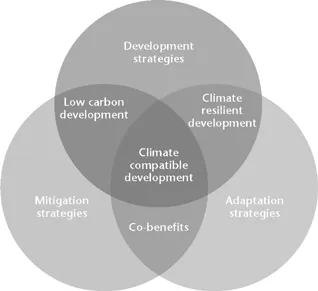
The term ‘climate compatible development’ (CCD) is associated with the Climate and Development Knowledge Network (CDKN) programme, which defined the term as ‘development that minimises the harm caused by climate impacts, while maximising the many human development opportunities presented by a low emissions, more resilient, future’ (Mitchell and Maxwell, 2010: 1). Mitchell and Maxwell (2010: 1) go on to observe that CCD ‘moves beyond the traditional separation of adaptation, mitigation and development strategies’ and present the concept as a Venn diagram in which CCD is found at the intersection of adaptation, mitigation and development. As can be seen in the Venn diagram shown in Figure 1.1, in addition to CCD, win-win strategies can be sought rather than triple wins; low carbon development results from mitigation and development objectives being sought together, climate resilient development from adaptation and development and co-benefits from mitigation and adaptation objectives coming together.
FIGURE 1.1 Climate Compatible Development
Source: Mitchell and Maxwell (2010: 1).
Table 1.1 builds on Figure 1.1 by setting out definitions and characteristics of low carbon development, climate resilient development, co-benefits and CCD.
Insights can be gained for CCD from low carbon development, climate resilient development and co-benefits. Urban and Nordensvärd (2013: 15–16) observe that there are two key interpretations of low carbon development: one that emphasises economic growth and the other that recognises a broader interpretation of development. The first interpretation prioritises low carbon growth, with attention to switching from fossil fuels to low carbon energy, promoting low carbon technology and promoting carbon sinks, including forests and wetlands. The second is more aligned with sustainable development thinking, with attention to issues of justice and poverty reduction. Both interpretations recognise that low carbon development implies a decoupling of economic growth from carbon emissions; growth should not be dependent on burning of fossil fuels, but alternative sources of energy should be sought which enable growth whilst reducing carbon emissions. The differing interpretations reflect different interpretations of the scope and aims of development, with implications for policy and practice.
Climate resilient development (CRD) emphasises the need to build the resilience of people, communities and nations to increasing climate variability. Resilience thinking, Carrapatoso and Kürzinger (2014) suggest, brings insight to responses to climate change on how to deal with uncertainties, integrate information from many areas of science, policy and experience and take bottom-up rather than top-down approaches, which deliver more appropriate and effective responses. Building resilience contributes to building the adaptive capacity of individuals, households, communities, organisations and economies, so that people and systems are better able to respond to change.
TABLE 1.1 Comparison of climate change and development terms
Term
Definition
Characteristics
Low carbon development
’a development model that is based on climate-friendly low carbon energy and follows principles of sustainable development, makes a contribution to avoiding dangerous climate change and adopts patterns of low carbon consumption and production’ (Urban and Nordensvärd, 2013: 5)
Brings together climate change mitigation and development policies, plans and actions, with emphasis on low emissions and avoiding ‘carbon lock-in’ (high carbon pathways). Requires decoupling of economic growth from carbon emissions
Climate resilient development
’means ensuring that people, communities, businesses, and other organizations are able to cope with current climate variability as well as adapt to future climate change, preserving development gains, and minimizing damage’ (USAID, 2014: 2)
Brings together climate change adaptation and development. Emphasises need:
• To accept and deal with uncertainties
• For more integrated, flexible systems and approaches
Co-benefits between mitigation and adaptation
• ’Adaptation actions that have consequences for mitigation,
• Mitigation actions that have consequences for adaptation,
• Decisions that include trade-offs or synergies between adaptation and mitigation,
• Processes that have consequences for both adaptation and mitigation’
(Klein et al., 2007: 747)
Integrated approaches that may involve multiple stakeholders in the design and delivery. Different spatial and time scales between mitigation and adaptation present challenges, as well as the need to engage different types of actors
Climate compatible development
’development that minimises the harm caused by climate impacts, while maximising the many human development opportunities presented by a low emissions, more resilient, future’ (Mitchell and Maxwell, 2010: 1)
Brings together mitigation, adaptation and development objectives, plans and actions to deliver on ‘triple wins’
Co-benefits are realised when mitigation efforts bring adaptation benefits and adaptation brings mitigation benefits. The scope of ‘inter-relationships between adaptation and mitigation’ was explored through a report to the fourth IPCC Assessment Report, with Klein et al. (2007: 747) identifying four types of interrelationships as shown in Table 1.1. Kongsager et al. (2016) provide encouragement of there being potential for delivering on co-benefits from their review of climate change projects in the agricultural and forestry sectors in Africa, Asia and Latin America. They concluded that although mitigation and adaptation objectives were often sought separately, in practice co-benefits were often delivered. Many of the projects they reviewed were addressing both mitigation and adaptation, despite the emphasis given to one rather than the other. In particular they found that mitigation projects sought to integrate adaptation approaches.
However, many challenges to integrating mitigation and adaptation efforts, and realising co-benefits, have been identified. These challenges stem from the contrasting spatial and temporal scales at which they are manifested and contribute; the difficulty related to measuring and valuing adaptation benefits compared to those associated with mitigation; and the involvement of different actors and interests, with adaptation likely to involve a greater range of actors and interests (Klein et al., 2005). Generally, the benefits from adaptation measures align with the scale at which the climate change effects are felt, whereas mitigation benefits are global. Klein et al. (2005: 582) identify three areas of risks associated with focusing too much on creating synergies between mitigation and adaptation: the complexity of institutions involved, with different interests, ways of working, networks and funding arrangements; there may not be sufficient opportunities for integrated responses to be developed; and the mitigation and adaptation benefits might be greater if measures were pursued separately. They also observe, however, that climate policy, whether pursuing mitigation or adaptation aims, is not implemented in a policy vacuum. It interacts with other areas of policy, including decentralisation, natural resource management, environmental protection, energy, transportation and health. Such interaction suggests a need for integrated approaches that build on the local context, experience and policy.
Figure 1.1 illustrates how CCD brings together development, mitigation and adaptation objectives and efforts. CCD is not the first, or only, terminology that has been used to reflect the convergence of mitigation, adaptation and development. ‘Low carbon climate resilient development’ (LCCRD) has been described as ‘capturing the need for mitigation and adaptation efforts to be fully integrated into development planning and implementation’ (Boyle, 2013: 1) and ‘low emission climate resilient development’ (LECRD) as combining ‘climate-compatible development and low-emission climate development strategies’ (Fisher, 2013: 7). Fisher (2013) claims that unlike CCD, a ‘development-first’ approach, LECRD brings together mitigation, adaptation and development with equal emphasis. Literature on CCD does not corroborate the claim that CCD prioritises development, though the term has been promoted within developing and emerging country contexts. This plethora of terms for bringing together mitigation, adaptation and development reflects their differing origins (conceptual and organisational) and location of emphasis on the individual comp...
Table of contents
Cover
Half Title
Title Page
Copyright Page
Table of Contents
List of figures
List of tables
List of boxes
Notes on contributors
Foreword
1 Conceptualising climate compatible development
2 Reconsidering climate compatible development as a new development landscape in southern Africa
3 Closing the knowledge gaps on gender and climate change for CCD
4 Climate smart agriculture: a critical review
5 Climate change and African agriculture: unlocking the potential of research and advisory services
6 Triple wins? Prospects for pro-poor, low carbon, climate resilient energy services in Kenya
7 Debunking free market myths: transforming pro-poor, sustainable energy access for climate compatible development
8 The political economy of REDD+ in Mozambique: implications for climate compatible development
9 Coping with climate extremes in Mongolian pastoral communities
10 Enabling climate compatible development in the coastal region of Kenya
11 A political economy of artisanal fisheries and climate change in Ghana
12 Prospects and challenges for climate compatible development
Index
Trusted by 375,005 students
Access to over 1.5 million titles for a fair monthly price.
Study more efficiently using our study tools.
Frequently asked questions
Yes, you can cancel anytime from the Subscription tab in your account settings on the Perlego website. Your subscription will stay active until the end of your current billing period. Learn how to cancel your subscription
No, books cannot be downloaded as external files, such as PDFs, for use outside of Perlego. However, you can download books within the Perlego app for offline reading on mobile or tablet. Learn how to download books offline
Perlego offers two plans: Essential and Complete
Essential is ideal for learners and professionals who enjoy exploring a wide range of subjects. Access the Essential Library with 800,000+ trusted titles and best-sellers across business, personal growth, and the humanities. Includes unlimited reading time and Standard Read Aloud voice.
Complete: Perfect for advanced learners and researchers needing full, unrestricted access. Unlock 1.5M+ books across hundreds of subjects, including academic and specialized titles. The Complete Plan also includes advanced features like Premium Read Aloud and Research Assistant.
Both plans are available with monthly, semester, or annual billing cycles.
We are an online textbook subscription service, where you can get access to an entire online library for less than the price of a single book per month. With over 1.5 million books across 990+ topics, we’ve got you covered! Learn about our mission
Look out for the read-aloud symbol on your next book to see if you can listen to it. The read-aloud tool reads text aloud for you, highlighting the text as it is being read. You can pause it, speed it up and slow it down. Learn more about Read Aloud
Yes! You can use the Perlego app on both iOS and Android devices to read anytime, anywhere — even offline. Perfect for commutes or when you’re on the go. Please note we cannot support devices running on iOS 13 and Android 7 or earlier. Learn more about using the app
Yes, you can access Making Climate Compatible Development Happen by Fiona Nunan in PDF and/or ePUB format, as well as other popular books in Scienze biologiche & Riscaldamento globale e cambiamento climatico. We have over 1.5 million books available in our catalogue for you to explore.