- 250 pages
- English
- ePUB (mobile friendly)
- Available on iOS & Android
eBook - ePub
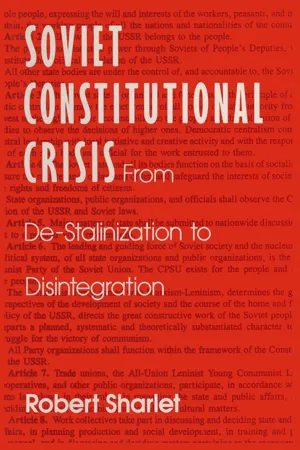
Soviet Constitutional Crisis
About this book
Moving from the adoption of the "post-Stalin" Constitution of 1977 through its subsequent implementation under Brezhnev, Andropov, and Chernenko to the radical legal "restructuring" of the Gorbachev years, Robert Sharlet traces the gradual evolution of a nascent constitutionalism in the erstwhile USSR. Sharlet, a noted authority on Soviet law and constitutional development, demonstrates the gradual transformation of law from an instrument of Communist Party rule into the new "rules of the game" for nonauthoritarian political development. In effect, he argues, one of Gorbachev's most durable achievements may be his redefinition of Soviet politics into a legal idiom along with his relocation of policymaking from behind the closed doors of Party conclaves into the more open, emergent arena of constitutional government. In analyzing the politics of law from the Brezhnev era to the rise of Yeltsin, the author takes account of the "war of laws", the symbolic uses of the Soviet constitution, and even the fact that the leaders of the failed coup attempted to justify their seizure of power on constitutional grounds. Constitutionalism has sufficiently suffused Soviet public life, the book concludes, that most of the sovereign republics as successors to the former USSR, have begun designing their futures - to varying degrees - in constitutional forms.
1. Brezhnev and the Soviet Constitution of 1977
Codifying De-Stalinization
In 1977—after nearly 20 years in the making—the Soviet Union finally promulgated its long-awaited new constitution. With little advance warning, impending publication of the draft document was announced at a Central Committee plenary session in late May. But the significance of this event was at once overshadowed by the simultaneously announced ouster of Nikolai Podgorny from the CPSU Politburo. Podgorny's dramatic exit from the party leadership and his "request" for retirement from chairmanship of the Presidium of the USSR Supreme Soviet paved the way for General Secretary Leonid Brezhnev to be elected to the Soviet "presidency" at the regular Supreme Soviet session in mid-June.1
Thus, in the space of a few weeks, Brezhnev reached the summit of his political career. Having successfully engineered the fall of his major Politburo rival, he became the first CPSU leader to serve as not only de facto but also de jure head of state. In this new capacity, he immediately embarked on a major and well-publicized state visit to France, where his reception was marked by considerable ceremony. Yet while the general secretary's new office attracted the attention abroad, the proposed constitution quickly occupied center stage at home. Indeed, the nationwide "public" discussion of the draft text during the summer and early fall, followed by revision and ratification of the new constitution in October 1977, took on the central role in the activities leading up to the celebration on November 7 of the 60th anniversary of the Bolshevik Revolution.2
The process of drafting a new constitution was not a smooth one. The published draft surfaced after nearly two decades of discussion and uncertainty—not just about its contents but about whether it would even appear at all. Entangled in the politics of de-Stalinization, the passage of the new Soviet constitution through the more open, factionalized, and conflict-ridden policymaking process of the post-Stalin era proved a complex undertaking, requiring numerous changes and compromises to accommodate the diverse interests involved in such a broad, overarching document.
The Path of Constitutional Reform
These circumstances contrasted considerably with those surrounding the appearance of the "Stalin Constitution" some four decades before. A constitutional commission was appointed in 1935 and charged with replacing the Constitution of 1924, which, after nearly a decade of social upheavals, no longer reflected the structure and content of the rapidly changing Soviet system. The commission produced a draft by mid-1936 and submitted it for nationwide discussion during the summer and fall. After mainly stylistic and semantic changes, it was ratified in late 1936, and December 5 was thereafter celebrated as "Constitution Day," invariably calling forth paeans of praise in the nation's media.3
The times then, of course, were very different. By the mid-1930s, Stalin had completed his "revolution from above," radically transforming the socioeconomic configuration of Soviet society in the process and, at the same time, ensuring his personal ascendancy over party and state. With collectivization behind him and heavy industrialization well under way, Stalin chose to consolidate these changes and stabilize the resulting status quo. Among other things this entailed reconstructing the legal system as a means of providing a formal framework for the planned, public economy, and of affording a larger measure of predictability to the individual citizen, who had just lived through a time of extraordinarily disruptive, indeed violent, social change. Toward this end, Soviet civil law, which had been rapidly "withering away" under the impact of radical Marxist jurisprudence, was gradually revived. A collective farm statute, legislating the peasant's right to a personal garden plot, was enacted in 1935; and new, more conservative family legislation, designed to stabilize the family as a social unit, was passed in mid-1936. The new constitution which followed served as Stalin's most public "signal" that the "revolution from above" was over and that "stabilization" was the new political and legal order of the day.4
The "Stalin Constitution" proclaimed that the Soviet Union had become "a socialist state of workers and peasants." It implied that the class war had ended, secured the peasant's garden plot in basic law, and constitutionally mandated the citizen's right to personal property. Although the "great purge" was reaching its crescendo at the same time, and the new constitutional guarantees of personal security were being honored in the breach for millions of Soviet citizens, the personal economic rights granted under the "Stalin Constitution" did extend to the individual some greater degree of certainty in his or her daily life.5
After the dictator's death and the onset of de-Stalinization, the rapid pace of reform and developmental change soon surpassed the 1936 Constitution's structural capacity to reflect it through the casual, piecemeal process of amendment and revision. Efforts to draft a new Soviet constitution formally began in 1962, but the removal of Nikita Khrushchev two years later interrupted the process.6 Brezhnev was elected Chairman of the Constitutional Commission in place of the deposed Khrushchev; thus the project was not abandoned. Yet, while the post-Khrushchev leadership thereby maintained a commitment to replace the supposedly long outdated "Stalin Constitution," progress on a new draft slowed ap preciably.7 Nor was this surprising, since previous Soviet constitutions had reflected each succeeding phase of Soviet political development, and the Brezhnev regime in the latter half of the 1960s set about reversing many of Khrushchev's innovations while advancing new policies of its own.
Another plausible reason for the delay in constitutional change was that the project presumably did not have the same priority for the pragmatic Brezhnev that it had for his more ideological predecessor. The 1936 Constitution was easily amendable; the more serious gaps could be filled by additional statutory legislation, and the major anachronisms superseded by new legislative principles and codes. Thus, the long established practice of incremental constitutional change could continue while the post-Khrushchev leadership addressed itself to the more urgent problems of agriculture, the economy, and foreign policy.
In the late 1960s and early 1970s, however, several Western scholars learned in private talks with Soviet colleagues that the drafting process was under way once again.8 The prospects for imminent constitutional change gradually gathered a modest momentum in the Soviet legal press and were stimulated from time to time by authoritative political hints. Speculation over the timing of the new constitution was rife among Western specialists, and anticipation from all quarters mounted as the 25th CPSU Congress approached in 1976. The most popular scenario making the rounds among Western journalists and scholars at the time predicted that Brezhnev would crown his career with a new constitution, to be presented at the Congress, which, presumably, would be Brezhnev's last in view of his age and deteriorating health. But the expected announcement failed to materialize, and Brezhnev confined himself to fresh promises on the subject in a few brief remarks at the end of his long opening-day report. His statement that work on the constitution was going forward, although "without haste," was echoed subsequently in the legal press, but without elaboration or indication of any deadline for completion.9 Then, without the usual advance clues, there came the abrupt announcement in May 1977 that the draft of a new constitution would soon be published for nationwide discussion.10
Continuity and Change
In keeping with Brezhnev's political style, the new Soviet Constitution of 1977 was a moderate, middle-of-the-road document, neither anti-Stalinist nor neo-Stalinist in its thrust, but rather a generally pragmatic statement of already existing practice and principle. Despite its association with the general secretary's concurrent political triumphs, however, this document was not simply a "Brezhnev Constitution." In the first place, as stressed in its preamble, the 1977 Constitution displayed much "continuity of ideas and principles" with the three previous constitutions.11 For example, most of the articles dealing with property and the economy (Chap. 2 of the Constitution) and with the ordinary citizen's economic rights and duties (Chap. 7) dated from the 1936 Constitution, in which they helped institutionalize and consolidate Stalin's "revolution from above." Moreover, Brezhnev himself had made constitutional "continuity" a keynote in his plenum report.12
Second, and of much greater importance, the 1977 Constitution codified major social and political changes which extended beyond the scope of Brezhnev's leadership alone. In the most general sense, this was demonstrated by the fact that Soviet authorities described it as the constitution of an advanced industrial society, one that, in Soviet parlance, had reached the stage of "developed socialism." In contrast, earlier constitutions were designed to serve a Soviet society at very different stages of revolutionary development or postrevolutionaiy consolidation.
More specifically, the new constitution took full account of the great volume of post-Stalin legislation that had affected nearly every branch and area of Soviet law. In fact, there were few points in the 1977 Constitution that had not been raised or institutionalized already in code law, statutory legislation, or the scholarly juridical commentary explicating the extensive post-Stalin legal reforms. For example, the environmental protection clauses (Arts. 18 and 67), the foreign policy section (Arts. 28-30), and the constitutional prescription (and pun) of a 41-hour maximum work week in Article 41 were all novel in comparison with the 1936 Constitution. But they broke no new ground in terms of post-Stalin policy, practice, and legal development.13
In broader terms, the Constitution served as a useful register of both the accomplishments and the limits of de-Stalinization. In retrospect, it was clear that Khrushchev himself had set out the boundaries of de-Stalinization in his famous "secret speech" to the 20th Party Congress in 1956. Although he indicted Stalin for the "cult of personality" and its egregious consequences for the party and "socialist legality," Khrushchev also explicitly praised his predecessor for the latter's "great services to the party" in forging the socioeconomic foundations of the Soviet system, laid out in the course of the First Five-Year Plan.14
One major aspect of de-Stalinization affirmed in the new document was the constitutionally enhanced status of the individual in relation to the state, especially in criminal proceedings (Arts. 151 and 160) but in civil matters as well (Art. 58).15 No less important was the formally institutionalized "leading" role of the party (Art. 6), a change in constitutional form that culminated in the party's renaissance following the end of Stalin's personal dictatorship. At the same time, the moderate tone and obvious compromises in the Constitution illustrated the consequences of post-Stalin leadership change, political factionalism, and interest group conflict.
The limits to change, however, were no less significant. Most important, the party had constructed in the new constitution a political instrument for routinizing the governance process, but it had done so in such a manner as to leave sufficient ambiguity for a jurisprudence of political expediency to circumvent the system of "legality" when necessary. In fact, the party had merely "constitutionalized" the traditional dualism of law and extralegal coercion.16 In this fundamental sense, the 1977 Constitution represented codification of the post-Stalin system as a party-led constitutional bureaucracy.
Still, a potentially important qualification should be considered. During the course of the lengthy constitutional drafting process, a lively theoretical debate developed among Soviet legal scholars over the concept of "constitution" in Soviet jurisprudence. In essence, two schools of thought vied in the legal press over the seemingly "academic" question of whether to call Soviet public law "state law" (gosudarstvennoe pravo) or "constitutional law" (konstitutsionnoe pravo).17 In fact, this debate held significant implications for the 1977 Constitution's drafters. "State law" referred to the traditional view which argued that the Soviet constitution basically was intended to reflect the structure of state power prevailing in Soviet society. From this perspective, the constitution, through the continuous process of amendment, performed little more than a codification function, recording and legitimating the changes in state structure as they occurred.
The "constitutional law" school, which for years was in a decided minority within the Soviet legal profession, asserted that the traditional approach tended to reduce the constitution to a mere sociopolitical mirror while neglecting its normative potential. In contrast, this side proposed that the constitution be conceptualized as both a reflective and a programmatic instrument. The latter function would incorporate the Communist Party's ideological and policy goals into a more open-ended, future-oriented document. The "constitutionalists" also insisted that their perspective would better facilitate the constitutional elaboration of the citizen's increased rights and duties, which had found legislative expression in the context of the changing post-Stalin relationship between state and individual.
The "constitutional" school prevailed18—at least to the extent that the 1977 Constitution included greater programmatic content in comparison with the 1936 version. A further "constitutionalist" contribution was the new constitution's greater emphasis on the sociopolitical, economic, and legal status of the Soviet citizen and the explicit correlation of the state's powers with its corresponding obligations to the citizen and vice versa.
To be sure, the party leadership intended to use the post-Stalin constitution as a stable and orderly framework through which to govern the increasingly differentiated and specialized socioeconomic system, while at the same time reserving for itself the inherent power of dictatorship to bypass the "legal state" by resorting to ad hoc, extralegal action when it thought it appropriate. Yet, in addition to providing a general legal policy that fixed the boundaries and functions of the social regulation process in higher law, the 1977 Constitution itself contained the seeds of a major party metapolicy—that is, a set of goals and rules of behavior, given normative value and with systemwide and not merely legal rami-fications.19
A Soviet "Systems" Approach
As expressed by Soviet political and legal commentators, a major purpose of the new Soviet constitution was to reflect the infrastructure of the Soviet system after 60 years of development. In particular, this meant recording in constitutional language the most important and enduring political, legal, socioeconomic, and doctrinal changes since promulgation of the 1936 Constitution, and especially following Stalin's death. In this connection, the more dynamic, "systems" approach to sociopolitical structure that was contained in Part I of the Constitution (Arts. 1-32) stood in decided contrast to the static, state-society formula of its predecessor.
Western-style "systems analysis" came into vogue in the Soviet social sciences in the 1970s, although its reception in jurisprudence was still in the formative stage by the end of the decade. In its legal context, the "systems" approach stemmed from post-Khrushchevian recognition of the distinction between the state (gosudarstvo) and the political system (politicheskaia organhatsiia sovetskogo obshchestva).20
The Constitution's description of the whole Soviet system therefore delineated a dominant political system (Chap. 1), together with economic and social subsystems (Chaps. 2 and 3). This framework implied a possible concession of at least some developmental autonomy for social and economic patterns in Soviet society. And it suggested a perceptible change in stress, from a political system that was essentially transformist to one that was more explicitly regu...
Table of contents
- Cover
- Half Title
- Title
- Copyright
- Dedication
- Contents
- Preface
- Introduction: Crisis and Constitutional Reform in Tsarist Russia and the Soviet Union
- 1. Brezhnev and the Soviet Constitution of 1977: Codifying De-Stalinization
- 2. The Andropov–Chernenko Interregnum: Juridicizing the System
- 3. Gorbachev and the Soviet Constitutional Crisis: From De-Stalinization to Disintegration
- Notes
- Readings for Further Study
- Chronology of the Rise and Fall of the Soviet System, 1917–1991
- Name Index
- Subject Index
Trusted by 375,005 students
Access to over 1.5 million titles for a fair monthly price.
Study more efficiently using our study tools.
Frequently asked questions
Yes, you can cancel anytime from the Subscription tab in your account settings on the Perlego website. Your subscription will stay active until the end of your current billing period. Learn how to cancel your subscription
No, books cannot be downloaded as external files, such as PDFs, for use outside of Perlego. However, you can download books within the Perlego app for offline reading on mobile or tablet. Learn how to download books offline
Perlego offers two plans: Essential and Complete
- Essential is ideal for learners and professionals who enjoy exploring a wide range of subjects. Access the Essential Library with 800,000+ trusted titles and best-sellers across business, personal growth, and the humanities. Includes unlimited reading time and Standard Read Aloud voice.
- Complete: Perfect for advanced learners and researchers needing full, unrestricted access. Unlock 1.5M+ books across hundreds of subjects, including academic and specialized titles. The Complete Plan also includes advanced features like Premium Read Aloud and Research Assistant.
We are an online textbook subscription service, where you can get access to an entire online library for less than the price of a single book per month. With over 1.5 million books across 990+ topics, we’ve got you covered! Learn about our mission
Look out for the read-aloud symbol on your next book to see if you can listen to it. The read-aloud tool reads text aloud for you, highlighting the text as it is being read. You can pause it, speed it up and slow it down. Learn more about Read Aloud
Yes! You can use the Perlego app on both iOS and Android devices to read anytime, anywhere — even offline. Perfect for commutes or when you’re on the go.
Please note we cannot support devices running on iOS 13 and Android 7 or earlier. Learn more about using the app
Please note we cannot support devices running on iOS 13 and Android 7 or earlier. Learn more about using the app
Yes, you can access Soviet Constitutional Crisis by Robert Sharlet in PDF and/or ePUB format, as well as other popular books in Law & Public Law. We have over 1.5 million books available in our catalogue for you to explore.