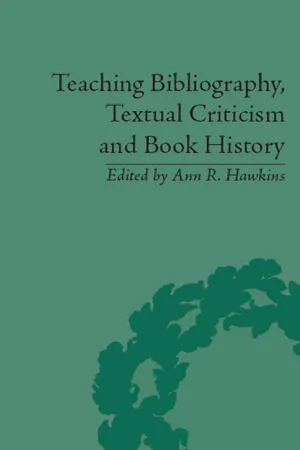
Offers a variety of approaches to incorporating discussions of book history or print culture into graduate and undergraduate classrooms. This work considers the book as a literary, historical, cultural, and aesthetic object. These essays are of interest to university teachers incorporating textual studies and research methods into their courses.
- 199 pages
- English
- ePUB (mobile friendly)
- Available on iOS & Android
eBook - ePub
Teaching Bibliography, Textual Criticism and Book History
About this book
Information
Exploring the Archaeology of the Book in the Liberal Arts Curriculum
You might think of your next visit to the college’s rare book room this way: handling an old book may be the closest you will ever come to physically holding hands with your intellectual predecessors.1 This is why rare book reading rooms are for me numinous spaces: when they are interpreted by an energetic curator the physical objects contained in them may be catalysts for deep intellectual and emotional connections and insights unavailable elsewhere or by any other means. At the same time, those of us who work in rare book rooms tend not to think of them as temples or shrines or (even worse) mausoleums of the book. Nor do we consider them any longer as ‘Treasure Rooms’, although the notion of rare books may conjure something elitist, rarefied, clubby, and a reminder of the pretensions of earlier generations of college benefactors. On the other hand, whereas at many colleges the rare book room may be the pride of the development office, it may also be an embarrassing burden to the library administration and a puzzle to everyone else on campus. In fact, many rare book curators in liberal arts colleges these days may be faced with a lack of enthusiasm or even apathy from the faculties they seek to serve. The following remarks are an attempt to explain how a small college’s rare book collection may be relevant and useful to all constituents of its home institution.
As many of today’s curators approach it, the rare books program in a liberal arts college has three separate but inter-related emphases or foci. The first is about presenting the book as a physical, an archaeological, object, about uncovering patterns in its physical fabric. In other words, we curators attempt to teach students how to look at a book – and, by extension, any artifact from the past – and to discover information about the features, the intent and the implications of its type, paper, printing, illustration and binding. Harold Brodkey, in the eloquent memoir of his dying, wrote about his own similar experience of visual discovery:
At one time I was interested in bird-watching, and I noticed that when I saw a bird for the first time I couldn’t really see it, because I had no formal arrangement, no sense of pattern for it. I couldn’t remember it clearly, either. But once I identified the bird, the drawings in bird books and my own sense of order arranged the image and made it clearer to me, and I never forgot it.2
We are involved in exactly the same process in our reading rooms – all of our deconstruction, classification and examination of the minutiae of books, paradoxically, provides us with a broader as well as deeper understanding of their role in history and a richer, more complete, appreciation of the objects themselves.
Our second focus is the impact of the book on society. Here we are concerned with the book not only as a commercial commodity or as vehicle for the transmission of ideas, but as an expression of the mentalité of all those who came in contact with it: author, printer, binder, illustrator, publisher, seller, reader, and censor. And our third focus is the mutability and transience of the text, the sometimes fragile and tenuous transmission of any given text from edition to edition, century to century, culture to culture. In exploring this we are mainly concerned with the question of how the reception of any given text is conditioned or mediated by the physical form and the physical appearance of its presentation.
Today, the history of the book is a relatively new field, rich with possibility, interdisciplinary in the widest possible sense as it constitutes a nexus between literature, bibliography, social history, intellectual history, mechanical arts, graphic arts, the history of science, and many others. The following brief observations on the intellectual undergirding or foundation of history of the book a field of inquiry are relevant because the conventions of the field as they exist at any given moment in time determine the shape of operations like college special collections departments as well as the types of goods and services librarians and conservators make available to faculty and students.
Until the mid 1980s the history of the book had been approached by means of two separate and distinct methodologies: the French school, which examines the effects of the impact of the book on society, and the Anglo-American school, which is primarily bibliographical, and concerned with the book as a physical object. Of course, each of these two methodologies has its own viewpoints, means, and ends.
Even in this country we refer to the French approach to the history of the book by its French name, l’histoire du livre. The fons et origo of the discipline is Henri-Jean Martin’s and Lucien Febvre’s magisterial L’Apparition du Livre (1958), one of the most important products of the Annales school of historiography founded by Febvre and Marc Bloch in the late 1920s. In general Annales addresses the social and cultural aspects of historical events, and attempts to interpret these events and their effects from the point of view of ordinary people. Annales historiography is primarily based on the analysis of archival materials – in this case of documents such as library inventories and borrowing records and booksellers’ and collectors’ catalogues.
Certainly L’Apparition du Livre (translated into English in 1976 as The Coming of the Book) revolutionized the way American scholars thought about the book. Before this book history was construed mostly as the documentation of developments in the technique of printing and related crafts and, to a lesser extent, the dissemination of texts. Instead, L’Apparition du Livre attempted to describe the role and function of the printed book in society in order to demonstrate ‘that the printed book was one of the most effective means of mastery over the whole world’.3 Febvre and Martin’s arguments were so startling, so compelling that in the decades since their work appeared, a long line of historians, mostly French, but notably including Elizabeth Eisenstein and Robert Darnton in the US, has explored the social and economic consequences of the presence of books in society.
To help students understand the French approach, I propose the following exercise: imagine a book as if it were a building, as if it were architecture and, concomitantly, book history as if it were architectural history. If you wished to study a cathedral in a European town, for example, you might analyze it in terms of style (gothic or romanesque or baroque or renaissance) or materials (marble, granite, stucco etc). But the Annales historian would be primarily interested in the significance that this cathedral held for the inhabitants of the town, and would ask questions related to the way they used it. How did the building itself condition the religious life of the townspeople? Were they even allowed inside? How often? What did they do there? How did the building contribute to the way the citizens thought of themselves, especially in contradistinction to citizens of neighboring towns. Public buildings like cathedrals were municipal projects that often took centuries and enormous human and capital resources to complete; they were complex human endeavors involving the collaboration of many sectors of the society. How was all of this collaborative activity coordinated, and what social, intellectual, financial and emotional results did it produce? These would be some of the questions that the Annales historians would ask – about buildings and about books.
On the other hand, the Anglo-American practice of book history was originally bibliographical, concerned with type, paper, printing and publishing. In addition, up until the rise of deconstruction, the Anglo-American approach had been considered a necessary adjunct to textual analysis. It was the study of early English literary works, especially Renaissance drama, by such scholars as R. B. McKerrow and W. W. Greg in the early twentieth century that provided the context for the development of ‘analytical bibliography’ (defined by G. Thomas Tanselle in his 1981 Hanes Lecture as ‘the elucidation of the printing history of a particular book by analysis of the physical evidence of its typography and paper’4). These scholars noticed that the texts they were working on might differ from copy to copy, even in the same edition. In an attempt to understand how that could happen they undertook the first detailed studies of what actually went on in English Renaissance printing shops. How did what transpired in the crowded and chaotic atmosphere of the shop affect the ways that the text was set up in type and printed? This question preoccupied English and American literary scholars, who were primarily concerned with textual analysis, and the evidence they uncovered fueled the engine of bibliographical scholarship for many decades.
To help my students grasp the Anglo-American approach, I propose another exercise: think about a book as if it were an archaeological artifact and book history as if it were archaeology. You have unearthed a small potsherd from a dig at a Neolithic site. From an observation of the artifact’s curvature and thickness you may be able to infer the size and shape of the original vessel. From this you make conjectures as to its function: was it used for storage, or transportation, or cooking? You might then go a step further and deduce the particular foodstuff that was stored, transported, or cooked in it. This may suggest the agricultural level of the people who made it and perhaps even the climate and meteorological conditions that prevailed. Perhaps most importantly, knowledge of all of the above will certainly help you assign a date range to your little shard. And so it is with bibliography: an analysis of the physical evidence in books allows us to make statements about how they were produced and how they were used.
Analytical bibliography is fascinating work, of course, but we realize now that dependence upon this strictly archaeological method is not sufficient. Indeed, in recent years English and American historians and bibliographers are finally venturing a comprehensive description of the workings of the book trade, something not previously considered as part of the practice of bibliography, which has, as I mentioned, focused for the most part on the production of books. We now see that such an approach does not possess the critical means to grapple with questions of the significance and implication of books in the lives of individuals of various classes and of society as a whole. Yet this is precisely something about which we’ve discovered we know much less than we need to know. And something, obviously, that is at the root of our understanding of our own intellectual history.
In the last decade or so an international group of semioticians and structural sociologists has also turned its attention to the history of the book. These scholars, following the lead of Gerard Genette, W.J.T. Mitchell, and others, analyze signs and visual communication – or rather, the form of a given sign, the form of a mode of visual communication – and interpret how that form conditions our understanding of the meaning of the sign. For the history of the book the key insight deriving from this new approach has been Genette’s theory of paratexts.5 Paratexts are liminal devices and conventions, both inside and outside of the book, that form part of the complex mediation between book, author, publisher, and reader. These conventions are found in most books – title pages, forewords, tables of contents, subscribers’ pages, indices, epigraphs and publishers’ jacket copy – and make up all of the things that are not the text but that surround and contextualize it. Along with Derrida, these scholars limit the value of the text in its traditional static sense (as an author’s ‘creation’); instead, they understand it as something more dynamic and fluid, reaching completion only after being ‘encorporated’ as it were by a publisher and then ultimately consumed by a reader. Thus publishers, readers, and authors form a dynamic triad responsible for the realization of the text. ‘Text’ is here defined as a relationship or as process.
Earlier, I said that up until the mid 1980s the history of the book had been approached by means of separate and distinct methodologies. Since then, many scholars and teaching curators in college special collections have attempted to reconcile or harmonize the separate methodologies, to forge something new. If we American scholars and curators can also adopt and adapt the socio-economic approach of the French historians and the theoretical insights of the international semioticians, blending them with our own techniques of bibliographical analysis and description, we will not only broaden the definition of the history of the book, we will also deepen its scholarly significance and intellectual excitement as well.
So, I propose the merits of this new amalgam, and urge you to consider its value to your own teaching and scholarship. Let’s move toward a fusion of these seemingly disparate methodologies. Let’s move toward an understanding of rare book collections as something with resonance for a wide variety of subjects and with a variety of access points. Our new view espouses the notion that all aspects of the production and distribution and consumption of reading matter are significant and that the various ways of approaching it are interconnected; the progress of book history as a field of learning – and therefore the implication of the rare book room for your pedagogy – depends on the recognition of this crucial point. And we curators are committed to catalyzing this fusion of methodologies in the field since it is bound to result in the more sophisticated use of special collections materials in your classrooms. In fact, the entire program of the pedagogical curator could be said to rest upon this new way of interpreting the book and its history.
Finally, the nineteenth-century historian and literary critic, Francis Underwood, wrote that ‘the life of every community is made up of infinite details’.6 How should we keep ourselves warm? What do we eat for breakfast? Where do we empty our chamber pots? How do we see well enough to work when the sun goes down? What do we keep in our pockets? The lives of the printers and publishers, the writers, readers and censors, the lives of all whom students encounter in the rare book room were filled, dominated, conditioned by these ‘infinite details’ – just as ours are today. But, when we think about history and the history of the book we tend to overlook these everyday details in favor of grand themes and big books which characterized each age and genre. Special collections librarianship used to be practiced as the quest for the big books, the important collections. Instead, we now train students to focus on the ‘infinite details’ of people’s literary lives (if and what and how they read) as well as of the ‘infinite details’ of life in the pressroom and bookshop. This is no trivial pursuit but rather, as social historian Jack Larkin describes it, the fertile and rewarding investigation into what has been taken for granted. We curators now recognize that the study of things not recorded, not commented upon – the mundane and arcane routines of daily work, the archaeological clues left behind in the fabric of material culture, the skein of little facts and details that make up the stuff of people’s lives – this is a gold mine for those of us who attempt to enliven with flesh and blood the bare bones of the past.
With all of the above in mind, the history of the book then can be understood as a crucible in which social history, bibliographical analysis, material culture, and semiotic theory is compounded. Indeed, the special collections curator oversees a laboratory that employs books as raw materials for scholarship in a discipline that at the same time impacts upon, and draws from, all others.
Notes
1. This essay is a version of lecture presented to a faculty forum at Smith College in September 2001.
2. Harold Brodkey, This Wild Darkness: the Story of My Death (New York: Metropolitan Books, 1996), p. 109.
3. Lucien Febvre and Henri-Jean Martin, David Gerard tr., The Coming of the Book ...
Table of contents
- Cover Page
- Half Title page
- Title Page
- Copyright Page
- Contents
- Notes on Contributors
- Foreword
- Introduction: Towards a Pedagogy of Bibliography
- Exploring the Archaeology of the Book in the Liberal Arts Curriculum
- Historical Bibliography for Rare-Book Librarians
- ‘A Clear and Lively Comprehension': the History and Influence of the Bibliographical Laboratory
- Bookends: Towards a Poetics of Material Form
- Book History on the Road: Finding and Organizing Resources outside the Classroom
- Jane Eyre on eBay: Building a Teaching Collection
- History of the Book in the American Literature Classroom: On the Fly and On the Cheap
- From Printing Type to Blackboard™: Teaching the History of the Early Modern Book to Literary Undergraduates in a ‘New' UK University
- Preparing Library School Graduate Students for Rare Book and Special Collections Jobs: Assignments and Exercises That Work
- Book History and Librarian Education in the Twenty-first Century
- Making the Medicine Go Down: Baggy Monsters and Book History
- ‘They are Not Just Big, Dusty Novels': Teaching Hard Times within the Context of Household Words
- ‘In a Bibleistic Way': Teaching Nineteenth-Century American Poetry Through Book and Periodical Studies
- The Bibliography and Research Course
- Integrating ‘Bibliography' with ‘Literary Research': A Comprehensive Approach
- The Hidden Lives of Books
- Learning from Binders: Investigating the Bookbinding Trade in Colonial Philadelphia
- Papermaking, History and Practice
- The Bibliographical Analysis of Antique Laid Paper: A Method
- How Things Work: Teaching the Technologies of Literature
- ‘Not to pick bad from bad, but by bad mend': What Undergraduates Learn from Bad Editions
- Book History and Reader-Response Theory: Teaching Shakespeare's Romeo and Juliet and King Lear
- Teaching Textual Criticism: Students as Book Detectives and Scholarly Editors
- Afterword
- Resources
- Index
Trusted by 375,005 students
Access to over 1.5 million titles for a fair monthly price.
Study more efficiently using our study tools.
Frequently asked questions
Yes, you can cancel anytime from the Subscription tab in your account settings on the Perlego website. Your subscription will stay active until the end of your current billing period. Learn how to cancel your subscription
No, books cannot be downloaded as external files, such as PDFs, for use outside of Perlego. However, you can download books within the Perlego app for offline reading on mobile or tablet. Learn how to download books offline
Perlego offers two plans: Essential and Complete
- Essential is ideal for learners and professionals who enjoy exploring a wide range of subjects. Access the Essential Library with 800,000+ trusted titles and best-sellers across business, personal growth, and the humanities. Includes unlimited reading time and Standard Read Aloud voice.
- Complete: Perfect for advanced learners and researchers needing full, unrestricted access. Unlock 1.5M+ books across hundreds of subjects, including academic and specialized titles. The Complete Plan also includes advanced features like Premium Read Aloud and Research Assistant.
We are an online textbook subscription service, where you can get access to an entire online library for less than the price of a single book per month. With over 1.5 million books across 990+ topics, we’ve got you covered! Learn about our mission
Look out for the read-aloud symbol on your next book to see if you can listen to it. The read-aloud tool reads text aloud for you, highlighting the text as it is being read. You can pause it, speed it up and slow it down. Learn more about Read Aloud
Yes! You can use the Perlego app on both iOS and Android devices to read anytime, anywhere — even offline. Perfect for commutes or when you’re on the go.
Please note we cannot support devices running on iOS 13 and Android 7 or earlier. Learn more about using the app
Please note we cannot support devices running on iOS 13 and Android 7 or earlier. Learn more about using the app
Yes, you can access Teaching Bibliography, Textual Criticism and Book History by Ann R Hawkins in PDF and/or ePUB format, as well as other popular books in Literature & Literary Criticism. We have over 1.5 million books available in our catalogue for you to explore.