- 164 pages
- English
- ePUB (mobile friendly)
- Available on iOS & Android
eBook - ePub
About this book
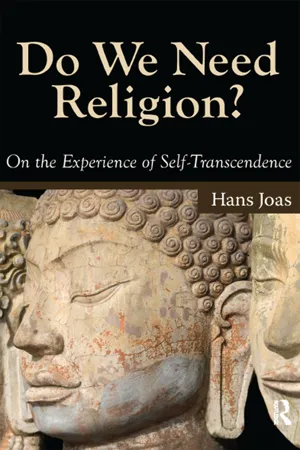
The old assumption that modernization leads to secularization is outdated. Yet the certainty that religion is an anthropological universal that can only be suppressed by governments is also dead. Thus it is now a favorable moment for a new perspective on religion. This book takes human experiences of self-transcendence as its point of departure. Religious faith is seen as an attempt to articulate and interpret such experiences. Faith then is neither useful nor a symptom of weakness or misery, but an opening up of ways of experience. This book develops this basic idea, contrasts it with the thinking of some leading religious thinkers of our time, and relates it to the current debates about human rights and universal human dignity.
Information
PART 1
Religious Experience
1
Do We Need Religion?
“Embarrassing Incident” is the title of a poem by Bertolt Brecht from the year 1943.1 Written in his Californian exile, it gives an account of a major celebration among German émigrés on the occasion of the sixty-fifth birthday of Brecht’s friend and admired colleague Alfred Döblin, whom he calls in this poem one of his “most revered gods.” The birthday celebration took place in a small theater in Santa Monica close to Hollywood, and they had all come: Brecht and his wife, Helene Weigel, Heinrich and Thomas Mann, Lion Feuchtwanger, and Hanns Eisler, who had composed a special piece for this occasion, and the great actors Fritz Kortner, Peter Lorre, and Alexander Granach, all three of whom read from Döblin’s books.2 This tribute to the impoverished and isolated Döblin, who had been a leading novelist and leftist political writer in the Weimar Republic, was going just as well as its organizers had planned. But suddenly the unexpected happened. Döblin began his speech of thanks. He announced that he, the Jewish intellectual, had found his way to the Christian faith and been baptized as a Catholic. Brecht captured this occurrence as follows:
Then the celebrated god himself stepped onto the platform reserved for artists
And declared in a loud voice
Right in front of my sweat-drenched friends and students
That he had just been afflicted with an illumination and now
Had become religious and with unseemly haste
He provocatively clapped a moth-eaten cleric’s bonnet on his head
Fell lewdly to his knees and shamelessly
Struck up a saucy hymn, thus offending
The irreligious sentiments of his listeners, some of them
Mere youths.
For the last three days
I haven’t dared show my face
Among my friends and students
I’m so
Embarrassed.
This episode provides us with an initial answer to the question I am posing today. Religiosity—in one possible translation of Brecht’s response—is a sign of weakness. Human beings are in need of religion only when they are too weak to live without it. Although the tone of the poem is more or less malicious, Brecht was certainly capable of treating his friend with greater empathy. In his journals,3 he articulates “the sympathetic horror felt when a fellow prisoner succumbs to torture and talks,” and he adduces the many terrible blows of fate that had brought matters to such a pass and that must be considered extenuating circumstances: the loss of two sons, lack of success, illness, and problems in his marriage. For Brecht, all this explains Döblin’s conversion as a breakdown, but the basic idea clearly remains the same: To be religious means to be weak, and one should not yield to such weakness, at least not publicly. One’s friends are embarrassed if one shows one’s weakness in broad daylight.
Döblin is unlikely ever to have seen Brecht’s poem, but the embarrassment and outrage felt by his friends, some of whom caused a stir by leaving the celebration early, and the cooling of his friendship with Brecht can surely not have escaped him. The views of Döblin’s leftist kindred spirits were quite out of sync with his own self-esteem. In literary terms, Döblin was as prolific as ever; the power of his language and even the brash Berlin tone, which continued to feature in many of his commentaries, do not suggest a broken man. In a similar set of circumstances, he ironically fends off the insinuation that he became a believer because of illness, stating: “I am not sick, I was not sick, and I will never be sick.”4 And he wrote a powerful dialogue on religion because he wanted to translate Christianity “into his own language.” Here, he distinguished between two types of weakness, as if to counter the interpretations of his friends: The first entails “declining strength,” the second “waning resistance.”5 Thus for him, it was the other way around: Those who flee from their relationship with God and indulge in false certainties are the weak ones.
What do we feel when we look back on this “embarrassing incident” today, more than sixty years later? Is it not Brecht’s response itself that we find embarrassing, because it reveals the embarrassing certainty of Brecht’s own beliefs? His faith was not, of course, a faith in God, but there is no doubt that Brecht felt he knew the answer to questions about the meaning of life, and this answer was political. He assumed that the laws of history had been discovered by the science of Marxism and that human history would progress until communism itself had been achieved. But does this “faith in history” not seem very aged today? Was not the term scientific communism, used in communist countries to refer to an academic discipline and academic posts at universities and colleges, the butt of jokes long before the collapse of the regimes in Eastern Europe? One could not go on forever blaming the failure to realize utopian dreams on unfavorable conditions. When the colossus that was the Soviet Union collapsed, it had definitely become impossible to deny that the focus of contemporary problems had shifted. Few, however, grasped just how profound these historical upheavals were.
Not only Marxists but almost all influential social scientists and historical thinkers had for long assumed that secularization, in the sense of the decline of religion, is a necessary corollary of modernization. We need only glance at the world around us to find this assumption seemingly confirmed at every turn. There have always been exceptions, such as Poland and Ireland, but these were quickly explained away with handy theories. The most difficult case has always been the United States. Nobody could deny that it is a modern society, yet religion has remained a vigorous force, not only in the shape of Protestant fundamentalism but in a rich plurality of forms.6 This is why the United States has been treated as a very special case, as a modern society in a religious third world, as some commentators have put it. But the perspective of sociologists of religion has changed dramatically even in this respect. As large parts of the world outside of those areas molded by Christianity modernize rapidly, a huge experiment is taking place before our eyes. This allows us to investigate empirically the relationship between secularization and modernization. The provisional findings make it more plausible to classify Europe—rather than the United States—as the exceptional case. Secularization as Europe has experienced it is not simply being repeated today on a global scale. Some authors therefore even speak of desecularization. Whatever the precise outcome of this research, there are good reasons to question the assumption that religion in all its diversity is set to disappear—without, however, simply presenting this as evidence that religion is a universal, an anthropological given that can only be suppressed by force.
I think this is a fair characterization of the present historical period, in which we ask: Do we need religion? If those who see religion as superfluous and dangerous, as well as believers who assume that without faith there is only decline and decadence, have both lost their certainty, this could be a favorable moment for a new way of thinking.
I certainly do not believe we can answer our question by pointing to advantages of one kind or another that an individual, society, or mankind might glean from religion. Some claim that only believers can be truly happy or consistently moral or psychologically healthy; only if people believe can societies be peacefully integrated and considerate toward minority groups. All this may be true; I personally tend to assume that some of these claims are plausible. But in every individual case, our reason compels us to investigate the alleged causal connections in an objective manner. We must never simply take a causal connection for granted because it chimes with the enthusiastic certainties of belief. Reflecting on the functional advantages and beneficial effects of religion in this way can lead to interesting research. Yet it brings us no closer to the point that those who ask “Do we need religion?” want to reach. For one thing seems to me indubitable. Whatever the results of such research, even the most perfect proof of the utility of religious belief cannot cause anybody to hold such a belief. Nobody can believe because he has been convinced by rational means that believing is useful, that it serves a purpose. If we apply notions of religious utility to ourselves, we end up with Pascal’s famous wager. But we all know that the result of such cold, rational calculation would inspire little emotional intensity. What is more, as William James once wrote, God would not be taken in by such rational calculations. “And if we were ourselves in the place of the Deity, we should probably take particular pleasure in cutting off believers of this pattern from this infinite reward.”7 If notions of utility with regard to religion are applied to societies as a whole, this inevitably gives rise to a division between an elite that knows better and the masses who supposedly need belief to pacify them. The famous quip “I am an atheist, but Catholic of course” comes from the radical Right in France about a century ago (Maurice Barrès) and articulates this thinking in a particularly cynical way.
This means that we have to conceive of the “need” in our question in a different way. “Need” relates not to the external purpose of a belief, its usefulness. It must refer to something inherent in belief. It must be bound up with the experience we call belief. The question is not “Is religion useful?” but “Can we live without the experience articulated in faith, in religion?” If this is the right question, then we have to look more closely at what kind of experience this is and in which forms we might encounter it.
I therefore propose that we reflect on those kinds of experience that are not yet experiences of the divine, but without which we cannot understand what faith, what religion, is. I call them experiences of self-transcendence. This means experiences in which a person transcends herself, but not, at least not immediately, in the sense of moral achievements but rather of being pulled beyond the boundaries of one’s self, being captivated by something outside of myself, a relaxation of or liberation from one’s fixation on oneself. We thus initially define this self-transcendence only as a movement away from oneself, as the somewhat antiquated German word Ergriffensein expresses quite beautifully.
There is no doubt that we do have such experiences. My book The Genesis of Values8 was an attempt to offer, together with philosophical and social psychological reflections on the precise character of this self-transcendence, a rich phenomenology of such experiences. You will be familiar with all of them. I invite you to read one description without succumbing to the suspicion that I am merely identifying religious faith with such experiences. Yet we can assuredly approach belief through such experiences.
In Knut Hamsun’s novel Mysteries, a man named Nagel walks into a forest. Here is what he experiences:
A tremor of ecstasy ran through him. He felt himself carried away and engulfed by the magic rays of the sun. The stillness filled him with an intoxicating sense of well-being; he was free from worry; the only sound was a soft murmur from above, the hum of the universal machinery—God turning his treadmill.
Not a leaf stirred in the trees—not a pine needle dropped. Nagel hugged his knees in sheer delight; he felt exhilarated because life was good. It beckoned to him and he responded. He raised himself on his elbow and looked around him. There wasn’t a soul in sight. He said yes to life once more and listened, but no one came. Again he said yes, but there was no answer.
Strange; he had distinctly heard someone calling him. But he dismissed the thought; perhaps he had imagined the whole thing. But nothing was going to shatter his joyful mood. He was in a strange, euphoric state of mind; his every nerve vibrated; music surged through his blood; he was part of nature, of the sun, the mountains; he was omniscient; the trees, the earth, the moss, spoke to him alone. His soul went into a crescendo, like an organ with all the stops pulled out. Never would he forget how this heavenly music would pulsate through his blood.9
Here we have all the attributes of an experience of self-transcendence in an experience of ecstatic fusion with nature. Our interaction with other human beings might involve similar experiences. Think of a conversation that goes beyond the exchange of trivialities, information, or argument, during which you suddenly have the feeling that your interlocutor has intuitively understood deep layers of your personality, giving you the courage to talk about the formative events in your life and, perhaps, about stirrings you yourself have as yet scarcely acknowledged. Such a conversation also represents the experience of transcending the boundaries of one’s self, an experience you will remember and that leaves behind some affective attachment to one’s interlocutor, making it easier to interact next time around. We have the same experience, felt with far greater intensity, when we fall in love or are in love with another person. This strong feeling of closeness has for long and in many cultures been interpreted as a renewal of a relationship, as if one had known the other before, or forever, or as if one’s ancestors or God had meant it to be thus. This expresses the force—for which no other explanation seems to be available—with which two human beings, often after just a few moments, are drawn to each other, recognize themselves in the other, and find themselves accepted by the other. We experience third parties’ enquiries as to what we find so attractive about the loved partner as inappropriate, because we are not falling in love with specific properties or attributes but with a whole person for whom there is no rational denominator. Sexual experiences, one might say, combine the experience of fusion with another person with fusion with nature: We can experience mutual understanding but also the enjoyment of the beauty of another’s body, the joy of knowing that one’s own body is experienced as beautiful and loved, and a sensual pleasure that goes beyond the quotidian and is one of the strongest foundations of deeply felt human relationships.
No impenetrable wall separates experiences of selflessness and overcoming of the self, in the context of love for one’s fellows and charity, from eros. Here, too, a phenomenology can begin with rather trivial experiences, such as the pleasure of giving and the fact that there is probably nobody who always thinks only of himself and his own advantage, although self-love is frequently extended only to a narrow circle, such as one’s family, and the fixation on one’s self remains intact. But the experiences of helping and receiving help can be experiences of self-transcendence. This is true of the experience of being shocked by others’ neediness, be they our loved ones or even anonymous others. The beggar we ignore on ninety-nine out of a hundred days or to whom we make a small donation to quiet our vaguely bad conscience might suddenly be experienced as our brother—although this term is too well-worn to really get across the shattering character of an experience that brings home to you the fact that the other truly is an ego like you and that you could be in his shoes, leading his life in his body.
Here, we encounter the voice of morality in the experience of being deeply moved, although erotic love, which demands a certain permanence, also produces obligations, and even the intense experience of nature has repercussions for how we deal with nature and for our moral conceptions of what constitutes an appropriate relationship with nature. In the shattering of one’s self by the other, some thinkers have seen the root of all morality, and there is no doubt that many moral emotions like shame and outrage feature an intense experience of self-transcendence. Finally, we must turn our attention to the experiences of collective ecstasy that arise when groups of people begin to feel fired up, as we say metaphorically; when the individual’s self-control diminishes to such an extent that she becomes overconfident and engages in activities she would otherwise consider beyond her capabilities. Speakers become funnier when they sense that their words are being well received, or grandiloquent when they sense agreement and support. We feel stronger, smarter, or more beautiful, or perhaps, when masked or dressed up, like completely different beings, just as others seem transformed by a mysterious, anonymous force. This transformation might make us generous. We mi...
Table of contents
- Cover
- Half Title
- Title Page
- Copyright Page
- Table of Contents
- Preface
- Part 1: Religious Experience
- Part 2: Between Theology and Social Science
- Part 3: Human Dignity
- Index
- About the Author
Trusted by 375,005 students
Access to over 1.5 million titles for a fair monthly price.
Study more efficiently using our study tools.
Frequently asked questions
Yes, you can cancel anytime from the Subscription tab in your account settings on the Perlego website. Your subscription will stay active until the end of your current billing period. Learn how to cancel your subscription
No, books cannot be downloaded as external files, such as PDFs, for use outside of Perlego. However, you can download books within the Perlego app for offline reading on mobile or tablet. Learn how to download books offline
Perlego offers two plans: Essential and Complete
- Essential is ideal for learners and professionals who enjoy exploring a wide range of subjects. Access the Essential Library with 800,000+ trusted titles and best-sellers across business, personal growth, and the humanities. Includes unlimited reading time and Standard Read Aloud voice.
- Complete: Perfect for advanced learners and researchers needing full, unrestricted access. Unlock 1.5M+ books across hundreds of subjects, including academic and specialized titles. The Complete Plan also includes advanced features like Premium Read Aloud and Research Assistant.
We are an online textbook subscription service, where you can get access to an entire online library for less than the price of a single book per month. With over 1.5 million books across 990+ topics, we’ve got you covered! Learn about our mission
Look out for the read-aloud symbol on your next book to see if you can listen to it. The read-aloud tool reads text aloud for you, highlighting the text as it is being read. You can pause it, speed it up and slow it down. Learn more about Read Aloud
Yes! You can use the Perlego app on both iOS and Android devices to read anytime, anywhere — even offline. Perfect for commutes or when you’re on the go.
Please note we cannot support devices running on iOS 13 and Android 7 or earlier. Learn more about using the app
Please note we cannot support devices running on iOS 13 and Android 7 or earlier. Learn more about using the app
Yes, you can access Do We Need Religion? by Hans Joas in PDF and/or ePUB format, as well as other popular books in Teología y religión & Religión, política y estado. We have over 1.5 million books available in our catalogue for you to explore.