eBook - ePub
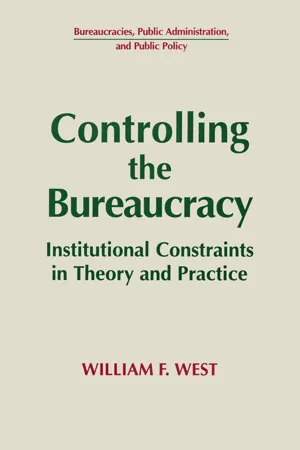
Controlling the Bureaucracy
Institutional Constraints in Theory and Practice
- 272 pages
- English
- ePUB (mobile friendly)
- Available on iOS & Android
eBook - ePub
About this book
Controls on the bureaucracy through administrative due process and presidential and congressional prerogatives are the focus of this book. The author examines these controls and assesses the trade-offs among them.
Information
1
Ideas and Politics: The Context for Understanding and Evaluating Institutional Controls
Although the growth of bureaucracy has accompanied modernization throughout the world, this development has been especially unsettling for our peculiar, tripartite system of democracy. Thus, American government has adapted to the rise of the administrative state through three often-conflicting means of promoting accountability. It has sought to ensure desired qualities in agency decision making through participatory opportunities and standards of rationality that are enforced through the courts. In addition, both the president and Congress have sought to monitor and shape agencies’ implementation of statutes in accordance with their own policy preferences.
Each of these controls has received considerable attention, yet there are few up-to-date discussions of all three that go beyond the brief accounts found in public administration and administrative law texts. The following chapters seek to fill this void by providing a balanced overview of the institutional powers and resources associated with administrative due process and executive and legislative oversight at the federal level. Special attention is given to how each has expanded in recent decades in direct relation to the growth of bureaucracy as a locus of policy-making discretion and as an arena for political conflict.
A more ambitious goal of this book is to evaluate controls over public administration. This entails a consideration of the decision-making qualities that different constraints promote in light of the criteria that we feel should guide statutory implementation. Equally as important, it may also entail a rethinking of the “process values” that we want from controls in light of what we can realistically expect. The reciprocal linkage between normative and empirical concerns, which underlies the allusion to “theory and practice” in the subtitle of this book, provides a partial justification for such a broad undertaking. Much has been written on the topics discussed here, yet the complementary relationship between prescriptive and descriptive analysis has frequently been slighted. Political scientists have often failed to make explicit, much less critically examine, the normative premises that ultimately must give meaning to the empirical questions they ask. Conversely, prescriptive works by legal scholars and others have often reflected faulty assumptions about the nature of administration and about its relationship to the incentives and capabilities that define the effects of institutional controls.
The scope of this book is further justified by a second interrelationship that is also crucial to the evaluation of controls over public administration. Although due process and executive and legislative oversight are often treated separately, one cannot adequately discuss the effects or the desirability of any of them in isolation from the others. This is because controlling the bureaucracy is a “negative-sum game” from a constitutional perspective. The values, political interests, and institutional prerogatives furthered by one type of constraint inevitably undermine the values, political interests, and institutional prerogatives promoted by each of the other two. Indeed, the most critical structural choices facing American government today concern the balance that should be struck among the three “named” branches within the administrative process. At one level or another, this concern underlies almost everything that is written about institutional controls over the bureaucracy.
In turn, the most important and vexing constitutional issues have to do with the control of delegated policy-making authority. Who should oversee bureaucracy and pursuant to what criteria were relatively easy questions to answer under the traditional assumption that administration was a matter of carrying out legislative goals objectively and efficiently. Thus, there was a fairly broad consensus during the early decades of this century that adjudicatory decisions affecting important individual rights should be subject to rigorous procedural constraints and judicial review, and that the remainder of the administrative process should fall under the executive’s managerial control. The issues surrounding bureaucracy’s role and its relationship to legislative, executive, and judicial power have become much more complex with the realization that implementation is also frequently a political function of balancing competing values.
A coherent and widely accepted doctrine has not emerged concerning the principles and institutional mechanisms that should constrain the quasilegislative dimensions of public administration. What is striking, though, is the popularity of the belief that agency policy making should reflect qualities of rationality that differ markedly from the kinds of pluralistic processes that our political system is seemingly designed to encourage. These prescriptions can be traced in large measure to institutional analyses that describe Congress’s delegation of authority and the structure of bureaucratic politics that has resulted from it in pathological terms. As such, they provide useful reference points for describing and assessing the roles played by due process and presidential and congressional oversight. Much current thinking about administrative accountability derives from simplistic empirical and normative assumptions about the role of administration in American government.
The Context for Limited Controls
The bulk of the discussion in the chapters that follow focuses on the determinants and the effects of expanded controls. Given this, and given the interrelationship between prescriptive and descriptive concerns in institutional analysis, it is useful to begin with a broad overview of the ideals and the realities that were associated with less-demanding constraints in the past. Lax controls over public administration were often justified by normative theories of administration that viewed agency discretion in sanguine terms. They could also be attributed in part to the low levels of conflict that accompanied policy implementation in many policy areas, and to correspondingly low incentives for affected groups to seek controls over the bureaucracy that would protect their interests.
Limited Constraints
Administrative due process and presidential and congressional oversight were not very extensive or rigorous at midcentury. This is a subjective and relative judgment that must be defended in the context of more recent developments. Deferring a discussion of these changes to later chapters, it is possible to characterize in broad terms the most important features of the old system of limited controls over administrative discretion.
Attempts to confine bureaucratic discretion through administrative due process were haphazard and generally undemanding through the 1950s. This owed in part to judicial modesty. Courts were initially reluctant to review administrative decisions at all unless authorized to do so by the enabling statutes under which agencies operated. Although a general “presumption of reviewability” evolved during the twenties and thirties, and was eventually codified in the Administrative Procedure Act,1 judicial precedent and professional norms continued to call for restraint in questioning agencies’ factual and policy determinations. This was especially true when decisions were based on administrators’ judgment in weighing evidence and assessing likely outcomes within their areas of expertise. The role of the courts was thus usually limited to questions of procedure and statutory interpretation.
The courts’ reluctance to interfere with administration was both a cause and an effect of undemanding or nonexistent procedural requirements and terms of judicial review in many statutes. Enabling legislation in the early part of the century occasionally stipulated the procedures that agencies were to use in carrying out their mandates, but bureaucrats were usually left to their own devices. Sentiment to impose some order on the administrative process began to mount in the early 1930s and eventually culminated in the passage of the Administrative Procedure Act in 1946. If the avowed purpose of the APA was to standardize the administrative process and render bureaucracy more accountable, however, its requirements evinced a continued reluctance to question the exercise of agency discretion. One limitation was its unwillingness to interfere in a substantial way with bureaucratic policy decisions. Another was that the applicability of its requirements for both rulemaking and adjudication was confined to regulatory administration and little else. Although the APA was never the sole source of administrative procedures and judicial review, its limited provisions remained the primary constraints on administrative output during the two decades following its passage.
The laxness of administrative due process until the 1960s coincided with a limited interest in policy implementation by the two political branches of government. It was only after the Second World War that presidents began to view the appointment of political executives as a management tool rather than as a source of patronage.2 In addition, the White House and Executive Office lacked the institutional capacity for systematic review and influence over agency policies before the 1970s. Centralized control over the bureaucracy only emerged as a significant strategy for promoting presidential objectives during the Nixon administration.3
Congress displayed a similar lack of interest in oversight. The conventional wisdom that had emerged among scholars by 1970 was that the mundane aspects of day-to-day administration were neither personally interesting nor politically salient to most legislators. Studies concluded that oversight sometimes did occur, but that it tended to be a sporadic response to constituent pressures or to widely publicized failings in the administrative process that provided opportunities for legislators to generate name recognition and to claim credit as protectors of the public trust. It was seldom informed by programmatic concerns, and its overall effects were often characterized as being negligible.4
Normative Foundations of Limited Control
The system of limited controls over administration that existed during the first half of the twentieth century initially found legitimacy in the normative theory of public administration that dominated thinking about bureaucracy and its role in government from the late 1800s into the 1930s. The premise of the so-called traditional model was that politics and administration were conceptually distinct functions and practically separable activities. Politics, which involved value judgments, was the process of accommodating and responding to society’s demands through the articulation of policy objectives. In contrast, administration was the task of accomplishing those objectives. As Luther Gulick stated, “Administration has to do with getting things done.”5 Although sophisticated scholars such as Gulick did not believe in this distinction as something that actually existed or that even could exist in an absolute sense (notwithstanding the misinformed ridicule they have received), they did embrace the politics/administration dichotomy as an approximation of reality that could serve as a unifying premise for normative theory and institutional design.
The traditional model is well known to those familiar with the intellectual history of public administration. Woodrow Wilson advocated as early as 1887 that bureaucracy and the processes by which it carried out legislative mandates should be studied systematically. In so doing, he argued that, given the instrumental function performed by agencies, we could...
Table of contents
- Cover
- Half Title
- Title Page
- Copyright Page
- Dedication
- Table of Contents
- Foreword
- Acknowledgments
- Chapter
- Index
- About the Author
Trusted by 375,005 students
Access to over 1.5 million titles for a fair monthly price.
Study more efficiently using our study tools.
Frequently asked questions
Yes, you can cancel anytime from the Subscription tab in your account settings on the Perlego website. Your subscription will stay active until the end of your current billing period. Learn how to cancel your subscription
No, books cannot be downloaded as external files, such as PDFs, for use outside of Perlego. However, you can download books within the Perlego app for offline reading on mobile or tablet. Learn how to download books offline
Perlego offers two plans: Essential and Complete
- Essential is ideal for learners and professionals who enjoy exploring a wide range of subjects. Access the Essential Library with 800,000+ trusted titles and best-sellers across business, personal growth, and the humanities. Includes unlimited reading time and Standard Read Aloud voice.
- Complete: Perfect for advanced learners and researchers needing full, unrestricted access. Unlock 1.5M+ books across hundreds of subjects, including academic and specialized titles. The Complete Plan also includes advanced features like Premium Read Aloud and Research Assistant.
We are an online textbook subscription service, where you can get access to an entire online library for less than the price of a single book per month. With over 1.5 million books across 990+ topics, we’ve got you covered! Learn about our mission
Look out for the read-aloud symbol on your next book to see if you can listen to it. The read-aloud tool reads text aloud for you, highlighting the text as it is being read. You can pause it, speed it up and slow it down. Learn more about Read Aloud
Yes! You can use the Perlego app on both iOS and Android devices to read anytime, anywhere — even offline. Perfect for commutes or when you’re on the go.
Please note we cannot support devices running on iOS 13 and Android 7 or earlier. Learn more about using the app
Please note we cannot support devices running on iOS 13 and Android 7 or earlier. Learn more about using the app
Yes, you can access Controlling the Bureaucracy by William F. West in PDF and/or ePUB format, as well as other popular books in Politics & International Relations & Business General. We have over 1.5 million books available in our catalogue for you to explore.