- 528 pages
- English
- ePUB (mobile friendly)
- Available on iOS & Android
eBook - ePub
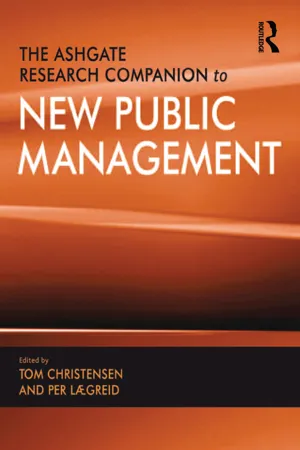
The Ashgate Research Companion to New Public Management
About this book
This collection provides a comprehensive, state-of-the art review of current research in the field of New Public Management (NPM) reform. Aimed primarily at a readership with a special interest in contemporary public-sector reforms, The Ashgate Research Companion to New Public Management offers a refreshing and up-to-date analysis of key issues of modern administrative reforms. This volume comprises a general introduction and twenty-nine chapters divided into six thematic sessions, each with chapters ranging across a variety of crucial topics in the field of New Public Management reforms and beyond. The principal themes to be addressed are: ¢
Information
1
Introduction
Tom Christensen and Per Lægreid
The Broader Picture
New Public Management (NPM) is a general concept denoting a global wave of administrative reforms that has had an impact on many countries’ public sectors over the last 25 years (Pollitt and Bouckaert 2004). Most NPM reform efforts have had similar goals: to improve the effectiveness and efficiency of the public sector; to enhance the responsiveness of public agencies to their clients and customers; to reduce public expenditure; and to improve managerial accountability.
The term ‘New Public Management’ was coined by Christopher Hood in 1991 (Hood 1991), but it actually referred to a concept that dated back a decade. The first NPM reform ideas and measures were introduced by the governments of Margaret Thatcher in the UK and of Ronald Reagan in the USA from about 1979/80, while Australia and New Zealand followed suit in the mid-1980s. Although the reforms definitely have an Anglo-American flavour (Hood 1996a), they have spread widely around the world, driven partly by the forces of globalization and by international organizations dominated by the same countries, but also nationally by conservative and neo-liberal parties, in some cases in collaboration with mainstream social democratic parties.
The first part of this companion will focus on the driving forces behind NPM. It will analyse the main components of NPM ideology, focusing on the generic aspects of this brand of reform. A distinction can be made between reform ideas and more specific reform measures, and here we emphasize the coupling between the two. A broad transformative approach to public reforms contends that when a political and administrative leadership tries to handle and further public reforms it operates in at least three types of contexts that can both enhance and/or obstruct reforms: the constitutionally laid-down political and administrative structure; the political and administrative culture; and the environment, whether technical or institutional (Christensen and Lægreid 2001b and 2007a). These different contexts will be discussed in separate chapters and their relevance for the NPM process analysed more generally.
The second part of the companion deals with the generic question of whether NPM is about convergence or divergence (Pollitt 2001a). One can argue that some major NPM reform ideas will spread around the world quite easily, while the more specific reform measures will show a pattern of divergence. One main reason for this may be national variations in the three contexts mentioned and the complex interaction between them, for each country has different constitutional/structural features, a different political and administrative culture, and a different environment (Christensen, Lie and Lægreid 2007). A quite common stereotype is that Anglo-American countries are NPM front-runners, followed by some Asian countries, while Continental Europe and Scandinavia have been more reluctant to take NPM on board. The four chapters examining each of these groups of countries will try to outline whether this stereotype reflects empirical reality or whether there are more similarities between the country groups or more variety within the groups than expected.
The third part will deal with whether there is a difference between ‘soft’ and ‘hard’ public policy areas with respect to implementation of NPM. Originally, NPM was often thought to be best applied to harder and more technical policy areas, where it was easier to set unambiguous targets and measure results (Gregory 2003a). In the meantime NPM seems to have spread to most policy areas, but does this distinction still exist?
NPM is said to be a ‘shopping-basket’ of different reform measures, not all pointing in the same direction. Part IV deals with this question and examines the spectrum of NPM reform measures, ranging from the more structural ones, to performance indicators, management and market elements, public–private partnerships and user-orientation.
Part V focuses on the effects and implications of NPM. NPM is broadly oriented and seems to produce both main effects and side-effects, according to Pollitt (2002). The most typical main effect is efficiency; but side-effects, concerning the larger questions of democracy, legitimacy, trust, accountability, control, professional competence and normative issues, seem to be just as important.
Part VI looks at what has followed NPM in terms of public reforms. Reforms that have emerged more recently have been variously labelled as post-NPM, whole-of-government, joined-up government, quality of government, New Public Governance and so on. A central question addressed in this part concerns what happens when different reform waves meet each other. Will NPM prevail, be modified and pushed back, or combined with newer reform measures?
The Content of NPM
One primary characteristic of NPM is the adoption by public organizations of the management and organizational forms used by private companies. This challenges two traditional doctrines of public administration (Dunleavy and Hood 1994): that public-sector organizations are ‘insulated’ from the private sector in terms of personnel, structure and business methods; and that they operate in accordance with a precise set of rules limiting the freedom of public officials in handling money, staff, contracts and so on. In contrast the NPM movement ascribes to the generic principle that the formal organization of the public and the private sector should be similar and that managers in public sector organizations should have enough discretion and leeway in their daily work to be able to make efficient use of allocated resources.
Even if NPM fundamentally espouses economic values and objectives, as a concept it is loose and multi-faceted and encompasses a range of different administrative doctrines. It offers a kind of ‘shopping basket’ of different elements to reformers of public administration (Pollitt 1995). The advantage of having a wide variety of reform elements is that it allows public leaders wishing to introduce NPM to be flexible. They may be able to contextualize a broad reform wave that is presented as de-contextualized, that is, a set of measures that will fit everywhere. The disadvantage is that some of the reform elements may be inconsistent or in conflict with one another. This may create ambiguities, conflicts and problems of implementation.
One important set of NPM reform measures are structural ones, which involve splitting up public organizations through horizontal and vertical specialization (structural devolution), whether inter- or intra-organizational. The main vertical change introduced by NPM was increased structural devolution, meaning a trend towards more autonomous agencies and state-owned enterprises (Christensen and Lægreid 2001c). The other main reform element was increased horizontal specialization, based on the principle of the ‘single-purpose organization’, which makes different organizational units’ roles more ‘pure’. In other words, following reforms, each unit deals only with ownership, regulation, purchasing, provision and so on (Gregory 2003b). The combination of these vertical and horizontal reform measures led in many cases to structural fragmentation.
Another basic feature of NPM is managerialism and the management model. Boston et al. (1996) see the inclusion of management models primarily as related to the NPM ideals of further devolution, delegation of authority and autonomy. There seem to be at least two basic management models. The first model – let the managers manage – is connected to devolution. A main component of the NPM philosophy is hands-on professional management, which allows for active, visible, discretionary control of an organization by people who are free to manage; explicit standards of performance; a greater emphasis on output control; disaggregation of units; and private sector management techniques. The second model – make the managers manage – leans more towards the use of incentives to further certain decision-making behaviour. It implies increased exposure to competition, contract management and market orientation (contracting out, purchaser-provider models). A third kind of NPM reform measure, connected to the two mentioned above, involves performance management, cost-cutting and budgetary discipline. The increased use of formal performance indicators represents an attempt to quantify the activities of public organizations more extensively, while ex post scrutiny and auditing are ways of connecting and comparing goals and actual results. The underlying principle is that good results should be rewarded while poor results should be punished.
Three types of reform measures deal with the connection to stake-holders in the environment – marketization, competition and privatization, which involves changing the organization of service provision. One NPM idea was that if services cannot be improved in the public sector, they should be privatized (Boston et al. 1996). Competitive tendering, whereby public and private providers compete for contracts, was advanced as one instrument for doing this; another was to get different private providers to compete for services once a decision had been taken to privatize them. The focus in these reform measures was often on service efficiency – that is, on getting providers to fulfil their contracts in the most appropriate way, to improve the service offered by public providers by introducing more competition and so on.
The flip-side of competitive tendering is its perception of citizens as users or consumers and its increased emphasis on service-orientation, user participation and satisfaction, and responsiveness to demands from customers, users and clients. Measures introduced to enhance these features include Citizens Charters and users’ declarations. Private–public partnerships, on the other hand, entail a more formalized partnership between the public and the private sectors. Instead of giving public organizations sole responsibility for planning, developing, financing, building and operating large projects, such as infrastructure projects, private actors also participate in funding, building and operating them.
Summing up, one can distinguish four different aspects of NPM: the efficiency drive; downsizing and decentralization; the search for excellence; and public service orientation (Ferlie et al. 1996). NPM promised to integrate these themes, linking efficiency and accountability. Other distinctions are between ‘hard NPM tools’, which address accounting, auditing and performance measurement, and ‘soft NPM tools’, which include things like human factors, user-orientation, quality improvement and individual development.
Tensions arising from the hybrid character of NPM, which combines economic organization theory and management theory, are well known (Aucoin 1990). They result from the contradiction between the centralizing tendencies inherent in contractualism and the devolutionary tendencies of managerialism. By advocating both decentralization (let the managers manage) and centralization (make the managers manage), NPM thus simultaneously prescribes both more autonomy and more central control.
Many of the most important and problematic reform elements, such as the relationship between managers and elected officials, reflect the potential tensions in the way these reform elements are combined. Through devolution and contracting out NPM has sought to separate policy-making more clearly from policy administration and implementation. Policy-makers make policy and then delegate its implementation to managers and hold them accountable by contract.
Driving Forces Behind NPM Reforms
A distinction can be drawn between reform ideology and ideas on the one hand and reform practice on the other (Christensen and Lægreid 2001b). The relationship between them may be variously interpreted. First, there may be a clear decoupling between the two, as emphasized in myth theory in general and the theory of ‘double-talk’ and hypocrisy more specifically (Meyer and Rowan 1977, Brunsson 1989). Second, at the other extreme, if reform ideas are driven by a strong leadership and prove to be compatible with the prevailing administrative culture they may be fully implemented. Third, between these two extremes, we have partial and pragmatic implementation of reform ideas, brought about by mechanisms like ‘rational shopping for reform elements’, editing or translation of reform ideas, ‘short-term failures and long-term successes’ (March and Olsen 1983), or a ‘virus mechanism’ (Røvik 2002).
The institutional dynamics of reforms can best be interpreted as a complex mixture of environmental pressure, polity features and historical-institutional context. These factors define how much leeway political leaders have in making choices about reforms – that is, they may both further and hinder NPM reforms (Christensen and Lægreid 2001a and 2007a). One school of thought points to the fact that different countries have different constitutional features and political-administrative structures and contends that these factors go some way to explaining how they handle national problems and reform processes. The constitutional and polity frames relevant here concern first, whether political and administrative leaders are constrained by constitutional factors that limit their ability to implement reforms decisively and swiftly, or whether they have more leeway. The second factor is whether the leadership operates within a homogeneous or heterogeneous political-administrative apparatus. A homogeneous apparatus allows leaders to exercise their hierarchical authority more easily, while a heterogeneous apparatus often engenders turf wars and negotiations among leaders and units (March and Olsen 1983). From a structural or instrumental point of view the reforms may generally be seen as conscious organizational design (Egeberg 2003). This perspective is based on the assumption that political and administrative leaders use the structural design of public entities as an instrument to fulfil public goals (Weaver and Rockman 1993).
According to Dahl and Lindblom (1953) two aspects are important in instrumental decision-making processes – social or political control and rational calculation or the quality of organizational thinking. Major preconditions for instrumental design of NPM reforms are that leaders have a relatively large degree of control over change or reform processes and that they score high on rational calculation or means-end thinking. With respect to constitutional and structural frames, one can say that leaders in political-administrative systems with few constitutional constraints and a homogeneous apparatus will probably be able to exert more control over reform processes and will have fewer problems of rational calculation.
Another view holds that reforms are primarily a product of the national historical-institutional context. Different countries have different historical–cultural traditions and their reforms are ‘path dependent’, meaning that national reforms have unique features. Informal norms and values established in their formative years will influence strongly the paths they follow later on (Krasner 1988). There are two crucial aspects of institutional culture: how strong and influential overall the cultural path is for decision-making and the quality or content of the culture. The reform roads taken reflect the main features of national institutional processes, where institutional ‘roots’ determine the path followed in a gradual adaptation to internal and external pressure. This view stresses institutional autonomy and internal dynamics.
Thus, the cultural context of reform is important. The cultural features of public organizations develop gradually in institutional processes, giving institutionalized organizations a distinct character or cultural ‘soul’ (Selznick 1957). How successfully a reform wave like NPM is applied in a public organization has a lot to do with cultural compatibility (Brunsson and Olsen 1993). The greater the consistency between the values underlying the reforms and the values on which the existing administrative system is based, the more likely the reforms are to be implemented. Generally speaking, culturally based adaptation tends to be partial.
The relationship between structure and culture is also of relevance for understanding NPM reform processes. On the one hand, culture can develop gradually in an ever more distinct path and eventually lead to structural adaptive changes. On the other hand, structure may heavily influence the development of the culture, either directly or indirectly (Christensen and Røvik 1999). A third alternative is that the structural and cultural processes may be rather loosely coupled. The potential for controlling NPM reform processes is definitely strongest when either a culture is compatible (reflecting the structure) or else rather weak, while a strong and incompatible culture makes political-administrative control difficult.
A third view regards NPM primarily as a response to external pressure. This environmental determinism can be of two kinds: either institutional or technical (Meyer and Rowan 1977). In the first instance a country may adopt internationally based norms and beliefs about how a civil service system should be organized and run simply because these have become the prevailing, ideologically dominant doctrine diffused all over the world. This diffusion process implies isomorphic elements, creating pressure for similar reforms and structural changes in many countries. The institutional environment may exercise one of several types of constraints on the leadership, but may also be rather dominant in certain countries in particular periods. The institutional environment may be either homogeneous or heterogeneous, whereby the latter is the most challenging for both executive control and rational calculation.
The institutional environment generally involves the development of myths and symbols in the macro-environment of public organizations to a considerable degree. In a complicated world, where political-administrative systems, patterns of actors, problems, solutions and effects are complex and difficult to understand, there is a need to have certain ‘rules of thumb’. These are supplied by myths and symbols that evolve and spread between countries, sectors and policy areas. They represent a kind of ‘taken-for-grantedness’ concerning which ideas, organizational structures, procedures and cultures are appropriate. Such myths may be provided by international organizations, like the OECD, the IMF, the World Bank, the WTO and the EU, but also by national organizations working as reform entrepreneurs. They may take the form of broad myths or else they may be narrower institutionalized standards (Røvik 2002). The myth theory stresses that myths imported to public organizations remain superficial, functioning as ‘window-dressing’, enhancing legitimacy without actually affecting practice (Brunsson 1989). But there are also some more instrumental versions of this theory that talk about the editing and translation of myths.
In the second instance, NPM may be seen as the optimal solution to widespread technical problems – that is, it is adopted to solve problems created by a lack of instrumental performance or by economic competition and market pressure (Self 2000a). In this instance NPM reforms are adopted not because of their ideological hegemony but because of their technical efficiency. Quite often, NPM reforms have been initiated or heavily influenced by the technical environment, because of an economic crisis or changing political or administrative pressure. The technical environment may also be either homogeneous or heterogeneous (Scott and Davies 2006). Overall technically-based pressure on a public organization to reform may be strongest either if it has to reply on one strong actor in the environment or if several actors have demands pointing in different directions.
Summing up, external reform components and programmes are filtered, interpreted and modified by a combination of two nationally based processes. One is a country’s political-administrative history, culture, traditions and style of government. The other is national polity features, as expressed in constitutional and structural factors. Within these constraints political and managerial executives have varying leeway to launch NPM reforms via an active administrative policy.
Studies of NPM reform processes around the world reflect many of the theoretical points outlined (Christensen and Lægreid 2001b and 2007a, Pollitt and Bouckaert 2004). Political and administrative leaders are often able to control the processes, even though there is also substantial evidence of negotiations, cultural resistance and pressure from the technical and institutional environment. While political leaders have tended to accept the main norms and values of NPM (which may be regarded as natural since they are the ones responsible for the reform processes), resistance in many countries has come more from the administrative grassroots. Acceptance of NPM among civil servants also varies according to educational background, with jurists most sceptical and business economists most accommodating, while national economists and political scientists are somewhere in between, generally leaning towards the positive side.
NPM processes seem to pose great challenges concerning rational calculation. The complex and turbulent waters of different and changing environments for reform, different cultures and structures, multiple goals, intentions, interests, problems and solutions certainly make organizational thinking problematic. There is a tendency to label many NPM reforms and measures in a similar way, as myths and symbols, even if NPM actually covers a much broader range of reform measures and thinking. The more problematic the rational calculations behind the NPM reforms, the more likely new reform processes are to have...
Table of contents
- Cover Page
- Half Title page
- Title Page
- Copyright Page
- Contents
- List of Figures
- List of Tables
- List of Contributors
- Preface
- 1 Introduction
- Part I NPM Processes: Driving Forces
- Part II Convergence and Divergence among Countries
- Part III Sector Studies
- Part IV NPM Features
- Part V Effects and Implications of NPM
- Part VI NPM and Beyond
- References
- Index
Trusted by 375,005 students
Access to over 1.5 million titles for a fair monthly price.
Study more efficiently using our study tools.
Frequently asked questions
Yes, you can cancel anytime from the Subscription tab in your account settings on the Perlego website. Your subscription will stay active until the end of your current billing period. Learn how to cancel your subscription
No, books cannot be downloaded as external files, such as PDFs, for use outside of Perlego. However, you can download books within the Perlego app for offline reading on mobile or tablet. Learn how to download books offline
Perlego offers two plans: Essential and Complete
- Essential is ideal for learners and professionals who enjoy exploring a wide range of subjects. Access the Essential Library with 800,000+ trusted titles and best-sellers across business, personal growth, and the humanities. Includes unlimited reading time and Standard Read Aloud voice.
- Complete: Perfect for advanced learners and researchers needing full, unrestricted access. Unlock 1.5M+ books across hundreds of subjects, including academic and specialized titles. The Complete Plan also includes advanced features like Premium Read Aloud and Research Assistant.
We are an online textbook subscription service, where you can get access to an entire online library for less than the price of a single book per month. With over 1.5 million books across 990+ topics, we’ve got you covered! Learn about our mission
Look out for the read-aloud symbol on your next book to see if you can listen to it. The read-aloud tool reads text aloud for you, highlighting the text as it is being read. You can pause it, speed it up and slow it down. Learn more about Read Aloud
Yes! You can use the Perlego app on both iOS and Android devices to read anytime, anywhere — even offline. Perfect for commutes or when you’re on the go.
Please note we cannot support devices running on iOS 13 and Android 7 or earlier. Learn more about using the app
Please note we cannot support devices running on iOS 13 and Android 7 or earlier. Learn more about using the app
Yes, you can access The Ashgate Research Companion to New Public Management by Tom Christensen,Per Lægreid in PDF and/or ePUB format, as well as other popular books in Politics & International Relations & Management. We have over 1.5 million books available in our catalogue for you to explore.