- 270 pages
- English
- ePUB (mobile friendly)
- Available on iOS & Android
eBook - ePub
About this book
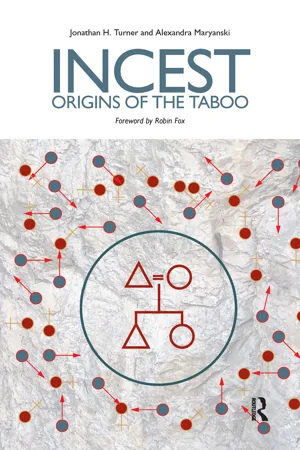
Throughout history humans have been fascinated with incest. Stories, fables, literature, philosophers, church officials, and scientists have explored this mysterious topic. The taboo is critical to human survival, as incest threatens the species and patterns of human social organization. Drawing upon the rich legacy of theory, empirical data, and speculation about the origins of the incest taboo, this book develops a new explanation for, not only the emergence of the taboo in hominid and human evolutionary history, but also for the varying strength of the taboo for the incestuous dyads of the nuclear family, the different rates of incest of these dyads, and the dramatic differences the psychological pathology incest has on its younger victims. Synthesizing findings from biology, sociobiology, neurology, primatology, clinical psychology, anthropology, and sociology, the authors weave together a scenario of how natural selection initially generated mechanisms of sexual avoidance; and then, as the nuclear family emerged in hominid and human evolution, how sociocultural selection led to the development of the incest taboo.
Information
1
THE GOLDEN AGE OF PROMISCUITY

Here lies the daughter, here lies the father, here lies the sister, here lies the brother, here lies the wife and the husband, and there are only two bodies here.
—Medieval tombstone epitaph 1
INTRODUCTION
Humans have been fascinated by incest for all of recorded history and, no doubt, long before ideas could be written down. When acts are taboo, they are mysterious, frightening, and yet captivating. This combination of responses makes them topics for not just quiet and private talk, but also for folk tales, drama, myths, and literary works. Such has certainly been the case for the incest taboo—the most bewitching taboo of all. Part of this attraction stems from being forbidden, but avoiding incest reaches deep into our humanity. Breaking the incest ban strikes at the core of the family and society, if not the viability of the species, and people’s implicit sense of what is at stake makes this taboo especially formidable.
The word “incest” is derived from the Latin incestum and refers to sexual union with a near relative. The word “taboo” comes from Tonga via Captain James Cook’s famous voyage to Polynesia, where Cook observed that the Tongans employ the word tabu, a variant of the more widespread Polynesian word, tapu. Writing in his journal in 1777, Cook noted that taboo has an “extensive signification” but in general denotes something that is “forbidden” (Cook [1777] 1967). The marriage of these two terms—incest and taboo—provided a label for a social interdiction that has preoccupied humans for millennia. Why should this be so? Émile Durkheim ([1897] 1963, 27) gave expression to part of the answer when he emphasized that “all repression of incest presupposes familial relations recognized and organized by society.”
For contemporary Westerners, the family is typically a mother, father, and children. Yet, since a female can raise her offspring alone, it is equally plausible that the elementary family can be composed of a mother (impregnated by a visiting “father”) and her offspring; and then, as Robin Fox (1967, 54) theoretically put it, “our mother-children group could settle down to a cosy little inbreeding arrangement and be totally self-sufficient for purposes of reproduction.” But nobody is supposed to mate in this bundle of relationships. And among all populations, there are often explicit but always implicit understandings that the mother–son, father–daughter, and brother–sister dyads of the nuclear family are not to mate. Sometimes this understanding is expressed as an explicit ban or taboo; at other times it is simply considered so unthinkable for close relatives to mate that a rule is unnecessary (Murdock 1949). Still, as we will see, there is something worrisome about the nuclear family and we should ask, Why are people in some societies so worried about sexual relations between mothers and sons, fathers and daughters, and brothers with sisters? Is there something about the nuclear family that makes sexual intercourse more likely, and if so, to what effect?
While the incest taboo applies worldwide to the nuclear family, customs and laws often extend the prohibition to other relationships, well beyond the nuclear unit. But again we can ask, Why would this be so? Why would people make other, often remote, relatives taboo? It is not just contemporary scholars and scientists who have asked these kinds of questions; they are only following on the heels of a long Western tradition, emerging with the Greeks and Romans and running through the Middle Ages, the early modern age, and the growth of the natural and social sciences. In fact, a wide swath of individuals—from early philosophers through the papacy and literary figures to early and late scientists—have all focused on the problem of incest and the taboo. It is useful, then,to begin our inquiry into the origins of the incest taboo by reviewing, in very broad strokes, the Western tradition of attitudes about incest. For incest is clearly something that humans have talked and thought about for a long time, certainly long before literacy. But with literacy and a written record, we can now see the varied forms such attention takes, whether these interests are recorded in the myths, legends, or narratives of the classical period in Western history, the laws of the Christian church, or the early speculations by the first generation of social scientists on the origins of the family and society.
THE FAMILY AND THE INCEST TABOO IN CLASSICAL TIMES (800 B.C.E.–350 C.E.)2
A family for Greeks (oikos) and Romans (familia) originally meant a household, or a private domestic group composed of parents and children, grandparents, other relatives, and even servants and slaves. While the Greeks banned sexual intimacy between parents and their offspring as well as lineal relatives, enforcement of this prohibition was by public opinion alone because Greek legal codes lacked a punishment or even a formal term for incest. Yet in Greek society, dreams about incest were seemingly a popular pastime and often discussed (Archibald 2001, 17), as is evident in Plato’s Republic, when Socrates is said to have observed of some men that “in sleep when … all that belongs to the calculating, tame, and ruling part … slumbers … the beastly and wild part, gorged with food or drink … seeks to go and satisfy its dispositions… . And it doesn’t shrink from attempting intercourse, as it supposes, with a mother or with anyone else at all.” (9.571). Yet in The Laws of Plato (7.838b), the Athenian attests to the unwritten law (concerning siblings or parents and child) that “guards in a very effective way … against touching … by open or secret sleeping together, or by any other sort of embracing. In fact, among the many there isn’t the slightest desire for this sort of intercourse” (7.838b).
It was left to the Romans to coin the word incestrum, a concept that included a variety of offenses from prohibiting incest in the nuclear family through the lineal line of kin and even some collateralrelations to banning sexual intercourse with a vestal virgin. However, as with the Greeks, Roman marriages (while subject to Roman law) were largely family matters, without religious or government intrusions (Archibald 2001, 12ff.; Beard 1980; Meyrick [1880] 1968, 1725–30).
The incest motif also found popular expression in ancient Greek and Roman myths, legends, narratives, and other literary works. In Hesiod’s Theogony, the coupling of divine siblings gave life to the Olympian gods after “Kronos forced himself upon Rheia, and she gave birth to a splendid brood” (quoted in Johnson and Price- Williams 1996, 110). Yet a sharp contrast was made between gods and humans, for whom even unwitting incest invited disastrous consequences. The infamous Oedipal tale, which is usually portrayed as a Greek tragedy, is the best-known story of the consequences of even inadvertent incest on human social relations. King Laius and Queen Jocasta abandon their newborn son (after mutilating his feet) on learning that he would someday slay his father and marry his mother. He survives and is adopted by the king of Corinth, who names him Oedipus (“swollen foot”). When told of the curse, Prince Oedipus flees Corinth to avoid his destiny (because he thinks that the king of Corinth is his biological father), but when on the road, he has an altercation with and murders King Laius, thereby committing patricide. Traveling to his native city, Oedipus successfully outwits the terrifying Sphinx (a hybrid monster), winning the hand of Queen Jocasta and fathering four children. When fate intervenes to expose their incestuous marriage, Queen Jocasta kills herself and King Oedipus blinds himself and prays for death.3 What is it that makes this tale so captivating? Is it the inevitability of fate, the parricide, or the incestuous union of mother and son? Whatever the answer, this story and a host of Oedipal-like tales are found in “family-complex folktales” that circle the globe in both literate and preliterate societies. Allen W. Johnson and Douglass Richard Price-Williams titled their fascinating book Oedipus Ubiquitous (1996) because the basic elements of the Oedipus narrative are familiar themes in diverse parts of theworld. And, of course, the shock of Sigmund Freud’s speculation on the Oedipal triangle in the Victorian family is only an extended Western manifestation of this widespread incest tale.
Given the general attitude in classical times that incest among humans is immoral and vile (Archibald 2001, 17), it is easy to appreciate why both the Greeks and Romans enjoyed disparaging barbarians for their incestuous behaviors, with Strabo in his historical Geography reporting that the Persian magi “consort even with their mothers” while the “inhabitants of Ierne (Ireland) count it an honorable thing, when their fathers die, to devour them, and openly to have intercourse … with their mothers and sisters” ([circa 7 B.C.E.] 1930, 2:259, 7:185). Thus in the ancient world charges of incest became a convenient way to debase outsiders and enemies. Rumors connecting individuals or groups to incest also served as a common Roman device for vilifying powerful politicians, minorities, and unpopular religious groups within society. Favorite targets were early Christians, who were charged with group marriage, sibling incest, and “a promiscuous ‘brotherhood’ and ‘sisterhood’ by which ordinary fornication, under cover of a hallowed name, is converted to incest” (Apologeticus, quoted in Archibald 2001, 20, and see The Ante-Nicene Fathers 1908, 2:112; de Ste. Croix 1963). In turn, early Christian apologists defended Christianity and accused their accusers of scattering their “lusts promiscuously.” For example, Minucius Felix writes that the “plotting of demons has falsely devised an enormous fable against us … (when in reality) … you worship incestuous gods, who have intercourse with mothers, with daughters, with sisters… . With reason … is incest frequently detected among you, and is continually permitted” (Ante-Nicene Fathers 1908, 4:192).
Despite the seductive entertainment in telling tales of incest, debauching enemies, and bashing outsiders with charges of incestuous acts, few Greeks and Romans ever questioned why incest rules existed or why incest was such a “wicked” thing. But there were exceptions. Well before modern times the Greek writer Plutarch (Honigmann 1976:26ff.) saw the incest taboo as a preventive measure for avoiding potential role conflict within the family (thus anticipating most sociological arguments on the origins of the incest taboo); and Plutarch along with the Roman historian Tacitus saw that the taboo created conflict-reducing alliances by forcing individuals to marry out into other kin groups and communities (thus anticipating many anthropological arguments).
THE FAMILY AND THE INCEST TABOO IN THE MIDDLE AGES (500–1500 C.E.)
When the Roman Empire splintered apart, as Germanic newcomers invaded the classical world, secular authority began to be slowly replaced by the ecclesiastical authority of the Christian church-state. And in post-Roman society, ever more aspects of sovereign family life gradually became dictated by canon law. Over time, when marriage became ordained a sacrament, and indeed as a “remedy for fornication,” the early Christian fathers imposed an increasingly righteous Christian morality on husband and wife that included strict monogamy and conjugal fidelity with few grounds for divorce (or even separation), prohibitions against both polygyny and concubinage, virginity before marriage for both sexes, sexual abstinence during Lent and all religious holidays, and a postpartum sexual taboo between husband and wife until a baby was weaned (Gies and Gies 1987, 45ff.; Goody 1983, 37ff.; Rouche 1987).
In this new land of medieval Christendom, incest laws also operated as a tool for the Church to gain control over the family.4 By reworking the old Roman codes of prohibited degrees of sexual relationships, the Church Fathers kept expanding the circle of forbidden marital connections, until by the twelfth century it included within Christendom all lineal and collateral relatives to the seventh degree or to a person’s sixth cousin. Most in-laws were also disallowed; a man was forbidden to marry his dead brother’s widow, his uncle’s widow, his wife’s sister, or anyone joined by a spiritual affinity to the fourth degree such as a godchild and godparent (Meyrick 1968, 1725–30; Goody 1983; Howard 1904, 287ff.). When taken to the extreme degrees, “near of kin” included all descendants of one’s great-great-great-great-great grandfather, thus making it nearly impossible for anyone in small communities to find eligible marriage partners (Gies and Gies 1987). These restrictive laws naturally ensured rampant violations of such an inclusive incest taboo, resulting in clandestine unions and reported offenses that today would never be considered incestuous.This being so, and with a powerful papacy fixated on lust, celibacy, and stamping out “incestuous” marriages, it is not surprising that the incest motif would become a prominent theme not just in medieval religious texts and canon law but also in vernacular folklore, myths, narratives, and legends.
During much of the Middle Ages, discourse on incest was used by clerical writers to warn of the “sins of the flesh” and to bolster canon codes on conjugal duties and on proper family relationships. By using such terms as “fornication,” “lechery,” “sexual sin,” and “unnatural act” to get their message across, the Church dramatized the “evils” of incest, a message that can still be heard today in some Christian churches. Yet, the Church’s energy was directed more toward “saving souls” by doing penance rather than enforcing laws or protecting young incest victims (Archibald 2001, 5, 27); consequently, allegations of incestuous behavior could be used as a wedge to rout out sinners committing “heinous acts” and to impart to them the “gift of grace” once they confessed and did penance for their sins (and thereby accepted the guidance of the Church over their lives). Church writers were also kept busy inventing incest narratives as a means to send explicit messages to the laity. Women were often depicted as weak and as consumed by insatiable desires for sex, much like Eve who committed the first act of incest by eating the forbidden fruit that symbolized her sexual desires. By equating incestuous acts with the doctrine of original sin, the Church reinforced the belief that all humans are sinners (or at least predisposed to be) and need spiritual redemption through ecclesiastical discipline. After the sixth century, the clerics relied on Penitentials (or guidelines for various sins) to police all sexuality, even sexual intercourse between husband and wife, by prescribing light penance for deviations from Churchprescribed sexual positions to heavy penance for oral sex and masturbation. Nuclear family incest was especially horrifying to the Church. But in the Anglo-Saxon Penitential of Theodore, only penalties for mother–son and brother–sister incest were covered. Father—daughter incest is not even mentioned (see Gies and Gies 1987, 62ff.)—a rather surprising omission perhaps reflecting the patriarchy of the church (see Mead [1880] 1968, 1586–1608 for an extended discussion).
Among the laity, fictional stories of incest were extremely popular for their ability to shock audiences, impart moral lessons, and provide a ready source of entertainment. Oedipal-like tales were particularly favored. Although subjects and stories were set in areligious context, the thrust of each tale was the same, with some close cognates to the original Greek classic. The Mediaeval Legend of Judas Iscariot, for example, tells of a rich father who, after learning that his newborn son will someday kill him, mutilates his son’s feet and pushes him from the household. But Judas is rescued, grows up, and unknowingly enters his real father’s orchard in search of fruit and inadvertently commits patricide. Later when given his mother’s hand, the incestuous marriage is consummated followed by the usual tragic ending (see Edmunds 1985 for a detailed discussion). Although Judas of the Bible met an ugly fate (for this villain also betrayed Christ), many mother–son incest tales had happier spiritual endings, once the sinners confessed and asked for divine forgiveness. In fact, according to Archibald (2001, 106), the Church was pleased to have Oedipus tales told in a Christian context to show how humans were mired in sin and, not coincidentally, how the Christian Fathers were there to confer the gift of grace. Other popular mother–son incest tales report on “near misses,” where identities are discovered in the nick of time. However, outside of Oedipal-like tales, consummated mother–son stories are rare, except in short exempla when used by the clergy to buttress a moral point (Archibald 2001, 106ff.).
Incest stories during the Middle Ages were also spun around medieval kings, queens, knights, saints, and even members of the papacy. One saucy and very popular Oedipus-type story is the legend of Pope Gregory. In this tale, incest is doubled as the story begins with an incestuous relationship between two royal siblings and the birth of their baby boy. The child is put in a small boat and sent out to sea; he is rescued and later returns to the land of his birth, where he unknowingly marries his queen mother and thereby becomes a king. But unlike the Greek tragedy, a shift occurs from secular to religious values: Upon the discovery of double incest, there is remorse and confession by mother and son (husband and wife), with the devil being blamed and, amazingly, the gift of divine grace (after a seventeen-year penancy in isolation) allows Gregory to become pope. (See Edmunds 1985; Archibald 2001; and McCabe 1993 for discussions.) Why the double incest in this apocryphal myth? According to the historian Otto Rank ([1912] 1992, 271), such novelty in the medieval imagination, which approached “the limits of the humanly conceivable,” simply reflects the fact that “the great repression of drives expressed in Christianity could be maintained only at the cost of a fantasy life pouring forth to the most voluptuous degree.”
Father—daughter incest tales commanded the widest attention, especially in the later Middle Ages. One tenth-century poem in the Exeter Book (based on Genesis 19:30–38) is a riddle of jumbled family relationships:
A man sat down to feast with t...
Table of contents
- Cover
- Half Title
- Title Page
- Copyright Page
- Dedication
- Table of Contents
- Foreword
- Acknowledgments
- 1 The Golden Age of Promiscuity
- 2 Avoiding Incest
- 3 Forbidden Acts
- 4 A Distant Mirror
- 5 The Horde
- 6 Family and Taboo
- 7 Unraveling the Mystery of the Incest Taboo
- Bibliography
- Index
- About the Authors
Trusted by 375,005 students
Access to over 1.5 million titles for a fair monthly price.
Study more efficiently using our study tools.
Frequently asked questions
Yes, you can cancel anytime from the Subscription tab in your account settings on the Perlego website. Your subscription will stay active until the end of your current billing period. Learn how to cancel your subscription
No, books cannot be downloaded as external files, such as PDFs, for use outside of Perlego. However, you can download books within the Perlego app for offline reading on mobile or tablet. Learn how to download books offline
Perlego offers two plans: Essential and Complete
- Essential is ideal for learners and professionals who enjoy exploring a wide range of subjects. Access the Essential Library with 800,000+ trusted titles and best-sellers across business, personal growth, and the humanities. Includes unlimited reading time and Standard Read Aloud voice.
- Complete: Perfect for advanced learners and researchers needing full, unrestricted access. Unlock 1.5M+ books across hundreds of subjects, including academic and specialized titles. The Complete Plan also includes advanced features like Premium Read Aloud and Research Assistant.
We are an online textbook subscription service, where you can get access to an entire online library for less than the price of a single book per month. With over 1.5 million books across 990+ topics, we’ve got you covered! Learn about our mission
Look out for the read-aloud symbol on your next book to see if you can listen to it. The read-aloud tool reads text aloud for you, highlighting the text as it is being read. You can pause it, speed it up and slow it down. Learn more about Read Aloud
Yes! You can use the Perlego app on both iOS and Android devices to read anytime, anywhere — even offline. Perfect for commutes or when you’re on the go.
Please note we cannot support devices running on iOS 13 and Android 7 or earlier. Learn more about using the app
Please note we cannot support devices running on iOS 13 and Android 7 or earlier. Learn more about using the app
Yes, you can access Incest by Jonathan H. Turner,Alexandra Maryanski in PDF and/or ePUB format, as well as other popular books in Social Sciences & Cultural & Social Anthropology. We have over 1.5 million books available in our catalogue for you to explore.