- 260 pages
- English
- ePUB (mobile friendly)
- Available on iOS & Android
eBook - ePub
About this book
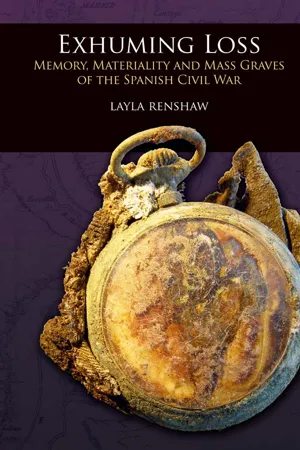
This book examines the contested representations of those murdered during the Spanish Civil War of the 1930s in two small rural communities as they undergo the experience of exhumation, identification, and reburial from nearby mass graves. Based on interviews with relatives of the dead, community members and forensic archaeologists, it pays close attention to the role of excavated objects and images in breaking the pact of silence that surrounded the memory of these painful events for decades afterward. It also assesses the significance of archaeological and forensic practices in changing relationships between the living and dead. The exposure of graves has opened up a discursive space in Spanish society for multiple representations to be made of the war dead and of Spain's traumatic past.
Information
Chapter 1
REPUBLICAN IDENTITY AND SPANISH MEMORY POLITICS
INTRODUCTION
The aim of this chapter is to identify the existence of a Republican collective identity in the 1930s, in order to examine those components of the Republican memory campaign that identify with it and see the grassroots political activity that characterised the Republican period as an inspiration for present action. There is a clear divide between the campaign practice of ARMH, which emphasises affective familial bonds with the dead while drawing personal inspiration from the Republicans, and their rival campaign group and fierce critics, Foro por la Memoria, who conceive of an ideological bond with the dead and explicitly seek to resurrect Republican ideology in order to achieve a hegemonic shift to the Left in Spanish society. This chapter also discusses how the prewar Republican identity was successfully dismantled by Francoist violence, transforming any attempt to revive it into an ambivalent, complex, and emotionally charged experience for those who have lived under Franco. I will also analyse why violence, particularly the acts of marginalisation and humiliation perpetrated against Republican families, was highly effective in engendering a state of atomisation. This prevented the transmission of memory between generations and dismantled the basis for a strong collective memory amongst Republicans in my field site. The experiences of repression presented here cast light on why a political representation of the dead may be experienced as threatening and destabilising in these communities. I conclude by looking at how this overarching Republican narrative, moving from a vibrant collective identity to a condition of atomisation, and then to the individualist discourse of contemporary post-transition Spanish society, presents a specific set of challenges to the Republican memory campaign. This can be detected in the internal debates on the relative significance of the individual and the collective within the exhumation process.
REPUBLICAN IDENTITY PRE- AND POSTWAR
The villages of Villavieja and Las Campanas lie between the market town Aranda del Duero, the historic regional centre of Lerma, and the city of Burgos, capital of the Burgos province in the Castile-León region. The violence and oppression experienced by Republicans and their families in these villages has to be understood in the context of the war in Castile-León and of the traditional identity and political affiliations of Burgos as capital of the province and of the Old Castile region as a whole. Due to Burgos’s self-perception and characterisation as a bastion of conservative social norms and devout Catholicism, the traditional political establishment and landowners of the city were natural sympathisers of the Francoist cause. A stereotypical characterisation would portray the region’s identity as staid, civilised, refined, and “European,” in contrast to the primitive and fiery South. In the Civil War, the South was perceived in pseudoracial terms as “tainted” by Moorish influences (Preston 2010). The area is seen historically as the cradle of the purest Castilian Spanish (a consciousness of being speakers of “received pronunciation” Spanish, and a belief in the aesthetic merits of Castilian Spanish were still apparent in these communities). This is the unifying state language in opposition to the regionally spoken vernacular languages that are associated with the more explicitly separatist regional identities further north in Spain. Burgos’s central geographical position is equated with its status as the core or heart of “Spanishness.”
A valuable document that emerged from this period is Burgos Justice, a contemporary account by district judge Ruiz Vilaplana (1938) that captures the prevailing relations between socioeconomic classes in the region of my fieldwork. His professional role led him to spend the days touring small peasant communities around Burgos, and the evenings in the upper-class social clubs known as casinos, in the company of landowners, fellow professionals, and minor aristocracy. This enabled him to observe the dissonance between two opposing perspectives on the same economic and social system. The communities around Burgos depended on farming, mainly arable crops. Small-scale farmers would rent the land from landowners, plant and harvest the crop, and then, due to their inability to organise their own markets, they would sell the grain back to the landowners, who could manipulate prices. My informants confirmed the level of overall economic and social control that came with landownership, and added that even those small farmers were fortunate in comparison to the day labourers who worked directly for the landowners and who did not always receive payment in cash. Their job insecurity forced them to conform to social norms of obedience, compliance, and piety (monitored by the local priest), or risk being blacklisted and becoming unemployable in the village. For labouring families that complied fully with these norms, quasi-feudal relationships developed over generations with the landowners, a situation similar to the one described by Narotzky and Smith (2006).
Accounts of the extreme level of social control maintained by the village authorities in both Villavieja and Las Campanas in the 1930s, primarily through the alliance between landowners and local clerics, were initially surprising to me. My informants told me of church-levied fines for all kinds of minor misdemeanours (particularly for working on one’s private vegetable garden on the Sabbath, which was most workingmen’s only day off). Working-class men also lost wages through the enforced “volunteering” of manual labour on church buildings and lands. Other techniques of control were: surveillance from the church steeple; limitation of the freedom of association by coded warnings not to “be seen with the wrong people”; village curfews during periods of shortage or strained labour relations to circumvent strikes or protests; and unofficial imprisonment in police cells below the town hall. These controls were quasi-legal, but within the self-contained environment of the village there were no higher authorities that could be appealed to. Remarkably, the trope of surveillance from the church steeple recurs in all my elderly informants’ accounts of village life in the 1930s, and clearly reveals a strongly felt preoccupation. This was later conflated with unsubstantiated accounts of how Francoists (including even the priest himself) used the church as a vantage point from which to shoot villagers during the war. This was indeed documented for some villages, but I believe it may be an example of village myth (Corbin 1995) that nonetheless reveals a symbolic truth about the way the physical presence of the church was perceived and experienced as omniscient and omnipotent. The dominant physical positioning of religious buildings in the village and the aural dominance of bells and celebrations are important factors contributing to the sense of surveillance that permeates these communities. The paradox of an armed priest is also a frequently invoked image amongst my elderly informants, perhaps because it is perceived as a moment in which religion’s potential for coercion and violence is revealed.
The older generation of my informants were at that time small children or as yet unborn. Some children may have been able to understand the social conditions around them, particularly during a flashpoint such as a strike, something that a few informants recalled firsthand; however, their accounts of these conditions in the 1930s are for the most part picked up from their parents or older workmates and friends. The severity of these prewar conditions was described enthusiastically to me in vivid, evocative terms, detailing cramped conditions and recalling how people wore rags and subsisted on “bread and onions.” There was no comparable common pool of knowledge about the organised resistance of the working-class communities in these villages in response to unjust conditions. Logically, there must have been a widely participated social and political movement throughout the 1930s, as by the time of the killings in 1937, both villages had a thriving casa del pueblo (workingmen’s club and centre of cultural and political activity), and Villavieja had a left-wing mayor and an almost entirely socialist town council. Significantly, the same informants who vividly described the prewar material deprivation professed total ignorance over who had participated in village politics, or the forms it had taken. It is also highly significant that my elderly informants talked about these unimaginable levels of poverty in essentialist or depoliticised terms, stressing poor technology, ignorance, and a general “backwardness” in the countryside during the 1930s, rather than citing the distribution of resources identified by Ruiz Vilaplana (1938). As will be expanded upon in chapter 2, the insistence on uniform scarcity and deprivation has become an important device for excusing the actions of all sides during the Civil War and justifying the political upheaval of the 1930s, while at the same time removing the ideological underpinnings of Republicanism and effectively bracketing it off from the relative affluence of the present.
The absence of memory and the inability to vocalise one’s own memories surrounding political activities will be explored in chapter 2. We can refer to the observations made in Burgos Justice to have a picture of what was happening in the area of my field sites at the time:
Nuclei of trade unions and working men’s associations were duly established in Miranda, Castrojeriz and Aranda and in the capital itself, while in the latter they even contrived to set up a Worker’s Discussion Centre […]. Burgos society, uncompromisingly reactionary, proceeded to launch its offensive against these experiments. The Church with its enormous influence over the big capitalists and industrial magnates set about persecuting members of the workers’ associations […]. But this organization of the lower classes was making headway, and was not to be stopped. In the people’s Ateneo they arranged lectures which were given by eminent intellectuals uninhibited by the local atmosphere: the new spirit spread through the province, and political clubs were founded here and there. Then schools and libraries sprang up: and a people’s choir even came into existence. Ruiz Vilaplana 1938, 13)
These forms of political-cultural organisation mirror those recalled by informants in Mintz’s classic ethnography The Anarchists of Casas Viejas (1982). Mintz conducted fieldwork in the 1960s, which means that his informants were of the generation that fought the Civil War and not their surviving children, as in my study. They were the neighbours and contemporaries of a group of anarchists massacred by the civil guard in 1933, and their firsthand accounts capture the almost messianic spirit of the Spanish workers involved in the labour movement in the 1930s, who felt on the cusp of a new reality. Interestingly, Mintz managed to obtain more frank and detailed accounts of participation in the radical politics of the 1930s than I ever heard during my fieldwork, or read about in other ethnographies. I think this is because the 1933 massacre at Casas Viejas is a famous and well-documented event, widely reported at the time. It is a matter of historical record, not shrouded in denial in the way Civil War massacres are, and therefore does not fall within the representational prohibitions of the pact of silence. The accounts and life histories in Mintz’s ethnography give an insight into the daily life of those involved in the anarchist and socialist movements. They detail the significance of creating meeting places such as the ateneo (cultural centre) and the casa del pueblo to conduct public discussions. The significance of this new category of space cannot be overstated, since the working class had no equivalent of the traditional member clubs for the upper classes, the casinos (Gilmore 1980). The only other public spaces were the bar, which many labourers’ wages could not stretch to, and the church, which was ideologically aligned to the ruling elites. The casa del pueblo was mainly a social space, but it also stressed the importance of literacy and access to newspapers and pamphlets. The main protagonists of the anarchist movement in Casas Viejas would travel considerable distances to meet like-minded representatives from other communities and return to disseminate news and opinions within their own communities. Their main aim was to situate the working class of each community within a wider regional and national network, in order to facilitate support in labour disputes and enable the transmission of ideas. This was of practical importance, for example when coordinating strikes, but also had a profound symbolic importance, as it infringed the insularity of villages and challenged the prevailing status quo within small communities. As will be explored in chapter 5 and in the conclusion, this has a clear resonance with the success of ARMH campaign in situating Republican families within a new nationwide network.
Mintz’s informants also emphasise the wide range of norms and values challenged by anarchism and socialism in the 1930s. These challenges include publicly questioning the existence of God, new practices like abstention from alcohol and vegetarianism, and highly progressive views on family planning, the upbringing of children, gender roles, and marriage. A common theme in both Casas Viejas and my field sites was the reduction of the role of the Catholic Church in one’s daily life by opting out of all religious rites of passage such as baptism and burial and pioneering secular alternatives. As I will show in chapter 5, the anticlerical dimension of Republicanism poses a problem to those formulating the new type of funerals and commemorative practices that accompany the reburial of the exhumed Republicans. These antagonistic movements had the same utopian vision shared by other revolutionary ideologies, and embraced the domestic and intimate realms, along with the public sphere, as spaces for political change (Buchli 2000). The spiritual and philosophical content of these ideologies meant that members of the politically active working-class were glossed simply as “los que tienen ideas,” or “those who have ideas.” This is an all-encompassing term that was used frequently in my field sites, but also recurs in ethnographic accounts of local politics throughout Spain (Mintz 1982; Narotzky and Smith 2002, 2006).
This diffuse form of politics is highly significant for memory politics in contemporary Spain and arguably presents a problem for ARMH, since many of the progressive goals of Republicanism now have come to be the accepted norm in contemporary Spanish society, particularly with regard to sexual behaviour and freedom of religious practice. This means that it is hard for anyone in the present to interpret those goals as manifestations of radical politics. It is hard to believe that in the 1930s, this departure from the social norms of the day was of sufficient gravity to render these people the target of political killings. This explains why many of the relatives of the dead, and even some supporters of the ARMH campaign, have trouble identifying these killings as politically motivated. When asked about the deaths in my field sites, my elderly informants’ first reaction was to deny the existence of any political activity in the village. However, when asked specifically about their own relative, the majority of my informants offered the information “No va a misa” (“He didn’t go to mass”). In the context of village life in the 1930s this was an inherently political act and an explicit challenge to existing hierarchies, but this scenario is either missed or remains unacknowledged by my informants. Holguín (2007) reflects on the difficulty of comprehending the intensely political character of daily life during this period, in which everyday actions were the site of “culture wars” long before the military conflict began.
I have been able to ascertain very little about the activities of Republicans in my field sites, but key informants from both villages had been gathering information for some years from both oral and archival sources, due to their own political affiliations and personal interest in local history. I was told in both sites that in the 1930s the leftists campaigned for a civil cemetery to be built in the region, and claimed the right to be buried in a secular ceremony without a priest. A story from my key informant in Villavieja, Julio, underscores the perceived radicalism of this demand: in the early 1930s a secular funeral was indeed conducted in another village within the Burgos province, and a small group of young people, both male and female, had journeyed to attend the ceremony in order to demonstrate their solidarity with the principle of secular rites of passage. On their journey back, they were ambushed by attackers who had concealed their identities, but were suspected of being young men from the elite families of Villavieja. The attackers shot one person dead and injured another. In Julio’s story, which was first told him by his parents and then corroborated by others, there was particular consternation because a woman had been injured. The lack of an investigation into the attack was interpreted as an indicator of ...
Table of contents
- Cover
- Half Title
- Title Page
- Copyright Page
- Table of Contents
- List of Illustrations
- Acknowledgements
- Preamble: Exhumation and the Traumatic Past
- Introduction: Mass Graves from the Spanish Civil War and the Republican Memory Campaign
- 1. Republican Identity and Spanish Memory Politics
- 2. Memory Idioms and the Representation of Republican Loss within the Confines of a Francoist Discourse on the Past
- 3. Materialisations of the Dead before Exhumation
- 4. The Open Grave: Exposed Bodies and Objects in New Representations of the Dead
- 5. Reburial and Enduring Materialisations of the Dead
- Conclusion
- Notes
- References
- Index
Trusted by 375,005 students
Access to over 1.5 million titles for a fair monthly price.
Study more efficiently using our study tools.
Frequently asked questions
Yes, you can cancel anytime from the Subscription tab in your account settings on the Perlego website. Your subscription will stay active until the end of your current billing period. Learn how to cancel your subscription
No, books cannot be downloaded as external files, such as PDFs, for use outside of Perlego. However, you can download books within the Perlego app for offline reading on mobile or tablet. Learn how to download books offline
Perlego offers two plans: Essential and Complete
- Essential is ideal for learners and professionals who enjoy exploring a wide range of subjects. Access the Essential Library with 800,000+ trusted titles and best-sellers across business, personal growth, and the humanities. Includes unlimited reading time and Standard Read Aloud voice.
- Complete: Perfect for advanced learners and researchers needing full, unrestricted access. Unlock 1.5M+ books across hundreds of subjects, including academic and specialized titles. The Complete Plan also includes advanced features like Premium Read Aloud and Research Assistant.
We are an online textbook subscription service, where you can get access to an entire online library for less than the price of a single book per month. With over 1.5 million books across 990+ topics, we’ve got you covered! Learn about our mission
Look out for the read-aloud symbol on your next book to see if you can listen to it. The read-aloud tool reads text aloud for you, highlighting the text as it is being read. You can pause it, speed it up and slow it down. Learn more about Read Aloud
Yes! You can use the Perlego app on both iOS and Android devices to read anytime, anywhere — even offline. Perfect for commutes or when you’re on the go.
Please note we cannot support devices running on iOS 13 and Android 7 or earlier. Learn more about using the app
Please note we cannot support devices running on iOS 13 and Android 7 or earlier. Learn more about using the app
Yes, you can access Exhuming Loss by Layla Renshaw in PDF and/or ePUB format, as well as other popular books in Social Sciences & European History. We have over 1.5 million books available in our catalogue for you to explore.