eBook - ePub
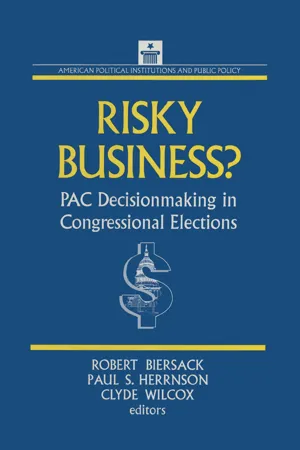
Risky Business
PAC Decision Making and Strategy
- 224 pages
- English
- ePUB (mobile friendly)
- Available on iOS & Android
eBook - ePub
About this book
By 1990, there were over 4000 Political Action Committees (PACs) active and visible in the USA. This study covers various perspectives of PACs - size, contribution strategies, access to Washington information networks and issues - by means of diverse case studies.
Trusted by 375,005 students
Access to over 1.5 million titles for a fair monthly price.
Study more efficiently using our study tools.
Information
1
Introduction
Political action committees—commonly called PACs—are the major organized financiers in congressional elections. During the 1992 elections the 4,792 members of the PAC community gave more than $187 million to 1,890 congressional candidates. Although PACs play an important role in American politics, journalists and scholars who write about them often describe them in the most general terms—how much money they raise, to whom they contribute, and whether the recipients of PAC money win or lose their elections. Rarely do they inform readers about why particular PACs gave contributions to the candidates they supported, or how these committees reached their contribution decisions.
The purpose of this book is to take a close-up look at a number of PACs that are representative of the PAC community. Instead of using a broad brush to paint a general picture of PACs, each of the contributors to this book focuses on one or at most two committees. Each chapter addresses three general questions: How do PACs select the candidates to whom they contribute? Where do PACs turn for the information they use when selecting candidates for support? How do they respond to the opportunities that emerge in particular elections? From this series of close studies of PAC decisionmaking, it is possible to draw broader conclusions about the role of PACs in the campaign finance system.
The 1992 elections offered a unique setting for studying PACs. Redistricting, widespread congressional retirements, and scandal created a climate of uncertainty for candidates and those who might support them. These conditions offered those PACs whose managers were interested in changing the composition of Congress the opportunity to break from the comfortable pattern of giving most of their money to incumbents. The uncertainties that resulted from these conditions had the potential to make the 1992 congressional elections more competitive than any others in the past decade. They also created the opportunity for PACs to inject some new lines into the script that has guided most PAC activity in the last four election cycles. In its simplest form, this script reads, “Incumbents always win, so contributions to challengers are wasted; PACs seek access to congressional decisionmakers, so PACs give to incumbents.” In 1992, it appeared to be reasonable for some PACs to add to the script the following phrase: “… except when prospects for drastically changing the composition of Congress are good, and additional policy or ideological goals can be met by backing open-seat or challenger candidates. Under these circumstances some PACs give to competitive nonincumbents as well.” The PAC community is not monolithic, and discerning which PACs are willing to change the “script” and take risks is one of the goals of this book.
PACs and Democracy
PACs are probably the most studied and certainly the most criticized actors in the campaign finance system. They represent one mechanism through which people who share some common interest can participate as a group in the political process. By pooling the financial resources of many individuals, PACs can turn $10, $100, or larger donations from their contributors into $1,000 or $5,000 contributions to congressional candidates. In so doing, PACs give their supporters an opportunity to voice their concerns to candidates, to reward members of Congress who have supported their positions, or to try to change the makeup of the Congress to better reflect their views.
While this description of PAC activity sounds like the very core of what Americans consider to be democratic politics, it is also true that people and groups have unequal abilities to participate in the financing of elections. Financial resources are not evenly distributed, and the ability to organize as a group is easier for some types of people and causes than others. As a result, the kinds of groups that have formed the most influential PACs do not represent all points of view on various issues. If PACs have greater influence on who serves in Congress and how members of Congress view issues because they help finance campaigns, then individuals and groups with greater financial resources have the potential to have a bigger impact on policymaking than others. The conclusion one comes to about these two contradictory views of PACs—that they are useful vehicles to pool small contributions and allow groups to express themselves, or that they represent a way for financial elites who hold strong views to have unfair influence in the political process—determines how one approaches the controversial issues inherent in campaign finance reform.
The Rules of the Game
The basic rules that govern how interest groups, corporations, labor unions, and other associations participate in federal election campaigns have been virtually unchanged since the Federal Election Campaign Act (FECA) was amended in 1974 and the Federal Election Commission (FEC) handed down its landmark SUNPAC Advisory Opinion in 1975. As a result of these legislative and regulatory acts, all kinds of organizations are allowed to create voluntary political institutions (popularly called PACs) that can raise money from their members and make contributions to candidates for federal office. Further, corporations, unions, and membership groups that create PACs can use their corporate profits, union dues, or membership fees to pay their PACs’ overhead expenses.
Any PAC that has existed for at least six months, has received contributions from at least fifty people, and has made contributions to at least five federal candidates is entitled to contribute up to $5,000 to any federal candidate for each election in which that candidate participates. In most cases this means a maximum contribution of $ 10,000 (because primary and general elections count as separate races) from a PAC to any candidate. Individuals are permitted to give up to $5,000 each year to a PAC, but PACs sponsored by corporations, unions, and groups with regular members can only accept contributions from certain “members” of the organization. Corporations can only receive contributions from management and executive employees or stockholders, and unions and other membership groups can only accept donations from members.
Within these basic rules are several variations and options that permit different kinds of PAC activities. The Supreme Court decision in Buckley v. Valeo established the right of any individual or PAC to make unlimited expenditures advocating the election or defeat of a federal candidate so long as those expenditures are made without the candidate’s prior knowledge or consent. Any PAC can therefore contribute $5,000 per election to any candidate and also make unlimited “independent expenditures”—anything from mailings to television advertisements—so long as no coordination takes place between the PAC and the campaign.
Most PACs are sponsored by an organization, such as a corporation, a trade association, a labor union, a professional association, or a membership group. Some PACs, however, are formed independently to influence the electoral process. These are known as “nonconnected” PACs. They are formed by individuals who care about specific issues or government policies and seek to promote their views by organizing groups that directly lobby members of Congress. PACs formed by these nonconnected, ideological, or issue groups must pay for their overhead using voluntary contributions. Moreover, these and other groups that are organized primarily for political purposes do not receive the same tax advantages as other charitable organizations. As a result, many issue-oriented groups create several organizations, some of which can receive tax-exempt contributions for public education and other purposes, and others, including PACs, that are primarily political. Nonconnected PACs have the same limits on contributions to candidates, but they may seek contributions from any individual, not just group members. It is these committees that have popularized the direct-mail solicitation techniques that fill America’s mailboxes.
In addition, the courts have ruled that these organizations can, in some instances, spend funds received by the organization itself, not just contributions to the PAC, for political purposes so long as the activity does not involve expressly advocating the election or defeat of a specific federal candidate. Pro-life organizations, for example, can spend their treasury money to send their members or others information about the positions that candidates take on abortion without counting that spending as a campaign contribution, so long as they do not specifically advocate the election of an identified candidate.
Campaign finance is a complex process, with the formal rules providing only a general framework within which PACs must operate. These rules are complex, and some of the managers of the PACs in the studies herein appear to have misunderstood some of the implications of these regulations. As we will see in the chapters that follow, the rules leave many choices available to committees about whom to support and how. Before looking at the individual committees we have selected to study in detail, we should consider the kinds of factors that might affect their decisions and the results that their collective choices have had on congressional elections.
The State of Nature
The world of campaign finance has been characterized by rapid change and development since the FECA was amended in 1974. For PACs, the period began with several years of rapid growth in both the number of committees and the amount of money they raised and spent. From 608 committees at the end of 1974, the number of PACs rose steadily, reaching 4,009 by the end of 1984 (see Figure 1.1).
There was substantial growth in the number of corporate-sponsored PACs after the FEC officially sanctioned their existence (from 89 in 1974 to 1,682 in 1984). Ideological (nonconnected) PACs also grew dramatically in number during this period, from 110 at the end of 1977 (when this type was first counted separately) to 1,053 at the end of 1984. Considerable if less dramatic growth also occurred among trade association PACs, such as the National Association of Realtors PAC. The numbers of union PACs grew the most slowly, from 201 in 1974 to 294 ten years later. This slower growth may be partially explained by the longer tradition of PAC activity among unions. Most of the larger unions had already established PACs before the passage of FECA, while most corporations had not.
Since the mid-1980s growth in the number of PACs has slowed considerably. There were 1,715 corporate PACs in mid-1993, only 33 more than in 1984 and down from a high of 1,816 at the end of 1988. Similarly, nonconnected committees totaled 1,011 in mid-1993–42 fewer than existed seven years earlier, and down from a high of 1,145 in 1992.
The financial activity of PACs shows a similar pattern of considerable growth in the early years followed by slower growth more recently (see Figure 1.2). PACs raised a total of about $80 million during the 1977–78 election cycle, the first for ...
Table of contents
- Cover
- Half Title
- Title Page
- Copyright Page
- Table of Contents
- Foreword
- Preface
- 1. Introduction
- Part One: Lead PACs
- Part Two: Institutionalized PACs
- Part Three: “Mom and Pop” PACs
- Part Four: Conclusions
- Appendices
- About the Editors and Contributors
- Index
Frequently asked questions
Yes, you can cancel anytime from the Subscription tab in your account settings on the Perlego website. Your subscription will stay active until the end of your current billing period. Learn how to cancel your subscription
No, books cannot be downloaded as external files, such as PDFs, for use outside of Perlego. However, you can download books within the Perlego app for offline reading on mobile or tablet. Learn how to download books offline
Perlego offers two plans: Essential and Complete
- Essential is ideal for learners and professionals who enjoy exploring a wide range of subjects. Access the Essential Library with 800,000+ trusted titles and best-sellers across business, personal growth, and the humanities. Includes unlimited reading time and Standard Read Aloud voice.
- Complete: Perfect for advanced learners and researchers needing full, unrestricted access. Unlock 1.5M+ books across hundreds of subjects, including academic and specialized titles. The Complete Plan also includes advanced features like Premium Read Aloud and Research Assistant.
We are an online textbook subscription service, where you can get access to an entire online library for less than the price of a single book per month. With over 1.5 million books across 990+ topics, we’ve got you covered! Learn about our mission
Look out for the read-aloud symbol on your next book to see if you can listen to it. The read-aloud tool reads text aloud for you, highlighting the text as it is being read. You can pause it, speed it up and slow it down. Learn more about Read Aloud
Yes! You can use the Perlego app on both iOS and Android devices to read anytime, anywhere — even offline. Perfect for commutes or when you’re on the go.
Please note we cannot support devices running on iOS 13 and Android 7 or earlier. Learn more about using the app
Please note we cannot support devices running on iOS 13 and Android 7 or earlier. Learn more about using the app
Yes, you can access Risky Business by Robert Biersack,Paul S. Herrnson,Clyde Wilcox in PDF and/or ePUB format, as well as other popular books in Politics & International Relations & Conservatism & Liberalism. We have over 1.5 million books available in our catalogue for you to explore.