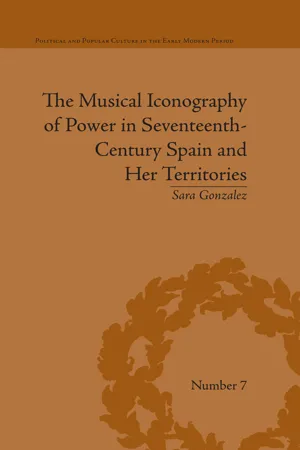
As Spain encountered economic and political crises in the seventeenth century, the imagery of musical performance was invoked by the state to represent the power of the monarch and to denote harmony throughout the kingdom. Based on contemporary sources, Gonzalez is able to unravel the complex iconography of Spanish politics.
eBook - ePub
The Musical Iconography of Power in Seventeenth-Century Spain and Her Territories
- 256 pages
- English
- ePUB (mobile friendly)
- Available on iOS & Android
eBook - ePub
The Musical Iconography of Power in Seventeenth-Century Spain and Her Territories
About this book
1
String versus Wind Instruments: The Ancient Tradition of the Musical Cosmos
In Greek antiquity the iconography of musical instruments was subject to a hierarchical classification, an influential paragone in cultural history. The zither or lyre, consecrated to Apollo, was a symbol of harmony, of reconciliation of opposites, of the rational part of the universe; wind instruments, on the other hand, associated with Dionysus and appropriated for modulation, were identified wiThecstasy, frenzy and the realm of the senses.
In Western culture, from ancient times the state was compared to a musical instrument in which all the strings, with different length and sound, ought to be in tune to produce a melody. The chosen ones were usually chordophones – harp, zither, lyre – able to produce a melody from different voices, and therefore to symbolize plurality. As will be explained, the chordophone came to reflect the total comprehension of the cosmos; for that reason, Greek myths and testimonies show that strings had a nobler connotation than wind instruments, as the zither or lyre was Hermes’s and Apollo’s instrument, identified with the education of the soul.
The biblical tradition also reinforced the idea of the superiority of string instruments. The Old Testament presents the harp as the royal instrument per excellence, as it is the attribute of King David, the tool with which he calmed the bad spirit that tormented Saul’s soul and with which he accompanied his prayers to God in the Psalms. The Hebrew name of David’s instrument was kinor, zither, but visual representations have, almost unanimously, opted for a harp. In Chronicles, dancing and music accompanied the Ark of the Covenant: ‘They moved the Ark from Abinadab’s house on a new cart, with Uzza and Ahio guiding it. David and the Israelites were celebrating with all their might before God, with songs and with harps, lyres, timbrels, cymbals and trumpets’.1 And no less important is the string melody in the Apocalypse, as the Twenty-Four Elders play zithers while adoring the Mystical Lamb in the moment of the opening of the Seven Seals:
And when he had taken it (the Book), the four living creatures and the twenty-four elders fell down before the Lamb. Each one had a harp and they were holding golden bowls full of incense, which are the prayers of God’s people. And they sang a new song, saying: ‘You are worthy to take the scroll / and open its seals, / because you were slain, / and with your blood you purchased for God / persons from every tribe and language and people and nation. / You have made them to be a kingdom and priests to serve our God, and they will reign on the Earth’. Then I looked and heard the voice of many angels, numbering thousands upon thousands, and ten thousand times ten thousand. They encircled the throne and the living creatures and the elders. In a loud voice they were saying: ‘Worthy is the Lamb, who was slain, / to receive power and wealth and wisdom and strength / and honour and glory and praise!’2
This apocalyptic landscape presents a universe organized around God and endowed, because of Him, with harmony, represented by the music of the twenty-four lyres and the song of the angels. The string and voice melody emanates from heaven; it had been prefigured by musician King David (‘Praise the Lord. Sing the Lord a new song, his praise in the assembly of his faithful people’)3 and by prophet Isaiah: ‘Sing the Lord a new song, his praise from the ends of the Earth’.4 In Revelation, the defeaters of the beast also accompanied themselves by lyres to sing the chants of Moses and the Lamb.5 As can be seen, chordophones in the Bible allude to the Kingdom of God, to the New World, represented by Heavenly Jerusalem after the victory over Satan and the Last Judgement. This idea of universal harmony is similar to the analogy employed in the ancient world to express the existing order. The Greeks made of music a paradigm of the universe. Hellenistic influence made possible that in the first centuries of the Christian era, Jesus was often perceived and presented as the Logos – the cosmic power of harmony which underlies universal order, personified, for the Greeks, in the gods ascribed to the string instrument, Apollo and Hermes.6
In the Greek tradition, the musical model of the firmament was based on the idea that the planetary spheres produce musical notes while moving around in circles. Pythagorean philosophers were most interested in this ‘world music’, in the words of Christian scholar Boethius; the very invention of the word ‘cosmos’ was ascribed to Pythagoras himself. The concept of harmony was key in the speculations of these thinkers, but, in principle, it resulted as a musical term only by analogy or extension, as its original meaning was ‘union of opposites’. This idea was complemented with that of number: ‘everything is ordered according to the number’, Pythagoras is credited to have said. Understood this way, the universe was a strictly hierarchical organization arranged by the mathematical relations that produced the intervals, through which each being or sound contributed to establish and maintain the order of the whole.
Plato, who belonged to the Pythagorean tradition, offered the earliest preserved description of the music of the spheres in The Republic,7 where he narrated the trip of Er to the world of the dead and his return to explain his experiences to the living. The passage describes the spindle of Necessity, which is the axis of the world, around which all heavenly spheres revolve impelled by their own uniform movement: eight orbs in total, corresponding to the seven planets then known and the sphere of the fixed stars. In turn, the seven inner circles also spin, at different speeds and in the opposite direction:
The spindle turns in the knees of Necessity; and on the upper surface of each circle is a siren, who goes round with them, hymning a single tone or note. The eight together form one harmony; and round about, at equal intervals, there is another band, three in number, each sitting upon her throne: these are the Fates, daughters of Necessity, who are clothed in white robes and have chaplets upon their heads, Lachesis and Clotho and Athropos, who accompany with their voices the harmony of the sirens – Lachesis singing of the past, Clotho of the present, Atropos of the future; Clotho from time to time assisting with a touch of her right hand the revolution of the outer circle of the whorl or spindle, and Atropos with her lefthand touching and guiding the inner ones, and Lachesis laying hold of either in turn, first with one hand and then with the other.8
The cosmic model based on the connection between the seven planets and the strings of the lyre (the instrument, as noted above, ascribed to Hermes and Apollo, as well as to demigod Orpheus) was a Hellenistic product with roots in the Pythagorean metaphors.9 The idea of the cosmic lyre goes back to poet Scythinos (at the end of the fifth century bc or after). In his cosmic scheme, the Sun was the plectrum. In his poem Hermes, Eratosthenes connects the planetary scale with the divine instrument, describing how Hermes ascended to heaven and was stunned to find the planets sounding along their orbits with the same notes of the lyre that he had invented on earth. The same image occurs in Heraclitus’s Homeric Problems; when explaining how the planets move in an orderly manner, he states: ‘They all pour forth a harmony that matches notes / of a seven-stringed lyre, each one of them at different intervals.’10
Apollo versus Marsyas: On the Ethics of String and Wind
Since the lyre became the image of the cosmos, it was an instrument naturally suited for the education of the ruling class, being used to accompany instruction. Plato stated in The Republic that there is nothing more apt than rhythm and harmony to penetrate the very depths of the soul and anchor there, filling with grace the correctly educated person, but not the uneducated one. The individual who receives an appropriate musical education will be the one who immediately notices the faults in the nature of an object, while, at the same time, he or she will know how to praise the good, how to adopt it with pleasure and how to profit from it and become a good citizen. From childhood, he will reject and hate ugly things, so when he finally comes to reason, he will be morally and intellectually well prepared.
For Plato, musical art models the character from childhood. Socrates, one of the narrators of The Republic, scorns the Mixolydian and Lydian harmonies because they are languid, and therefore inadequate ‘even for women’. The ideal city ought to ban relaxed and cordial harmonies and only use Dorian and Phrygian modes, which were regarded as necessary for education. The Dorian mode is warlike and imitates
the note or accent which a brave man utters in the hour of danger and stern resolve, or when his cause is failing, and he is going to wounds or death or is overtaken by some other evil, and at every such crisis meets the blows of fortune with firm step and determination to endure.11
The Phrygian mode, on the other hand, in times of peace and freedom of action, tries to influence someone’s opinion by persuasion or admonition, or is seeking to convince a god by prayer;
when he is expressing his willingness to yield to persuasion or entreaty or admonition, and which represents him when by prudent conduct he has attained his end, not carried away by his success, but acting moderately and wisely under the circumstances, and acquiescing in the event.12
These two harmonies, one martial, the other peaceful, were the ones to remain in the republic. They possessed a sober character, so they could be played on the classical zither or lyre, instruments that had just a few strings (usually seven, the number of the planetary spheres).
Such reasoning leads Socrates to state that neither instruments with many strings nor panharmonic music are needed. Aulós players and auloi are also discarded, as this instrument, a reed aerophone, is capable of producing the widest range of sounds. Only the zither and the lyre shall remain as useful instruments in the republic, although shepherds are allowed the pan pipes for their entertainment. And, concerning the rhythms, only the simple ones, typical of an orderly and courageous life, will be practised.
Developing Plato’s ideas, Aristotle in Politics believed that it is necessary to use a range of melodies in the republic, although not all of them in the same way: the sober ones were appropriate for education and the pleasant, enthusiastic ones were suited for purification rituals.13 The Dorian mode is, once again, the educational tool per excellence, as it possesses a masculine character, although the philosopher accepted the Lydian mode, less sober but still orderly, as suitable for the children’s formation.
Another very important document regarding the symbolism of musical instruments in Western culture and their political implications is the treaty On Music by Aristides Quintilianus (first–second century ad), which will be discussed further below. This book didactically presents the soul–music–cosmos relationship. As Plato had mentioned earlier, in traditional Greek thought some sounds were considered solid and masculine, and others relaxed and more feminine, while some other sounds participated in both characters. This also set a difference between instruments, as some tunes were suitable for the zither, but not for the aulós, and vice versa. The sounds resemble the movements and emotions of the soul: among them, the deepest ones are by nature more suited to the masculine and what concerns education and the formation of the character. High-pitched systems, however, correspond to the feminine. So, for example, the lyre is analogous to the masculine for its gravity and harshness, and the sambyke to the feminine, as it lacks nobility and inspires languor.
As stated previously, chordophones were unanimously identified with the rational part of the universe and with a creator divinity or Demiurge. The zither was one of the attributes of Apollo, a god associated with reason, light, beauty and music. As Marcel Detienne argued in Apollon le couteau à la main,14 mythological sources state that after his birth in the Island of Delos, the god immediately started a long trip with the aim of ‘building’, ‘establishing’ and ‘founding’ that culminated in the later foundation of the sanctuary of Delphos, according to the Homeric Hymns. So this figure personified humanity’s natural impulse to plough, to tidy up, to build fields, orchards, houses, streets, towns. Apollo the archegetes (the one who ‘starts’ and ‘leads’) was the guarantor of ‘harmonious’ foundations; this is the reason why, as helper and leader of humans, he had his abode in Delphi, the omphalós or centre.
As Homeric Hymn III, dedicated to Apollo, states, his attributes were the arch and the zyther (objects not dissimilar in their configuration). This instrument had been invented by Apollo’s half-brother Mercury, who gave it to the god of light in exchange for the caduceus (a token of peace that will be discussed later in this book). At the stroke of the golden plectrum, Apollo produces a delightful resonance that enchants the immortals and makes the Muses, the Graces and the Hours dance together with Harmonia, Hebe and Aphrodite; through his music, he is the guarantor of universal harmony. The Orphic Hymns contain similar ideas; number XXXIV presents the god as both the Sun and world music, which is ruled by Plato’s Dorian order.
Wind instruments, on the other hand, were ascribed to another brother of Apollo, the god Dionysus, whose attributes were both chaotic noise and mortal silence.15 The son of Zeus and Semele, he was conceived in antiquity as ‘the frenzied one’, whose presence drives people out of their minds and prompts them to commit wild actions. His noise revealed the fierce spirit of the monstrous, against any order and rule. Dionysus’s entourage always bursts in with a wild racket; some sources like the Homeric Hymns call him ‘the one of the thunder’, as he accompanies himself with thunderous and strident instruments such as drums, flutes and cymbals.
Wind instruments were not always well considered from the ethical point of view by the different authors who dealt with music in antiquity. To Plato’s negative opinion we could add Aristotle’s in Politics, as he states, when discussing the ideal city, that the aulós lacks educational character; that it is more of an ‘orgiastic’ instrument, so it should be used on those occasions where religious purification, not learning, is pursued. Like aerophones in general, the aulós also has a characteristic that makes it unsuitable for moulding the character: it cannot be accompanied by sung or spoken words. In Politics, Aristotle elaborates on this theme through the story of the rejection of the instrument by Pallas Athena, the goddess of wisdom and science: she tossed it away, upset because blowing into it altered her beautiful countenance.16 The fable symbolizes the fact that the aulós does not contribute anything to developing the intellect. The rejected chordo-phone fell on Phrygia, where it was found and adopted by the satyr Marsyas;17 later on, ill-fated Marsyas would use the instrument to foolishly challenge Apollo to a musical contest, as a result of which he would be flayed alive and his skin hung from a tree.
Some myths went so far as to demonize wind instruments. As Pierre Vernant indicates in Death in the Eyes: Gorgo, Figure of the Other,18 some musical instruments that were used orgiastically to provoke delirium belonged to the range of infernal sounds. In Pythic,19 Pindar presented another version of Athena’s rejection of the aulós: according to this narrative, the aulós and the skill of playing it were invented by Athena to simulate ‘the shrill sounds she had heard escaping from the mouths of the Gorgons and their snakes’ when Perseus slayed Medusa. This instrument combined ‘all sounds’ (another mention of its polyharmonic capacity in opposition to the zither’s simplicity, reviled by Aristotle). But, adds Vernant, he who mimics the shrieking Gorgon takes the risk of becoming one, of donning her terrifying mask: ancient authors report that Athena, absorbed in playing the aulós, did not listen to Marsyas’s warning, who at the sight of her with distended mouth, puffed-up cheeks and distorted face, said to her: ‘These ways do not become you. Take your weapons, put down the flute, and compose your features.’ When Athena looked at her reflection in the waters of a river...
Table of contents
- Cover
- Half Title
- Title
- Copyright
- CONTENTS
- Acknowledgements
- List of Figures
- Introduction
- 1 String versus Wind Instruments: The Ancient Tradition of the Musical Cosmos
- 2 The Harmony of the Divine Christian Order
- 3 The Harmony of Earthly Rule: Erasmus of Rotterdam and Jean Bodin
- 4 Emblematic Literature and the Ideal Ruler
- 5 Musical Emblems of the State in Seventeenth-Century Spain: Amphion, Timotheus Milesius, Marsyas and the Sirens
- 6 The Celestial Lyre: Royal Virtues and Harmonious Rule
- 7 Cosmic Harmony, Royal Wisdom and Eloquence
- 8 The Death of the Monarch and the Discord of the Elements
- Conclusion
- Notes
- Works Cited
- Index
Trusted by 375,005 students
Access to over 1.5 million titles for a fair monthly price.
Study more efficiently using our study tools.
Frequently asked questions
Yes, you can cancel anytime from the Subscription tab in your account settings on the Perlego website. Your subscription will stay active until the end of your current billing period. Learn how to cancel your subscription
No, books cannot be downloaded as external files, such as PDFs, for use outside of Perlego. However, you can download books within the Perlego app for offline reading on mobile or tablet. Learn how to download books offline
Perlego offers two plans: Essential and Complete
- Essential is ideal for learners and professionals who enjoy exploring a wide range of subjects. Access the Essential Library with 800,000+ trusted titles and best-sellers across business, personal growth, and the humanities. Includes unlimited reading time and Standard Read Aloud voice.
- Complete: Perfect for advanced learners and researchers needing full, unrestricted access. Unlock 1.5M+ books across hundreds of subjects, including academic and specialized titles. The Complete Plan also includes advanced features like Premium Read Aloud and Research Assistant.
We are an online textbook subscription service, where you can get access to an entire online library for less than the price of a single book per month. With over 1.5 million books across 990+ topics, we’ve got you covered! Learn about our mission
Look out for the read-aloud symbol on your next book to see if you can listen to it. The read-aloud tool reads text aloud for you, highlighting the text as it is being read. You can pause it, speed it up and slow it down. Learn more about Read Aloud
Yes! You can use the Perlego app on both iOS and Android devices to read anytime, anywhere — even offline. Perfect for commutes or when you’re on the go.
Please note we cannot support devices running on iOS 13 and Android 7 or earlier. Learn more about using the app
Please note we cannot support devices running on iOS 13 and Android 7 or earlier. Learn more about using the app
Yes, you can access The Musical Iconography of Power in Seventeenth-Century Spain and Her Territories by Sara Gonzalez in PDF and/or ePUB format, as well as other popular books in History & European History. We have over 1.5 million books available in our catalogue for you to explore.