- 264 pages
- English
- ePUB (mobile friendly)
- Available on iOS & Android
eBook - ePub
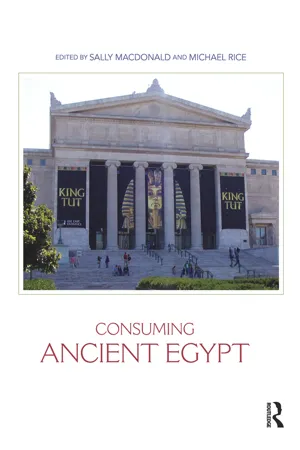
Consuming Ancient Egypt
About this book
Consuming Ancient Egypt examines the influence of Ancient Egypt on the everyday lives of contemporary people, of all ages, throughout the world. It looks at the Egypt tourist sees, Egypt in film and Egypt as the inspiration for opera. It asks why so many books are published each year on Egyptological subjects at all levels, from the austerely academic to the riotous celebrations of Egypt as a land of mystery, enchantment and fantasy. It then considers the ways in which Ancient Egypt interacts with the living world, in architecture, museum going, the acquisition of souvenirs and reproductions, design, and the perpetual appeal of the mummy. The significance of Egypt as an adjunct to (and frequently the subject of) marketing in the consumer society is examined. It reveals much about Egypt's immemorial appeal and the psychology of those who succumb to its magic.
Information
Chapter 1
Introduction - Tea With a Mummy: The Consumer's View of Egypt's Immemorial Appeal
Michael Rice and Sally MacDonald

The series of volumes of which Consuming Ancient Egypt is one sets out to express something of the catholicity of engagement that exists between Egypt in antiquity and the world of today, by focusing on the idea of ‘Encounters with Ancient Egypt’. To encounter a civilization of the distant past in the variety of guises and contexts revealed here represents a range of experiences far beyond what might be expected in the interface between a subject of academic study and the world outside. It is a resounding tribute to the power and vitality that Egypt’s past still commands, extending from the time of the foundation of the Egyptian state, 5,000 years ago, to the present day.
No other ancient society evokes so many responses, at so many different levels, as Ancient Egypt. Such responses range from the measured studies of the scholar’s library and the scientist’s laboratory to the meticulous excavation of ancient sites and the careful recording of their contents by the archaeologist, as much as to the enthusiasm for Egypt displayed by a multitude of people who, for an immense variety of reasons, are excited by its unique and complex past. The whole cavalcade of scholars, archaeologists, artists, writers, film makers, all manner of specialists and a significant percentage of the world’s literate population, is swept along by a tidal wave of books, films, television documentaries, architecture of Egyptian inspiration – some august, some bizarre – and a medley of works of art of the widest spectrum of quality. They are supported by an uncounted mass of products, designs, services, buildings, entertainment and communications media which, one way or another, for good or ill, are inspired by the physical remains of the ancient Egyptian civilization.
What other academic discipline concerned with the ancient world would be represented by an explicit linkage with ‘consumerism’ as in the title of this volume, a concept which was not even thought of when the first serious studies of Egypt’s past began to be formulated? Of course, there is none. It is this very direct relationship between Egypt, the scholars who study the evidence of its past and the lay public that produces this singular conjunction: sometimes, ‘confrontation’ may seem a better word.
That it is indeed a confrontation is evidenced by the assertive way in which parts of Egyptology’s constituency make their views and apprehensions known to those professionally engaged in the discipline; it is singular because no other academic discipline is obliged to maintain such a degree of dialogue with the lay public. What should be the scholar’s response to this public invasion of his or her domain? Indifference, dismissal, cautious acceptance? Perhaps, more perceptively, a degree of recognition is called for, if only because of the validity of the interest and enthusiasm expressed by members of society who have no professional involvement or responsibility, for in a variety of ways they contribute to the economic viability of the study of the past. We live in an age when the survival of scholarship in all its aspects is increasingly determined by society’s readiness, or lack of it, to commit public funds to the support of its activities. The degree of support forthcoming is often determined by the decisions of elected assemblies whose abiding priorities will assuredly be far from those of the Egyptologist; there can be little doubt where the answer lies. In such a context, recognizing the role of the ‘consumer’ becomes a means of recognizing the essential partnership of the academy and society at large.
This volume presents a view of the present state of Egyptology in all its aspects from the viewpoint of the market place, that locus of popular political myth. It accepts that the perception of Ancient Egypt is very complex: scholarly, aesthetic, morbid, sensational, occult, dotty. All these perceptions contribute to the prevailing image of the exceptional culture that evolved in the north-eastern quadrant of Africa in antiquity and, indeed, it is this matter of perception that really determines the nature of this volume. While it sometimes may invoke a shudder in the breast of the Egyptological purist, the commitment is real and, this volume contends, should be acknowledged and, if at all possible, respected.
Having said this, it is proper to acknowledge also the very particular nature of an academic discipline which touches the lives of so many and which engages a particular set of perceptions amongst those who follow its progress and occasional triumphs. Brain surgery does not attract alternative theorists, let alone practitioners; nuclear physicists are generally allowed to follow their path in peace. But for some perhaps arcane reason the history and the mystery of Egypt, real or perceived, are regarded as part of the inalienable heritage of the western world.
This volume, then, acknowledges the validity of this often fractious concern and the inevitable impact of the consumer society on the future welfare of the study of Egypt’s antiquity. As human society gropes its way uncertainly towards what may be a better understanding of its nature, its origins and perhaps its destiny, Egypt’s contribution to the history of the world in which we live becomes ever more pertinent. Consuming Ancient Egypt recognizes that the enthusiasm which so many diverse people demonstrate is itself often directly generated by the dynamics of the consumer society and especially by the immense impact of modern communications. The consumer – the hero(ine) of this volume – is the focus of those who are concerned to study and conserve, on the one hand, and of those who seek to popularize, on the other, the extraordinary heritage of Egypt.
But it is not the influence of mass communications alone which has produced this powerful, if sometimes fraught, alliance between professional and non-professional interests; nor is it a phenomenon peculiar to our day (Ucko and Champion 2003). In the Renaissance, Egyptian themes inspired legions of architects and artists; in the 18th century writers joined the party and began to explore ‘the mystery of Egypt’. By the early 19th century Ancient Egypt had already entered the public domain with vigour in Europe and America, with exhibitions, lectures by charismatic explorers and the public demonstrations of its wonders attracting mass audiences. Important public collections (and many private ones too) of Egyptian antiquities began to be assembled, which brought the experience of the glories of ancient Egyptian craftsmanship to the people, most of whom would never in their lifetimes reach the banks of the Nile. The acquisition of Egyptian artefacts became one of the defining marks of the emergent nationalisms in the 19th century, an ironic fate perhaps for the products of the first nation-state in the history of the world.
Geographical and historical factors are significant in assessing the extent and nature of the impact of Ancient Egypt on the modern world. There is patently a degree of bias that tilts much of the presentation, if not the study, of Egypt’s past onto a western axis. Medieval Arab writers documented the monuments of Ancient Egypt, and wrote extensively about its culture (El Daly 2003). Mummies and parts of mummies were being sold to consumers as early as the 12th century AD (El Daly, Chapter 10: 140). But from the late 18th century, and even earlier if the studies of Renaissance scholars are included, the discovery, promotion and exploitation of Ancient Egypt has been largely a eurocentric phenomenon (Jeffreys 2003: 4–9).
‘Eurocentric’ is used here in a cultural, not a geographical sense. There is no judgmental consideration involved; it is simply the way that it is. Although scholars from every quarter of the world now study Egypt’s history and culture, the fact remains that in its earliest manifestations scholars, artists, travellers and collectors trained in European traditions laid down many of the paradigms which still determine the study of its past in the present day. It is the dynamic of the response to that past which these paradigms evoke.
It may be that this consideration will become nugatory or at least less relevant in time. Egyptian Egyptology is well established, and Egyptological studies are to be found in Asia, the Central Asian Republics, Latin America and other regions far from the western matrix (Jeffreys 2003: 15). The western bias that can be detected arose from the wider educational opportunities, increased access to printed information and the growth of museum collections of Egyptological exhibits in western societies, making Ancient Egypt suddenly a reality in the lives of people who before had probably never given it a second thought.
Archetypal Egypt
It is suggested here that one reason that Ancient Egypt, once known, was so readily absorbed into the culture of the western world, is because of the archetypal character of so many of its forms. C. G. Jung, the father of analytical psychology, who was responsible for the articulation of the concept of the archetypes in his analyses of the individual psyche and of the unconscious, said: “The archetype is essentially an unconscious content that is altered by becoming conscious and by being perceived, and it takes its colour from the individual consciousness in which it happens to appear” (Jung 1959: 6).
Jung derived his concept of the archetypes from the earlier terminology, attributed to Jakob Burckhardt (1818–1897), of the “primordial image” (Burckhardt 1855 quoted in Jung 1956/1967: 45 n. 45), a term which is perhaps rather more explicit in its meaning. Jung saw the archetypes as unconscious, pre-existent forms, which are part of the universal inherited structure of the human psyche. Because they are part of the common neuropsychological inheritance of all people at all times, the archetypes can manifest themselves anywhere, at any time. Once recognized, the archetypes become part of the common vocabulary of human experience.
According to Jung, the archetypes and the impact of their recognition are the products of the collective unconscious, a phenomenon of which he wrote: “The hypothesis of a collective unconscious belongs to the class of ideas that people at first find strange but soon come to possess and to use as familiar conceptions” (Jung 1959: 195). Like the archetypes which arise from it, the collective unconscious is a faculty of all humans, in all societies, at all times; it is the product of those common neuropsychological mechanisms which all humans share. It can be argued that the Egyptians of the earliest dynasties and of the cultures that immediately preceded them were simply the first to give expression to the archetypes, in many cases in a three-dimensional, hence a particularly enduring, form. This may explain why later ages have reacted to them with something like instant recognition.
The archetypes in Egypt express themselves in the constellation of peculiarly satisfying forms and images developed by artists and architects, to employ modern terms to suggest the function involved rather than to define specific avocations, who transmitted the demands of the unconscious into concrete terms. The pyramid, the temple interior rich in columns, the multiplicity of symbolisms associated with kingship, the gods, especially the animal and animal-headed divinities later in Egypt’s history, are all archetypes which came to light in Egypt.
Of these, the pyramid, that miracle of petrified sunlight, is one of the most enduring and satisfying of all forms (Humbert 2003), which appears in many human societies, though Egypt seems to have priority in its expression. In Egypt it is a peculiarly forceful example of the archetypes at work, as it lay deep in the collective unconscious of the people of the Nile Valley, waiting to be recognized and called into existence; it can be seen in the lines of the little triangular hills painted on Naqada II pottery and in the terraced mound which lay in the heart of many first Dynasty mastabas. This ultimately erupted into the Step Pyramid at Saqqarah and so led on to the fourth Dynasty and later pyramids in their most familiar form.
Similarly, the figure of Horus, the Young Prince, as the falcon flying in the upper air, is the perfect metaphor for kingship. Tutankhamun is another example of this archetype which, apart from the sumptuous contents of his tomb, has guaranteed his posthumous celebrity; more will be said of him below. The Egyptian temple, dark and invested with a potently numinous quality, is a metaphor for the forest and hence, and by extension, for the human mind as it is in the Jungian canon.
The most revealing of all Egyptian archetypes is represented in the person and office of the king. Egypt was the first land, anywhere in the world, to grasp the idea of elevating one man above all others to personify the nation-state, its nature and essential individuality, around whom all the processes and paraphernalia of the state would constellate. It was an audacious concept, made still more penetrating by adding the dimension of divinity to the holder of the office, thus neatly securing all aspects of the management of the society in the person of one transcendental human being. It is hardly an exaggeration to observe that the creation of kingship in Egypt and the consequent recognition of its archetypal character was the single most important political decision of the last five millennia.
Like all good ideas, once the archetype of Egyptian kingship was released it swept across the ancient world as an ideal method of managing an emerging complex society, powered by the commitment of a powerful and pervasive elite to undertake the creation of the nation-state and all its departments. (This is not, of course, to argue that other examples of kingship were derived from Egypt directly, merely that the similar historical circumstances of evolving complex societies demanded the adoption of similar or comparable solutions to each society’s needs.) The role of the elite in early Egyptian society is crucial, both to the process of creating the state and in ensuring its ultimate viability. Attended by his close coadjutors, the king of Egypt is the first example in history of an archetypal psychological figure, ‘the Great Individual’, examples of which were to emerge throughout history (Neumann 1954: 421–435).
The fascination of Ancient Egypt can be explained by the fact that so many of its most powerful images are archetypes, in the literal sense that they are primordial, the first patent and identifiable representation of an enduring form. It was in Egypt that the archetypes of many of what have tended to be dominant cultures of the last five millennia were recognized and named as such for the first time in human history. This is in no sense an occult or mystery-laden phenomenon, for the archetypes, though their influence and mechanisms may seem mysterious, are entirely grounded in the human psyche. The generally occluded nature of the archetypes that well up from the collective unconscious – in this case of the early inhabitants of the Nile Valley – is the consequence of their relatively late identification and definition, over little more than the past century, the outcome of the science of the mind probing the deeper levels of the psyche and the unconscious.
This excursion to the margins of analytical psychology is only relevant here in so far as it may help to explain why people of all times respond so powerfully to Egyptian forms, and why these forms so often return in various shapes in many of the societies that have emerged since Egypt began the process. It is because the essential character of Egypt in its pristine guise was determined by the workings of the collective unconscious of the early Egyptian people and was manifested in ways that were peculiarly right for the stage of development that this first of all complex societies was undergoing, that it still continues to be wholly relevant today.
Ancient Egypt mass-produced
Ancient Egypt’s acceptance by the western world in the early 19th century was heralded by the expedition that Napoleon Bonaparte led to Egypt in 1798. This was of profound importance in bringing the ‘reality’ of Ancient Egypt to the academic world and to the public, releasing a mass of literally monumental forms into the consciousness of dilettanti and the expanding literate classes alike (Jeffreys 2003) (e.g. Figure 1:1, a painting dating from the same year as the expedition). These monumental forms first took hold of the public consciousness with the appearance of Vivant Denon’s (1802) handsome and superbly illustrated Voyage dans la Basse et Haut Égypte, which provided the first generally available conspectus of the antiquities of the Nile Valley. The interest which Denon aroused was accelerated whe...
Table of contents
- Cover
- Half Title
- Title
- Copyright
- Series Editor's Foreword
- Contents
- Contributors
- List of Figures
- 1 Introduction - Tea with a Mummy: the Consumer's View of Egypt's Immemorial Appeal
- 2 'Mummymania' for the Masses - is Egyptology Cursed by the Mummy's Curse?
- 3 How to Stage Aida
- 4 Vicent Lleó's Operetta: La Corte de Faraón
- 5 Egypt in Hollywood: Pharaohs of the Fifties
- 6 Lost in Time and Space: Ancient Egypt in Museums
- 7 'Acquisitions at the British Museum, 1998'
- 8 Selling Egypt: Encounters at Khan el-Khalili
- 9 Egypt's Past Regenerated by its Own People
- 10 What do Tourists Learn of Egypt?
- 11 'Wonderful Things': Publishing Egypt in Word and Image
- 12 Hijacked Images: Ancient Egypt in French Commercial Advertising
- 13 Alternative Egypts
- 14 Ancient Egypt on the Small Screen - from Fact to Faction in the UK
- References
- Index
Trusted by 375,005 students
Access to over 1.5 million titles for a fair monthly price.
Study more efficiently using our study tools.
Frequently asked questions
Yes, you can cancel anytime from the Subscription tab in your account settings on the Perlego website. Your subscription will stay active until the end of your current billing period. Learn how to cancel your subscription
No, books cannot be downloaded as external files, such as PDFs, for use outside of Perlego. However, you can download books within the Perlego app for offline reading on mobile or tablet. Learn how to download books offline
Perlego offers two plans: Essential and Complete
- Essential is ideal for learners and professionals who enjoy exploring a wide range of subjects. Access the Essential Library with 800,000+ trusted titles and best-sellers across business, personal growth, and the humanities. Includes unlimited reading time and Standard Read Aloud voice.
- Complete: Perfect for advanced learners and researchers needing full, unrestricted access. Unlock 1.5M+ books across hundreds of subjects, including academic and specialized titles. The Complete Plan also includes advanced features like Premium Read Aloud and Research Assistant.
We are an online textbook subscription service, where you can get access to an entire online library for less than the price of a single book per month. With over 1.5 million books across 990+ topics, we’ve got you covered! Learn about our mission
Look out for the read-aloud symbol on your next book to see if you can listen to it. The read-aloud tool reads text aloud for you, highlighting the text as it is being read. You can pause it, speed it up and slow it down. Learn more about Read Aloud
Yes! You can use the Perlego app on both iOS and Android devices to read anytime, anywhere — even offline. Perfect for commutes or when you’re on the go.
Please note we cannot support devices running on iOS 13 and Android 7 or earlier. Learn more about using the app
Please note we cannot support devices running on iOS 13 and Android 7 or earlier. Learn more about using the app
Yes, you can access Consuming Ancient Egypt by Sally MacDonald, Michael Rice, Sally MacDonald,Michael Rice in PDF and/or ePUB format, as well as other popular books in Social Sciences & Museum Studies. We have over 1.5 million books available in our catalogue for you to explore.