- 320 pages
- English
- ePUB (mobile friendly)
- Available on iOS & Android
eBook - ePub
About this book
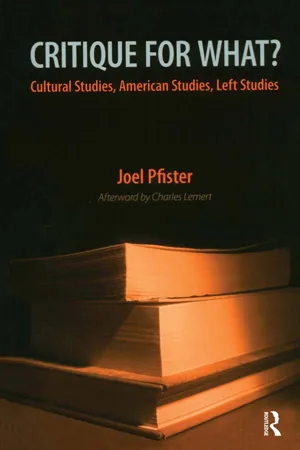
Students want to know: What does one do with critique? Fortunately, some of the most provocative self-critical intellectuals, from the postwar period to the postmodern present, have wrestled with this. Joel Pfister, in Critique for What?, criss-crosses the Atlantic to take stock of exciting British and US cultural studies, American studies, and Left studies that challenge the academic critique-for-critique's-sake and career's-sake business and ask: Critique for what and for whom? Historicizing for what and for whom? Politicizing for what and for whom? America for what and for whom? Here New Left revisionary socialists, members of the "unpartied Left," cultural studies theorists, American studies scholars, radical historians, progressive literary critics, and early proponents of transnational analysis interact in what amounts to a lively book-length strategy seminar. British political intellectuals, including Raymond Williams, E. P. Thompson, Stuart Hall, and Raphael Samuel, and Americans, including F. O. Matthiessen, Robert Lynd, C. Wright Mills, and Richard Ohmann, reconsider the critical project as social transformation studies, activism studies, organizing studies. Eager to prevent cultural studies from becoming cynicism studies, Critique for What? thinks creatively about the possibilities of using as well as developing critique in our new millennium.
Information
Part I
American Studies and Cultural Studies
1
The Americanization of Cultural Studies
IN 1990 I ATTENDED A CONFERENCE TITLED “CULTURAL STUDIES NOW AND in the Future,” sponsored by the Unit for Criticism and Interpretive Theory at the University of Illinois, Urbana-Champaign, and organized by Cary Nelson and Lawrence Grossberg. During his lecture, Stuart Hall commented critically on the proceedings and warned that cultural studies in the United States is in “a moment of danger.” Shortly after he began to take questions, some members of the audience of several hundred erupted in protest, claiming among other things that the conference positioned them as “fans” who were meant to support a star-making (or star-polishing) machinery. Some who were infuriated with the event drafted and distributed a manifesto titled, “Hypocrisy in Cultural Studies,” which posed the question: “Is there any point in establishing a radical voice which only duplicates those structures it seeks to displace?”
“Mixed impressions” describes my own take on the conference, and the term applies also, though for different reasons, to my reading of the first American book-length overview of cultural studies, Patrick Brantlinger s Crusoe’s Footprints (1990). In this chapter I hope to work out the implications of some of these impressions and place them in a clear theoretical and historical frame. Thus my aim is to return to and review some key contributions to the British tradition of cultural studies and, by examining the conference, Brantlinger’s book, and other sources, to trace the forms that the “Americanization” of the field seems to be taking. In what follows I will situate one important school of British cultural studies in its political-intellectual setting; review the conference and Crusoe’s Footprints as ideological symptoms of the “Americanization” of British cultural studies; discuss—and contest—the positioning of American studies by many of these critics as a cautionary example of an institutionalized cultural studies gone wrong; suggest continuities between British and U.S. cultural studies and work being done under the sign of the “history of subjectivity”; and close with some thoughts on cultural studies as a social practice, one undertaken by the academic wing of the professional-managerial class in this country.
Unlearning the Old Left: The Political Work of British Cultural Studies
In his review of Raymond Williams’s Politics and Letters (1979) Stuart Hall concluded, “It is not a book for the religious.” At the Illinois conference Hall profiled cultural studies in the same way and underscored how crucial it is to keep the field “open.” Hall learned how open its political project had to be in the mid- and late 1970s when feminism and concerns with race and racism “broke through the windows” of the Birmingham Centre for Contemporary Cultural Studies, while he served as its director. The center’s Women’s Studies Group published their anthology Women Take Issue (1978) as an “intervention” that would not only put women on the agenda but force a political-intellectual rethinking of the “field” and “object” of cultural studies. Next, The Empire Strikes Back (1982) and Paul Gilroy’s “There Ain’t No Black in the Union Jack” (1985) “intervened” as “correctives” to the “invisibility of ‘race’” within cultural studies. Tony Fry has suggested that the class-stratified students and staff of the Birmingham Centre learned about the dynamics of class within as well as outside their own institution. Thus Richard Johnson, who took over as director when Hall left for the Open University in 1979, had good reason to describe the field not as a doctrinal “research programme for a particular party or tendency” but rather as a “political-intellectual stance” made “possible because the politics which we aim to create is not yet fully formed.”1
Yet it is important to highlight that this understanding of British cultural studies as an open, though not pluralistic, project has its roots not in some pretence to “value-free scholarship,” but in what Alan O’Connor has termed “political commitment.” This is clear from both Hall’s opening statement as founding editor of New Left Review (1960–) and his contributions to New Times (1989), a collection of essays most of which originated in Marxism Today. “We are convinced that politics, too narrowly conceived, has been a main cause of the decline of socialism in this country,” he wrote in 1960. In arguing that the rebuilding of a Cold War socialist movement requires “cultural and social” as well as “economic and political” strategic critique, he stressed that the study of “the cinema or teenage culture in New Left Review” is not for purposes of appearing trendy but must be grasped as indispensable to a knowledge of “imaginative resistances of people who have to live within capitalism.” Early anthologies published by the Birmingham Centre under Hall’s directorship, such as Resistance through Rituals (1976) and Policing the Crisis (1978), joined by Paul Willis’s Learning to Labour (1977) and Dick Hebdige’s Subculture (1979), carried on this project.
Hall’s focus on culture grew out of the pressing need to unlearn some of the assumptions, strategies, and goals of the Old Left: “There is no law which says that the Labour Movement, like a great inhuman engine, is going to throb its way into socialism.” Under Hall’s editorship (1960–61), New Left Review featured articles by contributors such as E. P. Thompson, Raymond Williams, and Richard Hoggart next to advertisements for Left cafés and listings of Left discussion groups around Britain.2 The New Left’s cultural studies was indivisible from the project of regrouping in response to the predicament of socialism within the crisis of Cold War capitalism.
British cultural studies has continued to rethink the possibilities of political critique and organization in magazines like Marxism Today. Stuart Hall and Martin Jacques’s New Times collects essays whose object of study is not “culture” per se (for the interdisciplinary challenge it poses) but, more specifically, an epoch of advanced capitalism, a “post-Fordism” that supersedes what Gramsci labeled “Fordism.” The strategic question for the contributors is how post-Fordism has altered “the world in which the Left has to operate.” “If ‘post-Fordism’ exists,” writes Hall, much as he did in New Left Review decades before, “then it is as much a description of cultural as of economic change.” Here, too, Hall makes it clear that cultural study is driven by political necessity: “Can a socialism of the 21st century revive, or even survive, which is wholly cut off from the landscape of popular pleasures, however contradictory and ‘commodified’ a terrain they represent? Are we thinking dialectically enough?” Dialectical thinking in “new times” must take for its critique “cultural and subjective dimensions” and must recognize, for example, not only that gender is constructed and “deployed politically” in ways that must be delineated but that “social practices,” “forms of domination,” and even the “politics of the Left” are “inscribed in and to some extent secured by sexual identity and positioning.” A reluctance to acknowledge and study these intersections, Hall adds, is nothing less than a strategic failure, because without an understanding of them “we simply do not have a language of sufficient explanatory power” that illuminates both “the institutionalisation of power” and “the secret sources of resistances to change.”3 Richard Johnson’s statement that British cultural studies is not in any doctrinal sense a “research programme for a particular party” is true, but it underplays the fact that cultural studies’ New Left-inspired project has been, historically, “to create” or recreate a socialist politics “not yet fully formed.”
As Hall and Johnson note in their essays on intellectual developments within the Birmingham Centre, the center was drawn early on to E. P. Thompson’s Making of the English Working Class (1963) and Raymond Williams’s Long Revolution (1961)—two important books emerging from the “first” New Left—precisely because these works recognized culture as a productive, determining force in its own right and not merely as a reflection or expression of the economic “base.” But it was the translations of the work of the Frankfurt School, Louis Althusser, and Antonio Gramsci in the 1960s and 1970s—by the “second” New Left—that refashioned cultural studies at the Birmingham Centre. Althusser’s concept of “overdetermination,” for instance, challenged Old Left assumptions about “totalizing” and “totality” and the role of culture in causality: “A social transformation is not a ‘totality’ of the essential type, in which there is simple ‘identity between levels,’ with the superstructural levels the mere ‘epiphenomena’ of the objective laws governing ‘the economic base,’” writes Hall. “It is, rather, a unity of the necessarily complex type—an ‘ensemble’ which is always the result of many determinations.” The Althusserian structuralist “moment” of the 1970s prompted the Birmingham Centre to retheorize “culture” as a relatively autonomous “signifying practice” and “not so much the product of ‘consciousness’ as the conscious forms and categories through which historically definite forms of consciousness were produced.” This theoretical perspective was more subtle and comprehensive than the Old Left’s explanatory emphasis on what Richard Johnson has termed the “more brutally obvious ‘determination’—especially mechanisms like competition, monopolistic control, and imperial expansion.” The New Left challenge to the Old Left sets the context for Hall’s observation that the Birmingham Centre always approached Marxism as a problem rather than the solution.4
Old Left constructions of “history,” therefore, had to be rehistoricized and its categories retheorized, based on different concepts of totality, determination, and historical subjects. The Old Left labor history (for example, the work of Maurice Dobb and of Dona Torr) focuses on the category of class and on members of the working class as the universal subjects of history functioned, as Johnson notes, to classify both “a sphere of legitimate politics and a ‘non-political’ realm.” This “history” produced a “truth” that was both too narrow and unstrategic for New Left cultural studies in the 1970s, for their project had to acknowledge “new” historical agents (who were not new!).5
The influences of Roland Barthes, Althusser, Jacques Lacan, and Gramsci pushed forward a critique of assumptions about access to “lived experience” in Hoggart’s Uses of Literacy (1961), Williams’s Long Revolution, Thompson’s Making of the English Working Class, and other histories and ethnographies. Thompson’s Poverty of Theory (1978) retaliated by polemicizing against Althusser and the New Left Review policy of privileging “theory,” which Thompson felt was seducing the younger Left in Britain away not only from “lived experience” but from “lived” political activity. As Hall put it in his exchange with Thompson, “experience” must be thought of as a category rather than an essence to be discovered in “the people,” a category that must be “interrogated for its complex interweaving of real and ideological elements.” Or as Johnson framed it, “Concrete social individuals are always already constructed as class-ed, sex-ed, and age-ranked subjects, have already entered into complex cultural forms, already have a complexly formed subjectivity.”
At the same juncture, when history and theory were in danger of being perceived as separate or even antithetical enterprises, the Women’s Studies group and the race and racism group pressed the Birmingham Centre to reevaluate its “theoreticist” (to use Hall’s word) and historicist occlusions. The outcome was a commitment to a more theoretically informed history and historically informed theoretical practice, which was thought through in Birmingham Centre anthologies such as Working-Class Culture (1979) and Making Histories (1982): “The reintroduction of history is not a minimal aim,” Paul Gilroy noted, envisioning a more complex and inclusive historicizing of “history”: “Racism rests on the ability to contain blacks in the present.” And as Hall asserts, “[The] term historical is taken, simple-mindedly, to refer to the past, but we have attempted rigorously to break with this disabling, inert definition.”6
What is patent about these Birmingham anthologies is their political-intellectual-pedagogical commitment to enable their readers to think “dialectically enough.” If cultural studies is at a critical juncture, what Hall termed a “moment of danger,” I wonder if it might not also be the moment to make more of this Birmingham work available to a U.S. audience, as a crucial reminder of the breadth of activity British cultural studies has undertaken. Several republishing projects in particular would be desirable, certainly collections of Hall’s and Johnson’s essays as well as selected essays from Birmingham anthologies and working papers, especially Culture, Media, Language: Working Papers in Cultural Studies, 1972–79. If such publishing projects are undertaken, an effort must be made to situate these writings in the particular historical “conjuncture” (a term I discuss below) that produced their debates and that their debates sought to transform, rather than reifying them as “classic” or (even worse) “authentic” British cultural studies (the “real” way to do cultural studies). These debates and advances must be seen just as Cornel West profiled Hall, as examples, rather than as static models, of “how to keep political work alive in an age of shrinking possibilities.”7
Americanization: Toward a Postpolitical Cultural Studies
At the Illinois conference, Hall raised three points to clarify what the “moment of danger” is for cultural studies on American shores. First, he pointed out that British cultural studies never underwent a “moment” of extreme professionalization and institutionalization like the one that is already a determining force in U.S. cultural studies. Second, he expressed concern that if the American academy does to cultural studies what it did to French poststructuralism, then “it would formalize questions of power” and constitute power solely as a problem of “textuality.” Hall went on in good Foucauldian fashion to affirm that power...
Table of contents
- Cover
- Half Title
- Title Page
- Copyright Page
- Dedication
- Table of Contents
- Acknowledgments
- Introduction: For What and For Whom?
- Part I: American Studies and Cultural Studies
- Part II: Historical Studies and Literary Studies
- Part III: Beyond Critique for Critique’s and Career’s Sake
- Afterword: On Culture, Charles Lemert
- Notes
- Index
- About the Author
Trusted by 375,005 students
Access to over 1.5 million titles for a fair monthly price.
Study more efficiently using our study tools.
Frequently asked questions
Yes, you can cancel anytime from the Subscription tab in your account settings on the Perlego website. Your subscription will stay active until the end of your current billing period. Learn how to cancel your subscription
No, books cannot be downloaded as external files, such as PDFs, for use outside of Perlego. However, you can download books within the Perlego app for offline reading on mobile or tablet. Learn how to download books offline
Perlego offers two plans: Essential and Complete
- Essential is ideal for learners and professionals who enjoy exploring a wide range of subjects. Access the Essential Library with 800,000+ trusted titles and best-sellers across business, personal growth, and the humanities. Includes unlimited reading time and Standard Read Aloud voice.
- Complete: Perfect for advanced learners and researchers needing full, unrestricted access. Unlock 1.5M+ books across hundreds of subjects, including academic and specialized titles. The Complete Plan also includes advanced features like Premium Read Aloud and Research Assistant.
We are an online textbook subscription service, where you can get access to an entire online library for less than the price of a single book per month. With over 1.5 million books across 990+ topics, we’ve got you covered! Learn about our mission
Look out for the read-aloud symbol on your next book to see if you can listen to it. The read-aloud tool reads text aloud for you, highlighting the text as it is being read. You can pause it, speed it up and slow it down. Learn more about Read Aloud
Yes! You can use the Perlego app on both iOS and Android devices to read anytime, anywhere — even offline. Perfect for commutes or when you’re on the go.
Please note we cannot support devices running on iOS 13 and Android 7 or earlier. Learn more about using the app
Please note we cannot support devices running on iOS 13 and Android 7 or earlier. Learn more about using the app
Yes, you can access Critique for What? by Joel Pfister in PDF and/or ePUB format, as well as other popular books in Social Sciences & Historiography. We have over 1.5 million books available in our catalogue for you to explore.