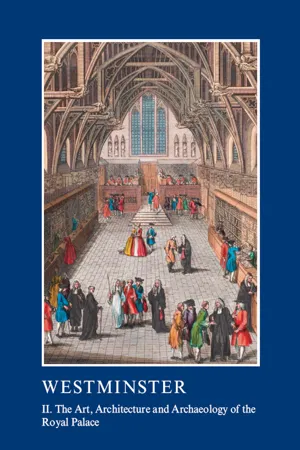
Westminster came into existence in the later Anglo-Saxon period, and by the mid-11th century, when Edward the Confessor's great new abbey was built, it was a major royal centre two miles south-west of the City of London. Within a century or so, it had become the principal seat of government in England, and this series of twenty-eight papers covers new research on the topography, buildings, art-history, architecture and archaeology of Westminster's two great establishments — Abbey and Palace.
Part I begins with studies of the topography of the area, an account of its Roman-period finds and an historiographical overview of the archaeology of the Abbey. Edward the Confessor's enigmatic church plan is discussed and the evidence for later Romanesque structures is assembled for the first time. Five papers examine aspects of Henry III's vast new Abbey church and its decoration. A further four cover aspects of the later medieval period, coronation, and Sir George Gilbert Scott's impact as the Abbey's greatest Surveyor of the Fabric. A pair of papers examines the development of the northern precinct of the Abbey, around St Margaret's Church, and the remarkable buildings of Westminster School, created within the remains of the monastery in the 17th and 18th centuries.
Part II part deals with the Palace of Westminster and its wider topography between the late 11th century and the devastating fire of 1834 that largely destroyed the medieval palace. William Rufus's enormous hall and its famous roofs are completely reassessed, and comparisons discussed between this structure and the great hall at Caen. Other essays reconsider Henry III's palace, St Stephen's chapel, the king's great chamber (the 'Painted Chamber') and the enigmatic Jewel Tower. The final papers examine the meeting places of Parliament and the living accommodation of the MPs who attended it, the topography of the Palace between the Reformation and the fire of 1834, and the building of the New Palace which is better known today as the Houses of Parliament.
The Topography of the Old Palace of Westminster, 1510–1834
MARK COLLINS
The medieval Palace of Westminster existed on the same site from at least the 11th century and developed to become the principal residence of the English monarchs until c. 1531, after which the Palace became the home of the legislature. The site was occupied by the Exchequer and the Law Courts as well as by both Houses of Parliament. The buildings underwent numerous transformations from the Reformation onwards before fire destroyed many of them in 1834.
INTRODUCTION
THE arrival of the Tudors at the Palace of Westminster marked its zenith in terms of size and magnificence. Something of its splendour may be appreciated in an image of about 1530 (Fig. 1, a composite of two halves of a drawing that at some time was cut in half and is now separated between two museums). This shows the clock tower to the right, with the long roof ridge (and louvre) of Westminster Hall to the left of the clock; then St Stephen’s Chapel in the centre, projecting to the front of the view, with the Lesser or Household Hall to the left; and next, the dog-leg of the Painted Chamber, Queen’s Chamber, and what was probably the Queen’s Chapel (later known as the Prince’s Chamber). The cloister of the College of St Stephen is hidden from view to the north of the chapel, but the top of the bell tower is visible at its north-west corner.1
The 14th-century buildings that still stood at the Dissolution appear in the foreground near the river, namely, the two White Chambers, the Green Chamber, the chapel of Edward III, and, on the far left, tall crenellated towers.2 No information has survived for the substantial towers on the left of the drawing, which stood between the landing stage and the moat that led east from the Jewel Tower into the Thames. The length of the river front was about 900 ft, similar to the length of the present, Victorian, Palace, and altogether the Palace used to cover six acres. Two engravings by Wenceslaus Hollar (1607–77) also provide an overview of the main features of what later became known as New Palace Yard (Figs 2 and 3): the king’s entrance or High Gate is seen top right, and in front of it the tall, canopied, octagonal 15th-century fountain known as the Great Conduit.3 Westminster Hall was still host to the four courts: the King’s Bench and Chancery on the dais at the southern end, the Common Pleas by the west wall, and the Exchequer through a doorway in the north-west corner. The Exchequer offices remained in their accommodation to the north-east of Westminster Hall.
Although in the early 16th century Westminster was still the centre of court ceremony and administration and was the most significant royal residence adjacent to the capital at that time, some of the most important events of Henry VII’s and Henry VIII’s reigns took place not at Westminster, but at the new Tudor palaces of Richmond and Greenwich. Nevertheless, lavish celebrations continued to be staged at Westminster. In February 1511, a tournament was held to celebrate the birth at Richmond of Henry, son and heir of Henry VIII. The elaborate pageantry took place in New Palace Yard and cost nearly £4,400 — the most expensive celebration of Henry VIII’s reign with the exception of the Field of Cloth of Gold. On the second day, after evensong and a banquet, entertainment was provided in the White or Lesser Hall, with songs, dancing, and a pageant.4
FIG. 1. Two sections of a single drawing now entitled Westminster Abbey and Parliament House, from the Thames, c. 1515–32 (Victoria & Albert Museum, acc. no. E 128–1924) and Vue de Londres avec Westminster Hall et les édifices environnants (Musée du Louvre, INV 18702, verso). The drawing, perhaps by Lucas Cornelis de Kock (1495–1552), was split at some time prior to 1750; the two pieces are now in different institutions. The colour is a recent addition by Jeremy Ashbee and Richard Lea.
FIG. 2. Sala Regal is cum Curia West-monasterÿ, vulgo Westminster haall, 1647, engraving by Wenceslaus Hollar Palace of Westminster Collection, WOA 681
FIG. 3. Civitatis Westmonasteriensis pars, 1647, etching by Wenceslaus Hollar Palace of Westminster Collection, WOA 845
THE FIRE OF 1512/13
IN 1512, Parliament sat at Westminster, and in June an allegorical tournament was held, with the king taking part in the jousting. (Such allegorical pageantry was abandoned after this occasion.) Then, in late 1512 or early 1513, ‘a great part of this Palace of Westminster was once againe burnt […]’ as Stow put it, ‘Since which time it hath not been reedified; onely the great Hall, with the offices near adioyning, are kept in good reparations, and serveth as afore’.5 This fire effectively brought to an end the 500-year long association of the monarchy as a domestic entity with the Palace of Westminster. Although the main chambers survived, some of the privy buildings appear to have been too badly damaged for the court to continue on the site. Henry VIII moved out, and the royal family never returned, except for occasional ceremonial events.
What exactly was lost in this fire? We have no record, but certainly Westminster Hall and St Stephen’s Chapel were not seriously affected, nor it would seem was the Painted Chamber, for the 14th-century wooden roofs of the former, and the 13th-century wooden roof of the latter survived. Maybe the Lesser Hall, the Queen’s Hall, or the Great Kitchen to the west were damaged, but in any case the fire acted as the catalyst for the departure of the king.
Henry built accommodation in the Tower of London for court officials who had lost their premises in the fire, whilst he himself spent a good proportion of his time at Greenwich Palace. The site at Westminster was given over to Parliament, to the Law Courts, and the Exchequer, and here the legislature operated in increasingly inconvenient, albeit picturesque buildings for a further 320 years. The Palace was developed for administrative purposes; for example, the royal court no longer required the household hall, so the Court of Requests began to sit in the Lesser Hall in 1516.6 In the following year, work took place ‘lengthening and making of the Sterre Chamber’, with further work undertaken to this range soon afterwards.7
The principal 16th-century contribution at the Palace was undoubtedly a rebuilding of a 14th-century structure belonging to the College of St Stephen — an institution that had continued with a separate life of its own, even after the fire and the departure of the royal family — that is, the two-storey cloister, built around 1520. The earlier cloister had been constructed by Edward III to the north of the chapel and to the east of Westminster Hall; immediately to the east of the cloister stood the vicars’ houses. This new cloister was similar in its high quality and architectural importance to its later 14th-century brother cloister at Windsor Castle (where Thomas Wolsey [1475?–1530] was a canon 1511–14), and also that to be found at Old St Paul’s Cathedral (until it was destroyed by the Great Fire of 1666). The St Paul’s structure was doubleheight in form, built in the 1330s by William de Ramsey III, with a chapter-house and chapel projecting into the courtyard.8 The layout appears to have been repeated at Westminster and leads one to speculate that this cloister also was by William de Ramsey.
In early 1514, Wolsey became dean of St Stephen’s College; he then stepped down from this role and became archbishop of York later in the same year. The replacement cloister was built in the late Perpendicular style soon after 1514, during the early years of the last dean of the college, Dr John Chambre (1470–1549), physician to Henry VIII (Fig. 4).9 The master mason was almost certainly William Vertue (d. 1527), assisted by Henry Redman.10 Vertue was also probably responsible for both the high vault of Henry VII’s Chapel at Westminster Abbey (1506–09), and the high nave and chancel vaults of St George’s Chapel, Windsor Castle. The ground-storey south walkway was originally an open colonnade, each of the archways onto the inner courtyard being about 10 ft wide. The lower fan-vaulted walkways were provided with bosses that featured emblems of the Passion, fleurs-de-lis, and portcullises for the Beaufort family (Henry VII’s mother), together with the arms of Edward the Confessor, Edward III, England ancient, Henry VIII and his first queen (Catherine of Aragon), and Thomas Wolsey. The projecting bay at Westminste...
Table of contents
Cover
Half Title
Title Page
Copyright Page
Table of Contents
List of Abbreviations
Preface
An Introduction to the Topography of the Medieval Palace of Westminster
Romanesque Westminster Hall and its Roof
The Great Hall at Caen and its Affinities with Westminster
Henry III’s Palace at Westminster
St Stephen’s Chapel, Westminster
Late-14th-Century Reconstruction of Westminster Hall
Parliaments, MPs and the Buildings of Westminster in the Middle Ages
A Monument to St Edward the Confessor: Henry III’s Great Chamber at Westminster and its Paintings
‘The New Tower at the End of the King’s Garden’: The Jewel Tower and the Royal Treasure
The Topography of the Old Palace of We stminster, 1510–1834
The New Palace of Westminster
Trusted by 375,005 students
Access to over 1.5 million titles for a fair monthly price.
Study more efficiently using our study tools.
Frequently asked questions
Yes, you can cancel anytime from the Subscription tab in your account settings on the Perlego website. Your subscription will stay active until the end of your current billing period. Learn how to cancel your subscription
No, books cannot be downloaded as external files, such as PDFs, for use outside of Perlego. However, you can download books within the Perlego app for offline reading on mobile or tablet. Learn how to download books offline
Perlego offers two plans: Essential and Complete
Essential is ideal for learners and professionals who enjoy exploring a wide range of subjects. Access the Essential Library with 800,000+ trusted titles and best-sellers across business, personal growth, and the humanities. Includes unlimited reading time and Standard Read Aloud voice.
Complete: Perfect for advanced learners and researchers needing full, unrestricted access. Unlock 1.5M+ books across hundreds of subjects, including academic and specialized titles. The Complete Plan also includes advanced features like Premium Read Aloud and Research Assistant.
Both plans are available with monthly, semester, or annual billing cycles.
We are an online textbook subscription service, where you can get access to an entire online library for less than the price of a single book per month. With over 1.5 million books across 990+ topics, we’ve got you covered! Learn about our mission
Look out for the read-aloud symbol on your next book to see if you can listen to it. The read-aloud tool reads text aloud for you, highlighting the text as it is being read. You can pause it, speed it up and slow it down. Learn more about Read Aloud
Yes! You can use the Perlego app on both iOS and Android devices to read anytime, anywhere — even offline. Perfect for commutes or when you’re on the go. Please note we cannot support devices running on iOS 13 and Android 7 or earlier. Learn more about using the app
Yes, you can access Westminster Part II: The Art, Architecture and Archaeology of the Royal Palace by Warwick Rodwell,Tim Tatton-Brown in PDF and/or ePUB format, as well as other popular books in Architecture & Architecture General. We have over 1.5 million books available in our catalogue for you to explore.