- 272 pages
- English
- ePUB (mobile friendly)
- Available on iOS & Android
eBook - ePub
About this book
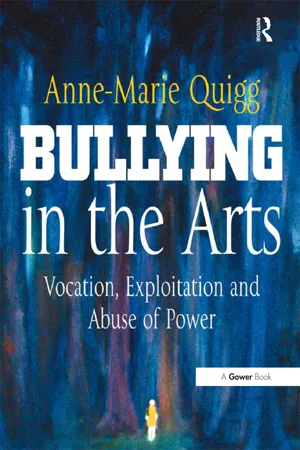
Diva, Prima Donna, Maestro, Virtuoso: creative geniuses with the ability to deliver artistic excellence. However this perception can serve to tilt the balance of power in relationships and to substantiate the notion of artistic temperament; the Master is always right and the Diva must have her way. The artistic genius may be hell to work with but the end result (the art) is exceptional, so behaviour deemed unacceptable in normal circumstances must be tolerated. If the corporate culture in the arts is in thrall to the concept of the artistic genius, then across the various disciplines within the creative sector the prevailing mentality may be subscribing to a set of values that allows, even directly encourages, behaviour and employment conditions that are abusive. Bullying in the Arts argues that this mindset can have a profoundly negative effect in performing arts organisations, permitting managers and other staff to ignore bullying behaviour, as long as the show goes on. Researchers in a range of disciplines and fields have studied workplace bullying and, having witnessed bullying in a number of different arts organisations, Anne-Marie Quigg researched whether the behaviour represented isolated, rare occurrences in specific creative environments or if it was indicative of a more widespread problem in the arts and cultural sector. She discovered the highest level of bullying recorded in any single employment sector in the UK. Bullying in the Arts reveals Dr Quigg's findings, including the personal, organisational, legal and economic consequences of bullying behaviour. Looking at the experiences of countries such as Australia, Canada, France, Sweden, and the United States, this book challenges the notion that the arts are beyond the limitations of the ordinary milieu, exempt from the rules and regulations governing the treatment of employees. Arts managers and professionals, teachers, students and researchers in the arts world, and all those in management or management education, will find here a new model centred on management responses to bullying behaviour, which demonstrates the beneficial effect that knowledgeable, skilled action can have on the outcome of bullying incidents.
Information
CHAPTER 1
Bullying, Mobbing and Harassment
Bullying is offensive, abusive, malicious, insulting and/or intimidating behaviour that occurs on more than one occasion. The frequency of bullying behaviour precludes one-off incidents of aggression or violence; the most common type of bully encountered in the arts is the serial bully who picks on one employee after another and attempts to destroy them. A serial bully identifies a target and proceeds to systematically bully that person until they are forced to move on, either to another role in an organization or to another workplace altogether. Sometimes a serial bully is bullying more than one person at a time and when, usually, the bully has succeeded in destroying the target(s), another target is selected and the cycle of bullying behaviour begins all over again. In the case study below, a director in a privately owned company with a strictly hierarchical structure targets the Chief Executive Officer (CEO). Both perpetrator and target are mature, well-educated and relatively high-powered people in their individual circles.
THE ART GALLERY: HIERARCHICAL BULLYING/SERIAL BULLYING
In a small town, a privately-funded commercial gallery was opened to provide educational exhibitions, workshops and installations. The gallery’s owner was London-based and the Board of Directors included a local, retired financial executive, Alastair. The owner appointed an art gallery manager: an intellectual, Hazel had experience in managing large exhibition centres and was a distinguished curator, a personable individual and an accomplished professional. From the time of her arrival to take up her post, Alastair made himself known to Hazel as the eyes and ears of the owner. In the early weeks following her appointment, he began to take a particular interest in the day-to-day running of the gallery, as well as the policy and governance issues appropriate to his remit as a company director.
A retired executive with time on his hands, Alastair developed the habit of ringing Hazel daily, often with trivial queries ostensibly connected with the work of the gallery, or to question her about income streams and expenditure. This continued for several weeks and then Alastair began to appear on site, often turning up unannounced. At Board meetings, it became apparent that Alastair had been reporting back to the owner, without consulting Hazel, on a number of different issues. His reports were not always accurate.
Hazel made it clear that his continual interference was having a serious effect on her ability to manage. As a result, Alastair reported to the owner that Hazel had admitted she was not coping with the job and, six months into her tenure, he moved himself into an office in the gallery, full time.
Alastair was extremely polite and courteous to all the gallery staff, including Hazel when other people were present, and he made a particular point of letting everyone know of his important role as sentinel for the owner. However, in Hazel’s absence, he often made insulting and belittling remarks about her to other members of staff, especially about her intellectual capacity – describing her as a know-it-all – and her appearance. When alone with Hazel, his polite façade disappeared and he continually found flaws and weaknesses in the systems and procedures she had introduced, sometimes becoming angry and loud, and threatening that he could have her sacked any time.
Hazel’s attempts to inform the owner of Alastair’s actions and explain their effects were met with incredulity: the owner believed Alastair to be looking after things properly. During the following three or four months, Hazel’s behaviour began to change. She became increasingly isolated from the rest of the staff and ceased to make her customary tours of the gallery to greet staff and visitors, only venturing out of her own office to leave the building. She was fearful of meeting Alastair and being drawn into one of his discussions, during which he took the opportunity to find fault with something she was doing, or not doing. Knowing that he was in regular contact with the owner, discussing topics to which she was not privy, she did not feel in a position to disagree when he suggested doing things in a different way. Other staff began to be affected by Alastair’s constant patrolling of the gallery, and his tendency to draw them into conversations during which he often would make offensive and malicious remarks about Hazel.
Hazel became more and more withdrawn and began to worry incessantly about company meetings where, increasingly, Alastair adopted the role of reporting on every aspect of the organization’s performance. Without her knowledge, he tabled financial papers he had drawn up and evaluations of staff performance, including her own, which contained negative personal comments, none of which were justified.
Unable to bear the situation any longer, Hazel left the gallery abruptly, and shortly afterwards so did several of her colleagues.
A new art gallery manager was recruited. The absentee owner’s reliance on Alastair increased as he made it clear that he could provide consistency and stability during the handover period. His status and influence was enhanced and the incoming manager, Helen, although not apprised of the situation at interview, found that she had inherited a live-in company director. Helen had worked abroad for several years and had an array of qualifications in arts management. She was a bright and lively individual with an inquiring mind. After a few weeks, she had begun to get to know how the gallery operated, had met the remaining staff and had instigated recruitment procedures for new employees. Alastair had been abroad on holiday. When he returned he again began to take a particular interest in the day-to-day running of the gallery.
What followed was a duplicate of the type of behaviour and events that had resulted in Hazel’s departure. After repeated bouts of sick leave, Helen, too, left abruptly and, shortly afterwards, so did several of her recently recruited colleagues. Alastair held the fort pending the next appointment.
(Names and environs have been changed to protect confidentiality.)
The relationship between employees and their managers is a crucial factor in determining the effective management of many arts organizations. In this case, the absentee owner placed all trust and confidence in a company director who happened to live locally, rather than in the professional CEOs who were employed. Both Hazel and her successor, Helen, were well qualified for the post they held. They had strong track records at national and international level, and were popular with staff. Initially, Alastair may have had a genuine interest in being more involved in the business of running the gallery; however his behaviour indicates that there was a high level of confusion about the respective roles of company directors and staff members within the organization – evidence of a lack of constructive leadership (Einarsen, Raknes and Matthiesen 1994, as reported in Rayner 1999: 34). Also, Alastair patently enjoyed his privileged access to the owner and, rather than use this to build bridges between staff and directors and to encourage incoming managers to share aspirations and concerns, he embraced management as personal politics (Watson 1986, as reported in Bratton and Gold 1999: 13), employing Machiavellian intelligence to render himself indispensable to the owner. Needless to say, Alastair’s actions seriously impaired the succession strategy of the gallery: the arts world is a small world, and this post developed the reputation of being a poisoned chalice.
Bullying
Bullying is also known as mobbing, victimization or le harcèlement moral (moral or psychological harassment). These are the terms most commonly employed among researchers and they are almost, although not entirely, interchangeable. They can refer to destructive, harmful and intimidating behaviour among schoolchildren, in places of work and in militarized organizations. The physical environment in which intimidation takes place plays a part in determining the terminology used in different parts of the world.
The issue of workplace bullying has been investigated by a growing body of researchers, for example, Adams with Crawford (1992), Randall (1997), Rayner Hoel and Cooper (2002) and Lewis (2002); and the predicament of bullying targets has been exposed by champions seeking to give prominence to the issue, for example Field (1996, 1999, 2001) and Wheatley (1999). Adult bullying behaviour has resulted in court cases involving large sums of money (The Guardian 2005) and are making headlines, particularly where high-profile people or organizations are involved – such as the disclosure of bullying behaviour by UK television presenter Esther Rantzen, which received national publicity in 2006, and in 2010, the alleged bullying at the office of the former UK Prime Minister Gordon Brown. Trades unions and employers’ organizations have been drawing attention to the issue — for example the Trades Union Congress (TUC 1999), the Public Service trade union (Unison 2003), Broadcasting, Entertainment, Cinematograph and Theatre Union (BECTU 2005), the Manufacturing, Science and Finance union (Amicus MSF 2006) and the Chartered Institute of Personnel and Development (CIPD 2006) – and against this background of validated research, confessional interviews and headline-grabbing, expensive, courtroom battles, awareness of workplace bullying is rising in many employment sectors.
The body of available knowledge is constantly growing, and as researchers have learned more about the underlying complexity of bullying behaviour and its implications, frequently a multidisciplinary approach is being taken and evaluation is becoming increasingly sophisticated. Research into workplace bullying now incorporates elements of psychology (Olweus 1993; Hoel and Cooper 2000), sociology (Lewis 2002) and social anthropology (Edgar and Russell 1998), as well as theories of management and organizational development (Rayner 1999; Ishmael with Alemoru, 1999). Important contributions to the growing body of literature continue to be made by psychologists in the psychosocial sciences, for example Ståle Einarsen and Dieter Zapf, those with a background in clinical psychology, such as Ruth Namie, and those in counselling, education, and training, such as Gary Namie. Methodologies now employ elements of anthropology, sociology and psychology, as well as theories of management and organizational development, thus promoting better understanding of the behaviour and an increasingly sophisticated evaluation.
One of the early pilot studies in the arts research was with arts managers in theatres and arts centres, almost all of whom were experienced line managers or employee supervisors. It revealed that 46.2 per cent of managers were aware of bullying behaviour; none stated that they had been targets or witnesses of bullying, although a few had been asked to take action on behalf of a complainant or management, or had been accused of bullying by a colleague. The managers who declared themselves to be unaware of bullying actually may have been so, or they may have been denying the existence of the phenomenon: most bullies are managers, and the later, national, survey found that half of those who had been targeted by bullies were line managers themselves.
A website survey enabled other arts workers to contribute their views, and the range of case histories compares and contrasts the experiences of bullied arts workers in eight separate settings. A major study in conjunction with BECTU involved a wide range of employees, including managers, in theatres and arts centres in the UK, and investigated whether arts organizations were guilty of corporate bullying because of unfair terms and conditions, such as working hours, rates of pay, attention to employee welfare, policies and organizational culture. This was particularly relevant in light of the fact that the arts managers considered some of the cultural sector’s working terms and conditions to be traditional, with all that this implied.
The evidence gathered during the statistical research supports the existence of bullying in the performing arts. This is perpetrated by individuals – in the main by managers – and is widespread: in the national study two in every five people working in theatres and arts centres reported being targeted by a bully. Half of the members of the arts workforce were told of bullying by a colleague and over 46 per cent reported witnessing bullying at work.
The research literature tells us that bullying is destructive and damaging (Leymann 1996; Wilkie 1996; Field 1999; McKeown and Whiteley 2002) and there is ample evidence that this applies to individuals working in the performing arts specifically, and also to those in other arts organizations. There is an impact on physical health and/or mental welfare, and it is clear that there is sometimes permanent damage that affects the professional and personal development of some individuals. Bullying also has an economic impact on organizations – it mars organizational effectiveness, morale, attraction and retention of employees, and reputation. The arts sector comprises a range of small, medium and large organizations, and the damaging nature of workplace bullying is particularly hazardous in terms of personal and organizational welfare in those companies at the smaller end of the scale.
The majority of cases of workplace bullying regularly reported to the UK National Workplace Bullying Advice Line until January 2004, and thereafter to The Field Foundation and Bully Online, involve an individual being bullied by their manager, and these account for around 75 per cent of cases reported. Approximately a quarter of cases involve bullying and harassment by peers – often with the collusion of a manager, either by proactive involvement or by the manager refusing to take action. A small number of cases (around 1–2 per cent) involve the bullying of a manager by a subordinate. Serial bullies like to tap into hierarchical power, but they also generate their own power if they are enabled to bully with impunity, and successfully justify or deny their behaviour through rationalization, manipulation, deception or lying.
In 1996, Swedish psychologist Heinz Leymann noted that researchers in Australia and England used the term bullying to refer to intimidating behaviour whether in schools, the workplace or in military establishments, whereas elsewhere in Europe and in the USA bullying referred only to school settings and mobbing was used for workplaces. In France and French-speaking Canada, the terms le harcèlement moral and le harcèlement psychologique place special emphasis on attacks on the integrity of the individual and the psyche. The terminology used in courts in English-speaking Canada is psychological harassment or mental harassment. Other common terms used in different parts of the world include psychological terrorization and horizontal violence. The latter is used to refer to peer-to-peer bullying.
The earliest publications about bullying in schools appeared in Scandinavia in the early 1970s. Professor Dan Olweus, of the Research Centre for Health Promotion, University of Bergen, Norway, carried out an extensive, long-term research project on bullying in Sweden in 1970. In 1997–1999, he led a group in a substantial study that introduced the widely respected Olweus anti-bullying programme to schools in Norway (from 2003, this became the Olweus Bullying Prevention Program, or OBPP). Publications about mobbing in workplaces appeared over a decade after the 1970 study in Sweden (Gustavsson and Leymann 1984). Generally, mobbing was considered to have connotations of mental and emotional harassment, whereas a strong element of physical coercion was always included in definitions of bullying.
Today in the United Kingdom, Australia and New Zealand, growing awareness about bullying behaviour in the workplace has led to the term becoming synonymous with the more covert and subtle intimidation among adults, traditionally associated with mobbing and with psychological harassment. For example, the definition of bullying given in the Dignity at Work Bill, the UK employment legislation bill first introduced in 1997, which then ran out of parliamentary time is:
• behaviour on more than one occasion which is offensive, abusive, malicious, insulting or intimidating;
• unjustified criticism on more than one occasion;
• punishment imposed without reasonable justification; or
• changes in the duties or responsibilities of the employee to the employee’s detriment without reasonable justification.
The definition does not contain any references to physical threats specifically; it covers behaviour between individual adults and also between employers, and their representatives, and employees. It provides greater clarity for individuals who use employment tribunals to seek redress against bullying (Ball 1998) and is the term most commonly used in the UK by:
• researchers, for example: Adams with Crawford (1992); Field (1996); Rayner (1997); Wheatley (1999); Salin (2001);
• campaigning organizations, for example: the Dignity at Work Partnership – a project jointly funded by Amicus and the Department for Trade and Industry; Bully OnLine – a project of The Field Foundation; Harcèlement Moral Stop – a French association for the fight against bullying at work;
• the media, for example: Cath Janes in The Guardian (February 2010); Colin Brown in The Independent (April 2010); Michael Herman in The Times (May 2010); Web pages, for example: BBC (2010) ‘Manchester head teacher sacked after bullying claims.’
Tim Field’s definition of bullying is expressed ...
Table of contents
- Cover
- Half Title
- Title Page
- Copyright Page
- Table of Contents
- List of Figures
- List of Tables
- About the Author
- Foreword
- Preface
- Chapter 1 Bullying, Mobbing and Harassment
- Chapter 2 Researching the Bullying Experience
- Chapter 3 Pair Bullying and Founder’s Syndrome
- Chapter 4 Institutional Bullying
- Chapter 5 Being a Target
- Chapter 6 Management Interventions
- Chapter 7 Bullying and the Law: A Global Issue
- Chapter 8 Are The Arts ‘Different’?
- Chapter 9 Creativity, Genius and Artistic Temperament
- Chapter 10 Beating Bullying
- Appendix: Bullying Help and Support Groups
- Bibliography
- Index
Trusted by 375,005 students
Access to over 1.5 million titles for a fair monthly price.
Study more efficiently using our study tools.
Frequently asked questions
Yes, you can cancel anytime from the Subscription tab in your account settings on the Perlego website. Your subscription will stay active until the end of your current billing period. Learn how to cancel your subscription
No, books cannot be downloaded as external files, such as PDFs, for use outside of Perlego. However, you can download books within the Perlego app for offline reading on mobile or tablet. Learn how to download books offline
Perlego offers two plans: Essential and Complete
- Essential is ideal for learners and professionals who enjoy exploring a wide range of subjects. Access the Essential Library with 800,000+ trusted titles and best-sellers across business, personal growth, and the humanities. Includes unlimited reading time and Standard Read Aloud voice.
- Complete: Perfect for advanced learners and researchers needing full, unrestricted access. Unlock 1.5M+ books across hundreds of subjects, including academic and specialized titles. The Complete Plan also includes advanced features like Premium Read Aloud and Research Assistant.
We are an online textbook subscription service, where you can get access to an entire online library for less than the price of a single book per month. With over 1.5 million books across 990+ topics, we’ve got you covered! Learn about our mission
Look out for the read-aloud symbol on your next book to see if you can listen to it. The read-aloud tool reads text aloud for you, highlighting the text as it is being read. You can pause it, speed it up and slow it down. Learn more about Read Aloud
Yes! You can use the Perlego app on both iOS and Android devices to read anytime, anywhere — even offline. Perfect for commutes or when you’re on the go.
Please note we cannot support devices running on iOS 13 and Android 7 or earlier. Learn more about using the app
Please note we cannot support devices running on iOS 13 and Android 7 or earlier. Learn more about using the app
Yes, you can access Bullying in the Arts by Anne-Marie Quigg in PDF and/or ePUB format, as well as other popular books in Education & Business General. We have over 1.5 million books available in our catalogue for you to explore.